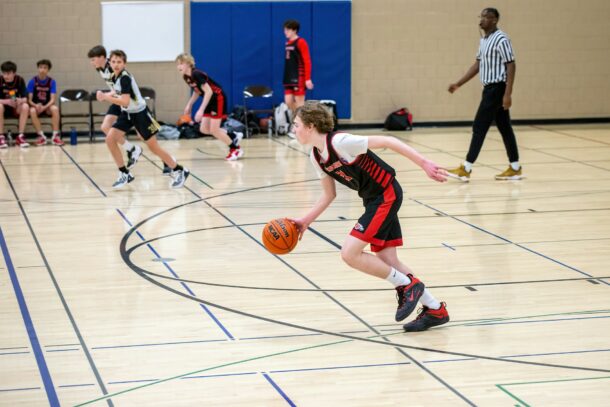
If you want to crank up the tempo, create easy points, and use your whole bench, you have to learn how to teach basketball pressing the right way.
In this clinic conversation, Coach Collins and his guest coach walk through why they press, how they build their system, and the drills they use almost every day. What follows is a cleaned-up, blog-friendly version of that discussion you can plug right into your own practices.
Why You Should Teach Basketball Pressing
Even if you never want to be a full-time pressing team, your players must learn it. Why?
- If you can’t break a press, you can’t play.
Understanding how a press works makes your press offense better. The teams that press well almost always break presses easily because they see the game from both sides. - 94 feet for 32 minutes.
Coach talked about their program motto: “94 feet for 32 minutes.” They do not want to give opponents a “free trip” up the court. The floor is 84 or 94 feet long, so they want to make you earn all of it. - Shot clock or not, pressure wins.
In non-shot-clock states, pressing can keep teams from stalling late. In shot-clock states, even a soft press that steals 8–10 seconds can knock an offense out of rhythm. Either way, pressure tests ball handling and decision making. - Create easy points.
Every good coach is hunting “gimme” points. Some steal them on baseline out of bounds. Some get them with a dominant post. Pressing is another way to grab 8–10 extra points in transition without having to grind against a set defense all night. - Play more players, build energy.
Pressing lets you rotate deeper into your bench. One coach talked about his “grandma unit” of smart but slower seniors who ran a 2-2-1 back to zone while his younger group played at a frantic pace. Pressing also brings energy to the gym, which matters a lot in the girls game where you are trying to build crowds and excitement.
When Will You Press?
Before you teach basketball pressing to your team, you need clear rules on when you will use it.
Common rules these coaches shared:
- Dead balls and made free throws.
That is their standard: always press on dead balls and made free throws. They practice it that way, too. - Made field goals (by philosophy).
Some years they press on every make. Other years they are more selective. One simple rule they use: if they score, get right back into the press until there is a clean miss and defensive rebound. - End-of-game live ball pressure.
If they are behind late, they will press off misses as well. This is a different gear. You have to practice it so your kids know spacing, matchups, and how to avoid panicked fouls. - “One trips” after timeouts.
A favorite trick: out of a timeout, play one trip in a different defense or press, then go back to your base. That single possession is enough to throw off the other team’s ATO play or rhythm.
You also need rules for when to get out of the press:
- If the other team scores three times in a row, they are out of it.
- If they reach the bonus too early, they shut the press down. Fouling kills hustle.
- If players are “fake pressing” and not really getting into the ball, the staff will either demand they turn it up or they will get out and play solid halfcourt.
Having some math and clear rules helps you avoid coaching strictly on emotion in the fourth quarter.
Join the TeachHoops Community
Building Better Basketball Coaches
- College Coaches: Elevate your knowledge with advanced strategies and insider tips.
- High School Coaches: Expand your playbook and get an exclusive look behind the scenes of a nationally recognized program.
- Youth Coaches: Master the fundamentals and teach the game with confidence.
Teaching Coaches Since 2011 | 14-Day Money-Back Guarantee
Join Now and Step into Enhanced Coaching
Choosing Your Press: Man, 2-2-1, or 1-2-1-1?
These coaches use three main looks. You can mix and match, but you need to understand the strengths and weaknesses of each before you teach basketball pressing in your gym.
1. Fullcourt Man-to-Man
Strengths:
- Everyone is matched up.
- The basket is protected if you keep a solid “protector” back.
- You can hide your traps behind different alignments and junk it up for ball handlers.
- It flows naturally into your halfcourt man if you teach it correctly.
Weaknesses:
- It is the hardest of the three to teach.
- Rotations are complex once you start trapping. Everybody is responsible for the basket at some point.
- If communication is bad, you give up layups or open threes while you try to “scramble” back.
They also use a “marriage rule” when they trap in man. Once you commit to a trap, you are married to it until the ball comes out. No half-hearted, one-step-and-bail effort. If you go, you go.
2. 2-2-1 Press (“20”)
Why they like it:
- Great for controlling tempo, especially in the girls game.
- More conservative than full scramble, but still creates turnovers for weaker ball-handling teams.
- You can keep your 5 at the top of the key to protect the rim and never let her get into deep rotation.
They will:
- Keep the five back and tell her to keep a foot inside the top of the key.
- Trap in “purgatory” (just before half court) and “hell” (just after half court).
- Emphasize turning the ball handler back into the second guard, then run and jump from there.
They admit you do not get as many steals with this version, but you also do not give up as many layups.
3. 1-2-1-1 Press (“40”)
This is their more aggressive, diamond-style press.
- They will put the four on the ball, try to force the inbound to the “short side” and trap hard there.
- On the “long side” they may stay more 2-2-1 and delay the first trap.
- It can morph from a 1-2-1-1 into a 2-2-1 and then into their halfcourt man or amoeba zone.
The key here is teaching where and when to trap and how to protect the basket behind the action. If you pull your protector into the rotation too much, you are asking three or four different kids to handle the rim in one possession.
Teaching Method: Whole–Part–Whole
Both coaches are big believers in whole–part–whole teaching when they teach basketball pressing:
- Show the whole thing first.
- Walk through the full press alignment.
- Show film clips of the press live in games.
- Break it into parts with drills.
- No-middle stance work.
- Cut-off and trap angles.
- Rotations behind the ball.
- Go back to the whole.
- 5-on-5 with clear rules (press on dead balls, then fall back to halfcourt).
They also stressed one big mistake: do not build your press before your man-to-man foundation. They tried that once with a young team and regretted it. Now they always spend the first week or so installing core man-to-man principles before they layer the press on top.
Start With Breaking the Press, Then Build Your Own
Coach closed with a simple point: before you teach basketball pressing to attack, make sure your kids can break it.
He told a story about a middle school program that wanted to put in a press even though they did not have a press break installed. That is backwards. Start by giving your players solutions against pressure. Then layer in your own pressure packages.
Once your team can handle that, choose one or two presses that fit your personnel, teach them with a whole–part–whole approach, and use daily drills like zigzag, cut, rugby, and rotation work to build toughness and trust.
If you want more drills, practice ideas, or one-on-one support, or if you need help installing a shooting workout with your team, explore everything on TeachHoops.com. With a 14-day free trial, one-on-one mentoring, and a library of proven practice tools, it’s one of the best places for coaches who want to take the next step.
Latest Posts
- 3 basketball practice mistakes that hurt player development
- Basketball practice plan: 7 ways to keep young players focused
- Basketball Practice Games work better when every player has a role
- Basketball individual workout: Build a quicker pull-up against pressure
- How to become a Great Rebounder: 5 rules every basketball player should know