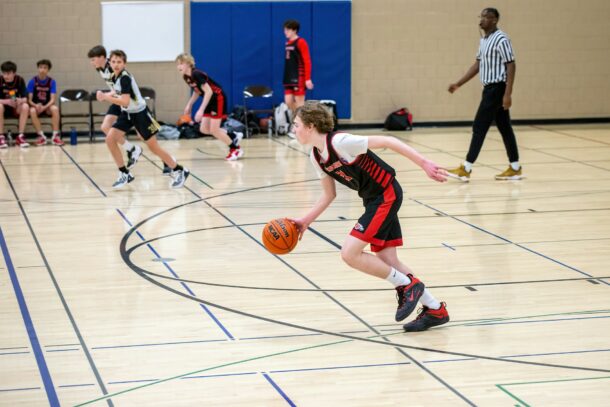
If you’ve coached long enough, you know this feeling. The opponent cranks up the pressure, your players get trapped, and suddenly everything you worked on in practice disappears. The problem usually isn’t effort. It’s panic.
Good basketball press breaking is not about memorizing five different plays. It’s about teaching players simple rules that travel from a 1-2-2 to a 1-3-1 to any run-and-jump look they see during the season. When players understand spacing, movement, and decision-making under pressure, traps turn from a problem into an advantage.
Below are the core basketball press breaking principles every team needs when facing aggressive pressure.
1. Start With Rules, Not Plays
The biggest mistake teams make against pressure is trying to out-scheme it. You can’t prepare for every press variation. You can prepare your players to recognize space and make the defense pay.
Press breaking works best when players know:
- Where the outlets should be
- How many passing options the ball must have
- What to do when they feel a double coming
Once those rules are clear, the exact alignment becomes secondary.
2. The Three Passing Lanes Rule
Any time the ball is pressured, the offense must give the ball three passing lanes.
That means:
- One outlet behind or safety
- One release flashing into space
- One deep or diagonal option to stretch the floor
A trap can only take away one or two options. It can never take away three if players are moving with purpose. The key word is moving. Standing and waiting kills press breaking.
Teach your players that if they are being trapped, it’s not a crisis. It’s an opportunity. Someone is open.
3. Breaking the 1-2-2 Halfcourt Trap Without a High Post
Most teams automatically place a player in the high post against a 1-2-2. Against an aggressive trap, that often helps the defense. The middle defender can sit in between passing lanes and play two people at once.
A better solution is to move that player down to the short elbow or short corner on the ball side.
This forces the middle defender to make a real choice:
- Stay high and give up a pass behind the trap
- Drop down and leave a flasher open
When that decision point exists, the trap breaks itself. The pass behind the trap becomes available, and the defense cannot recover in time.
4. Same Concept vs a 1-3-1 Press
The good news is you don’t need a new system for a 1-3-1. The same principles apply.
In fact, the flash behind the trap is often more open against a 1-3-1. The middle defender is usually a bigger player taught to protect the paint and deny the middle. When a guard flashes behind the trap, that recovery is almost impossible.
Teach your players this clearly. Against pressure, they are not looking to dribble through it. They are looking to move defenders and attack the gaps they create.
5. North-South Passing, Not East-West
One simple rule cleans up a lot of turnovers: Pass north-south, not east-west.
Sideways passes against pressure lead directly to runouts and layups the other way. Vertical passes advance the ball and force defenders to turn their hips. Even if the pass doesn’t lead to a basket, it buys time and space.
This rule should be part of your daily language in practice.
Join the TeachHoops Community
Building Better Basketball Coaches
- College Coaches: Elevate your knowledge with advanced strategies and insider tips.
- High School Coaches: Expand your playbook and get an exclusive look behind the scenes of a nationally recognized program.
- Youth Coaches: Master the fundamentals and teach the game with confidence.
Teaching Coaches Since 2011 | 14-Day Money-Back Guarantee
Join Now and Step into Enhanced Coaching
6. No-Dribble Press Breaking to Teach Movement
If players are allowed to dribble under pressure in practice, they will rely on it in games. That’s when panic sets in.
One of the fastest ways to teach press breaking habits is a no-dribble rule until the ball crosses the three-point line or half court.
Without the dribble:
- Players must cut with urgency
- Passing angles improve
- Spacing becomes non-negotiable
Players quickly learn that standing still is the same as being guarded.
7. Use the Disadvantage Drill to Eliminate Lazy Cuts
A powerful way to reinforce these ideas is a disadvantage drill.
Set up:
- Five offensive players
- Six defenders
- No dribbling
The only way the offense advances the ball is by cutting hard across the floor and creating new passing lanes. Curl cuts and jogging won’t work. Strong downhill cuts will.
This drill exposes bad habits fast and teaches players how to move with a purpose under pressure.
8. Teaching Bigs Not to Panic When Doubled
Bigs often struggle the most against pressure because they aren’t used to being doubled immediately.
You have to train that moment.
Simulate it:
- Throw the ball off the backboard
- Have the big secure the rebound
- Immediately double them
Teach the big to:
- Stay strong with the ball
- Use pass fakes above the shoulders
- Understand that sometimes the best play is simply protecting the ball
A bad pass out of a double is worse than a held ball. That mindset alone can save multiple possessions.
9. Attack the Trap Mentality
One of the most important cultural shifts you can make is how your team feels about pressure.
When your best player gets trapped, the other four should be excited, not anxious. Traps mean numbers. Numbers mean advantage.
Teach your players:
- Three passing lanes
- Immediate cuts
- Attack once the ball is released
Pressure usually comes from a team that is trying to change momentum. Make them pay for it.
10. Press Breaking Is Built in Practice, Not During the Game
If players haven’t experienced pressure in practice, they won’t handle it in games. Press breaking should not live in one drill at the end of practice.
Build it in:
- Early, while legs are fresh
- With constraints like no dribbles
- With disadvantage situations that force decision-making
The first few drills of practice set the tone. If you value spacing, cutting, and confidence under pressure, your practice should reflect it.
Final Thought
Basketball press breaking is not about surviving pressure. It’s about attacking it with confidence and clarity. When players know the rules, trust their spacing, and move with purpose, aggressive pressure becomes a gift.
Teach principles first. Reps second. Diagrams last. That’s how you turn chaos into control.
If you want more drills, practice ideas, or one-on-one support, or if you need help installing a shooting workout with your team, explore everything on TeachHoops.com. With a 14-day free trial, one-on-one mentoring, and a library of proven practice tools, it’s one of the best places for coaches who want to take the next step.
Latest Posts
- 3 basketball practice mistakes that hurt player development
- Basketball practice plan: 7 ways to keep young players focused
- Basketball Practice Games work better when every player has a role
- Basketball individual workout: Build a quicker pull-up against pressure
- How to become a Great Rebounder: 5 rules every basketball player should know