The best basketball decision-making drills force players to think while moving at game speed. Players must react, adjust, and execute in real time. Small-sided games and controlled one-on-one situations can create those moments naturally.
Great basketball teams make quick decisions. Players who can read defenders, attack space, and react under pressure often separate themselves from the competition. Coaches spend countless hours teaching offense and defense, but many practices still lack enough live decision-making opportunities.
A recent TeachHoops video breaks down several simple but effective drills that challenge players to make fast reads while attacking the basket.
Why Basketball Decision-Making Drills Matter
Many traditional drills teach movement patterns without adding pressure or unpredictability. Players may look great in lines but struggle once defenders enter the picture. Decision-making drills help players improve:
- Ball handling under pressure
- Offensive spacing
- Defensive recovery
- Change-of-speed moves
- Shot selection
- Transition awareness
- Competitive toughness
Live-action drills also increase practice intensity while keeping players engaged.
Cone One-on-One Drill
One of the simplest basketball decision-making drills from the video uses cones to guide offensive and defensive players into specific areas on the floor.
The setup is flexible and easy for coaches at any level.
How the Drill Works
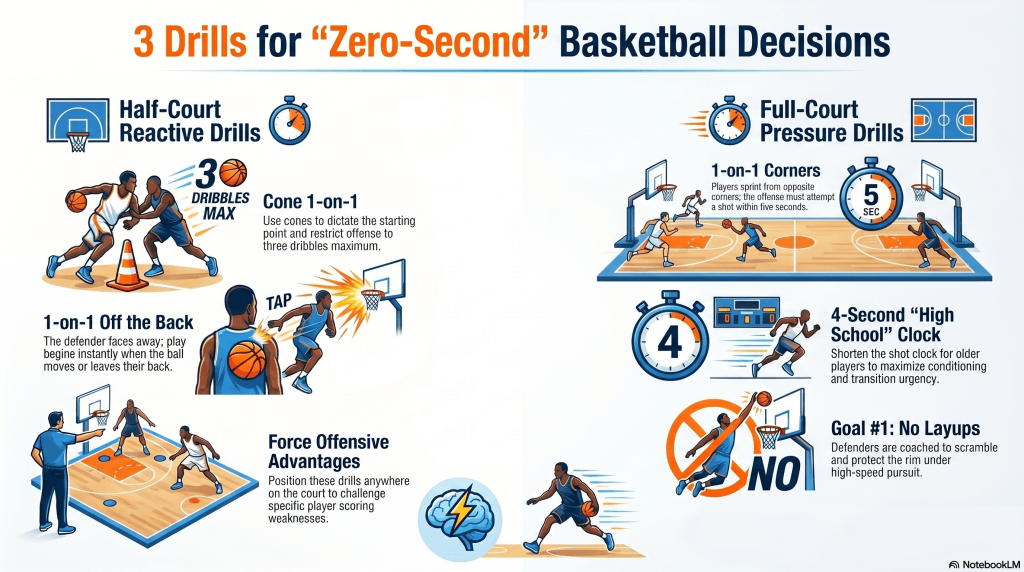
Players start on opposite sides of the cones. The offensive player dribbles slowly into the action while the defender approaches from the opposite direction. Once both players clear the cones, the game becomes live one-on-one basketball.
Coaches can limit the offensive player to three dribbles to encourage quick decisions and efficient scoring moves.
Why This Drill Helps Decision-Making
The cone placement allows coaches to control where the attack begins. Players learn how to react from different spots on the floor instead of repeating the same drive every possession. Coaches can:
- Force attacks toward the baseline
- Create middle-drive situations
- Simulate wing isolation actions
- Emphasize finishing near the paint
- Work on hesitation and change-of-direction moves
One strong teaching point from the video focused on selling fakes with the shoulders during hesitation moves.
Small details like body language and pacing often determine whether players can create separation.
Using Dribble Limits to Improve Basketball IQ
Limiting dribbles changes how players think. Players who know they only have two or three dribbles stop over-dribbling and start reading defenders earlier. Offensive players must attack decisively, while defenders learn how to contain space quickly. The TeachHoops video repeatedly reinforces three-dribble restrictions during live reps.
Dribble limits teach players to:
- Read help defense faster
- Attack gaps immediately
- Avoid wasted movement
- Improve footwork efficiency
- Finish through contact
Many high school players struggle because they dribble without purpose. Constraints help eliminate that habit.
One-on-One Back Drill
Another excellent basketball decision-making drill from the video creates an immediate reaction environment.
Setup
The defender faces the basket while the offensive player stands behind them with the basketball resting on their back. Once the ball moves or comes off the back, the defender can turn and play live defense.
The offensive player gains a slight advantage, which forces the defender to react quickly.
Coaching Points
This drill teaches offensive players how to:
- Attack immediately
- Read defensive recovery angles
- Use space efficiently
- Finish before help arrives
Defenders learn how to:
- Recover under pressure
- Sprint into position
- Contest without fouling
- Stay balanced after turning
Reaction time becomes a huge factor in this drill. Players cannot rely on scripted movement. The video also highlights an important rule adjustment. Players previously tried rolling the ball down their backs to trick defenders, so the coach modified the rules to trigger the action whenever the ball starts moving.
Good coaches constantly adapt drills to remove loopholes and maintain competitive integrity.
One-on-One Corners Full-Court Drill
Transition basketball demands quick thinking. Coaches need drills that combine conditioning, defensive urgency, and offensive pressure. The one-on-one corners drill checks every box.
Drill Setup
One player starts with the basketball in one corner while the defender starts in the opposite corner. The offensive player attacks full court and must score within five seconds.
For high school teams, the coach in the video recommends shortening the limit to four seconds.
What Players Learn
Offensive players develop:
- Speed attacking in transition
- Decision-making at full speed
- Finishing against pressure
- Time awareness
Defenders develop:
- Sprint recovery habits
- Rim protection instincts
- Transition communication
- Competitive hustle
The video emphasizes one major defensive teaching point: do not allow easy layups. Even when defenders cannot fully stop the play, they still learn how to disrupt timing and contest at the rim.
How Coaches Can Add Variations
The best basketball decision-making drills evolve throughout the season. Simple adjustments can completely change the challenge level:
Offensive Variations
- Weak-hand finishes only
- Pull-up jumpers only
- No paint touches
- One-dribble scoring
- Read-and-react passing options
Defensive Variations
- Closeout starts
- Trailing defense
- Shot contest bonuses
- Charge-taking emphasis
- Recovery angle restrictions
Conditioning Variations
- Shorter shot clocks
- Consecutive reps
- Continuous transition
- Winner-stays-on format
Minor changes prevent drills from becoming stale while continuing to challenge players mentally.
Why Basketball Decision-Making Drills Improve Player Development
Players improve fastest when they compete. Controlled chaos creates better habits than stationary drills. Athletes learn how to process information under pressure while building confidence in live situations.
Competitive basketball decision-making drills also increase practice energy. Players stay engaged because every rep feels like a real possession. Strong practices should include:
- Fast decisions
- Limited overthinking
- Live defenders
- Real consequences
- Game-speed repetition
Those elements build smarter basketball players over time.
Final Thoughts on Basketball Decision-Making Drills
Coaches do not need complicated systems to improve player IQ. Simple one-on-one games can create powerful teaching moments when structured correctly. Cone drills, reaction-based games, and transition competitions all force players to think quickly while executing skills under pressure. Players become more confident because they repeatedly experience live basketball situations during practice.
Coaches searching for better basketball decision-making drills should focus on creating competitive environments where players must read, react, and attack in real time.

Latest Posts
- Player Development Youth Basketball: Build Skills that Last
- Best youth basketball shooting drills for better reps, rhythm and pressure
- Basketball Defensive Tracking Stats: How to Measure Funnel Down Success
- Youth Basketball Defensive Systems: Why Funnel Down Is Easier to Teach
- Why Funnel Down Defense is better than Lock Left for Youth Basketball