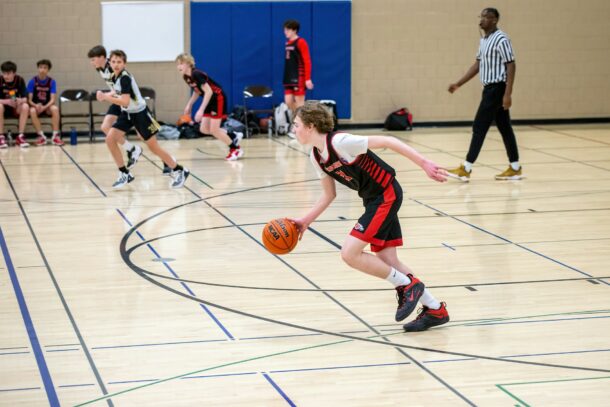
A good basketball individual workout should prepare players for the shots they’ll actually see in games. Defenders won’t politely move their hands out of the way, so guards and wings need to learn how to bring the ball around pressure, reach their shooting pocket and get into a pull-up without wasting time.
One common problem appears when a defender extends a hand near the ball. Many players are comfortable dribbling straight into their normal shooting pocket, but an active defender can interrupt that path with a reach, slap or deflection. Instead, players should practice moving the ball around the defender’s hand and smoothly back into their normal shooting motion.
This workout teaches that skill through a simple progression. Players begin close to the basket, develop the ball path without much movement and gradually add harder dribbles, quicker feet and more game-like pull-ups.
Ball path on a pull-up jumper
Most players naturally bring the basketball through the front of their body when they shoot. They’ll pick up the dribble, move the ball directly toward the shooting pocket and rise into the jumper. However, defenders know where the ball is going, too. A low, extended hand can sit directly in the path between the dribble and the shot.
When that happens, the offensive player needs another route. Instead of carrying the basketball straight through the defender’s hand, move it slightly outside the body before bringing it back toward the shooting shoulder.
The adjustment is small, but the difference can be huge. A few inches of movement can protect the ball while still allowing the shooter to get into a familiar release.
Start your basketball individual workout close to the basket
Begin the basketball individual workout at roughly 15 feet or closer. At this stage, the goal isn’t shooting range because the player first needs to understand the movement. Have a coach or partner stand in front of the shooter with one hand extended.
The player starts with the basketball below the hand, then moves it around the obstacle and directly into the shooting pocket. Work through the movement slowly at first:
- Start with the ball below the defender’s extended hand.
- Move the basketball around the outside of the hand.
- Bring it directly toward the normal shooting pocket.
- Rise into the jumper without stopping the ball.
- Repeat from both sides of the body.
Smoothness matters more than speed during the first few repetitions. Once the player understands the path, gradually increase the pace.
Avoid the hitch in your shooting motion
Players learning this move often create a pause after getting the ball around the defender. They’ll avoid the hand, bring the basketball to the shooting pocket, stop for a moment and then begin their normal shot. The problem is, this hitch gives the defense time to recover. It can also change the rhythm of the shooter’s release.
Instead, the ball should travel continuously from the dribble into the shot. Think of the entire sequence as one connected action rather than separate movements.
The pattern should feel like dribble, around, pocket and up. As players become more comfortable, the extra movement around the defender should blend into their regular pull-up mechanics.
Add a hard dribble and quicker pickup
Once the basic motion becomes comfortable, begin working from the dribble. Start near the 3-point line and attack toward the coach or partner with one strong bounce. Conduct this at game speed. Players rarely attack defenders with a soft dribble, so they should practice pounding the basketball before quickly transferring it into the shooting motion.
Listen for the sound of the dribble. A strong pound usually helps the player create rhythm and gives the basketball enough energy to return quickly to the hand. From there, keep the pickup compact. The ball shouldn’t swing away from the body or float through a wide loop before reaching the shooting pocket.
Keep the basketball quick and tight
Efficiency is the goal when working around a defender’s hand. The basketball needs to travel far enough outside the defender’s reach without creating unnecessary movement. Picture a defender’s hand occupying the space in front of the shooter’s body. Rather than lifting the basketball directly through that space, the player moves it outside the hand and brings it toward the shoulder.
A useful coaching cue is “quick and tight.” The ball should stay close to the body while moving rapidly from the dribble toward the shooting shoulder. Players can even rehearse this movement without shooting. Pound the basketball, move it around an imaginary hand and bring it directly toward the shoulder before resetting.
Train both hands
A complete basketball individual workout should include repetitions going both directions. Players who can only execute the pickup comfortably with their dominant hand become easier to defend. After working from the right side, switch to the left. Keep the same focus on ball protection, a clean shooting pocket and one continuous motion.
The shooting hand still needs to finish in its normal position. Moving the basketball around the defender shouldn’t cause the player to shoot from the side of the body or alter the release point. Instead, think of the move as changing the route to the shooting pocket. The destination stays the same.
Add outside-inside footwork
After players become comfortable with the ball movement, introduce different footwork. One useful option is an outside-inside stop. When moving right, plant the right foot first and then the left. When attacking left, plant the left foot before bringing the opposite foot into the shot.
The sequence gives players another way to stop quickly while reading a defender. It also teaches them to coordinate their feet with the protected ball pickup. Keep the steps short and sharp. A long lateral step can slow the shot and give the defender more time to react.
Read the defender instead of predetermining the move
This skill becomes especially useful against defenders who play with a hand extended near the dribble. Guards often use that low hand to bother the ball while keeping the other hand available for a contest. Watch what the defender gives you. If the hand drops into the normal shooting path, bring the basketball outside the reach before lifting it into the shot.
Meanwhile, players should learn to recognize when a defender is backing up or preparing to reach. Those reads can create the small window needed for a quick pull-up. The goal isn’t to make the movement exaggerated. Players simply need enough space to keep the defender from touching the ball.
Use a partner to make the drill more realistic
This is an easy drill to add to an individual workout with a teammate, parent or coach. One person rebounds and provides the extended hand while the shooter works through the repetitions. After several shots, switch roles. Players can also change the angle of the hand so the shooter has to react instead of repeating the exact same movement every time.
As the shooter improves, the partner can become more active. A realistic reach or late contest forces the offensive player to read the defense while maintaining good mechanics. However, keep the progression controlled. Players should master the ball path before turning every repetition into a full-speed competition.
Coaching cues for a faster pull-up
Small reminders can keep players focused throughout the workout. Coaches don’t need to overload the shooter with several corrections at once, so choose one or two cues and build from there. Useful cues include:
- Pound the dribble.
- Keep the ball tight.
- Avoid the defender’s hand.
- Get directly to the shooting pocket.
- Stay in one continuous motion.
- Use quick feet.
- Bend the knees instead of leaning at the waist.
- Keep the pickup close to the body.
- Finish with your normal shooting mechanics.
Once one part looks comfortable, add the next detail. Building the movement piece by piece usually produces better results than asking the player to fix everything simultaneously.
How this basketball individual workout translates to games
Great shooters need more than perfect catch-and-shoot mechanics in an empty gym. Games force players to release the ball through traffic, adjust to different defenders and create shots when the ideal shooting path disappears. This basketball individual workout helps connect shooting mechanics with those defensive problems. Players learn how to protect the basketball, shorten their pickup and get into the shot before a defender can react.
Those details become especially valuable for guards who live in the midrange or attack hard closeouts. The quicker a player can turn a strong dribble into a balanced jumper, the harder that player becomes to contain.
Ultimately, the difference between a good shooter and a great one often appears when the shot isn’t perfectly clean. Practice getting the basketball around pressure, into the pocket and up quickly so those difficult game shots start to feel much more familiar.

Latest Posts
- Preseason parent meeting: 7 things basketball coaches should cover
- Offensive spacing in youth basketball: 5 rules players can actually remember
- How to give effective feedback during basketball practice
- Basketball press break: A simple alignment that beats full court pressure
- How to motivate a basketball team that’s losing