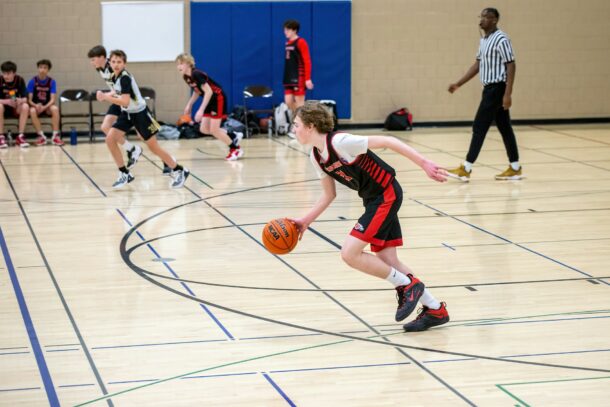
If you are searching for basketball press break concepts that translate directly into game success, the key is understanding spacing, timing, and decision making under pressure. Many youth basketball teams struggle against full court pressure because they rely on memorized plays instead of movement concepts. When players understand where to move, how to cut, and how to create space, breaking pressure becomes far more consistent.
This blog post covers practical basketball press break concepts, plus coaching ideas for inbound situations, rebounding principles, and defensive adjustments drawn from real coaching conversations with TeachHoops.com members.
Why Spacing Is the Foundation of Every Press Break
The biggest reason press breaks fail is poor spacing. Players often start too close together, which allows defenders to deny passing lanes and trap quickly. A simple adjustment can help immediately:
Move your bigs closer to half court and give guards more room to operate. When cutters have space to accelerate, defenders must react instead of dictate.
Players know where they are going. Defenders do not. That advantage creates separation.
Let Your Point Guard Inbound Against Heavy Pressure
One of the effective basketball press break concepts is an adjustment against aggressive denial. Have your point guard throw the ball in.
This works because defenders can deny a player on the court more easily than an inbounder. After passing, the point guard can cut off a screen and receive the ball back in motion. It also reduces early traps near the sideline.
Small tactical choices like this often make a major difference against pressure defenses.
A Simple Press Break Concept That Gets Your Best Player the Ball
One of the most reliable basketball press break concepts involves using a big as a release valve near half court. The movement works like this:
- Guards begin near the sideline areas
- Bigs start higher toward half court
- A guard screens to create confusion
- A big cuts hard toward the ball
- The pass goes to the big
- The point guard curls back to receive the return pass
The big is difficult to deny because he is moving downhill. Once the ball is secured, the guard knows exactly where the return pass is coming from. The defender is reacting instead of anticipating.
Using X-Cuts to Beat Denial Pressure
Another strong basketball press break concept is crossing guards off a stationary big near the free throw line area. The tight crossing action creates confusion and forces defenders to communicate quickly.
Spacing is critical. When the court is spread, one of the cutters will usually have an advantage. Even if the first option is denied, the second guard can read space and adjust.
Teaching players to recognize open space is more valuable than teaching a specific route.

End of Game Inbound Strategy for Free Throw Situations
Late game situations require intentional planning, especially when you need the ball in the hands of your best free throw shooter.
A strong approach is to have two players screen for each other while deep players stretch the defense. After screening, the screener rolls back toward the ball. This creates multiple passing options and large space in the backcourt.
The inbounder should always have several reads available. Predictability helps the defense.
A Detail That Improves Sideline Out of Bounds Plays
One adjustment that many coaches overlook is what happens after a player sets a screen.
Screeners should roll back toward the ball after contact. When defenders help on cutters, the screener often becomes open. This also creates another passing lane for the inbounder.
Giving the passer multiple options increases success rates dramatically.
Rebounding Out of a 1-3-1 Alignment
Teams running a 1-3-1 offense often worry about rebounding balance. The solution comes from teaching responsibility based on shot location.
Players opposite the shot should crash hardest. Coaches can teach this by creating a target area near the blocks and emphasizing contact with opponents instead of just chasing the ball.
Rebounding success comes from anticipation and physical positioning.
How to Slow Down a High Scoring Guard
When facing a player capable of scoring 30 or more points, the focus shifts to disruption and fatigue.
Rotating multiple defenders onto that player throughout the game can help. Picking the player up full court forces constant effort. Special defenses such as box and one or diamond and one may also be necessary.
The goal is to reduce efficiency over time by making every possession difficult.
Teaching Players to Move Away From the Ball
Across all situations, one concept appears repeatedly. Players you want open should have teammates moving away from them. This creates misdirection and forces defenders to shift their attention.
Coaches who emphasize movement without the ball see better results against pressure defenses.
Final Thoughts on Basketball Press Break Concepts
The best basketball press break drills focus on decision making, spacing, and timing rather than memorization. When players understand how to create space and anticipate movement, they gain confidence against pressure.
If you want more practice plans, systems, and coaching resources, TeachHoops.com was built for coaches who want to improve and help their players succeed.

Latest Posts
- Basketball Coaching Mindset: 5 Lessons from a Proven Winner
- Free Throw Drill: Build Game-Winning Confidence in Just 30 Seconds
- Mastering the Back Door Cut Drill for Game-Changing Offense
- Youth Basketball Coaching Tips: Why Great Coaches Teach More Than X’s and O’s
- 5 Ways to Manage Social Media Impact on Youth Basketball