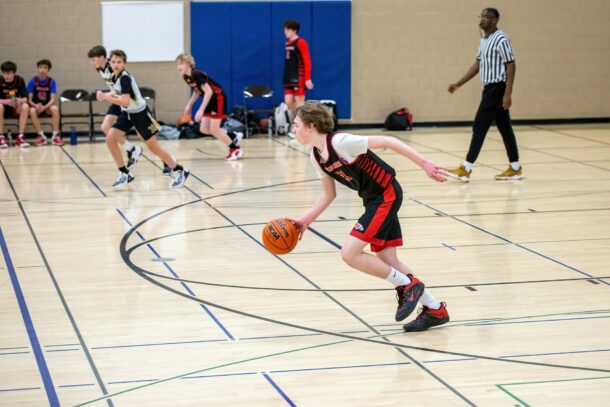
A lot of games aren’t lost in the half court. They’re lost in the three seconds after a missed shot or a turnover, when one team is sprinting and the other team is standing there watching. Those layups don’t take any work from the offense, and three or four of them a night is the difference between winning and losing. That’s a transition defense problem, and it’s fixable.
Good transition defense isn’t about being the most athletic team. It’s effort, organization and talk. If every kid knows his job the moment the ball changes hands, the easy baskets go away and the other team has to run offense against all five of you. These are the five rules we used.
1. Somebody is always back
Transition defense starts before your shot goes up. Every possession, at least one player is the safety and gets back the second a shot is taken. A lot of teams give that to the point guard or whoever is at the top.
Some coaches keep both guards back and send three to the glass. Some send two and keep three back. Either is fine. What isn’t fine is kids having to guess who’s getting back.
2. In transition defense, run to the paint first
When the ball changes hands, kids want to find their own man and run at him. That leaves the middle wide open and the ball handler goes straight to the rim.
Sprint to the paint first, then find somebody. Protect the basket before anything else. If you get three guys back in the lane fast, there are no layups, and they have to settle for a jumper or pull it out.
- First man back protects the rim
- Second man back stops the ball
- Everybody else fills the paint, then matches up
- Nobody stops running until the offense is stopped
3. Stop the ball early
The ball handler is the most dangerous guy on the floor in transition. If he gets to the lane at full speed, you’re in trouble. Your second man back has to turn and stop him, ideally out above the three point line.
That doesn’t mean go for the steal. It means get in front, get your hands up and make him hesitate. Even one second of delay lets your teammates get back.
4. Talk and match up
Transition defense falls apart without talk. Two guys chase the same player and the shooter on the wing is all alone. As soon as you’re back, say who you’ve got.
“I’ve got ball.” “I’ve got 23.” Simple. You probably won’t be on your normal matchups, and that’s okay. In transition, guard the closest guy who can hurt you. Sort it out once the possession settles.
5. Transition defense means you don’t stop running
This is the most common breakdown and the easiest to fix. Kids jog the last few steps because they think the play is over, and then somebody trails it for a layup.
Run until they pull it out or you have the ball. In practice I’d give points to kids who beat the ball down the floor and stop the drill when anybody jogged back. They figure out real quick that this isn’t optional.
Transition defense drills we used
3 on 2, 2 on 1
The old continuous drill. Three attack two. Then those two go back the other way against one defender who has to hold until help arrives. It teaches stopping the ball, protecting the rim and talking when you’re outnumbered.
Scramble
Five on five in the half court. The coach shoots and calls a number, and that defender has to touch the baseline before getting back. Now the defense plays four against five until he recovers. Lots of sprinting, lots of talking.
Change
Five on five half court. Whenever the coach blows the whistle, the offense drops the ball and the defense picks it up and goes the other way. It builds the instant reaction you need when the ball changes hands.
Transition defense is a choice
Transition defense is mostly effort, which makes it one of the most coachable parts of the game. Assign a safety, sprint to the paint, stop the ball, talk and keep running. Do that and the other team loses the easy baskets it’s counting on.
We have transition drills, practice plans and our full Funnel Down Defense system at TeachHoops.com. Getting back is a choice your team makes every trip down the floor.