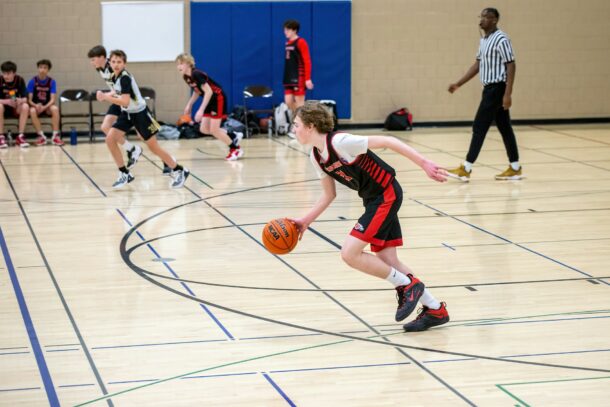
Your players will decide what your program is about in the first two hours of the first basketball practice. Maybe not consciously, but they’ll decide. If the gym is organized and loud and everybody is working, that’s who you are. If kids are standing around while coaches figure out the next drill, that’s who you are too.
I made the mistake early in my career of trying to install half the playbook on day one. Nobody remembered any of it. What I learned over 27 seasons at Memorial is that the first basketball practice isn’t about what you run. It’s about how you practice. Get that right and everything else gets easier.
1. Script every minute of your first basketball practice
Write the whole practice out before you walk in the gym. Times, drills, teaching points, which coach runs which station. Give it to your assistants the night before.
Kids notice when a coach looks at a clipboard, blows the whistle and the next drill starts right away. They also notice when a coach stands there thinking. I wanted my teams to feel like practice had a pulse from the first minute.
Keep most segments short, somewhere between 6 and 12 minutes. Have a backup drill in your pocket in case something falls flat.
2. Tell them your standards, then enforce them right away
Before a ball bounces, take five minutes and tell them what you expect. Not a speech. Three or four things they can actually see. Be on time. Sprint between drills. Talk on defense. Own your mistakes.
Then the first time a group jogs to the next drill, stop everything and do it again. That first correction teaches more than anything you said in the huddle. Players are watching to see if you meant it.
3. Teach them how to practice
Where do they line up? What’s the signal to bring it in? How do lines rotate? It sounds small. It isn’t. If you can move from one drill to the next in fifteen seconds instead of a minute, you get hours back over a season.
I’d actually run a simple drill on day one just to practice the transitions in and out of it. Kids thought it was silly for about ten minutes, and then we never had to talk about it again.
4. Keep everybody moving
Day one is not the day for a drill with one kid working and eight watching. Pick stuff with lots of balls and lots of reps. Two ball layup lines. Partner shooting at every basket. Defensive slides in small groups. Simple 3 on 0 passing and cutting.
Players will judge that first practice by two things: how much they touched the ball and how tired they were at the end. Give them plenty of both.
5. One habit on offense, one on defense
Don’t teach your whole system. Pick one thing on each end that’s going to be in every practice for the rest of the year. Maybe it’s a stance and a closeout. Maybe it’s a jump stop and pivot, or a spacing rule.
Explain it, show it, have them do it with no pressure, then put a defender on them. By the time they leave, every kid on the roster should be able to show you both. That’s a good first day.
6. Compete before your first basketball practice ends
Finish with something competitive. A shooting game, a 3 on 3 rotation, a stops drill. You learn more about your players in ten minutes of competition than in an hour of drills.
Score it based on what you taught. If you harped on talking, give a point every time a team calls out a screen. If you taught jump stops, reward a bucket that comes off a good one. Now they see that your standards and winning are the same thing.
7. End your first basketball practice with something specific
Bring them in for the last couple minutes. Don’t just say good job. Name the kid who sprinted every transition. Name the one who talked on every possession. Tell them what tomorrow is about so they walk out knowing where this is headed.
Then grab your staff for ten minutes. What worked, who stood out, what needs to change. Write it down while it’s fresh. You’ll want those notes in a week.
Make your first basketball practice the blueprint
You don’t need to install everything on the first day. You need to show them how your team works. Do that well and the next hundred practices run themselves a little more.
If you want help planning out those first few weeks, we have practice plans, drill libraries and season templates at TeachHoops.com.

Latest Posts
- How do I start coaching basketball with no experience?
- First basketball practice: 7 ways to set the tone on day one
- Youth basketball tryouts: 7 ways to evaluate players more effectively
- 3 on 2 shooting drill: Build better reads, ball movement and shot selection
- Basketball timeout strategy: How to manage momentum without wasting timeouts