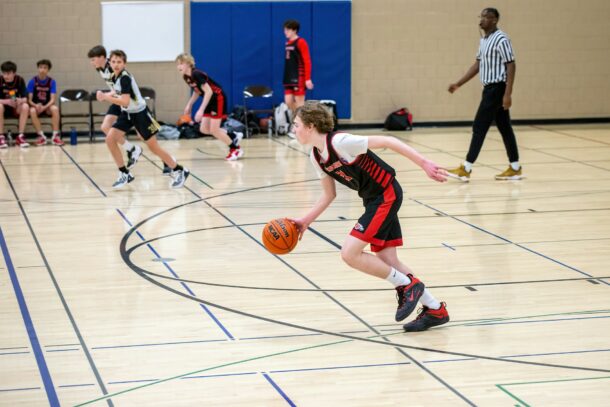
Hey coach, if you are like most of us, your practice plan is already packed before you even roll the balls out. You want to install presses, zones, man-to-man coverages, special game-plan defenses for that one rival, and somehow still have time for shooting and skill work. That is where a smart approach to youth basketball defensive systems can save your sanity.
What I want to walk you through here is the idea behind our Funnel Down Defense and why it has become the backbone of what we do. It shrinks the floor, simplifies decisions for your players, and gives you a real chance against teams that might be more athletic or talented.
The Origin Story: From Too Many Defenses To One Clear System
Like a lot of coaches, I used to have “defensive clutter.”
Box-and-one here, a special zone there, a game-specific tweak for one opponent. After a close loss where I had tried to put in multiple specific defenses for one team, I was driving home, Chick-fil-A in the passenger seat, thinking:
“I just have too many things. Too many defenses. I need variation, but I also need to narrow it down.”
On that drive, with a Chick-fil-A napkin and a pen, the early version of Funnel Down Defense was born. The goal was simple:
- Keep the system versatile enough to work against good teams
- But simple enough that high school kids could remember it in November, not just in March
Over the last five or six years, we have tweaked and refined it, but the core idea has stayed the same.
Using The Lines Already On Your Court
Most of you already have part of the defense drawn on your floor and do not realize it.
If you look at a typical high school gym, you will see a volleyball court on top of your basketball floor. A volleyball court is about 30 feet wide, while a basketball court is about 50. That is an instant visual tool.
We use that:
- The volleyball court becomes our “funnel”
- We are trying to force the ball into roughly 40% of the floor
- We do not need painter’s tape to mark lanes or pack line borders, because the lines are already there
If you have ever put down tape to mark help lines or gaps, this is the same concept, but baked into the court permanently.
Join the TeachHoops Community
Building Better Basketball Coaches
- College Coaches: Elevate your knowledge with advanced strategies and insider tips.
- High School Coaches: Expand your playbook and get an exclusive look behind the scenes of a nationally recognized program.
- Youth Coaches: Master the fundamentals and teach the game with confidence.
Teaching Coaches Since 2011 | 14-Day Money-Back Guarantee
Join Now and Step into Enhanced Coaching
Gutters, Alleys, And The Strike Zone
Because I coach in Wisconsin, a state full of bowling alleys and churches, our language is built around that.
We talk about:
- Gutter: The outer lanes near the sideline, outside the volleyball court lines
- Alley: The main middle area where most offenses want to operate
- Strike Zone: The short corner / deep baseline area near the basket
We want the offense out of the alley and into the gutters. And to funnel the ball into that strike zone along the baseline, where we can trap and where the court itself becomes a defender.
Here is why that matters:
- Behind the backboard is a terrible place to live on offense
- The baseline and the basket act like two extra defenders
- Passing angles shrink, and pull-up jumpers from 14–18 feet are low-percentage shots for most high school and youth players
Most kids today want threes or layups. Short corner, off-the-dribble midrange jumpers with a weak hand are exactly the shots we are happy to give up.
Forcing Baseline And Shrinking The Floor
In Funnel Down, we are always trying to get the ball to the gutter and then into the strike zone.
Key concepts:
- We force baseline, not middle
- We do it on both sides of the court, but prefer the left gutter when possible because shooting percentages are usually a little lower going left
- Our goal is to keep the ball in that 40% slice of floor for 80–90% of the game
We use a simple mental landmark: the equator, which is the middle line of the court.
- If the ball is on the right side of the equator, we funnel right
- If it is on the left, we funnel left
- Once the ball crosses half court, we do not let it reverse back across that line
Again, this is why simple lines on the floor make this one of the most coachable youth basketball defensive systems you can run.
Why Funnel Down Works For Youth Basketball
This system is built for real teams with real limitations, not All-Star squads.
1. It Works In Man And Zone
You can run Funnel Down out of:
- Man-to-man
- 2–3 zone
- 2–1–2
- Even 1–3–1, depending on your personnel
We have run it roughly 50/50 man and zone in different seasons, based on who we had in the program.
2. It Fits Any Athlete Type
Would I rather have long, athletic kids? Sure. But Funnel Down gives you a fighting chance even when:
- You are not the most athletic team
- You are playing a team with a stud guard who lives in ball screens
- You need to protect slow-footed players by keeping help and traps predictable
The system is built on angles, help positioning, and communication, not just raw talent.
3. It Saves Practice Time
Once we went all-in on Funnel Down as our main defensive system:
- We cut about 20% of our defensive teaching time in practice
- We stopped chasing 4–5 different defenses for different opponents
- Our players learned one clear, layered system instead of a menu of complicated schemes
That gave us more time for:
- Skill work
- Offensive sets and spacing
- Special situations
Simple Rules Players Can Remember
One of my guiding principles is that my players can consistently remember about three key concepts at a time. So almost everything in our program is built in threes.
For Funnel Down, those three are:
- Pin
- Funnel
- Trap
We teach them to:
- Funnel the ball into the gutter
- Pin the ball handler toward the baseline and sideline
- Trap in the strike zone when the timing is right
Whether we are in man or zone, those actions stay consistent. That simplicity is why players pick it up quickly and why it works so well at the youth and high school levels.
Running Off The Three-Point Line
The hardest adjustment for most players is understanding we are not always “closing out” like a traditional defensive system. Instead, we are often running shooters off the line.
We emphasize:
- Do not give up rhythm, catch-and-shoot threes
- Force them into the dribble, preferably towards the gutter
- Trust that you have help and a defined funnel behind you
The modern game revolves around the three-point line. A system that ignores that reality will not hold up, especially as your players get older.
Bonus Benefit: Your Offense Gets Better Too
One thing I did not plan on when I scribbled this on a napkin:
Our offense got better.
Because Funnel Down:
- Forces tough passes
- Speeds teams up
- Takes away reversals
We needed to practice against it. That meant:
- Our ball movement improved
- Our players learned how to attack a shrunk floor
- Our decision-making under pressure got sharper
Sometimes the best youth basketball defensive systems are the ones that accidentally make your offense tougher and more skilled too.
A Smarter Way to Coach

If you’re coaching club ball or running weekend tournaments, organization is half the battle. Between travel logistics, gate fees, and scheduling headaches, it can be overwhelming.
That’s why platforms like SidelineSavings.com are emerging, helping tournament operators, coaches, and parents streamline entry, scheduling, and payment systems so everyone can focus on basketball, not spreadsheets.
If you want more breakdowns like this, or if you need help installing a full court press with your team, explore everything on TeachHoops.com. With a 14-day free trial, one-on-one mentoring, and a library of proven practice tools, it’s one of the best places for coaches who want to take the next step.
Latest Posts
- Basketball Practice Planning: A Simple System for Youth and High School Coaches
- Basketball Coaching Culture: What Great Coaches Teach Beyond the Playbook
- A Quick Passing Warm-Up Drill to Emphasize Communication and Movement
- Does the 5-Man Weave Drill Still Have a Place in Youth Basketball?
- When Culture Meets Competence: What Indiana Football’s Turnaround Teaches Every Coach