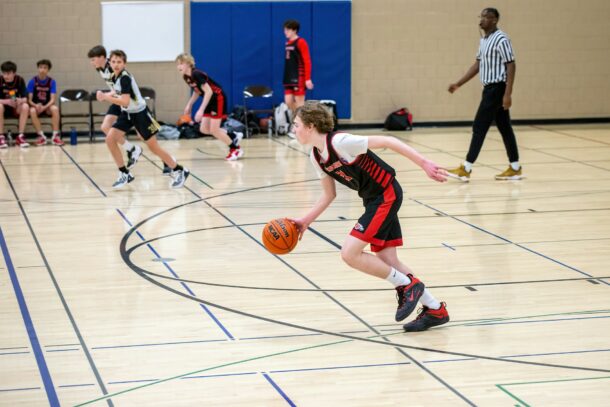
Every coach needs competitive 1-on-1 drills that teach players how to score, defend and make quick decisions under pressure. This half-court 1-on-1 drill is simple to set up, easy to adjust by age level and perfect for helping players understand real game situations. It forces the offensive player to attack with limited dribbles while challenging the defender to sprint, recover and stop the ball before giving up an easy finish.
Why 1-on-1 Drills Matter in Basketball Practice
Basketball comes down to matchups. Players need to learn how to beat a defender, but they also need to learn how to stop the ball when they’re the last line of defense.
This drill hits both sides of that skill set. The offensive player has to catch, attack and finish quickly. The defender has to close space, contest and stay disciplined without fouling. It’s competitive, clean and game-like, which makes it a great fit for youth basketball practices.
Good 1-on-1 drills also give coaches a quick look at a player’s confidence, footwork, ball control and finishing ability. On defense, coaches can evaluate sprint effort, angle discipline and contest habits.
How to Set Up the Half-Court 1-on-1 Drill
- Start with one player under the basket holding the ball.
- Place the second player at half court. This player will begin on offense.
- The player under the basket passes the ball to the player at half court.
- The pass can be a bounce pass, chest pass or baseball pass, but it must be catchable.
- If the pass is too far away or gives the offensive player no chance to catch it cleanly, reset and throw it again.
- As soon as the offensive player catches the ball, the game is live.
- The defender sprints out, follows the pass and tries to stop the ball.
- The offensive player attacks the basket with a limited number of dribbles.
Rules for the Drill
Keep the rules simple so the players can compete right away.
- The offensive player starts at half court.
- The defender starts under the basket with the ball.
- The defender passes to the offensive player, then sprints out to guard.
- The offensive player gets three or four dribbles to score.
- The defender tries to force a tough shot, contest the finish or get a stop.
- Coaches can adjust the number of dribbles based on age and skill level.
- Younger players may need four dribbles.
- Older or more advanced players can be limited to three, or even fewer if the coach wants to increase the challenge.
Coaching Points for Better 1-on-1 Drills
This drill works best when players understand the purpose. The defender isn’t just running out for show. He has to sprint with urgency, close the gap and make the offensive player uncomfortable.
The passer should throw the ball hard enough to create a realistic reaction. After the pass, the defender should follow the ball as fast as possible. Lazy closeouts turn the drill into a layup line, and that defeats the point.
For the offensive player, the goal is to make a quick read. Catch the ball, attack the space and finish strong. Players should not waste dribbles going sideways. Limited-dribble 1-on-1 drills teach players to be efficient with the ball and decisive with their feet.
Game Situations This Drill Teaches
This half-court 1-on-1 game connects directly to transition basketball.
How often does a defender have to stop the ball on a fast break? How often is one player the last line of defense between the ball handler and the rim? This drill creates those moments over and over in a controlled setting.
The offensive player learns how to attack a retreating or recovering defender. The defender learns how to sprint back, square up and contest without giving up a clean layup. Those habits matter when games get fast and messy.
How to Adjust the Drill by Age Level
For younger players, give the offense four dribbles and focus on basic attack moves, balance and finishing. Coaches can also move the starting point closer than half court if players struggle to reach the basket under control.
For middle school players, four dribbles is a solid starting point. As players improve, reduce the limit to three. This forces stronger ball handling, better angles and quicker choices.
For high school players, coaches can make the drill tougher by requiring three dribbles, changing the pass type or scoring the drill by stops and finishes. A defender might need three stops to rotate out, while an offensive player might stay on if he scores.
Add Competition to Raise the Energy
Players love simple scoring systems. Coaches can turn this into a quick competitive segment at the end of practice or use it as a high-energy station.
Try playing offense vs. defense to five points. The offense earns one point for a made basket. The defense earns one point for a stop, forced turnover or missed contested shot. Rotate quickly so players get plenty of reps.
Coaches can also split the team into two groups and have players compete on both ends. This keeps the pace high and gives everyone a chance to work on attacking and defending in space.
Final Thoughts on 1-on-1 Drills
The best 1-on-1 drills are simple, competitive and tied to real basketball situations. This half-court version checks all three boxes. It teaches players how to attack with purpose, finish with limited dribbles and defend when there’s no help behind them.
Add it to practice when your team needs more competitive reps, better transition defense or sharper offensive decision-making. It doesn’t take much setup, but it can build tough, smart players who are more prepared for the moments that decide games.

Latest Posts
- 7 fundamentals of basketball every coach should teach
- Help side defense: 6 rules for teaching players where to be off the ball
- Closeout drill: How to teach players to close out without getting beat
- How do I start coaching basketball with no experience?
- First basketball practice: 7 ways to set the tone on day one