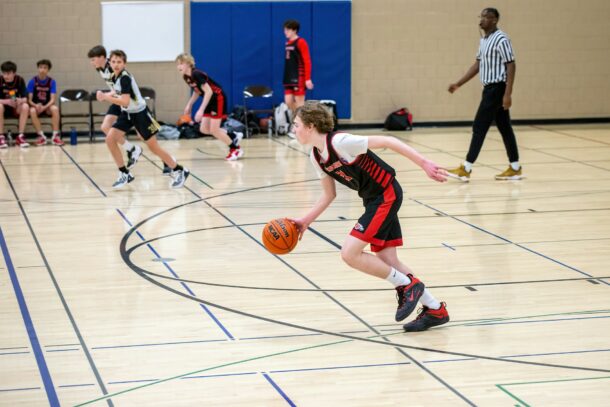
Zone defenses are popular in youth basketball for one simple reason. They hide individual defenders and force the offense to think. When young players hear the word “zone,” many of them freeze. The ball sticks. Cuts disappear. Everyone waits for someone else to make a play. Effective youth basketball zone offense does not require a binder full of plays. It requires movement, spacing, and a few clear principles that players can recognize in real time.
When taught correctly, zone offense actually becomes easier than attacking man-to-man because zones struggle with constant decision-making. Below are four core concepts that consistently break down zone defenses at the youth and high school levels.
Run Your Man Offense vs Zone
One of the most effective ways to attack a zone is counterintuitive. Run your man offense. Zones dislike movement. They struggle with players cutting through gaps, screening defenders who are guarding areas, and making quick decisions as the ball moves. When you run a man offense against a zone, you naturally get:
- Better spacing
- Continuous cutting
- Screening actions that force defenders to communicate
This approach also solves another common problem. It helps your players quickly identify whether the defense is actually in zone or man. If defenders pass cutters through and bump on screens, you know you are facing a zone. If they chase, it is man.
For youth teams, this simplifies teaching. Instead of learning a brand-new offense for every defense, players focus on habits that translate.
Overloading the Zone: The “Chair” Look
Zones hate overloads, especially on the ball side. One effective overload concept creates what looks like a “chair” shape on the floor. You load one side of the zone with multiple offensive players while maintaining a safety release at the top. This forces the defense to choose between:
- Protecting the rim
- Giving up a perimeter shot
- Leaving a cutter uncovered
From this alignment, you can flow into simple actions:
- A guard-to-guard pass with a screen
- A curl cut into the lane
- A quick pass to a shooter lifting behind the play
For youth basketball zone offense, overloads work because they remove hesitation. The defense is immediately outnumbered, and the reads become obvious.
Join the TeachHoops Community
Building Better Basketball Coaches
- College Coaches: Elevate your knowledge with advanced strategies and insider tips.
- High School Coaches: Expand your playbook and get an exclusive look behind the scenes of a nationally recognized program.
- Youth Coaches: Master the fundamentals and teach the game with confidence.
Teaching Coaches Since 2011 | 14-Day Money-Back Guarantee
Join Now and Step into Enhanced Coaching
Short Corner Solutions vs Any Zone
If you only teach one zone concept, teach the short corner. The short corner is one of the hardest spots for a zone to guard. When an offensive player occupies that space, defenders must either:
- Collapse and leave shooters
- Stay home and give up a layup
- Rotate late and foul
Using the short corner also opens the middle of the floor. As defenders sink toward the baseline, cutters have space to flash through the lane. This is especially effective against packed-in zones that try to take away paint touches.
For younger players, the short corner provides a clear visual cue. It gives them a destination instead of telling them to “read the defense,” which is often too vague.
How to Identify Man vs Zone Quickly
Late in games or after dead balls, defenses will change. Some will switch from man to zone. Others will run matchup coverages that blur the line. The fastest way to identify coverage is through cutting.
Have one or two players cut hard through the lane early in the possession. Watch the defense:
- If defenders pass cutters off and sink to the help line, it’s zone
- If defenders chase cutters through, it’s man
This information allows your players to settle into the right spacing without burning a timeout or forcing the coach to shout instructions from the sideline. For youth teams, this empowers players. It teaches them to solve problems on the floor instead of waiting for direction.
Final Thought
Great youth basketball zone offense is built on movement, not memorization. Zones struggle when they are forced to guard multiple actions at once. They struggle even more when players cut, screen, and occupy uncomfortable spaces like the short corner.
Teach your players how to move. Teach them how to identify coverage. Then let the offense flow. When zones can’t sit still, they break down.
If you want more drills, practice ideas, or one-on-one support, or if you need help installing a shooting workout with your team, explore everything on TeachHoops.com. With a 14-day free trial, one-on-one mentoring, and a library of proven practice tools, it’s one of the best places for coaches who want to take the next step.
Latest Posts
- Help side defense: 6 rules for teaching players where to be off the ball
- Closeout drill: How to teach players to close out without getting beat
- How do I start coaching basketball with no experience?
- First basketball practice: 7 ways to set the tone on day one
- Youth basketball tryouts: 7 ways to evaluate players more effectively