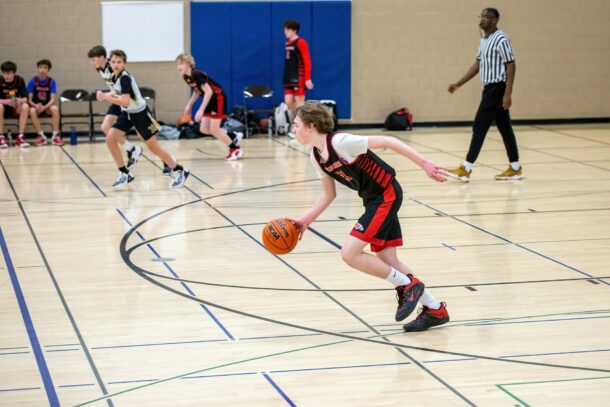
Nothing exposes a young team like a full court press. You can look great in your half court offense all week, then the other team starts trapping and suddenly you’ve got four turnovers in two minutes and a timeout you didn’t want to use. That’s when a good basketball press break earns its keep.
You don’t need anything fancy to handle it. The best basketball press break is one your kids can learn quickly, use against any press and actually trust when the pressure shows up. Here’s the simple setup I like, the rules that make it work and how to practice it.
Why a basketball press break falls apart
In fact, it’s usually the same few things. Players stand still waiting for the ball. The inbounder throws it to somebody who’s covered. The ball handler dribbles right into the trap. Nobody’s in the middle of the floor.
Pressure works because it makes kids hurry and react instead of think. A good press break slows their brain down. Everybody has a spot, a job and one simple read.
The setup
- 1: Point guard at the free throw line extended on the ball side
- 2: Second guard at the opposite free throw line extended
- 3: Middle man at half court in the center of the floor
- 4: Inbounder after made baskets
- 5: Deep man near the far free throw line, ready to run
Also, spacing matters more than anything. The two guards need to be far enough apart that one defender can’t guard both. The middle man stays in the middle. The deep man keeps their back line honest and becomes a target once you cross half court.
Getting it in
Most press turnovers start with the inbound pass, so we spent real time on it.
Don’t rush
After a made basket you can run the baseline, so use it to change the angle. Look middle first, then the guards. I told inbounders to count three in their head before forcing anything. Panic passes are what kill you.
Guards have to get open
A V cut, or a cut off a screen from the middle man, is usually enough. Catch it with your feet set and your eyes up the floor, not looking down at the guy guarding you.
Always have a safety valve
After the pass, the inbounder steps in bounds and becomes an outlet. If the first guard gets trapped, he has somewhere to go with it.
Beating the press after the catch
Once it’s in, you want the ball in the middle or ahead to an open teammate. Every forward pass puts the defense in chase mode.
Look middle
The middle man is the key to the whole thing. When the guard catches, the middle man flashes to an open spot. Hit him and you’ve split the trap, and now you usually have numbers going the other way.
Stay out of the corners
Traps live on the sidelines and in the corners, especially near half court. Guards need to stay away from the sideline. If they get pushed there, they don’t pick up the dribble until they know where the pass is going.
Throw it over the top
When the trap comes, somebody is open. Use a two hand overhead pass and throw it over the trap. Passing beats pressure. Dribbling out of a trap almost never works for young players.
Then go score
However, this is the part teams forget. You broke the press, now attack. If you have the numbers, go to the rim. Pulling it out after you broke it just wastes all the work you did to get there.
How we practiced our basketball press break
5 on 0
Walk through every inbound option, the middle flash and filling lanes with no defense. Then speed it up until it runs smoothly off every made basket.
5 on 7
Five on offense, seven on defense. Practice should be harder than the game. After this, a real press feels like a lot more room.
Trap and find
Two defenders trap a ball handler on the sideline. He has five seconds to pivot, protect it and find a teammate. That’s how kids learn to stay calm when the trap actually hits.
Practice your basketball press break before you need it
Your basketball press break doesn’t need to be complicated. Kids just need to know where to stand, how to get it in safely, when to look middle and to attack once they’re through. Do that and pressure becomes a chance to score instead of something to survive.
We have more press offense options, plays and video breakdowns at TeachHoops.com. Teams that see pressure in October aren’t scared of it in December.