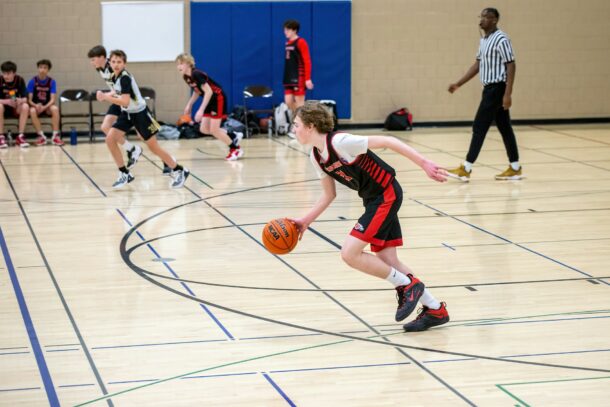
You can spot it in about thirty seconds of a youth game. Some kids catch the ball and look up. Others catch it, look down at it and start dribbling in place until a defender takes it from them. Ball handling is usually the difference, and that’s why I believe every youth team needs good youth basketball ball handling drills in practice.
It also improves faster than most skills if kids get the right reps. The trick is not letting them just pound the ball in place forever. Start simple, then keep moving them toward real game stuff: dribbling on the move, with their eyes up, with somebody guarding them. Here are six youth ball handling drills I like.
1. Stationary pounds: where youth ball handling drills start
Everybody starts here because control comes first. Athletic stance, dribble hard, ball low, fingertips not palms. Run through a quick series with each hand.
- Hard pounds at the waist
- Low pounds at the knee
- Side to side outside the foot
- Front to back beside the body
- Crossovers in front
About 20 to 30 seconds each. The thing I always added was a coach holding up fingers and players calling out the number. It forces their eyes up, and eyes up is the whole point.
2. Two balls
Two ball dribbling makes the weak hand work just as hard as the strong one. It’s frustrating at first. That’s kind of the idea.
Start with both balls bouncing together, then alternate. Better players can walk forward, back and sideways with both going. Five minutes a few times a week and you’ll see a real difference in that off hand.
3. Cone weave with a change of pace
For example, set five or six cones in a line, about six feet apart. Players weave through with a move at each cone. Crossover, between the legs, behind the back.
What I care about here isn’t the move, it’s the speed change coming out of it. Slow in, fast out. That’s because the burst is what actually beats a defender. Have kids overdo it at first so they feel the difference.
4. Retreat dribble
Young players get trapped because they keep dribbling forward into trouble. The retreat dribble teaches them to back out, keep the ball protected and reset.
Dribble up the floor. On a whistle, two or three retreat dribbles back, then attack again. Body between the defender and the ball, stay low, eyes up the floor. Add a defender with light pressure once they’ve got it. This one pays off big when you see your first press.
5. Keep it in the box
Mark off a box about 15 by 15. One kid has the ball and has to keep it for 15 seconds. One kid tries to take it. Step out or lose it and you switch.
Kids love this one, so it gets competitive in a hurry. They learn quickly that fancy moves don’t help much here. A low stance and a strong off arm do.
6. Attack and finish: youth ball handling drills with a purpose
However, dribbling only matters if it gets you somewhere. Start at half court and attack a defender or a coach with a pad. Make a move, then finish at the rim or hit a teammate cutting from the corner.
I’d often cap it at three dribbles. That forces kids to go somewhere with the ball instead of dribbling in circles.
What I look for in youth ball handling drills
- Eyes up whenever possible
- Fingertips, not palms
- Ball low when pressured
- Off arm protecting
- Weak hand working at least as much as the strong hand
- Changing speeds, not just directions
Also, track some numbers. How many crossovers in 30 seconds. How fast through the cones without losing it. Kids work on their own a lot more when they can see themselves getting better.
Ten minutes of youth ball handling drills a day
Still, you don’t need a huge block of practice for this. Ten minutes at the start of practice with a couple of these drills adds up over a season. Kids who can handle it play with more confidence, and your team stops panicking when the pressure comes.
We have more youth basketball ball handling drills, practice plans and player development programs at TeachHoops.com.

Latest Posts
- Basketball team culture: 5 standards to build in the preseason
- Basketball conditioning drills: 5 ways to get in shape with a ball in your hands
- What makes a great youth basketball coach?
- Youth basketball ball handling drills: 6 ways to build confident dribblers
- What are the 4 C’s of effective coaching?