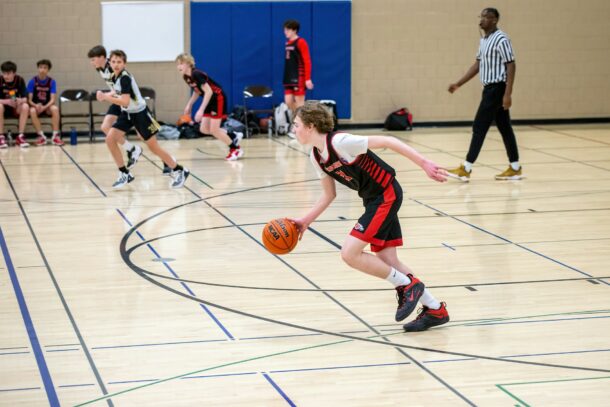
The basketball shooting pound drill helps players connect ball-handling rhythm with quick shot preparation. Instead of separating dribbling and shooting into two different skills, this drill teaches players how to pound the ball, read a cue and rise into their shot right away.
In games, scoring chances don’t always come from a perfect catch. A defender’s hands drop. A player backs off. A screen action creates space. A help defender looks away for one second. Good shooters have to recognize that window and get the ball up before the defense recovers.
This stationary shooting drill gives players a simple way to practice that exact moment.
Why the Basketball shooting pound drill works
The basketball shooting pound drill is built around the hanging pound dribble. Players pound the ball hard while keeping control, letting the ball hang as long as possible without carrying it. From there, they react to a cue and go straight into their shot. The goal is to train players to move from hesitation rhythm to shot rhythm quickly.
This matters because many players can shoot well when their feet are set. Fewer players can shoot well when they have to create space, read a defender and release the ball in one smooth motion.
This drill helps with:
- Quick shot preparation
- Better rhythm off the dribble
- Cleaner footwork into the shot
- Faster reactions to defensive mistakes
- Stronger confidence on hesitation pull-ups
Players learn to stay active with their feet, keep the ball alive and shoot the moment an opening appears.
How to run the basketball shooting pound drill
Start each player in a stationary position with the ball. The player begins with a hard hanging pound dribble, keeping the hand on top of the ball and avoiding any carry. The coach gives a cue, such as saying “go.” As soon as the player hears the cue, they stop the dribble, gather and shoot immediately.
The key is the reaction. Players should not take one more comfort dribble. They should not pause to reset their feet. They should go from pound dribble to shot as quickly as possible.
A simple setup looks like this:
| Step | Coaching Point |
|---|---|
| Start with a hanging pound dribble | Keep the hand on top of the ball |
| Stay active with the feet | Rock lightly instead of standing flat |
| React to the coach’s cue | Shoot as soon as the cue happens |
| Avoid extra dribbles | Gather and rise right away |
| Repeat with both hands | Build comfort going left and right |
This can be done from the wing, slot, top of the key or short corner. Coaches can also move players around the arc to work on different shooting angles.
Add visual cues for better game transfer
Once players understand the basic version, change the cue from sound to sight. Instead of saying “go,” the coach can raise a hand, drop a hand or use another clear movement. When the player sees the cue, they shoot.
This version is valuable because basketball is a visual game. Players aren’t waiting for someone to yell “shoot” during a possession. They’re reading defenders. They’re watching hands. They’re noticing when a defender relaxes or shifts weight the wrong way.
A visual cue helps players connect the drill to live action. For example, the coach can tell players: “When my left hand goes up, shoot.” Players continue pounding the ball until they see the hand move. Then they gather and fire.
This small adjustment makes the drill more realistic and forces players to focus with their eyes while controlling the ball.
Partner version of the pound shooting drill
The basketball shooting pound drill also works well with partners. One player starts with the ball and begins the hanging pound dribble. The partner stands in front or off to the side and gives the cue. The cue can be a hand raise, hand drop or quick defensive movement.
This partner setup is great because it makes players react to another person instead of a predictable coach command. It also keeps more players involved during skill work. A partner can act like a defender by:
- Dropping their hands
- Turning their head
- Taking a small step back
- Shifting their body out of position
- Flashing a hand signal
When the ball handler sees the opening, they shoot. Coaches can turn this into a competitive drill by tracking makes out of 10 or requiring players to make two in a row before switching spots.
Coaching points for cleaner shots
The most common mistake in this drill is the extra dribble. Players often want one more bounce to feel comfortable. Coaches should correct that quickly. The whole point is to shoot on the cue.
Players should also avoid dead feet. Even though the drill is stationary, the feet should stay light and ready. A player who stands flat will be slow getting into the shot.
Use these reminders:
- Keep the dribble strong.
- Stay on top of the ball.
- Keep the feet active.
- React right away.
- Gather cleanly.
- Shoot without the extra bounce.
- Land balanced.
Coaches should also encourage players to practice with both hands. A right-handed player still needs to be able to pound with the left hand and rise into a clean shot.
When players use this shot in games
This drill prepares players for hesitation pull-ups, drag dribbles and quick shots after a defender relaxes. A player might use it when:
- A defender backs up to protect against the drive
- A defender’s hands drop
- A ball screen creates separation
- A help defender looks away
- A defender gets caught leaning
- The offense needs a quick shot late in the clock
Players don’t need to overcomplicate the move. The drill teaches them to recognize a tiny window and attack it with a quick, confident shot.
Final thoughts on the basketball shooting pound drill
The basketball shooting pound drill is simple, but it solves a real game problem. Players need to shoot quickly when the defense gives them space. They also need to do it without wasting time, adding extra dribbles or losing their rhythm.
By combining a hanging pound dribble, a clear cue and an immediate shot, coaches can help players build better ball control, quicker reactions and cleaner pull-up mechanics. Run it with a coach cue first. Then add visual signals. After that, use partners to make it more game-like.
Small details make sharp shooters, and this drill gives players a practical way to turn a hesitation into points.

Latest Posts
- Closeout drill: How to teach players to close out without getting beat
- How do I start coaching basketball with no experience?
- First basketball practice: 7 ways to set the tone on day one
- Youth basketball tryouts: 7 ways to evaluate players more effectively
- 3 on 2 shooting drill: Build better reads, ball movement and shot selection