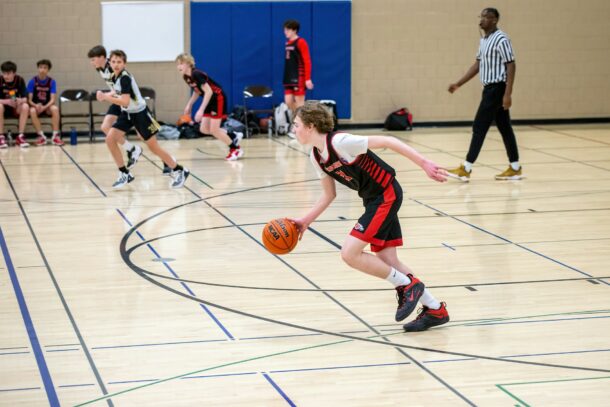
Ask a young player what defense is and they’ll tell you it’s guarding the kid with the ball. That’s one fifth of it. The rest is help side defense. At any moment four of your defenders are guarding somebody without the ball, and where those four are standing usually decides whether the other team gets a layup.
The problem is that help side positioning is hard for kids to see. From the bench it’s obvious. On the floor, with everything moving, it isn’t. So I always tried to boil help side defense down to a handful of rules players could apply without thinking too hard. These are the six I came back to every year.
1. See ball, see your man
You have to be able to see the ball and your player without turning your head. We called it pistols. Point one hand at the ball, one hand at your man. If you can’t do both, you’re in the wrong spot.
Lose sight of the ball and you get beat by a drive you never saw. Lose sight of your man and he back cuts you for a layup. In the early drills I’d have kids actually say “ball” and “man” out loud as they adjusted. They hate it for a day. Then it sticks.
2. Help side defense moves on the pass, not the catch
Every pass changes where all five defenders should be. Your feet move while the ball is in the air. If you wait for the catch, you’re already late.
The phrase we used was jump to the ball. On every pass, every defender moves toward the ball and toward the middle. That keeps you tight and takes away the driving lanes that open up on reversal.
3. Passes away tells you where to stand
However, kids don’t need a diagram for every situation. They need one question: how many passes away is my man?
One pass away, you’re in the gap or denying, close enough to bother the pass but still able to help on a drive. Two passes away, you sink to the lane with a foot in the paint. Weak side low, you’re protecting the rim. That one question answers most positioning problems on its own.
4. Talk the whole time on help side defense
Help side defense falls apart without talk. A kid slides over to stop a drive and nobody behind him knows, so two guys end up on the driver and the corner shooter is wide open.
So keep the vocabulary short and use the same words every year. Ball. Help. I’ve got two. Screen left, screen right. When I had the same terms from our youth program all the way up to varsity, kids showed up already knowing the language.
And in practice, if a drill goes quiet, stop it. It slows things down at first. That’s fine. Talking only becomes a habit if you won’t let them skip it.
5. Stop the ball, then get back to your guy
When the ball handler gets by, the closest help defender has to step in early, feet set, and make the driver stop or change direction. Showing up late just means a foul or a layup.
The part teams forget is the recovery. Stop the ball, show your hands so he doesn’t just dump it off, then sprint back to your own man with a controlled closeout. We’d work this 2 on 2 first, then 3 on 3, then 4 on 4. Same rule every time.
6. It’s not a stop until you have the rebound
Help side guys are often out of position when the shot goes up because they just rotated. That makes them easy targets on the glass. Nothing hurts more than playing 25 seconds of great defense and giving up a putback.
Find somebody, hit him, hold your ground. In practice we didn’t count a defensive possession as a stop until we had the ball. Players figured out fast that the rebound was part of the job.
Help side defense drills I’d use
Shell drill
Plain old 4 on 4 shell. Start with passing only, no dribbling, and freeze it after passes to check everybody’s spot. Add penetration, skip passes and cutters as they get it. I’ve never found a better way to teach this.
Help and recover
One defender in help position, offensive players on the wing and in the corner. A coach drives from the top, the defender helps, then recovers to the corner on the kick out. Good for the habit and it gets them in shape too.
3 on 3, no middle
Live 3 on 3, but the offense gets an extra point any time they drive to the middle. Help side guys get a lot more alert when every middle drive costs them.
Work on help side defense every day
Help side defense isn’t something you cover once in October and check off. It needs a few minutes every practice. Get those six rules into your players’ heads and your defense gets a lot harder to score on.
If you want the full system we built, including the Funnel Down Defense, the breakdown drills and practice plans are at TeachHoops.com.

Latest Posts
- Help side defense: 6 rules for teaching players where to be off the ball
- Closeout drill: How to teach players to close out without getting beat
- How do I start coaching basketball with no experience?
- First basketball practice: 7 ways to set the tone on day one
- Youth basketball tryouts: 7 ways to evaluate players more effectively