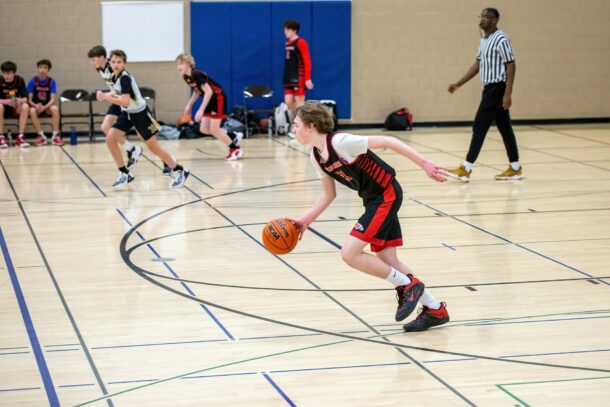
Watch any youth game for a minute and you’ll see the same problem. Five kids chase the ball, and now there’s no room for anybody. Offensive spacing fixes more problems than any play you’ll ever draw up.
The trouble is that spacing feels abstract to young players. They don’t see the floor the way a coach does. So I always tried to give them a few simple rules instead of long explanations. When kids can remember the rule, they can follow it in a game.
Why offensive spacing matters more than plays
Good spacing makes one defender guard two players. It opens driving lanes and makes help defense harder. Also, it gives your shooters time because the closeouts are longer.
Bad spacing does the opposite. One defender can guard two of your players at once, so every drive runs into a crowd. Then kids start forcing passes, and you get turnovers. That’s why I taught spacing before I taught any set.
1. Stay 15 to 18 feet apart
This is the first rule and the most important. Teammates should be about 15 to 18 feet from each other. For example, I’d tell younger kids it’s about three big steps or the length of a long couch.
Then we’d freeze scrimmages and check. If two players could touch each other, somebody was in the wrong spot. Kids figure it out fast once you stop it a few times.
2. When the ball moves, you move
Spacing isn’t a spot you stand on all game. Every pass and every drive changes it. So when the ball moves, everybody adjusts to keep the floor balanced.
A simple version for young players: if the ball comes toward you, move away. If the ball goes away from you, fill the space it left. It isn’t perfect, but it keeps kids from standing still.
3. Fill the corners
Young players drift toward the ball and leave the corners empty. However, the corners are where a lot of the space comes from. A player in the corner pulls a defender away from the lane.
I’d often have one rule for each scrimmage: somebody is always in a corner. As a result, our drives had more room, and our kick out passes got easier.
4. Don’t stand in the lane
Nothing kills a drive like a teammate parked in the paint. Teach players to cut through the lane and get out. Three seconds is a rule, but it’s also a spacing habit.
Also, when a teammate drives, the players away from the ball should move to a spot where the driver can see them. That gives him an outlet when the help comes.
5. Spacing before the advantage
I always told players to get spaced first, then attack. If you drive before the floor is set, you drive into traffic. Instead, take a second to let your teammates find their spots.
This one takes patience, especially with young kids who want to go right away. Still, it’s worth teaching because it turns bad drives into good ones.
Drills that teach offensive spacing
5 on 0 spacing walk through.** Put players in spots, then move the ball and have everybody adjust. Freeze it often. Ask kids where they should be before you tell them.
3 on 3 with no dribble.** Passing only. Because players can’t dribble, they have to move and space to get open. It’s a great teacher.
Drive and kick.** One player drives, and the others have to find a spot where he can see them. Then the kick out pass leads to a shot or another drive.
Keep offensive spacing simple
You don’t need a complicated system to space the floor. A few rules your players can remember go a long way. Then, once kids understand offensive spacing, everything else you teach on offense gets easier.
If you want a full system built on spacing and simple reads, our Rule of 3 Offense and youth practice plans are at TeachHoops.com.

Latest Posts
- Offensive spacing in youth basketball: 5 rules players can actually remember
- How to give effective feedback during basketball practice
- Basketball press break: A simple alignment that beats full court pressure
- How to motivate a basketball team that’s losing
- How to handle difficult parents as a basketball coach