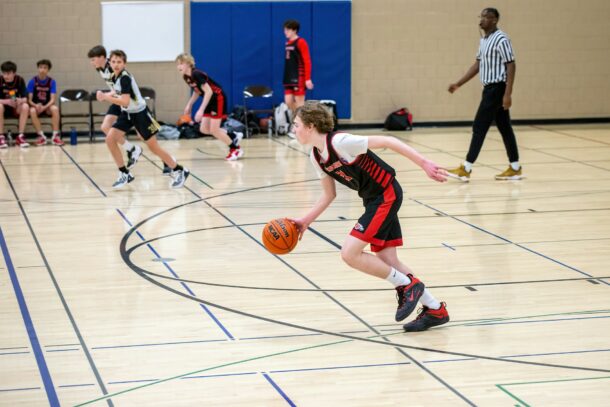
Tennis balls and basketball drills are a great combination for players who need tighter handles, better focus and more control with the ball. By adding a tennis ball to a ball handling workout, players are forced to keep their eyes up, make quicker adjustments and control two different objects at the same time.
This type of drill can look simple at first, but it gets challenging fast. A tennis ball is smaller, lighter and harder to control than a basketball. Players have to stay low, pound the ball harder and use their fingertips with more precision.
For coaches, that makes this a simple but smart way to build stronger ball handlers.
Why Tennis Balls and Basketball Drills Work
The main benefit of tennis balls and basketball drills is that they force players to do two things at once. In a regular ball handling drill, players can stare at the basketball, find their rhythm and settle into the movement. Once a tennis ball is added, they have to keep their head up and react. They have to feel the basketball instead of watching it.
Ball handlers need to see defenders, teammates, help rotations and open space. They can’t play with their eyes down. Tennis ball drills help build that habit because the player has to track a smaller object while still controlling the basketball.
The tennis ball also creates small mistakes. It bounces differently, can get away from the player, and requires quick hands and constant micro-adjustments. Those tiny corrections help players develop better touch and stronger control.
Drill 1: Tennis Ball as the Dummy Ball
One way to introduce this series is by using the tennis ball as the dummy ball. In this setup, the basketball performs the main move while the tennis ball stays in front. The player works through a rhythm, such as a 3-2-1 style ball handling pattern, then crosses over with the basketball while keeping the tennis ball under control.
The idea is to make the player focus on two different balls at once without making the drill too complicated right away. A simple progression could look like this:
- Start with the basketball in one hand and the tennis ball in the other.
- Dribble both balls in rhythm.
- Keep the tennis ball as the dummy ball.
- Use the basketball to perform the crossover.
- Repeat the pattern without catching the tennis ball.
Players should stay low, keep their eyes up and avoid letting the tennis ball become the main focus. The basketball is still the working ball in this first level.
Drill 2: Switch the Roles
Once players can handle the first version, they can make it harder by switching the roles. Now the tennis ball becomes the ball performing the move. The basketball becomes the dummy ball.
This is much more difficult because the tennis ball is harder to control. Players may only be working with a couple of fingers, so every small mistake feels bigger. A slight miss with a basketball can be corrected pretty easily. A slight miss with a tennis ball usually forces the player to react fast.
Players can work on crossovers, between-the-legs moves or simple rhythm moves with the tennis ball. The goal is to improve hand control, coordination and comfort with uncomfortable drills.
When players go back to using a regular basketball, the ball often feels easier to control.
Drill 3: Throw-And-Catch Tennis Ball Series
Another strong option is the throw-and-catch series. The player dribbles the basketball while tossing the tennis ball into the air. While the tennis ball is in the air, the player performs a move with the basketball, then catches the tennis ball.
There are three levels coaches can use.

Level 1: One-Move Tennis Ball Drill
At level one, the player performs one move before catching the tennis ball. The player can use an in-and-out, crossover, between-the-legs move or behind-the-back move. The key is to keep the dribble alive while tracking and catching the tennis ball.
The higher the player tosses the tennis ball, the easier the drill becomes. The lower the toss, the harder it gets because the player has less time to complete the move.
Coaching points:
- Stay low.
- Keep the eyes up.
- Do not rush the move.
- Control the basketball with the fingertips.
- Catch the tennis ball cleanly.
This is a great starting point for younger players or players new to tennis ball ball handling.
Level 2: Double-Move Tennis Ball Drill
At level two, the player performs two moves before catching the tennis ball. For example, a player might toss the tennis ball, go crossover, between the legs, then catch the tennis ball. Another option is a double crossover, or a Tim Hardaway-style between-the-legs crossover combination.
This level teaches players to move faster while staying under control. They have to complete two clean moves before the tennis ball comes back down.
Coaches can adjust the difficulty by changing the toss height. A higher toss gives players more time. A lower toss makes the drill faster and tougher.
Level 3: Three-Move Tennis Ball Drill
Level three is the hardest version. The player tosses the tennis ball, completes three ball handling moves, then catches it. This forces quick hands, balance and focus.
Players should not rush into this level too soon. They need to earn it by showing they can handle level one and level two with good control. Sloppy speed does not help. Clean speed does.
Coaches can let players mix moves once they’re ready. Crossovers, between-the-legs moves and behind-the-back moves can all fit into the progression.
Add the Drop Challenge
A more advanced variation is the drop challenge. Instead of tossing the tennis ball high into the air, the player holds it out, drops it and tries to complete the move before catching it. This is much harder because the player has very little time to react.
To make this work, players have to get low, move quickly and stay locked in. It’s a great challenge for advanced ball handlers who need a new way to sharpen their speed and focus.
Coaching Tips for Tennis Balls and Basketball Drills
Coaches should introduce tennis ball drills slowly. Players may struggle at first, and that’s fine. The point is to challenge their coordination and comfort level. A few simple reminders can help:
- Start with the basketball as the main ball.
- Use the tennis ball as the dummy ball first.
- Do not let players catch the tennis ball instead of dribbling it during dummy-ball work.
- Encourage players to stay low.
- Adjust the toss height based on skill level.
- Make sure players keep their head up.
- Let players master one move before adding double or triple moves.
Coaches can also use different objects if a tennis ball is not available. A small bouncy ball, a soft rubber ball or even a crumpled piece of paper can work in a pinch. The main idea is to give the player something else to track while they handle the basketball.
Why This Helps Players Handle Pressure
Tennis ball drills create a controlled kind of chaos. The player has to react, adjust and recover. That’s exactly what ball handlers do in games.
Defender reach. Teammate cut. Screens change angle. Passing lanes open for a split second. Good guards have to process all of that while keeping the dribble alive.
Tennis balls help players practice that feeling in a simple way. They build tighter handles because the tennis ball demands more touch, better vision because the player has to keep the eyes up, and better confidence because the basketball feels easier after the tennis ball work.
Final Thoughts on Tennis Balls and Basketball Drills
Tennis balls and basketball drills are easy to add to almost any workout. They don’t require much space, they don’t need fancy equipment and they can be adjusted for different skill levels.
Start simple. Use the tennis ball as a dummy ball. Move into throw-and-catch drills. Add double moves, triple moves and drop challenges as players improve.
The best ball handlers are comfortable being uncomfortable. A tennis ball gives players a different kind of challenge, and that challenge can lead to cleaner control, quicker hands and better game-ready handles.

Latest Posts
- Closeout drill: How to teach players to close out without getting beat
- How do I start coaching basketball with no experience?
- First basketball practice: 7 ways to set the tone on day one
- Youth basketball tryouts: 7 ways to evaluate players more effectively
- 3 on 2 shooting drill: Build better reads, ball movement and shot selection