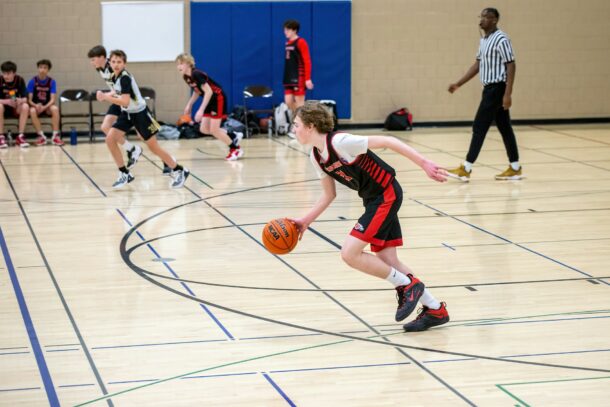
Ball handling can make or break a basketball player. Great shooters and smart passers still struggle if they can’t control the ball under pressure. A strong two ball dribbling drill helps players improve hand speed, coordination, court awareness, and confidence all at once. Coaches looking to sharpen guards or challenge younger players should absolutely have this drill package in their practice plan.
Coach Collins from TeachHoops.com recently broke down a pair of creative two-ball drills that force players to keep their heads up, react quickly, and pound the basketball with purpose. Both drills are simple to set up, but they create serious skill development in a short amount of time.
Why the two ball dribbling drill works
Many young players develop bad habits because they dribble casually. Loose dribbles lead to turnovers, deflections, and frustration. A quality two ball dribbling drill teaches players to:
- Dribble hard and low
- Keep their eyes up
- Improve weak-hand control
- React without staring at the basketball
- Handle distractions and pressure
Coach repeatedly stresses one important point during the workout: players must pound the basketball hard. Hard dribbles create quicker ball returns and stronger control. Soft dribblers usually struggle once defenders apply pressure.
Drill No. 1: Two-ball reaction passing drill
This is one of the best reaction-based ball-handling drills for guards and wings.
How to run the drill
- The player starts with two basketballs.
- Both balls are dribbled hard and below the knees.
- A partner stands several feet away.
- The partner tosses a bounce pass toward either hand.
- The player catches and returns the pass while continuing the two-ball dribble.
The passing partner should keep the tosses controlled and accurate. No lasers across the gym. Focus matters more than speed early on.
As players improve, coaches can shorten the distance and increase the pace.
What makes this two ball dribbling drill effective?
Reaction drills create real-game habits. Players can’t stare at the floor because they must read the incoming pass and respond quickly.
Coach explains that the passing itself isn’t the key teaching point. Vision and focus drive the drill. Players learn how to handle the basketball while processing movement around them.
Several important skills improve at the same time:
- Peripheral vision
- Hand-eye coordination
- Ball security
- Reaction speed
- Passing touch under pressure
Guards especially benefit because games rarely allow players to dribble in a calm, controlled environment.
Drill No. 2: Two-ball stationary control drill
This second two ball dribbling drill adds another layer of difficulty. Younger players may need smaller basketballs at first, which Coach Steve openly recommends.
How the drill works
Players begin by dribbling two basketballs aggressively.
Next, one ball is slammed harder into the floor so it momentarily “sticks” or pauses near the ground while the other hand continues dribbling.
The player then restarts the stopped ball and repeats the sequence on alternating sides.
A slight curl or cupping motion helps control the stationary basketball before restarting it.
Coaching points for this drill
Several teaching cues can make the drill more successful:
Keep the dribble below the knees
Low dribbles improve control and reduce wasted movement.
Pound the basketball
Strong dribbles create rhythm and faster reactions.
Use the weak hand constantly
Coach Steve recommends using the strong hand to stop the ball while the weak hand continues pounding the basketball. Players often improve weak-hand confidence without even realizing it.
Stay patient with younger players
This drill is difficult at first. Frustration usually shows up before improvement does. Stick with it.
Common mistakes coaches should correct
Players often make the same errors during a two ball dribbling drill:
- Standing too upright
- Dribbling too softly
- Looking down constantly
- Trying to go too fast too early
- Slapping at the basketball instead of controlling it
Short teaching pauses help fix these habits quickly.
Building the drill into practice
These drills work well during:
- Ball-handling stations
- Guard development sessions
- Pre-practice skill work
- Summer workouts
- Individual improvement plans
Five focused minutes can create major improvement over the course of a season.
Coaches searching for more practical skill development drills can find additional resources, practice plans, and coaching clinics at TeachHoops.com. Coach Collins’ teaching style keeps drills simple, competitive, and easy to implement for youth and high school programs alike.

Latest Posts
- 7 fundamentals of basketball every coach should teach
- Help side defense: 6 rules for teaching players where to be off the ball
- Closeout drill: How to teach players to close out without getting beat
- How do I start coaching basketball with no experience?
- First basketball practice: 7 ways to set the tone on day one