The Funnel Down defense gives youth basketball coaches something every program needs: a simple system players can see, understand and repeat. Lock Left has strong ideas, especially against right-hand dominant players, but Funnel Down is usually the better base defense for youth and high school teams because it starts with court geography instead of complicated layers.
At its core, Funnel Down asks players to shrink the floor. Instead of defending the entire court, teams work to keep the ball outside the volleyball lines, push it toward the sideline and baseline, then trap in the short corner. The PDF describes this as a court-geometry-first system designed to reduce the playable court to roughly 40% of the floor.
https://youtu.be/ThivLnYdW2U?si=6m9VJLjNQRBREOmx
Why Funnel Down defense is easier to teach
Most youth players struggle when defensive rules change every possession. Funnel Down gives them a clear visual map. The ball is either in the gutter, in the alley or in the strike zone.
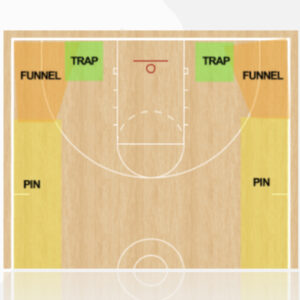
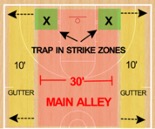
That language is simple enough for middle school players, freshman teams and varsity groups to use every day. The gutter is the sideline area outside the volleyball court lines. The alley is the middle of the floor. The strike zone is the short corner and deep baseline area near the basket where the trap happens.
Lock Left, by comparison, has more moving parts. Its system includes layers such as Lock the Ball, Build the Wall, Stunt and Hunt, Snipe the Free Side, Jail Overload, Close and Fly, Role Rebounding, Weak and Switch, Color Code and Special Situations. Those are valuable concepts, but they can be a lot for an inexperienced roster to process.
Funnel Down starts with only three main jobs.
Funnel Down concept
What players do
Pin
Keep the ball from reversing back to the middle
Funnel
Push the ball down the sideline toward the baseline
Trap
Double-team in the short corner strike zone
That’s why Funnel Down fits so well as a youth basketball defensive system. It gives players fewer rules, clearer landmarks and faster practice carryover.
Funnel Down shrinks the court
The biggest advantage of Funnel Down is that it changes the geometry of the game. Instead of trying to guard every possible driving lane, the defense wants the ball in a smaller section of the floor. The PDF notes that the system’s goal is to keep the ball confined to the gutter for a large percentage of possessions, with top programs pushing that number toward 70% or higher.
That helps youth teams in three major ways.
First, it reduces the amount of space defenders have to cover. Second, it makes help rotations easier because the ball is trapped near the sideline and baseline. Third, it keeps the offense from attacking the middle, where most breakdowns become layups, kick-out threes or scramble situations.
Coaches don’t need five elite athletes to make that work. They need five players who understand where the ball should go.
Why Funnel Down beats Lock Left as a base defense
Lock Left is built around forcing the ball left. That can be powerful against right-hand dominant guards, especially at the high school level. The PDF points out that weak-hand pressure can create a major shooting drop for amateur players, particularly on pull-ups and floaters.
The problem is that Lock Left depends on directional discipline every possession. Players must force the ball left, protect against right-hand drives, build a wall near the rim and rotate into passing lanes. Funnel Down is more forgiving.
If the ball ends up in either gutter, the defense is still doing its job. Lock Left wants the ball in one specific place. Funnel Down simply wants the ball out of the middle and headed toward the sideline or baseline.
That difference matters for youth teams. Players will make mistakes. They will take bad angles. They will get beat. Funnel Down gives them a structure that can survive some of those mistakes because any sideline channel can become a win.
Funnel Down works in man and zone
Another reason Funnel Down is better for most youth and high school programs is its flexibility. Coaches can use the same language whether they’re playing man, 2-3 zone, 2-1-2 zone or 1-3-1. Funnel Down is compatible with both man and zone concepts, while Lock Left can also work as man or matchup zone but requires more layered adjustments. This makes Funnel Down easier to install across a full program.
A varsity coach can teach the same defensive vocabulary to the JV, freshman and middle school teams. Everyone learns the same landmarks, learns the same trap spots, and learns that the middle is dangerous and the gutter is the goal. That kind of program-wide consistency is hard to beat.
Funnel Down creates better practice habits
Funnel Down also gives coaches easy practice targets. Instead of only saying, “Play harder on defense,” coaches can chart clear goals:
Stat
What it tells coaches
Gutter percentage
How often the defense kept the ball outside the volleyball lines
Middle drive rate
How often the offense attacked the alley
Strike zone entries
How often the defense created trap chances
Trap conversion rate
How often traps created turnovers or bad shots
Stop ratio
How often the possession ended without a score
Those numbers are simple enough for a manager, assistant coach or injured player to track. The PDF recommends charting half-court possessions with basic codes such as G-L for left gutter, G-R for right gutter, MID for middle and SZ for strike zone entry. This gives a coach something concrete to review after games.
Did the defense actually keep the ball out of the middle, and did traps lead to turnovers? Did players force the ball into the strike zone, and did the team improve from week to week? Funnel Down makes those answers visible.
When Lock Left still helps
Lock Left still has useful concepts. For example, forcing right-handed players left can make sense against certain guards. The “Build the Wall” idea can also help teams protect the rim, while “Snipe” teaches off-ball defenders to hunt passes instead of standing flat-footed.
The best approach for many programs may be to use Funnel Down as the foundation, then borrow Lock Left ideas as add-ons. Start with Funnel Down geography. Teach players to pin, funnel and trap. Once the team understands those habits, coaches can add weak-hand forcing, wall help and passing-lane pressure.
This keeps the defense simple without ignoring good ideas from other systems.
Final thoughts on Funnel Down defense
For most youth basketball coaches, Funnel Down is the better base system because it’s easier to teach, easier to see and easier to measure. Lock Left has value, especially for older teams with experienced defenders, but Funnel Down gives developing players a clearer starting point.
The goal is simple: shrink the court, keep the ball out of the middle, force baseline and trap with purpose. When players understand where the ball should go, defense stops feeling random. Funnel Down gives them that map.
Hey coach, if you are like most of us, your practice plan is already packed before you even roll the balls out. You want to install presses, zones, man-to-man coverages, special game-plan defenses for that one rival, and somehow still have time for shooting and skill work. That is where a smart approach to youth basketball defensive systems can save your sanity.
What I want to walk you through here is the idea behind our Funnel Down Defense and why it has become the backbone of what we do. It shrinks the floor, simplifies decisions for your players, and gives you a real chance against teams that might be more athletic or talented.
https://youtu.be/ThivLnYdW2U?si=2rikYALL15uetcqh
The Origin Story: From Too Many Defenses To One Clear System
Like a lot of coaches, I used to have “defensive clutter.” Box-and-one here, a special zone there, a game-specific tweak for one opponent. After a close loss where I had tried to put in multiple specific defenses for one team, I was driving home, Chick-fil-A in the passenger seat, thinking:
“I just have too many things. Too many defenses. I need variation, but I also need to narrow it down.”
On that drive, with a Chick-fil-A napkin and a pen, the early version of Funnel Down Defense was born. The goal was simple:
Keep the system versatile enough to work against good teams
But simple enough that high school kids could remember it in November, not just in March
Over the last five or six years, we have tweaked and refined it, but the core idea has stayed the same.
Using The Lines Already On Your Court
Most of you already have part of the defense drawn on your floor and do not realize it.
If you look at a typical high school gym, you will see a volleyball court on top of your basketball floor. A volleyball court is about 30 feet wide, while a basketball court is about 50. That is an instant visual tool.
We use that:
The volleyball court becomes our “funnel”
We are trying to force the ball into roughly 40% of the floor
We do not need painter’s tape to mark lanes or pack line borders, because the lines are already there
If you have ever put down tape to mark help lines or gaps, this is the same concept, but baked into the court permanently.
Because I coach in Wisconsin, a state full of bowling alleys and churches, our language is built around that.
We talk about:
Gutter: The outer lanes near the sideline, outside the volleyball court lines
Alley: The main middle area where most offenses want to operate
Strike Zone: The short corner / deep baseline area near the basket
We want the offense out of the alley and into the gutters. And to funnel the ball into that strike zone along the baseline, where we can trap and where the court itself becomes a defender.
Here is why that matters:
Behind the backboard is a terrible place to live on offense
The baseline and the basket act like two extra defenders
Passing angles shrink, and pull-up jumpers from 14–18 feet are low-percentage shots for most high school and youth players
Most kids today want threes or layups. Short corner, off-the-dribble midrange jumpers with a weak hand are exactly the shots we are happy to give up.
Forcing Baseline And Shrinking The Floor
In Funnel Down, we are always trying to get the ball to the gutter and then into the strike zone.
Key concepts:
We force baseline, not middle
We do it on both sides of the court, but prefer the left gutter when possible because shooting percentages are usually a little lower going left
Our goal is to keep the ball in that 40% slice of floor for 80–90% of the game
We use a simple mental landmark: the equator, which is the middle line of the court.
If the ball is on the right side of the equator, we funnel right
If it is on the left, we funnel left
Once the ball crosses half court, we do not let it reverse back across that line
Again, this is why simple lines on the floor make this one of the most coachable youth basketball defensive systems you can run.
Why Funnel Down Works For Youth Basketball
This system is built for real teams with real limitations, not All-Star squads.
1. It Works In Man And Zone
You can run Funnel Down out of:
Man-to-man
2–3 zone
2–1–2
Even 1–3–1, depending on your personnel
We have run it roughly 50/50 man and zone in different seasons, based on who we had in the program.
2. It Fits Any Athlete Type
Would I rather have long, athletic kids? Sure. But Funnel Down gives you a fighting chance even when:
You are not the most athletic team
You are playing a team with a stud guard who lives in ball screens
You need to protect slow-footed players by keeping help and traps predictable
The system is built on angles, help positioning, and communication, not just raw talent.
3. It Saves Practice Time
Once we went all-in on Funnel Down as our main defensive system:
We cut about 20% of our defensive teaching time in practice
We stopped chasing 4–5 different defenses for different opponents
Our players learned one clear, layered system instead of a menu of complicated schemes
That gave us more time for:
Skill work
Offensive sets and spacing
Special situations
Simple Rules Players Can Remember
One of my guiding principles is that my players can consistently remember about three key concepts at a time. So almost everything in our program is built in threes.
For Funnel Down, those three are:
Pin
Funnel
Trap
We teach them to:
Funnel the ball into the gutter
Pin the ball handler toward the baseline and sideline
Trap in the strike zone when the timing is right
Whether we are in man or zone, those actions stay consistent. That simplicity is why players pick it up quickly and why it works so well at the youth and high school levels.
Running Off The Three-Point Line
The hardest adjustment for most players is understanding we are not always “closing out” like a traditional defensive system. Instead, we are often running shooters off the line.
We emphasize:
Do not give up rhythm, catch-and-shoot threes
Force them into the dribble, preferably towards the gutter
Trust that you have help and a defined funnel behind you
The modern game revolves around the three-point line. A system that ignores that reality will not hold up, especially as your players get older.
Bonus Benefit: Your Offense Gets Better Too
One thing I did not plan on when I scribbled this on a napkin:
Our offense got better.
Because Funnel Down:
Forces tough passes
Speeds teams up
Takes away reversals
We needed to practice against it. That meant:
Our ball movement improved
Our players learned how to attack a shrunk floor
Our decision-making under pressure got sharper
Sometimes the best youth basketball defensive systems are the ones that accidentally make your offense tougher and more skilled too.
A Smarter Way to Coach
If you’re coaching club ball or running weekend tournaments, organization is half the battle. Between travel logistics, gate fees, and scheduling headaches, it can be overwhelming.
That’s why platforms like SidelineSavings.com are emerging, helping tournament operators, coaches, and parents streamline entry, scheduling, and payment systems so everyone can focus on basketball, not spreadsheets.
If you want more breakdowns like this, or if you need help installing a full court press with your team, explore everything on TeachHoops.com. With a 14-day free trial, one-on-one mentoring, and a library of proven practice tools, it’s one of the best places for coaches who want to take the next step.
Scheming the right defensive system for your team remains one of the most important parts of preseason preparation for any basketball coach. While defensive principles may largely be the same from year to year, the athletes on the team might not be. Coaches must gear their strategies and approaches to fit the capabilities of their players. That makes systems like the Funnel Down Defense so valuable. Funnel Down stands as a versatile defensive weapon for any team, no matter the level.
The Funnel Down Defense
The basic principle of this defensive set up is to prevent opposing offenses from comfortably using the middle of the floor. Funnel Down creates “gutters” outside the volleyball lines, which are present on most high school and even college courts. Defenders force dribblers into these gutters and funnel them down the line to the next man. The ball is pushed down to the baseline and toward “strike zones,” or trap areas in the short corner.
Ideally, the offense never centers the ball, or swings the ball to the weak side of the floor. This defense focuses on shrinking the court for opposing offenses. Funnel Down tries to prevent offenses from effectively using 60 percent of the court.
Funnel Down is purposefully built to get opposing offenses out of their normal rhythm and flow, resulting in turnovers, and bad or rushed shots. When deployed in games that feature a shot clock, the effectiveness of this strategy is further amplified because the offense must spend time getting out of the trap zones.
Why Use Funnel Down?
This defensive system provides coaches with a versatile set up, adaptable to almost any talent level. Funnel Down can be paired with any base defense. It doesn’t matter if a team normally runs man-to-man or zone, funnel down can work either way.
When used correctly, this system disrupts any offense by keeping the ball on one side of the floor. Funnel Down seeks to “pin” opposing offenses to the sidelines and forcing them into traps. This creates an urgency in dribblers that often speeds them up to a point where they are uncomfortable. By speeding up the dribbler, the offense becomes more mistake prone, leading to game-changing turnovers.
And this defense can be taught by any coach, to basically any team. The lesson linked below provides all of the video tutorials, drills and practice plans needed to implement this system. Funnel Down might be the only defense a team needs!
The versatility of this set up allows for any type of athlete to be used on the floor. The defense creates difficult angles for passing and shooting, especially once the ball handler enters that baseline trap area. Funnel Down uses the sideline and the baseline as extra defenders to leverage pressure on the floor.
Incorporating this system into your routine forces opposing teams to spend extra time preparing. That ultimately robs opponents of time to prep for other parts of their game plans.
For more on how to implement this game-changing defensive system, Click Below for the Limited Time Offer!
Basketball coaches often find themselves scheming for different ways to defeat the best team on their schedule. Many of those schemes are oriented around the defense. Coaches searching for ways to streamline their practices and become more efficient in their instruction need to look no further than the Funnel Down Defense. This approach provides coaches with a tried and true defense system that dictates pace and generates turnovers.
The Funnel Down Defense
Funnel Down uses something most basketball courts feature and many coaches dismiss: the volleyball lines. This defense focuses on shrinking the court for opposing offenses by pushes ball handlers outside of that key stretch of the floor. Funnel Down tries to prevent offenses from effectively using 60 percent of the court. Instead, it forces them to the perimeter, operating on just 40 percent of the floor.
This approach attempts to keep the ball on one side of the floor. It speeds up opposing offenses to the point where they become mistake-prone. It also shrinks the usable floor space for the offense.
Funnel Down is purposefully built to get opposing offenses out of their normal rhythm and flow, resulting in turnovers, and bad or rushed shots. When deployed in games that feature a shot clock, the effectiveness of this strategy is further amplified because the offense must spend time getting out of the trap zones.
Three Key Concepts of the Funnel Down Defense
1. Pin the ball on the sideline
2. Funnel the ball to the baseline
3. Trap and Rotate in the short corner
The design of this defense borrows its terminology from bowling. The task of the defense remains to “funnel” the ball along the “gutter” of the court to the baseline, where a trap awaits in the “strike zone.” Funnel Down seeks to keep the ball out of the “alley,” which is the main stretch of center court inside the volleyball lines. The traps occur in “strike zones” positioned at the short corners.
Ideally, defenders pressure the ball into the gutters, avoiding the centering pass. This is called a “pin.” This tactic overplays the ball handler away from the middle so that the ball can’t be swung. Defenders stay ahead of the ball handlers by sprinting, not sliding, trying to stay half a body width ahead of the dribbler. This discourages penetration and funnels the ball toward the trap areas.
The defender “up the line” covers a man below the ball level on the court. This defender needs to remain between his man and the ball in order to help. The defenders continue to “funnel” the ball along the sideline, encouraging the dribblers to head toward the baseline. Once the ball enters the “strike zone” in the short corner, that triggers a trap and weak side rotation.
For more on how to implement this game-changing defensive system, Click Below for the Limited Time Funnel Down Defense Offer!



 The
The 
 1. Pin the ball on the sideline