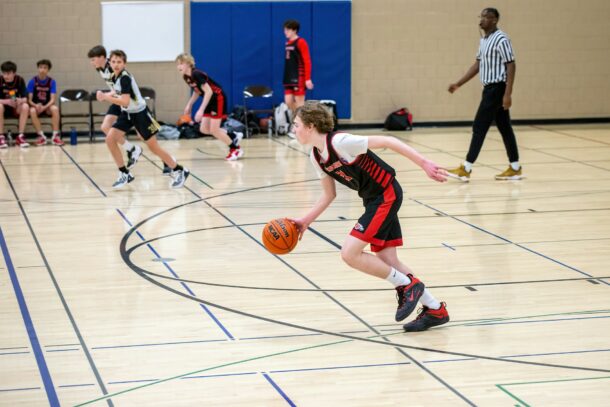
If you are searching for basketball press break concepts that translate directly into game success, the key is understanding spacing, timing, and decision making under pressure. Many youth basketball teams struggle against full court pressure because they rely on memorized plays instead of movement concepts. When players understand where to move, how to cut, and how to create space, breaking pressure becomes far more consistent.
This blog post covers practical basketball press break concepts, plus coaching ideas for inbound situations, rebounding principles, and defensive adjustments drawn from real coaching conversations with TeachHoops.com members.
Why Spacing Is the Foundation of Every Press Break
The biggest reason press breaks fail is poor spacing. Players often start too close together, which allows defenders to deny passing lanes and trap quickly. A simple adjustment can help immediately:
Move your bigs closer to half court and give guards more room to operate. When cutters have space to accelerate, defenders must react instead of dictate.
Players know where they are going. Defenders do not. That advantage creates separation.
Let Your Point Guard Inbound Against Heavy Pressure
One of the effective basketball press break concepts is an adjustment against aggressive denial. Have your point guard throw the ball in.
This works because defenders can deny a player on the court more easily than an inbounder. After passing, the point guard can cut off a screen and receive the ball back in motion. It also reduces early traps near the sideline.
Small tactical choices like this often make a major difference against pressure defenses.
A Simple Press Break Concept That Gets Your Best Player the Ball
One of the most reliable basketball press break concepts involves using a big as a release valve near half court. The movement works like this:
Guards begin near the sideline areas
Bigs start higher toward half court
A guard screens to create confusion
A big cuts hard toward the ball
The pass goes to the big
The point guard curls back to receive the return pass
The big is difficult to deny because he is moving downhill. Once the ball is secured, the guard knows exactly where the return pass is coming from. The defender is reacting instead of anticipating.
Using X-Cuts to Beat Denial Pressure
Another strong basketball press break concept is crossing guards off a stationary big near the free throw line area. The tight crossing action creates confusion and forces defenders to communicate quickly.
Spacing is critical. When the court is spread, one of the cutters will usually have an advantage. Even if the first option is denied, the second guard can read space and adjust.
Teaching players to recognize open space is more valuable than teaching a specific route.
End of Game Inbound Strategy for Free Throw Situations
Late game situations require intentional planning, especially when you need the ball in the hands of your best free throw shooter.
A strong approach is to have two players screen for each other while deep players stretch the defense. After screening, the screener rolls back toward the ball. This creates multiple passing options and large space in the backcourt.
The inbounder should always have several reads available. Predictability helps the defense.
A Detail That Improves Sideline Out of Bounds Plays
One adjustment that many coaches overlook is what happens after a player sets a screen.
Screeners should roll back toward the ball after contact. When defenders help on cutters, the screener often becomes open. This also creates another passing lane for the inbounder.
Giving the passer multiple options increases success rates dramatically.
Rebounding Out of a 1-3-1 Alignment
Teams running a 1-3-1 offense often worry about rebounding balance. The solution comes from teaching responsibility based on shot location.
Players opposite the shot should crash hardest. Coaches can teach this by creating a target area near the blocks and emphasizing contact with opponents instead of just chasing the ball.
Rebounding success comes from anticipation and physical positioning.
How to Slow Down a High Scoring Guard
When facing a player capable of scoring 30 or more points, the focus shifts to disruption and fatigue.
Rotating multiple defenders onto that player throughout the game can help. Picking the player up full court forces constant effort. Special defenses such as box and one or diamond and one may also be necessary.
The goal is to reduce efficiency over time by making every possession difficult.
Teaching Players to Move Away From the Ball
Across all situations, one concept appears repeatedly. Players you want open should have teammates moving away from them. This creates misdirection and forces defenders to shift their attention.
Coaches who emphasize movement without the ball see better results against pressure defenses.
Final Thoughts on Basketball Press Break Concepts
The best basketball press break drills focus on decision making, spacing, and timing rather than memorization. When players understand how to create space and anticipate movement, they gain confidence against pressure.
If you want more practice plans, systems, and coaching resources, TeachHoops.com was built for coaches who want to improve and help their players succeed.
If you’ve coached long enough, you know this feeling. The opponent cranks up the pressure, your players get trapped, and suddenly everything you worked on in practice disappears. The problem usually isn’t effort. It’s panic.
Good basketball press breaking is not about memorizing five different plays. It’s about teaching players simple rules that travel from a 1-2-2 to a 1-3-1 to any run-and-jump look they see during the season. When players understand spacing, movement, and decision-making under pressure, traps turn from a problem into an advantage.
Below are the core basketball press breaking principles every team needs when facing aggressive pressure.
1. Start With Rules, Not Plays
The biggest mistake teams make against pressure is trying to out-scheme it. You can’t prepare for every press variation. You can prepare your players to recognize space and make the defense pay.
Press breaking works best when players know:
Where the outlets should be
How many passing options the ball must have
What to do when they feel a double coming
Once those rules are clear, the exact alignment becomes secondary.
2. The Three Passing Lanes Rule
Any time the ball is pressured, the offense must give the ball three passing lanes.
That means:
One outlet behind or safety
One release flashing into space
One deep or diagonal option to stretch the floor
A trap can only take away one or two options. It can never take away three if players are moving with purpose. The key word is moving. Standing and waiting kills press breaking.
Teach your players that if they are being trapped, it’s not a crisis. It’s an opportunity. Someone is open.
3. Breaking the 1-2-2 Halfcourt Trap Without a High Post
Most teams automatically place a player in the high post against a 1-2-2. Against an aggressive trap, that often helps the defense. The middle defender can sit in between passing lanes and play two people at once.
A better solution is to move that player down to the short elbow or short corner on the ball side.
This forces the middle defender to make a real choice:
Stay high and give up a pass behind the trap
Drop down and leave a flasher open
When that decision point exists, the trap breaks itself. The pass behind the trap becomes available, and the defense cannot recover in time.
4. Same Concept vs a 1-3-1 Press
The good news is you don’t need a new system for a 1-3-1. The same principles apply.
In fact, the flash behind the trap is often more open against a 1-3-1. The middle defender is usually a bigger player taught to protect the paint and deny the middle. When a guard flashes behind the trap, that recovery is almost impossible.
Teach your players this clearly. Against pressure, they are not looking to dribble through it. They are looking to move defenders and attack the gaps they create.
5. North-South Passing, Not East-West
One simple rule cleans up a lot of turnovers: Pass north-south, not east-west.
Sideways passes against pressure lead directly to runouts and layups the other way. Vertical passes advance the ball and force defenders to turn their hips. Even if the pass doesn’t lead to a basket, it buys time and space.
This rule should be part of your daily language in practice.
If players are allowed to dribble under pressure in practice, they will rely on it in games. That’s when panic sets in.
One of the fastest ways to teach press breaking habits is a no-dribble rule until the ball crosses the three-point line or half court.
Without the dribble:
Players must cut with urgency
Passing angles improve
Spacing becomes non-negotiable
Players quickly learn that standing still is the same as being guarded.
7. Use the Disadvantage Drill to Eliminate Lazy Cuts
A powerful way to reinforce these ideas is a disadvantage drill.
Set up:
Five offensive players
Six defenders
No dribbling
The only way the offense advances the ball is by cutting hard across the floor and creating new passing lanes. Curl cuts and jogging won’t work. Strong downhill cuts will.
This drill exposes bad habits fast and teaches players how to move with a purpose under pressure.
8. Teaching Bigs Not to Panic When Doubled
Bigs often struggle the most against pressure because they aren’t used to being doubled immediately.
You have to train that moment.
Simulate it:
Throw the ball off the backboard
Have the big secure the rebound
Immediately double them
Teach the big to:
Stay strong with the ball
Use pass fakes above the shoulders
Understand that sometimes the best play is simply protecting the ball
A bad pass out of a double is worse than a held ball. That mindset alone can save multiple possessions.
9. Attack the Trap Mentality
One of the most important cultural shifts you can make is how your team feels about pressure.
When your best player gets trapped, the other four should be excited, not anxious. Traps mean numbers. Numbers mean advantage.
Teach your players:
Three passing lanes
Immediate cuts
Attack once the ball is released
Pressure usually comes from a team that is trying to change momentum. Make them pay for it.
10. Press Breaking Is Built in Practice, Not During the Game
If players haven’t experienced pressure in practice, they won’t handle it in games. Press breaking should not live in one drill at the end of practice.
Build it in:
Early, while legs are fresh
With constraints like no dribbles
With disadvantage situations that force decision-making
The first few drills of practice set the tone. If you value spacing, cutting, and confidence under pressure, your practice should reflect it.
Final Thought
Basketball press breaking is not about surviving pressure. It’s about attacking it with confidence and clarity. When players know the rules, trust their spacing, and move with purpose, aggressive pressure becomes a gift.
Teach principles first. Reps second. Diagrams last. That’s how you turn chaos into control.
If you want more drills, practice ideas, or one-on-one support, or if you need help installing a shooting workout with your team, explore everything on TeachHoops.com. With a 14-day free trial, one-on-one mentoring, and a library of proven practice tools, it’s one of the best places for coaches who want to take the next step.
The 2-on-3 Press Break Drill is one of the most effective ways to teach young players how to handle pressure, stay composed, and avoid turnovers. It also trains your defense to trap without fouling and builds team communication. If you’re a youth basketball coach looking to sharpen both ends of the floor, this drill should be in your weekly rotation.
The setup is simple, but the benefits are deep. Below, you’ll learn how to run the 2-on-3 Press Break Drill, what to emphasize, and why it’s a valuable tool for developing smarter, tougher players.
How the 2-on-3 Press Break Drill Works
The drill begins with two offensive players against three defenders. From there, you build into:
3-on-3
3-on-4
4-on-4
4-on-5
And finally 5-on-5
Each progression adds more complexity and game-like pressure. This structure helps players learn how to read traps, move without the ball, and rely on quick passing instead of panicked dribbling.
Two Rules That Build Discipline
To make the 2-on-3 Press Break Drill work effectively, keep the rules simple:
Players cannot dribble until they cross half court.
Players must catch the ball inside the three-point line.
These rules force players to develop strong pivoting skills, maintain proper spacing, and avoid sloppy passes. It also reduces bad habits that often show up in pressure situations.
Defensive Emphasis: Controlled Chaos
The drill also gives your defense a chance to learn trapping technique. Instead of reaching for steals, defenders focus on:
Cutting off passing angles
Forcing mistakes with footwork and body control
Rotating and recovering
Steals are not allowed on the ball during the trap. Instead, the off-ball defender reads the next pass and jumps the lane. This teaches smarter help defense and reduces fouls.
Join the TeachHoops Community
TeachHoops.com offers a unique platform for coaches to share experiences and gain new insights. Learn from others who have navigated similar challenges. It’s an invaluable resource for those looking to:
Although every position improves with the 2-on-3 Press Break Drill, your bigs gain the most. They learn how to:
Protect the ball without panicking
Use proper footwork to pivot out of traps
Square up and look up the court
This is especially useful in games where your bigs may have to handle the ball in high-pressure situations.
What to Emphasize Each Time You Run It
When first installing this drill, you’ll stop play often to correct bad habits. Common points to stress include:
Avoiding the corner when catching the ball
Squaring up as soon as you receive a pass
Keeping your head up to see the court
No lob passes over the top
Trapping with control, not with hands
Run this drill two or three times a week early in the season. Once habits form, it can become a quick five-minute segment to reinforce key concepts.
Real-Game Payoff
One program credits this drill with helping them handle full-court pressure from nationally ranked teams. By emphasizing the 2-on-3 Press Break Drill in practice, they built confidence that showed up in big moments. This kind of preparation helps your team stay calm when the game speeds up.
Final Takeaway with the 2-on-3 Press Break Drill
The 2-on-3 Press Break Drill is more than a practice activity. It’s a teaching tool that develops poise, teamwork, and decision-making under pressure. If you’re looking for a simple yet powerful way to prepare your players for game-speed pressure, this drill delivers.
Try it. Run it consistently. Teach it the right way. Your players will thank you for it on game day.
As a veteran basketball coach, I’ve seen my fair share of games where the outcome hinged not just on talent or strategy, but on the ability to handle pressure. Specifically, the pressure of breaking a full-court press with limited ball-handling resources. It’s a scenario that can intimidate even the most experienced teams, turning potential victories into frustrating defeats. Yet, with the right approach, breaking the press with one ball handler can be demystified and even turned into an opportunity to gain an advantage.
Breaking the Press with One Ball Handler: A Strategy Guide
In basketball, the press break is as much about mental fortitude as it is about physical skill. Here are several key points and coaching tips to help your team master the art of breaking the press, even when relying heavily on one ball handler:
1. Create Space and Movement
Coaching Point: Emphasize the importance of spacing on the floor. Players should spread out, making the defense work harder to cover ground. This not only creates passing lanes but also tires out the pressing team over time.
2. Use Angles and Quick Passing
Coaching Point: Teach your players to make sharp, angled cuts against the press. Quick, decisive passing can exploit the brief moments when defenders are out of position, creating opportunities to advance the ball with minimal dribbling.
3. Strategic Player Positioning
Coaching Point: Consider starting your best player out of bounds as the inbounder. This tactic allows them to receive the ball back immediately in a position where they are most likely to be open, giving them better control to orchestrate the press break.
4. Attack from Behind
Coaching Point: Instead of lining up across the frontcourt, pull players back towards the half-court line or further. This draws the press back and creates more room to maneuver in the frontcourt, making it easier to initiate the press break.
5. Minimize Dribbling
Coaching Point: Instill in your players the discipline to avoid over-dribbling. When faced with a press, the instinct is often to dribble through it, but this usually results in traps and turnovers. Encourage players to look for quick passes and move the ball swiftly.
Make an impact with your players this year! This is a made to order painting on stretched canvas signed by the artist, Candice Griffy. Choose your own colors, name and number for this unique piece of artwork! The canvas has stapled back and is ready to hang directly on the wall so there is no need for further framing!
Mastering the press break, particularly with a limited number of ball handlers, is an achievable goal with disciplined practice and strategic planning. By focusing on space creation, movement without the ball, and smart player positioning, a team can effectively neutralize the press. Moreover, emphasizing quick, sharp passes over dribbling can prevent common pitfalls that many teams face. Remember, the key to breaking the press is not just in the physical execution but in the mental preparation and confidence you instill in your players. With these strategies, your team can turn a potentially stressful situation into an advantage, maintaining composure and control against even the most aggressive presses.





 The Best Senior Night Gifts!