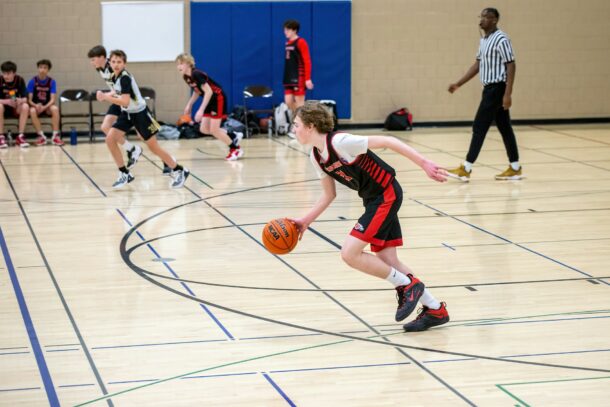

Youth Basketball Practice Planning: Finding Balance Between Drills and Plays
When it comes to youth basketball practice planning, one of the biggest challenges new coaches face is deciding how to divide practice time. Should you run through plays? Focus on skill development? Teach game strategy? The truth is, you can’t do it all, especially when you’re working with young players and only have an hour or two each week.
I’ve coached at nearly every level, from second grade to high school seniors, and one lesson stands out: at the youth level, fundamentals come first. If you’re just starting out as a coach, here’s how you can think about practice planning in a way that builds long-term player success.
Why Fundamentals Should Dominate Youth Basketball Practice Planning
If you only take one thing from this post, let it be this: young players need reps, not playbooks. Ball handling, footwork, passing, spacing, and shooting are the foundation of everything they do in a game. Without those basic skills, no amount of plays or schemes will matter. The players simply won’t be able to execute them.
At the youth level, consider using simple, repetitive drills that allow for lots of touches and decision-making. For example, have players work on stationary and on-the-move dribbling, form shooting near the basket, and one-handed passing off the dribble. These are the kinds of habits that lead to confidence on the court.
A good rule of thumb for youth teams is to spend at least 80 to 90 percent of your practice time on fundamentals. The younger the players, the closer to 90 percent you should aim for. Save the play diagrams and full-court sets for later down the road when the kids can actually move and think at the same time.
Don’t Skip Strategy, Just Keep It Simple
While fundamentals are key, your team will need some structure during games. Kids should know where to stand on an inbound, how to start an offensive set, and what to do when they do not have the ball. That said, the teaching should be light, and the execution should be flexible.
Stick to simple concepts like spacing, ball movement, and defensive positioning. For example, teach a basic motion where players pass and cut, or show them how to set and use a screen without needing to memorize a playbook. Defensively, start with a basic man-to-man defense where players stay in front of their man and help when the ball gets inside.
When you do introduce plays or actions, walk through them slowly. Use cones or lines on the court to help players visualize spacing. Reinforce with repetition, but never let a play dominate the practice. Let it complement the fundamentals, not replace them.
Join the TeachHoops Community
TeachHoops.com offers a unique platform for coaches to share experiences and gain new insights. Learn from others who have navigated similar challenges. It’s an invaluable resource for those looking to:
- Broaden perspectives
- Refine strategies
- Enhance their leadership and motivational skills
Step into Enhanced Coaching
Win the Season: Basketball Masterclass!

Youth Basketball Practice Planning by Age Group
How much time you spend on skill work versus team concepts should change as your players grow and improve. Here’s a basic breakdown that works well across age groups:
- Grades 2–4: Spend about 90 percent of the time on fundamentals and just 10 percent on team concepts.
- Focus on dribbling, passing, basic shooting, and understanding spacing.
- Grades 5–7: Shift to around 80 percent fundamentals and 20 percent team play.
- Introduce basic offense and defense structure. Start teaching how to move without the ball.
- Grades 8–10: Spend about 70 percent on fundamentals and 30 percent on strategy.
- By now, players should understand spacing, screening, help defense, and simple inbound plays.
- High School Varsity: Spend 30 percent on fundamentals and 70 percent on strategy.
- Most of your practice time will be on game prep, scouting, and advanced team systems. Players should already have a solid skill base.
This progression ensures that as kids grow physically and mentally. They also grow in their understanding of how to play the game in a team setting.
Create a Youth Basketball Practice Plan That Maximizes Time
New coaches often feel like they are running out of time the second practice starts. Having a structure in place can make a big difference. A balanced plan keeps players moving, cuts down on downtime, and builds habits that last all season.
Here’s a simple 90-minute practice plan template:
- 0 to 10 minutes: Warm up with dynamic stretches and ball-handling drills.
- Let every player touch the ball early.
- 10 to 30 minutes: Station work with skill development.
- Include passing off the dribble, layups from both sides, footwork drills, and closeout defense.
- 30 to 50 minutes: Competitive small-sided games like 1-on-1 or 3-on-3.
- These allow players to use their skills in a game-like setting without needing a full team.
- 50 to 70 minutes: Introduce or review basic team actions.
- Teach where players should space, how to rotate defensively, or walk through an inbound play.
- 70 to 90 minutes: Finish with a controlled scrimmage that reinforces the theme of the day.
- For example, you can limit dribbles or require a certain number of passes before shooting to encourage teamwork.
This kind of practice structure keeps things focused, purposeful, and fun while maximizing reps and learning.
Final Thoughts on Youth Basketball Practice Planning
It’s easy to feel pressure to run flashy plays or mimic high school and college systems, especially when you watch YouTube videos or see what other coaches are doing. But remember, you are coaching kids. Your job is to give them tools they can carry with them as they grow.
If your players finish the season with better footwork, more confidence handling the ball, and a clearer sense of spacing and movement, you have done your job. Focus on steady improvement, and let wins and losses take a backseat. The game rewards those who master the basics.
Latest Posts
- Youth Sports Schedule Planning: When Is an Event Really Family-Ready?
- Basketball Workout Examples: A Simple 4-Minute Shooting Workout Players Can Track
- Youth Sports Schedule Changes Affect the Whole Family, Not Just Practice
- 4 Common Mistakes Youth Basketball Coaches Make and How to Avoid Them
- Why More Youth Sports Scheduling Apps Aren’t Solving the Real Problem