10 Youth Basketball Coaching Lessons From 300 Podcast Episodes

10 Youth Basketball Coaching Lessons From 300 Podcast Episodes

Three hundred episodes is a milestone worth celebrating. Over the years, the coaches behind TeachHoops.com and the Coaching Youth Hoops podcast have spent countless hours helping coaches become better teachers, leaders, and mentors for young athletes. Episode 300 wasn’t just a celebration of longevity. It became a reflection on the biggest youth basketball coaching lessons learned through decades of experience on the court. 

From parent communication to player confidence, the episode delivered practical wisdom that applies to coaches at every level of the game. Whether you coach third graders or varsity players, these lessons can help improve your practices, your culture, and your impact.


Winning Can Hide Coaching Problems

One of the strongest takeaways from the episode was the reminder that winning can sometimes mask poor coaching habits. Coaches often evaluate themselves differently after losses than after wins. 

When teams lose, coaches tend to replay mistakes, study film more carefully, and look for areas to improve. But after a win, it’s easy to overlook issues that still need attention.

Great coaches stay critical even during successful stretches. They ask:

  • Are players truly developing?
  • Are fundamentals improving?
  • Are bad habits forming underneath the wins?
  • Is the team succeeding because of strong teaching or simply superior talent?

The best youth basketball coaching lessons often come from moments of discomfort and reflection.

The 24-Hour Rule Helps Parent Communication

Every coach eventually deals with emotional conversations after games. One practical lesson discussed in the podcast was the “24-hour rule.” 

The idea is simple:

After games or practices, parents should wait 24 hours before discussing concerns with coaches.

This cooling-off period helps everyone communicate more clearly and respectfully. It prevents emotional reactions from turning into unnecessary conflict.

The coaches also recommended asking parents for an agenda before scheduling a meeting, a preparation allows coaches to give thoughtful responses instead of reacting on the spot.

Strong communication remains one of the most important skills in youth basketball coaching. Parents are more likely to trust coaches who communicate clearly, consistently, and calmly.

Players Mirror a Coach’s Emotions

Young athletes absorb energy from the sideline. If coaches panic, yell constantly, or show visible frustration, players often become tighter and more anxious during games. 

On the other hand, calm and composed coaches help players settle down during pressure situations. This doesn’t mean coaches should never coach hard. Accountability matters. But players perform better when they feel supported rather than fearful. One of the best youth basketball coaching lessons is understanding that body language matters just as much as words.

Ask yourself during games:

  • What energy am I giving my team?
  • Are my players afraid to make mistakes?
  • Am I helping confidence or hurting it?

Confidence can spread quickly through a team, but so can stress.


Positive Feedback Matters More Than Most Coaches Think

Another major takeaway centered around the “positive ratio” in coaching. The coaches discussed aiming for roughly four or five positive comments for every correction or criticism. That ratio becomes even more important with younger players.

Youth athletes make mistakes constantly because they are learning. Coaches who focus only on errors often create hesitant players who become afraid to try new things. Positive coaching does not mean avoiding corrections. It means balancing instruction with encouragement.

For example:

  • Praise effort before correcting technique.
  • Highlight improvement before discussing mistakes.
  • Reinforce confidence while teaching accountability.

Players who believe in themselves usually develop faster.

Parents Are Not the Enemy

One of the most valuable youth basketball coaching lessons from the episode involved relationships with parents.  The coaches argued that parents are rarely the true problem. Miscommunication and misalignment usually create the conflict. Parents often worry because they do not fully understand what coaches are teaching or why certain decisions are being made. Simple weekly communication can solve many issues before they grow.

Ideas include:

  • Weekly team emails
  • Practice summaries
  • Development updates
  • Clarifying team goals
  • Explaining player roles

Parents feel more comfortable when they understand the process. That communication also builds trust, which becomes critical during difficult stretches of a season.

Your Bench Drives Team Culture

One overlooked part of coaching is keeping non-starters engaged. The podcast described the bench as the “engine room” of the team.  Great teams need more than five committed players.

Bench players influence:

  • Practice intensity
  • Team chemistry
  • Energy levels
  • Defensive communication
  • Long-term player development

Keeping reserves engaged becomes especially difficult at higher levels where rotations shrink.

Youth coaches can help by:

  • Giving every player meaningful roles
  • Celebrating hustle plays
  • Recognizing improvement publicly
  • Building competitive practices
  • Setting clear expectations early

Players who feel valued stay invested.

Player Development Is Not Linear

This may have been the most important basketball development lesson from the entire episode. 

Improvement rarely happens in a straight line. Young athletes often plateau before making major breakthroughs. Coaches who understand this stay patient during slow stretches.

Development looks more like stairs than a smooth upward curve:

  1. Improvement
  2. Plateau
  3. Growth
  4. Plateau
  5. Another jump forward

Many players quit during plateaus because they assume they are stuck. Great coaches help athletes push through those moments. Patience remains one of the most underrated qualities in youth basketball coaching.

Teach Players the “Why”

Modern athletes want purpose behind instruction. The coaches emphasized the importance of teaching the “why,” not just the “how.” 

Instead of simply saying: “Do this drill.”

Explain:

  • Why the drill matters
  • How it applies to games
  • What habit it builds
  • Why the team values it

When players understand purpose, effort improves. This applies beyond basketball skills too, such as:

  • Pre-practice routines
  • Visualization exercises
  • Team rules
  • Travel expectations
  • Locker room behavior

Players buy in faster when they understand the reasoning behind expectations.

Coaches Influence More Than Basketball

One powerful moment from the episode focused on the responsibility coaches carry every day.  The coaches explained that they are not simply teaching basketball anymore, they’re teaching confidence, a mindset changes everything.

Youth coaches often become:

  • Mentors
  • Role models
  • Motivators
  • Support systems
  • Trusted adults

Some players may not receive encouragement elsewhere. A coach’s words can shape how athletes view themselves long after the season ends. That responsibility should never be taken lightly. The impact of coaching extends far beyond wins and losses.

Redefine What Success Looks Like

The final lesson tied everything together. Success should not always be measured by the scoreboard. Especially in youth sports, success can mean:

  • Improved confidence
  • Better teamwork
  • Skill development
  • Stronger habits
  • Emotional growth
  • Competing harder
  • Responding well to adversity

Competitive coaches naturally want to win. That passion is valuable. But the best youth basketball coaching lessons remind coaches that development matters most. Sometimes the biggest victory comes from watching a player believe in themselves for the first time.

Final Thoughts

Three hundred podcast episodes represent thousands of coaching conversations, lessons, mistakes, and breakthroughs. The Coaching Youth Hoops podcast continues to provide practical advice that helps coaches improve both on and off the court. 

At its core, coaching youth basketball is about much more than drawing up plays or winning tournaments. It’s about building confidence, teaching life lessons, and helping young athletes grow into better people. If coaches focus on communication, patience, positivity, and development, the wins often take care of themselves.

For more coaching resources, practice ideas, and basketball development tools, visit TeachHoops.com and check out the Coaching Youth Hoops podcast.


TeachHoops Daily Newsletter

Latest Posts

How to Handle Parents in Youth Basketball

How to Handle Parents in Youth Basketball

Do you know how to handle parents in youth basketball, especially when they’re yelling from the stands?

Many think their sideline coaching helps their child, but it often creates confusion, stress, and frustration for players and coaches alike. In a recent episode of Coaching Youth Hoops, veteran coaches Bill Flitter and Steve Collins, with more than 50 years of combined experience, explained the real cost of sideline shouting and shared practical strategies that every youth coach should know.

If you’re wondering how to handle parents in youth basketball without causing unnecessary conflict, here’s a clear game plan.


Why You Need to Handle Parents Before the Season Starts

It doesn’t take long for sideline chaos to throw off a game. Even well-meaning parents can derail your team’s rhythm with constant instructions from the bleachers.

Coach Collins recalled losing a close high school game because a player’s dad yelled “Shoot!” from the stands, directly contradicting the coach’s timeout instructions. The player listened to her dad, missed the shot, and the team ultimately lost. All because of mixed messages.

That’s why knowing how to handle parents in youth basketball before the season begins is key. Coach Flitter recommends:

  • Holding a preseason meeting to explain sideline expectations.
  • Setting a “one voice” rule for in-game communication.
  • Making it clear that yelling instructions will result in a warning and possibly their child being pulled from the game.

Subtle but Effective Ways to Handle Parents in Youth Basketball

You don’t need to start a confrontation. Most parents simply need a reminder of how much their involvement affects their child’s performance. Coach Flitter suggests:

  • Using comparisons: “You wouldn’t want two teachers giving different directions at once.”
  • Emphasizing the player’s perspective: conflicting messages hurt the athlete more than anyone else.
  • Reframing it as support: “The best way you can help your kid is to let them focus and listen to one coach.”

When parents understand that their child is caught between two voices, they’re often more willing to step back.


Win the Season

The Bench Can Speak Volumes

If sideline coaching continues, the best move might be silent: sit the player. It sends a message without drama and gives both parent and player a chance to reflect. As Coach Collins puts it, “Now you’ve got the rest of the game to talk to them because they’re not going back in.”

This approach protects the team, reinforces your authority, and shows you’re serious about focus and development.

It’s Not Just About Winning, It’s About Teaching

One of the best parts of youth basketball is using games as learning opportunities. When your team is up big, slow things down and practice running the offense. Let players learn game management, not just scoring.

Of course, if you haven’t explained this beforehand, parents may not understand why their child isn’t shooting. That’s why handling parents in youth basketball means constant, clear communication—before, during, and after games.

Final Takeaway

If you’re a coach trying to figure out how to handle parents in youth basketball, remember:

  • Set expectations early and stick to them.
  • Use clear, player-focused language to explain your approach.
  • Don’t be afraid to bench a player if it protects the team’s focus and learning.
  • Keep reinforcing the bigger picture: development, teamwork, and trust.

Looking for More Tools to Simplify Coaching?

Check out CoachingYouthHoops.com for full-season practice plans, drills, and resources built by experienced coaches. Whether you’re new to coaching or looking to save time, everything is done for you.

Turn Game Film Into A Game Plan with AI:

Don’t miss our new tech tool launching this fall, designed to streamline practice planning, highlight reels, and individual workouts. Sign up for early access at CoachingYouthHoops.com/AI.


Latest Posts:

Better Basketball: Point Motion Shooting Drills

Better Basketball: Point Motion Shooting Drills

Last month’s article dealt with the installation of various Point Motion sets. What I want to focus on in this month’s article are some drills to help install and get your players shots out of these various looks. We all know that as coaches we want todevelop the needed muscle memory, footwork, and confidence from the spots on the court where the shots will come from.

Below I will describe 3 different shooting drills with diagrams attached to help get shots for players in the spots they will shoot from.

Point Motion Shooting Drills

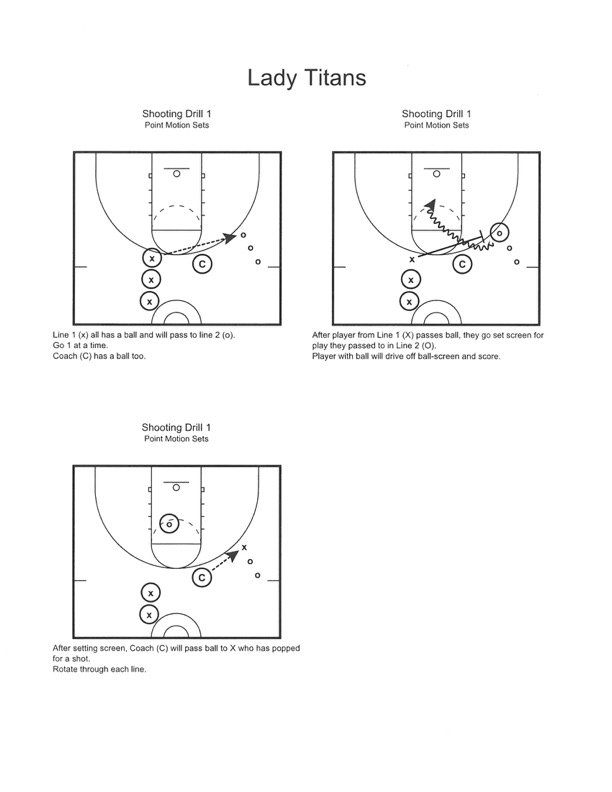
Drill 1: Need 2 lines. 1 line in the left pinch area where the 5 will usually receive the ball and a line on the right wing. You also need a coach/manager in the right pinch area with a ball.

The line of players with a ball will pass their ball to the right wing and immediately set a ball screen. The player on the right wing will receive the ball and drive for a layup. The player that sets the screen will pop and receive a pass from the coach/manager for a shot.

Switch lines after each rep to work both actions.

shooting drills

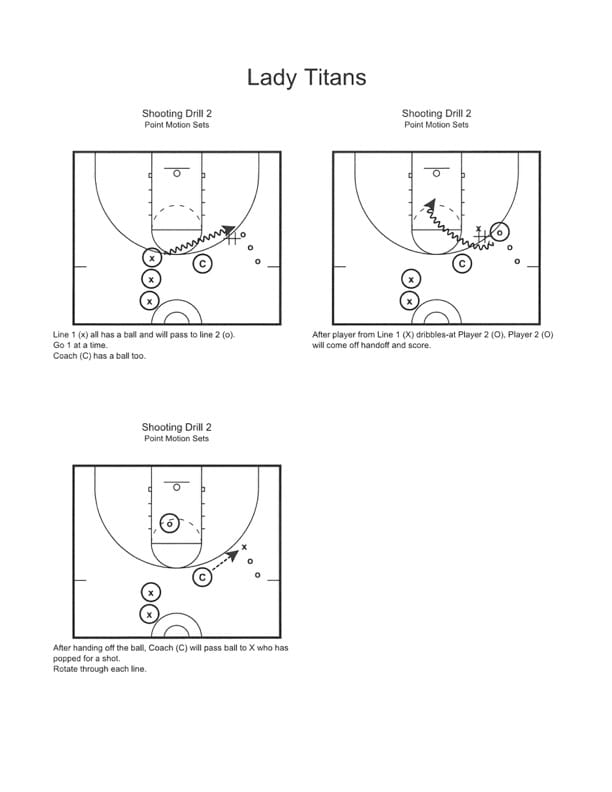
Drill 2: Same setup as Drill 1. The ball line will dribble and do a handoff with the other line. The lin without the ball to start will take that handoff and drive for a layup.

After the handoff, the player that started with the ball and shape up for a shot attempt from a pass from the coach/manager.

Switch lines after each rep to work both actions.

shooting drills

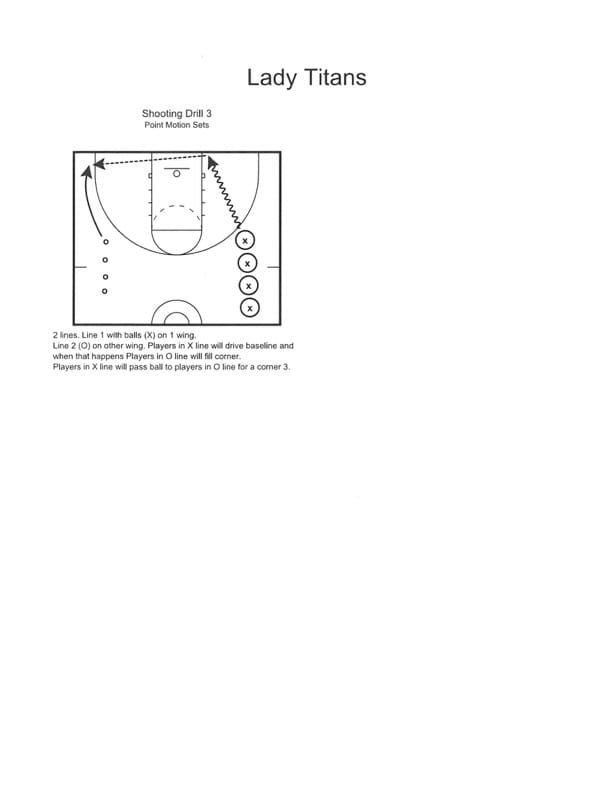
Drill 3: This drill needs 2 lines, 1 on the right wing and 1 on the left wing. The line on the right wing will start with balls. They will drive down to the baseline, attacking the paint. The other line will move from the left wing to the left corner.

Once the player with the ball gets to the baseline area, they will hit their teammate in the opposite corner. The player willreceive the pass in the left corner and take a shot.

Switch lines after each rep to work both actions.

shooting drills


Kyle Brasher | Gibson Southern High School
Lady Titans Basketball Coach


Related: 4 Essential Individual Defensive Drills to Practice


Resources:


Coach Unplugged Podcast:

Ep 1720 Coaching Youth Hoops


Youth Basketball Coaching Made Easy

If you coach a K-8th grade team, we have hundreds of resources. All laid out in an easy-to-follow, step-by-step system to save you time and money. Check out coachingyouthhoops.com today!


If you found this useful, don’t forget to check out additional blog posts at TeachHoops.com. Also, check out TeachHoops on FacebookTwitterInstagram and YouTube.

Coaching Youth Hoops Podcast

Coaching Youth Hoops Podcast

Coaches Steve Collins and Bill Flitter have joined forces for a new basketball podcast: Coaching Youth Hoops! This latest venture joins Coach Collins’ portfolio of popular podcasts on coaching basketball, both youth hoops and high school. These coaches bring a wealth of knowledge from their experiences in the game of basketball, developing talented players across the spectrum of talent levels.

If you’re new to coaching youth hoops, or perhaps an experienced coach looking to cut through the noise, this is the podcast for you! Coach Steve and Coach Bill will provide weekly episodes to simply your processes. They’ll help you avoid wasting time and money learning to coach basketball players from as young as kindergarten.

Goal of the Podcast

This podcast is designed to help volunteer coaches, or coaches getting a small stipend, that jump in and try to figure it out in their spare time. Join these seasoned youth basketball coaches as they give you the blueprint you need to succeed on and off the court. In each episode, you’ll discover easy-to-implement tips and techniques that you can apply to your next practice.

As Coach Flitter says in the first the first episode:

“I want to help one million kids learn the game of basketball. But how do you do that? By helping the coaches.”

The episodes for the show will drop on Tuesday mornings. They’re designed to educate coaches from rec leagues all the way to competitive youth leagues. It doesn’t matter if you have a team of third graders who can’t dribble, or a group of eighth graders being recruited. You’ll find something helpful here.

Check out the dedicated Facebook group right now. As the podcast grows, you’ll find downloadable resources and deep dives into the nitty-gritty of coaching youth basketball. Subscribe today!


Coaching Youth Hoops Podcast on YouTube:


More Coaching Youth Hoops Podcast Episodes:

Coaching Youth Hoops podcast2nd Episode: 5 Things I Wish I Had Known About Coaching Youth Hoops

3rd Episode: The Skills Needed for K-2 Players

4th Episode: Thoughts on Running A Youth Basketball Camp

5th Episode: Basketball Skills for Grades 3-5

Related: Missed Free Throw Set Play

If you found this useful, don’t forget to check out additional blog posts at TeachHoops.com. Also, check out TeachHoops on FacebookTwitterInstagram and YouTube.

Free Video Series

Enter your email address to gain access to our FREE video series.

basketball blitz offense

You have Successfully Subscribed!