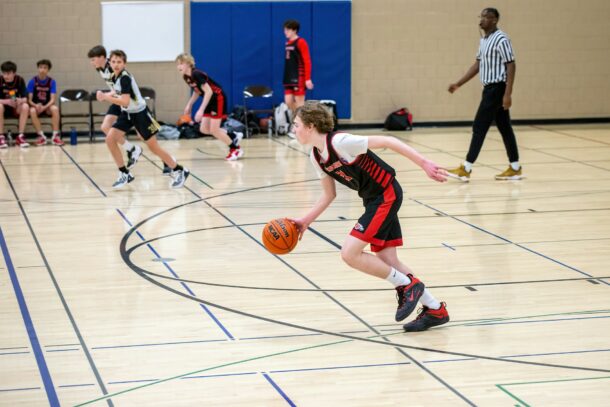
Youth basketball is evolving quickly, and one of the biggest shifts happening right now involves how coaches, players, and parents use video. For years, capturing basketball highlights required expensive cameras, hours of editing, and a lot of time sitting behind a screen instead of watching the game.
Today, new AI-powered tools are making it possible for coaches to capture game footage, create highlights, and review teaching moments instantly. For youth basketball programs, this technology is changing how players learn, how coaches teach, and how families preserve memories from the season.
If you coach youth basketball, understanding how modern highlight technology works can help you improve player development while saving valuable time.
Why Basketball Highlights Matter in Youth Sports
When people think about highlights, they often picture flashy dunks or big scoring plays. But highlights serve a much bigger purpose in youth basketball. For players and families, highlights capture memories. Kids put in countless hours of practice and games. Being able to look back at those moments matters.
For coaches, highlights provide teaching opportunities. Video allows players to:
See what they did well
Identify mistakes
Understand spacing, timing, and decision-making
Many coaches believe one of the fastest ways to improve is simple: play the game and watch yourself play the game. Video brings that learning process to life.
The Problem With Traditional Game Film
Despite its value, traditional basketball video has several challenges.
First, recording games often forces parents to spend the entire game behind a camera instead of enjoying the moment. Second, editing film takes time. Coaches and parents may spend hours scrubbing through video trying to find a specific play. Finally, storage becomes an issue. Many parents record full games only to keep a few clips.
The reality is most families want just a handful of meaningful moments from each game.
AI Is Changing How Basketball Highlights Are Created
New video platforms are using artificial intelligence and computer vision to solve these problems. Instead of filming an entire game and editing it later, these tools allow users to capture only the moments that matter.
The process is simple:
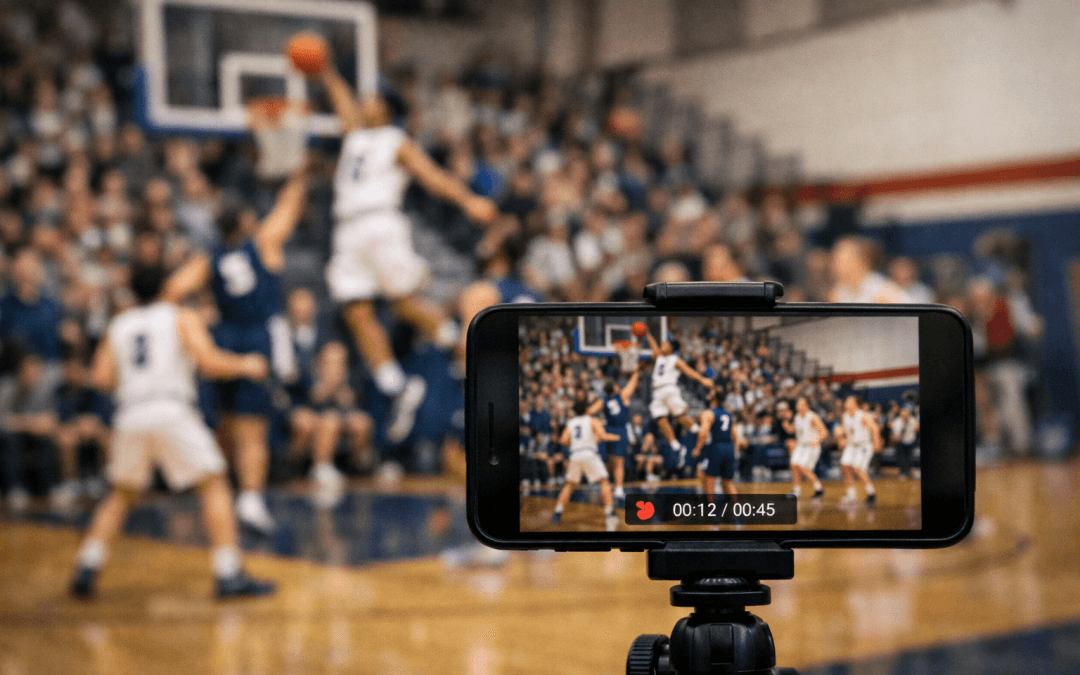
Set a phone on a tripod to record the game
Watch the game normally with other parents or players
Tap a button when a big play happens
The app automatically saves the clip
The system grabs the previous few seconds of action, reframes the video, and creates a highlight clip instantly. Within seconds, players can share the moment or store it for later review.
Why This Matters for Basketball Coaches
For coaches, the biggest benefit is time. Film study traditionally takes hours. Finding a specific play during a game can be tedious. With AI-assisted tagging, coaches can mark plays instantly during the game. That means:
A missed defensive rotation can be saved immediately
A great screen or assist can be tagged for later praise
Players can review specific moments after the game
Instead of watching an entire game again, players can jump directly to the clips that matter most. This makes film sessions faster and more focused.
Better Video for Player Development
One important detail that often gets overlooked in highlight clips is the camera angle. Many social media clips focus tightly on the player with the ball. While that works for social media, it doesn’t always help coaches evaluate decision-making. A wider horizontal view allows coaches to see:
Defensive help positioning
Offensive spacing
Timing of screens and cuts
Overall court awareness
This makes video much more valuable for coaching and recruiting.
Helping Players Share Their Journey
Another advantage of modern highlight tools is how easily clips can be shared. Players can quickly send clips to:
Coaches
Scouts
Trainers
Teammates
Instead of building a highlight reel months later, players can collect clips throughout the season. Over time, those clips become a record of development and growth. For many athletes, these highlights are not just social media content. They become part of their basketball story.
Using Video During Games
One of the most exciting possibilities with modern video tools is real-time coaching. Imagine a coach tagging a play during a game and showing it to players during halftime or a timeout.
Players today are highly visual learners. Seeing the mistake immediately often helps them understand the correction much faster. Instead of saying, “You missed the screen,” a coach can show the clip. Film does not lie.
A Tool for Programs and Teams
Beyond individual players, highlight technology can help entire basketball programs. Teams can use clips to:
Promote their program on social media
Highlight player development
Share recruiting footage
Build engagement with families
Clubs and schools that consistently share video content often attract more players and attention.
In today’s digital environment, visibility matters.
Technology Is Making It Easier for Everyone
The most exciting part of these new systems is accessibility. Instead of requiring expensive cameras and editing software, many tools now use the camera already sitting in your pocket. That means parents, coaches, and teams can capture professional-quality highlights with very little equipment.
More importantly, it allows families to stay present at the game instead of worrying about filming every second. And in youth sports, that may be the most valuable feature of all.
Most coaches have been there. You know exactly what you want your team to hear before tip-off, but finding the right words in a short window isn’t always easy. That’s where an AI pregame speech for basketball coaches can be a practical tool, not a gimmick. When used correctly, AI helps you organize your message, sharpen your focus, and deliver a clear, confident pregame talk without sounding scripted or forced.
This is exactly how I used AI to write a 60-second pregame speech centered on toughness, execution, and dictating the game, while keeping my own coaching voice intact.
Step 1: Start With Clarity, Not a Speech
The mistake most coaches make is asking AI to “write a motivational speech.” That’s how you get fluff. Instead, I started with clarity. I told the AI exactly what the speech needed to be about:
To keep things clean, I used a six-part prompt that mirrors how coaches already think: task, role, context, requirements, boundaries, and purpose. Here’s the exact prompt structure I used.
TASK: Write a 60-second pregame locker room speech focused on toughness, execution, and dictating the game. The speech should be concise, impactful, and designed to be delivered immediately before tip-off.
ROLE: You are a Hall-of-Fame high school basketball coach speaking directly to your team in the locker room. Your voice is calm, confident, authoritative, and coach-to-player, not a motivational speaker.
CONTEXT: This pregame talk emphasizes being the tougher team, running our offensive system with discipline, and imposing defensive pressure. The goal is to dictate pace, physicality, and style of play rather than reacting to the opponent.
SPECIFIC REQUIREMENTS: The speech should be approximately 60 seconds when spoken aloud. Use short sentences and natural pauses. Keep the language simple and locker-room appropriate. Emphasize that toughness equals discipline, executing when it’s hard, pressuring without gambling, and a next-play mentality.
BOUNDARIES: Do not use clichés, cheesy motivational phrases, profanity, or yelling tone. Avoid long explanations or detailed play calls.
REASONING: The purpose is to create a message players can remember and repeat mentally during adversity.
This took less than two minutes to write, and it made all the difference
Once I ran that prompt, I didn’t expect magic. What I wanted was structure. AI helped me:
Tighten my message
Remove unnecessary words
Keep the speech focused
Make it easy to deliver naturally
The key is this: AI didn’t create my philosophy. It organized it.
Step 4: The Final 60-Second Pregame Speech
Here’s the final version that came out of that process, lightly edited to match my delivery style:
Fellas, bring it in.
Tonight is about toughness. Not talk. Not talent. Toughness.
Toughness means we’re disciplined. We run our stuff with pace and purpose. Hard cuts. Solid screens. Sprint into actions. When it gets hard, we don’t go rogue, we get sharper.
Defensively, we dictate. We pressure the ball. We talk early. We’re physical and smart. No gambling. Just making everything uncomfortable.
There will be adversity. That’s when we show who we are. Next play. Together.
From the opening tip, we set the tone. We impose our will. We play our way for 32 minutes.
Now let’s go be the tougher team.
That’s a speech I can deliver confidently, without notes, and without sounding scripted.
Why This Matters for Coaches
AI isn’t about shortcuts. It’s about clarity and efficiency. You still coach, still lead, still decide what matters.
AI just helps you say it better, faster, and with less stress on game day. If you can explain your philosophy to an assistant coach, you can use AI effectively.
Want to Go Further?
This is just one use case. Coaches inside TeachHoops are already using AI to:
Create pregame, halftime, and postgame talks
Build practice plans faster
Write parent emails
Develop scouting questions
Create player development plans
If you’re curious how AI can actually help you coach, not distract you, that’s exactly what we cover inside TeachHoops. Because better preparation leads to better performance. And that starts long before the opening tip.
Every coach wants to get better results on the court, but the real challenge is knowing where to start and how to measure it. The PROOF Process™ gives you a simple, repeatable way to integrate AI tools into your basketball program without getting overwhelmed. It helps you focus on what matters most: measurable improvement, fast feedback, and lasting results. Here’s how you can adapt the PROOF Process™ to use AI effectively in your basketball coaching.
P – Prime for On-Court Results
What it means: Before diving into AI, pinpoint one specific stat you want to improve. Don’t just say, “We need to get better.” Define exactly what success looks like.
Coach’s Action: Instead of chasing “productivity,” focus on outcomes, like cutting down turnovers or improving shot selection.
Example:
Old Way: “We need to cut down on turnovers.”
AI Way: “We’ll use an AI video tool to auto-tag all 75 of our turnovers from the last five games. We’ll identify our top two causes (like skip passes vs. zone or dribbling into traps) and reduce those by 20% in the next two weeks.”
AI turns vague goals into actionable, trackable objectives.
R – Rapid Results
What it means: You don’t need to wait months to see improvement. Use AI to create small, measurable wins, ideally by your next game or week of practice.
Coach’s Action: Take your AI-generated insights and immediately design two new drills that target the main issues (like passing vs. zone or handling traps). Run them early in the week.
The Test: During your next scrimmage, track only those two types of turnovers. If they drop, you’ve got proof the AI-driven adjustment works. That’s a rapid win and one your players will notice.
O – Optimize the Strategy
What it means: Once you’ve seen improvement, the next step is consistency. Use AI to monitor whether the gains hold up over the next few games.
Coach’s Action: Keep feeding new film into your AI system. Track that stat across multiple games to see if the improvement sustains.
When you see that your turnover rate stays down, that’s not luck, it’s a new standard. AI isn’t a gimmick anymore; it’s part of your team’s DNA.
This is how your entire program learns to “speak the same language” when it comes to using data and technology effectively.
F – Futureproof Your Program
What it means: The goal isn’t to use AI for one season. It’s to build a culture that uses it forever.
Coach’s Action: Make AI part of how you do film, scouting, and player development. When players graduate or staff changes, your system stays strong.
AI isn’t the new thing. It’s the normal thing. It helps every player, every season, improve faster and smarter.
Final Thoughts
The PROOF Process™ is a roadmap for how basketball coaches can use AI effectively, starting small, proving results, and building a system that lasts. You don’t need to be a tech expert. You just need a plan, a focus, and the discipline to measure what matters.
AI can’t replace your coaching instincts, but it can amplify them.
Ready to Build Your Coaching Machine?
The truth is simple: every coach wants to spend less time grinding and more time coaching. With AI, that’s not a fantasy, it’s the future. If you’ve ever wished for an extra assistant, this is your chance to create one.
Join The Coaching AI Masterclass and learn how to build your own AI basketball coaching system, the one that organizes, plans, and communicates so you can just coach.
If you’d like to explore further, also check out theAIsportscoach.com, a free community for coaches to share prompts, strategies, and ways AI is helping them win both on and off the court.
AI is quickly becoming a powerful tool in coaching, but most of us still aren’t using it to its full potential. When it comes to AI practice planning for youth basketball, many coaches make the mistake of treating it like a quick Google search instead of the game-changing mentor it can be.
In this post, we’ll explore how basketball coaches can use AI effectively, not just for drills and practice plans, but for real, strategic growth.
The Bad Habit That’s Holding Coaches Back
Hey Coach, listen up. There’s a habit most of us have, and it’s holding us back from unlocking AI’s full potential in our basketball programs.
For decades, we’ve been trained by Google. Need an answer? Type in a few short keywords.
Google spits out a page of links, and it’s on us to dig through each one, decide which random “coach” to trust, and then piece together what might work in our next practice plan.
We’ve been doing this for so long that we bring the same “quick-hitter” mindset to AI.
But that’s like using your best player as a decoy.
From “Google Searcher” to “Coach in Conversation”
Think about it: You wouldn’t walk up to a mentor coach you respect and just say, “zone offense.”
No! You’d give them the full picture:
“Hey Coach, I’m prepping for our rival. They run an aggressive 2-3 zone that extends high. My guards are quick but small, and my best shooter is my 4-man, who struggles to get open on the wing. We run a basic 4-out motion. What specific actions or quick-hitters can we install this week to get my 4-man open looks from the high post or short corner?”
See the difference? You’re giving context, your opponent, your personnel, and your goal.
Your mentor gives you a strategy. Google gives you a list.
AI is your new mentor coach. Start treating it like one.
“I’m an AI coach. My team is struggling with on-ball defense and late help-side rotations. We keep getting beat off the dribble, and our closeouts are sloppy. I have 90 minutes for practice tomorrow. Can you build me a 25-minute practice block with a 3-drill progression that focuses on 1) containing the ball-handler, 2) proper closeout technique, and 3) the first help rotation? Give me the key teaching points and coaching cues for each drill.”
That’s the foundation of AI practice planning for youth basketball, giving the system enough detail to act like an experienced assistant, not just a search engine.
The same idea applies to culture building. Don’t just type, “How to build team culture.” Try this instead:
“I’m an AI coach. I’m taking over a high school program that won 5 games last year. The players seem unmotivated, and the parents are negative. I need to establish a new culture of accountability and ‘next play’ mentality. Give me a 30-day plan for the off-season that includes 3 specific activities I can do with the team, a theme for the month, and a sample letter I can send to parents outlining my philosophy and expectations.”
Why This Works
When you give AI context, you’ll get a response that’s:
Immediately Actionable: You’re not just getting a list of random ideas. You’re getting a real game plan you can take straight to the court.
Strategic: You can think critically about the plan, confirm your instincts, or spot a new angle you hadn’t considered.
Efficient: You’ll walk away with a full script: a practice plan, a culture blueprint, a parent letter, ready to share with your assistants or AD.
That’s how basketball coaches can use AI effectively: by treating it like a coaching partner who knows your system, your players, and your goals.
The Takeaway: Give AI the Scouting Report
The next time you sit down to plan a practice or prep for a big game, break the “Google habit.” Don’t toss in a few keywords and hope for the best.
Treat AI like your mentor coach. Give it the full scouting report: your team, your opponent, your time constraints, and your objective. You’ll be amazed at how much faster, and better, it works for you.
Any questions about this or anything else you’re working on AI-wise? I’m an email away.
Ready to Build Your Coaching Machine?
The truth is simple: every coach wants to spend less time grinding and more time coaching. With AI, that’s not a fantasy, it’s the future. If you’ve ever wished for an extra assistant, this is your chance to create one.
Join The Coaching AI Masterclass and learn how to build your own AI basketball coaching system, the one that organizes, plans, and communicates so you can just coach.
If you’d like to explore further, also check out theAIsportscoach.com, a free community for coaches to share prompts, strategies, and ways AI is helping them win both on and off the court.
Every coach dreams of being more organized, more efficient, and more focused on the court. That’s exactly what an AI basketball coaching system can help you do. Instead of spending hours on film, practice plans, and parent emails, you can let AI handle the heavy lifting, just like Coach Steve Collins teaches in The Coaching AI Masterclass.
It’s not about replacing coaches; it’s about giving them the tools to coach freely again.
Every Coach Is Running Two Programs
Let’s be honest, every coach runs two programs. There’s the basketball program: practices, games, and player development. And then there’s the everything else: film breakdowns, scouting reports, parent emails, travel logistics, communication, and scheduling.
Coach Steve Collins calls that grind “The Human Machine.” It’s the system he ran for 27 years, one that demanded endless hours of manual prep just to keep things afloat.
Now, he’s built something better.
Masterclass Spotlight: The Coaching AI Masterclass
In The Coaching AI Masterclass, Coach Collins reveals how to turn that “Human Machine” into an AI-driven coaching system that almost runs your program for you.
Across four weeks, you’ll see live demonstrations of the exact tools he uses to automate film work, generate practice plans, and write professional parent emails in seconds. You’ll also get ready-to-use templates for scouting reports, communication, and organization, all designed for high school and youth coaches who want to work smarter, not longer.
The AI System That Almost Runs Your Program for You
Coach Collins’ message is simple: AI won’t replace coaches, but coaches who use AI will replace those who don’t.
In the masterclass, he shows how AI can become your Director of Operations, Head of Scouting, Analytics Assistant, and Communications Coordinator, all rolled into one. Here’s what that looks like:
Film in minutes: Upload notes and let AI create organized insights.
Practice plans in seconds: Generate 90-minute plans with breakdowns, games, and teaching cues.
One-page scouting reports: Summarize opponents with personnel tables, tendencies, and short player versions.
Stress-free communication: Draft supportive but firm parent emails that save time and eliminate back-and-forth.
These are real examples from Coach Collins’ workflow, not theory.
Every coach has felt the weight of running a program alone. The AI basketball coaching system that Coach Collins teaches is designed to lift that burden.
As he says:
“Here’s what we’ll do: teach you how to do film in minutes, practice plans in seconds, college-looking scouts, and emails done for you.”
This is the difference between surviving the season and actually enjoying it. AI handles the repetitive tasks so you can focus on player development, game strategy, and leadership, the parts of coaching that truly matter.
The Human System vs. The AI System
For decades, Coach Collins ran everything manually, that was his “Human Machine.” Today, his AI-powered system does the same work faster, cleaner, and more consistently.
The masterclass teaches you how to build your own version of that system, one that fits your team, your level, and your style. You’ll walk away with the structure and templates needed to streamline your entire program.
Ready to Build Your Coaching Machine?
The truth is simple: every coach wants to spend less time grinding and more time coaching. With AI, that’s not a fantasy, it’s the future.
If you’ve ever wished for an extra assistant, this is your chance to create one.
Join The Coaching AI Masterclass and learn how to build your own AI basketball coaching system, the one that organizes, plans, and communicates so you can just coach.
If you’d like to explore further, also check out theAIsportscoach.com, a free community for coaches to share prompts, strategies, and ways AI is helping them win both on and off the court.
Coaching today isn’t just about the court. It’s about juggling emails, organizing practices, managing parents, and keeping everything running smoothly. That’s where AI for youth basketball coaches comes in. You don’t need to be a tech expert or data wizard to use it; you just need to know how to ask the right questions.
With the right approach, AI can help you save time, simplify your program, and get back to what you love most: coaching.
“I’m Not Tech-Savvy…” Is No Longer an Excuse
Every coach knows the feeling: you hear about some new piece of technology and immediately think, That’s not for me.You’re not alone.
This isn’t about learning complicated software or coding. It’s about using tools you already know, your phone, your laptop, your curiosity, to make coaching easier and more efficient.
Workshop Spotlight: The Coaching AI Masterclass
The Coaching AI Masterclass is a four-week live workshop built specifically for youth and high school basketball coaches who want to use technology without feeling overwhelmed.
Coach Collins walks you through the entire process of making AI your assistant coach, showing you how to ask the right questions, build better prompts, and turn everyday tasks into automated systems.
Coach Collins breaks it down into three simple steps:
Ask the right questions.
Ask them the right way.
Ask for feedback.
That’s it. You don’t need to be a tech expert, you just need to know how to coach your AI the same way you coach your players. The better your communication, the better the results.
In The Coaching AI Masterclass, you’ll see how small wording changes can turn AI from a confusing chatbot into a confident assistant that helps you plan, organize, and prepare like never before.
Here’s one of Coach Collins’ real examples straight from the masterclass PDF:
“Explain basketball.” (Bad)
“Explain basketball to a 10-year-old who plays soccer.” (Better)
“Explain basketball to a 10-year-old who plays soccer and hates running, under 120 words and explain why.” (Best)
That’s the power of specificity. When you tailor your questions, AI tailors its answers, just like a good assistant coach who knows your players, your system, and your goals.
Practical Prompts Any Coach Can Try
You don’t need to reinvent the wheel. Here are a few simple prompts Coach Collins shares in the masterclass that any youth coach can use:
“Explain zone defense like I’m a brand new youth coach.”
“Give me 3 pregame speeches for a nervous middle school team.”
“Make a parent email about practice times sound supportive but firm.”
Each one saves you time, reduces stress, and sharpens your communication without replacing the personal touch that makes you a great coach.
The Secret Isn’t the Tool, It’s the Question
Coach Collins compares AI to a veteran assistant: it never sleeps, it never forgets, and it gets better the more you use it. AI won’t replace your judgment, it amplifies it. Once you learn how to talk to it, you’ll wonder how you ever managed without it.
Join The Coaching AI Masterclass and see how AI for youth basketball coaches can turn busywork into breakthroughs, freeing you to focus on player development and the game you love.
If you’d like to explore further, also check out theAIsportscoach.com, a free community for coaches to share prompts, strategies, and ways AI is helping them win both on and off the court.
Let’s get one thing straight: AI isn’t replacing basketball coaches. But coaches who use AI will replace those who don’t. That’s the bold claim at the heart of The Coaching AI Masterclass from Coach Steve Collins, a Hall of Fame coach with 3 state titles, 10 state appearances, and nearly three decades of building winning programs. His message to coaches everywhere is simple: the game is changing, and early adopters win.
This isn’t about losing the human side of coaching. It’s about using new tools to handle the heavy lifting, so you can spend more time doing what you do best coaching the game.
AI Is the Assistant Coach That Never Sleeps
Imagine having an assistant who never gets tired. One who can serve as your Director of Operations, Head of Scouting, Analytics Wizard, and Communications Director, all at once.
That’s what AI can be when you learn how to use it correctly. It’s not a gimmick. It’s a tireless helper that organizes, writes, analyzes, and plans faster than any coach could on their own.
Every time, the coaches who embraced change gained an edge and this is no different. AI is simply the next step in that evolution. The coaches who adopt it early will be the ones out-organizing, out-preparing, and out-performing their opponents for years to come.
As Coach Collins says: “Building a machine is easier today than it’s ever been.” The only question is whether you’ll start building yours now or later.
If you’ve ever felt like you spend more time managing logistics than coaching your team, AI can change that.
In The Coaching AI Masterclass, you’ll see how to systemize the “program side” of your job, everything from communication to organization, so you can finally focus on the court again. It’s about reclaiming your time and reducing the mental clutter that comes with running a program.
Coach Collins has already tested the system himself. He calls it: “The Human Machine vs. The AI System,” 27 years of running everything manually compared to the new model that almost runs itself.
Masterclass Spotlight: The Coaching AI Masterclass
The Coaching AI Masterclass is a live, four-week training designed by Coach Steve Collins, a Hall of Fame high school coach with three state titles and 10 state appearances. In it, he reveals how to use AI tools to run your program faster, cleaner, and smarter, so you can focus on what really matters: coaching.
You’ll see live demonstrations of the exact systems he uses for scouting, practice planning, and communication. By the end, you’ll know how to turn AI into your most reliable assistant, the one that never sleeps.
This masterclass isn’t theory. It’s a practical, hands-on demonstration of what AI can do for your program today. You’ll see the exact tools Coach Collins uses, how he uses them, and what it looks like when AI handles the busywork while you focus on coaching.
Because the truth is, every coach wants more time. And now, you can finally have it.
If you’d like to explore further, check out theAIsportscoach.com, a free community for coaches to share prompts, strategies, and ways AI is helping them win both on and off the court.
Coaching youth basketball today comes with more responsibilities than ever: practice planning, film breakdown, scouting opponents, and constant communication with players and parents. For new or inexperienced coaches, it can feel overwhelming. That’s where AI Coaching Prompts come in.
By learning how to ask AI the right questions, you can save hours of busy work and focus on what really matters: developing players and building your program.
What Are AI Coaching Prompts?
AI Coaching Prompts are carefully worded instructions that tell AI exactly what you need, whether that’s designing a practice, analyzing film, or even writing a weekly parent email. Instead of spending hours piecing together drills, clips, and notes, you can let AI do the heavy lifting while you keep the final say.
The difference between a vague prompt and a sharp one is the difference between a messy assistant and a skilled one. These prompts give you the second kind.
Examples of AI Coaching Prompts You Can Use
Here are some real prompts and how you can put them to work:
Practice Planning Prompt: “Design a 90-minute practice for transition defense tomorrow. Include 2 breakdown drills, 2 competitive games with scoring, a 5-minute film segment, and time blocks.” Instead of juggling drills at the last minute, you’ll get a structured, balanced plan with teaching moments built in.
Film Breakdown Prompt: “Analyze our last game with 5 key clips. Create a 30-minute film session plan and suggest 3 practice drills to fix the issues.” You can turn raw game footage into actionable teaching points your players understand, without having to spend your whole night cutting clips.
Player Development Prompt: “Write a 4-week shooting plan for two guards under 30% from three. Include daily drills, weekly goals, and checkpoints.” This gives struggling shooters a personalized plan you can track week by week, instead of recycling the same generic shooting drills.
Team Communication Prompt: “Draft a short weekly parent email about updated practice times. Keep it clear, positive, and under 200 words.” No more scrambling to write updates. AI does the drafting, you add the personal touch.
Join the TeachHoops Community
TeachHoops.com offers a unique platform for coaches to share experiences and gain new insights. Learn from others who have navigated similar challenges. It’s an invaluable resource for those looking to:
Discover powerful AI prompts that professional coaches use to analyze game footage and identify winning strategies.
Unlock advanced training techniques that will elevate your players’ skills and basketball IQ to the next level.
Learn how to create personalized development plans for each player using AI assistance in minutes, not hours.
Learn how to ask AI the right questions the first time, so you stop wasting time on bad prompts and start injecting AI into your program. Do less busy work, and spend more time coaching where it matters most!
AI Coaching Prompts are just the start. They’re part of a larger movement to bring AI into youth sports in practical, coach-friendly ways. By using prompts as your foundation, you’ll start to see how AI can fit into every corner of your program, from practice plans and scouting to player development and culture-building.
The future of coaching isn’t about replacing coaches with technology. It’s about giving coaches the tools to spend less time on busy work and more time teaching the game.
What Other Coaches Are Saying
I’m not the only one who’s seen the impact. One high school coach shared that using these prompts boosted his team’s scoring average by 15 points a game. Here’s another:
“These AI prompts have completely transformed my coaching approach. I’m now able to break down opponent strategies more effectively and create targeted practice drills that address our specific weaknesses. My team’s defense has improved by 23% in just one month!” -Coach Johnson
That’s not magic. It’s better organization and smarter planning.
Final Word
If you’re a new or developing coach, AI Coaching Prompts can be the bridge between feeling overwhelmed and feeling in control. They’ll give you clear, ready-to-use outputs that free you to focus on the court, your players, and your team culture.
This is about making coaching simpler, smarter, and more effective. That’s a win for every coach and every player.
If you’d like to explore further, check out theAIsportscoach.com, a free community for coaches to share prompts, strategies, and ways AI is helping them win both on and off the court.
In today’s game, data, analytics, and AI are reshaping how coaches prepare and how players develop. But true progress isn’t about replacing coaches with technology, it’s about using tools to strengthen how we teach and connect. That’s where The Coaching Habit comes in. By pairing its simple framework with AI-backed basketball coaching strategies, you can build smarter players, stronger leaders, and a team culture that thrives on curiosity and accountability.
1. Stay Curious Longer
Instead of jumping in with “Run this set” or “Do this drill,” lead with curiosity. Ask questions before giving instructions.
“What did you see? And what else? What’s the real challenge here for you on that coverage?”
When you lead with questions, you shift players from order-takers to decision-makers, an essential part of modern, AI-backed basketball coaching strategies.
2. Find the Real Problem, Not the First Miss
A missed layup is often a symptom, not the root issue.
Was the angle off?
Did they misread pace or spacing?
Was contact the culprit?
Stick with one issue until it’s clear, instead of piling on five quick fixes. Probe:
“Of all the things here, what’s the real challenge for you finishing through contact?”
3. Coach for Autonomy
When players own their choices, they grow faster.
Ask for their ideas before giving yours: “Give me two ways you can guard that horn set.”
Use the “Lazy Question”: “How can I help?”
The real success metric: players begin self-correcting mid-possession, no coach voice needed. This type of autonomy is central to AI-backed basketball coaching strategies, where insights meet self-led adjustments.
4. Be Strategic with Time & Energy
Coaching is a finite resource. Use it wisely.
Strategic Question: “If we say yes to more transition, what are we saying no to in half-court touches?”
Keep micro-coaching to 1–3 questions, then get back to reps.
Use short film segments (10 minutes), focused on one theme, one cue, one behavior.
5. Make Coaching a Habit
Turn your best questions into daily rituals.
Daily loop closer: “What was most useful for you today, and what will you try tomorrow?”
Make it team culture that players ask each other first, then bring the coach in.
The habit isn’t answering. The habit is asking.
Join the TeachHoops Community
TeachHoops.com offers a unique platform for coaches to share experiences and gain new insights. Learn from others who have navigated similar challenges. It’s an invaluable resource for those looking to:
Pocket Scripts You Can Use (Or Adapt with AI Insight)
Sometimes coaches need ready-made prompts they can pull out on the fly. These “pocket scripts” keep your questions sharp and consistent, whether you’re in the middle of a drill, dealing with a slump, or breaking down film.
After a defensive breakdown:
“What did you see?” → “And what else?” → “What’s the real challenge for you on that switch?” → “How can I help?” → “What was most useful?”
Shooting slump:
“What do you want on your next two shots?” → “If yes to quicker release, what are you saying no to?” → “What was most useful from that sequence?”
Film review:
“What’s on your mind from Q3?” → “And what else?” → “What’s the real challenge for you vs. #24?” → “What’s one adjustment you’ll own next game?”
Player-Led Huddle Checklist
If you want players to lead from within, give them a clear framework. This checklist turns a huddle into a space where athletes drive the dialogue, while coaches step back and listen.
What’s on your mind?
And what else?
Real challenge for you?
What do you want?
How can I/teammates help?
If yes to X, what are you saying no to?
What was most useful?
The AI Connection: Coaching Habit + Smart Tools
Pairing The Coaching Habit with modern technology gives coaches a powerful edge. AI tools like video analysis, shot-tracking software, and player workload monitors can identify patterns or hidden weaknesses. But questions keep the learning personal.
AI highlights the “what” (e.g., shot release speed slowed in the 4th quarter).
The Coaching Habit digs into the “why” (mental fatigue? defensive pressure?).
The two together form AI-backed basketball coaching strategies that are both data-driven and player-centered.
Conclusion
If your goal is to create players who think, adapt, and lead, adopting The Coaching Habit is essential. By blending this framework with AI-backed basketball coaching strategies, you give your athletes the tools to self-correct, stay engaged, and grow into leaders on and off the floor.
Running a basketball program takes countless hours of planning, preparation, and communication. Between practice planning, player development, parent updates, and game prep, it can feel like there’s never enough time in the day. That’s where AI tools for basketball coaches come in.
AI won’t replace coaches. Instead, think of it as an assistant coach who never sleeps: ready to help you brainstorm, organize, and polish your ideas so you can spend more time focusing on players and less time stuck behind a laptop.
Why AI is a Game-Changer for Coaches
AI can give coaches a big boost in daily tasks. Even saving 15–30 minutes a week adds up to hours over the course of a season. Some of the biggest practical uses include:
Jump-starting the blank page: Struggling with practice planning or game adjustments? AI generates quick first drafts that you can refine.
Pattern recognition: Use AI for drill progressions, practice checklists, and team organization.
Polished communication: Draft parent reminders, player notes, and team updates in your own tone.
Idea generation: Stuck in midseason with a struggling team? AI can suggest new drills or strategies tailored to your constraints.
Consistency: From game notes to pre-practice routines, AI helps you stay organized and efficient.
What AI Can’t Do
Like any tool, AI has its limits. It doesn’t know your players’ personalities, attention spans, or your gym layout. It also tends to default to “middle of the road” answers unless you guide it with specific prompts.
And most importantly, AI drafts the plans, but you still teach. You’re the one demonstrating, motivating, and managing your players.
Join the TeachHoops Community
TeachHoops.com offers a unique platform for coaches to share experiences and gain new insights. Learn from others who have navigated similar challenges. It’s an invaluable resource for those looking to:
AI only works as well as the instructions you give it. A vague prompt will return vague results, but a clear, specific request can deliver real value. Think of it as working with an eager assistant who’s helpful but needs direction.
Here are a few tips to make AI work for you:
Be specific with context: Include details like age group, gym setup, time available, and team focus. For example: “I’m coaching a sixth-grade girls team with two baskets and 60 minutes. Give me a practice outline that includes ball-handling, shooting, and fun competitive drills.”
Ask for follow-up questions: Before AI gives you a plan, tell it to ask clarifying questions. This makes the output more tailored and useful.
Request short formats: Instead of long paragraphs, ask for bullet points, checklists, or a one-page outline that you can glance at quickly.
Tweak and refine: Don’t settle for the first draft. Adjust, re-prompt, and reshape until it fits your style and needs.
Think of it as a library: Over time, AI can “learn” your coaching voice and store your practice plans, emails, and notes, becoming a personal coaching archive.
The key is reps: the more you practice prompting, the better your results. Just like coaching itself, using AI is a skill you sharpen over time.
Getting Started with AI
There are plenty of free and accessible AI platforms. Options like ChatGPT, Gemini, Claude, or Grok all offer different features, but you don’t need to master them all. Start by picking one and practicing with simple prompts.
Think of AI like a cookbook: it won’t cook the meal for you, but it provides the recipes, order, and ingredients. You’re still the chef. It just makes your prep work faster and more efficient.
Final Thoughts
AI tools for basketball coaches are not about replacing human coaching. They’re about making the job easier, more efficient, and more creative. By using AI for practice planning, communication, and organization, you can free up valuable time to focus on what really matters: developing your players and building your team culture.
If you’d like to explore further, check out theAIsportscoach.com, a free community for coaches to share prompts, strategies, and ways AI is helping them win both on and off the court.