
If you found this useful, don’t forget to check out additional blog posts at TeachHoops.com. Also, check out TeachHoops on Facebook, Twitter, Instagram and YouTube.
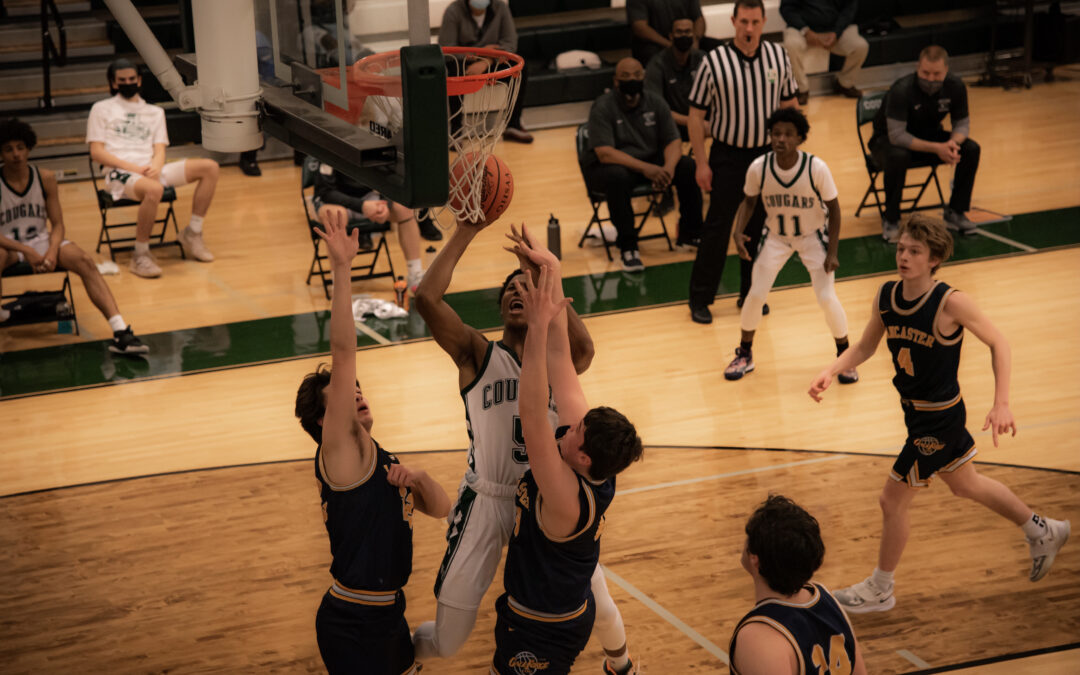
Understanding situational basketball comes only after playing the game competitively for some time. Getting young and developing players to understand the ins and outs of different situations takes time, and experience. Coaches can carve out practice time for situational drills, but often, players won’t fully understand until they’ve experienced it in a competitive game.
Let’s start by setting a scene: low-scoring, hard fought playoff game in a loud high school gym in the first week of March. We worked for this all year long. It’s the month of the season where any coach would work for free just to have the chance to feel that utterly different, barely describable adrenaline that comes with a win to advance to the next round.
So that’s where I was as an assistant coach. Up off the bench trying to diagnose the intended action of a play before our team forced a five-second call on a sidelines out of bounds play. It’s where I was a few moments later, using what was left of my voice to remind our inbounder that we were out of timeouts. It’s where I was when his inbounds pass took our best free throw shooting guard back toward our own basket.
I exhaled as a late whistle negated a steal that would have led to our opponent tying the game. With both hands pressed behind my head, I felt a tap on my shoulder from our older and more composed assistant coach.
“We’ve got to work on late game situations tomorrow in practice,” seemingly oblivious to the fact that we still needed to make a pair of free throws to ice the game.
“I hope we have a practice tomorrow,” I shouted back to him.
We survived and advanced. I knew he was right. Teaching situational basketball was integral. But, in my career and with the coaches I had played for, worked for, or even spoken to, it’s always been the thing that got cut out of practice.
I first heard this response as a high school player when I was talking to a respected and decorated retired coach from my high school as I explained the newfangled approach of fouling in the closing seconds when up three points.
“You’d have to practice that and then hope you get it right with the same players,” he said. “And no one is going to find time to practice that.”
I next heard the response as an eager young coach, trying to offer something different to a coach in my first job.
“That’s great, Bennett,” he said. “But have you noticed that we aren’t even good enough to be in late-game situations?”
“This is why we don’t do this,” I heard another coach say as I watched a comical close to an otherwise fine practice when my situations were marred by managers not being able to run the clock and JV players incapable of handling any sort of pressure defense.
But my idea persisted. I tucked it away in a notebook until finally, called for out of complete frustration, it got its chance to make its way into a practice plan.
“Bennett,” our head coach said. “We’ve got to figure out ways to teach our players what to do in different situations.” I heard this after a weekend where we nearly choked away a double digit lead in a Friday night game. We suffered a very frustrating loss a night later when we gave up not one, not two, but three 3-point shots to close quarters.
So what did I propose and implement? Nothing too time consuming. Nothing too difficult. But something that has helped our players think situationally better.
Three to four times in each practice, in little short segments, we blow a whistle, gather two teams, and conduct a situation. It works as a palate cleanser for whatever else has happened to that point in practice or to what might happen next. Of course, there are also consequences. We run when we don’t achieve our stated goal for that situation.
But, above all, it’s a chance to teach, talk, and coach players through a situation that they have seen or could see. It’s the opportunity to work on that last second play, see how long it will take to get into a set and execute it. Teaching situational basketball can reaffirm a recently taught point, or test the mental mettle of your team.
Too often, I think coaches envision working on situations to mean the last two minutes, holding a lead or last 45 seconds trying to come back. Those kinds of situations often do take too much time or can lead to frustration when a JV team can’t pressure or a manager doesn’t know when to stop the clock.
Our situations are often short. I think back to the idea of getting a pass inbounded with two seconds left and no time outs. After that situation, we can grade our players immediately as to whether we got what we wanted. Did the right player get the catch or was the pass thrown to a place where it would hurt us the last if it were to be intercepted?
Often our situations aren’t end game either. One of my favorites is putting 45 seconds or so on the clock, giving the ball to us on a sideline out of bounds and saying that I want to win the end of the quarter. Our players have learned to look for quick action off the sideline out of bounds and then to move into a “get the last shot” situation.
Other times, we simply talk about urgency and give the ball to the opposition with 20 or so seconds to go. Give up that last shot? Enjoy a few sprints before we move on to the next part of practice. I reiterate that the most important thing that we do is huddle again after the situation and address exactly what we thought went right and what still needs to be fixed in future situations.
It’s a great way to bring some intensity to practice, even amongst coaches. I have been given free reign to coach our top varsity unit through the situations. Our other varsity assistant and JV coach, who both work in our building, often find me at lunch to try to figure out what situations we’ll be working on that day and what lineups I plan to use.
By the beginning of practice, I find that they’ve schemed to come up with sets they want to run against the top group in order to force them to have to run sprints. There’s been a healthy amount of competition while our players are also learning. As I mentioned earlier, it can also act as either a bridge to the next segment of practice or a cap on the previous portion.
How often do we say to our guys “know the time and situation” or “be aware of the situation”? Now, we have three to four chances each day to teach our basketball players situational awareness. Want to know how and when to foul up three? How about focusing on getting 2-for-1 at the end of a quarter or half? Want to practice turning a ball handler after getting a score with a few seconds left on the clock?
These are all little quizzes that you can more easily incorporate into practice. Better yet, it’s a great way to review the situations you might have failed in previous games. Finally, it even gives us a chance to fit in sets/tendencies of our upcoming opponent.
So often because of fouls, you wind up with strange groups on the floor. How often is your big on the floor at the end of the half because of foul trouble? This is a great way to try out different lineups as you envision the best or worst case that might come Friday night.
It’s also a great way to know who you can trust to do certain things. Going back to my high school’s old coach – I can pick one or two guys and teach them how to foul with a 3-point lead.
How often as coaches do we say things like “Can we do this?” “Can so-and-so run that?” “How much time do we need to do this?” So much of the intel that I try to collect and have ready for our games comes from these situations.
I have an “end of quarter” column on a sheet I have with me each game that lets me know exactly how much time each set might take us to run. That way when our head coach calls something out at the end of a quarter, I can let our point guard know exactly what time to start the action. It’s similar with lineups. I know, based often by what guys have done in the past couple weeks, who can handle what assignment or what certain guys actually know how to do.
Does this cure all situational ails? Of course not. But, what it does do is it gets players thinking throughout practice. Just the other day, we had worked on how we wanted to finish a quarter by getting a stop and then running a bit of clock before going to a closing seconds set that we call “tap.”
Toward the end of practice, we worked a simple 8-minute quarter as a scrimmage situation. A ball got batted out of bounds with about 30 seconds left on the clock. Without prompting, our shooting guard turned to me and said “You want this like we did earlier?” I nodded and he right away called out and gave direction to his teammates. Something had clearly stuck with him.
How has it helped though? I think some. And the wins and losses do show that to be the case. Going back to that frustrating weekend where our current head coach tasked me with coming up with some solutions. We were 3-12 in two possession games over the past year and a half. Since then, a sample size of a little more than a year now, we are 8-1 in two possession games.
I go back to the coach I worked for (and highly respect) who said there were so many other things that needed to be done before we worried about end game situations. He was exactly right. But, I think winning situations in the first three quarters is integral in getting a lot of teams to the fourth with a chance. Nevertheless, it is something that you can work on in practice tomorrow – if there even is a practice tomorrow.
Brian Bennett is the associate boys basketball coach for Richmond (Indiana) High School. He has coached high school basketball for more than a decade in Indiana high schools. Bennett teaches composition, speech, and journalism.
If you found this useful, don’t forget to check out additional blog posts at TeachHoops.com. Also, check out TeachHoops on Facebook, Twitter, Instagram and YouTube.
When I was in college I would get through some of the most tedious lectures by drawing out basketball plays within my notes. And that evolved into designing offensive sets that would seamlessly flow from one right into another. At the time I didn’t have a big picture in mind but I was being creative and I was trying to solve a problem.
Little did I know the problem was already being solved. And the journey through the rabbit hole began.
The Princeton Offense is more often than not a polarizing topic for offensive basketball discussion. Coaches seem to either love it or they will say, “you’ll never catch me running that offense!”
There are three main reasons coaches will not entertain running Princeton and these are the actual words they say to me:
1) The Offense is too much. It is too hard to learn. It’s a slow down offense… and even if I wanted to run it, I don’t even know where to start.
2) The Offense is too complicated, too hard to break down, and takes too much time to install in practice.
3) I just don’t have smart enough or skilled enough players to run it. And my best players won’t buy in. It will bog them down.
And on the surface… these concerns ARE valid.
1) Yes the offense can be overwhelming and yes most teams run it as a slow down offense. But did you ask “why” those teams slow the game down? For example: Princeton University vs any Tournament Program. Northwestern vs The Big Ten. The Air Force Academy vs The Mountain West.
The teams we typically see run the offense slow it down because of who the can recruit and more importantly who they compete with. Have you seen Chris Mooney’s Richmond teams play lately?
2) Sure Princeton looks like an extremely complicated offense. It has many moving parts and an unorthodox philosophy. But have you actually seen a good coach break it down “correctly” in a practice situation?
One thing I have done is I’ve completely abandoned the “Whole-Part-Whole” philosophy of teaching. Sure that is a little controversial. But what I’ve learned is teaching (especially Princeton) in a progression based manner which I am calling The Progression Method, is much more efficient at getting reps and covering every scoring action and counter action. And it is simple because it addresses them step by step.
3) Having less than skilled or instinctual players is something we all battle with. But I am going to repeat some of the best advice i’ve ever received as a coach, “So you’re players aren’t good… Well, Coach Em Coach!”
The Princeton Offense will actually do MORE for your role players because it has the ability to “manufacture” shots that they cannot create on their own. So the advantage of running an offense like that versus one where you hide your role players is this. Now the defense has to stay honest and they cannot as easily target your best player with double teams and stopper defensive philosophies. I actually argue Princeton can actually “FREE” up your best player(s) rather than coup them up.
The Princeton Offense is designed to take the tension out of the game and to help even the playing field especially for the underdogs. And it might be the championship game but eventually we will all be the underdog. How will you compete to win that game?
And when you do have players, alright who wants to lace them up now!!!
If you want to learn more about The Princeton Offense go to www.teachhoopsprinceton.com for a free training. Coach John Wheeler has 20 years experience with The Princeton Offense in both girls and boys programs and has a unique ability to simplify what is complicated and emphasizes the details of the game that elevates a players’ ability to execute under pressure.
Princeton Simplicity Diagram PDF

Ep: 705 How to Breakdown and Teach the Princeton Offense
If you found this useful, don’t forget to check out additional blog posts at TeachHoops.com. Also, check out TeachHoops on Facebook, Twitter, Instagram and YouTube.
Coaching basketball at any level often means teaching situational awareness. The out of bounds play stands as a key situation any basketball offense must master. These sets afford a team with a quick-hitting opportunity, as well as a chance to enter into the normal offensive flow.
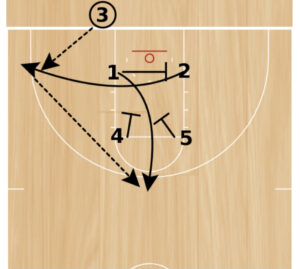
Designing a useful Out of Bounds Play provides coaches with multiple options. A good set allows the offense to immediately attack the defense with a series of calculated cuts. And if the initial quick-hitting action doesn’t produce a scoring opportunity, the set seamlessly flows into a normal offensive action.
For this play, the initial set up calls for a Box formation. This formation puts the bigs, 4 and 5, at the elbows. 1 and 2 man the low blocks to start.
In the first action, 1 provides a cross screen for 2. 2 cuts to the strong side corner. The inbounder looks to make this corner pass first.
After setting the initial cross screen, 1 cuts up the court in a zipper action. 4 and 5 provide the screens in this elevator action. From the corner, 2 looks to pass to 1.
The permutations of this set might see an open three-pointer from 2 in the corner, or an open three-pointer from 1 near the top. If the defense overplays 2’s pass to 1, there might be an opportunity for a slip from one of the bigs. If both of those opportunities are covered up, the offense might flow into a continuity set.
Another option might be a down screen from 2 for the inbounder. 3 can pop to either corner after the entry pass for an open look.
Ep: 696: Out of Bounds Play of the Week
If you found this useful, don’t forget to check out additional blog posts at TeachHoops.com. Also, check out TeachHoops on Facebook, Twitter, Instagram and YouTube.
Every basketball coach needs to be clear on their vocabulary for their team. Some basketball terms are interchangeable, while others are wholly unique. When discussing the concept of basketball entry plays, a coach might think of an inbound play like a SLOB or a BLOB. But an “entry” can also be considered any play that gets the offense going, providing both quick hitting options as well as getting into a continuity offense.
Sometimes, these plays are described as “false motions” or “decoy motions.” Regardless of the terminology, coaches need plays that deal specifically with pressure. Pressure-release plays must combat defenses that overplay or deny passes to the wings or the post.
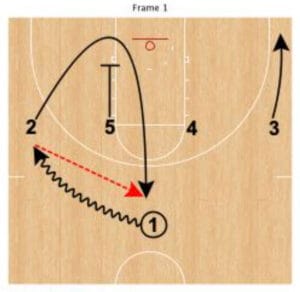 This play begins with using the 1-4 High set.
1 starts with a dribble entry to the wing. As 1 makes his way to the wing, 2 imitates a zipper or loop cut.
2 cuts down and loops around 5, who provides the down screen.
As that action is taking place, 3 cuts to the corner as a decoy action.
This initial action might get an open look for 2 at the top of the key.
Any defensive overplay might result in a dump down pass to 5 for a layup.
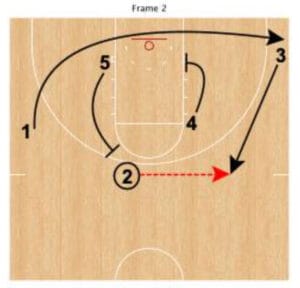
3 pops up from the corner to receive a pass on the wing.
1, meanwhile, cuts from the opposite wing to the strong side corner. He cuts along the baseline, receiving a screen from 4 at the block to free him.
2 reverses the ball to 3 on the wing. Once that pass has happened, 5 provides a flare screen for 2.
This action might get an open shot for 3. It might also get an open shot for 1 in the corner, or 4 on the block.
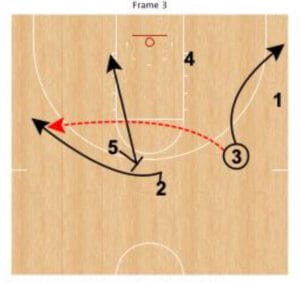
The final sequence of this play sees 3 make the decisions. He might be open, or 1 in the corner, or 4 on the block.
3 can also skip pass to 2, whose flair screen might see him open on the opposite side. Depending on how the defense plays it, 5 might slip the screen for an open layup as well.
The value of a play like this one remains the pressure-release aspect. If a defense overplays or denies certain passes, preventing a team from initiating a continuity offense, then a set like this one provides a useful counter attack.
If this sequence hasn’t produced a good look, the offense can immediately shift into a continuity offense set.
Ep: 797: Basketball Entry Plays
If you found this useful, don’t forget to check out additional blog posts at TeachHoops.com. Also, check out TeachHoops on Facebook, Twitter, Instagram and YouTube.
The fast break stands as of the most exciting plays in basketball. Regardless of a team’s skill level, the fast break injects a level of energy and excitement to any game. Coaches constantly scheme for ways to incorporate a fast break offense for their team, and the 2-Side Fast Break allows them to do just that.
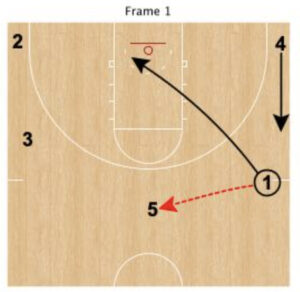
The 2-Side Fast Break Offense loads a pair of players on the weak-side of the floor, the “two-side.” One player takes the weak-side corner, while the other takes the weak-side wing. The ball handler attacks from the opposite end, which features an empty corner. One of the bigs fills the rim runner role, while the rebounder who outlet the ball occupies the trail position.
This approach to fast break offense avoids players racing to balance the floor. Instead, the 2-side spaces the floor completely for the ball handler, allowing that player to dictate how the play unfolds. The ball handler attacks the paint, forcing the defense to choose which of the weak side options on the “two-side” will be left open.
The ball handler always looks to pressure the paint on the break, and if that means kicking the ball ahead, he makes the pass.
With the numbered break, the ball centers and the wings are occupied by runners. Sometimes, based on how a defensive possession played out, one of the wings would find themselves out of position. That player might cut across the floor, ultimately ruining some of the timing of the fast break. That relocating might short circuit the flow of the break and ruin whatever opportunities had presented themselves.
Not every fast break opportunity will result in a basket, or even a good shot attempt. It’s important for players to understand that just because they’re on a break doesn’t mean they need to take a fast shot. Sometimes, the transition defense covers up any openings and the offense is forced to run a half-court set.
If the defense prevents a score or shot attempt, teams using the 2-side fast break set up can easily flow into a base offense.
The break itself saw the 2 and 3 both run the weak-side of the floor. 2 takes the corner and 3 the wing. 4 started as a rim runner on the break, but since nothing materialized, he cleared to the strong-side corner.
1 probed the defense, but ultimately is forced to run a set. To initiate this set, 1 finds the 5 man, who was trailing the fast break. The 2-side fast break flows immediately into a 5-out offensive set.
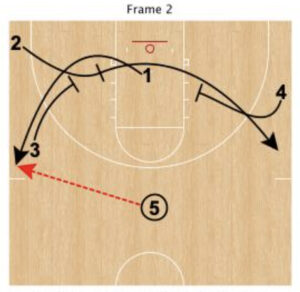 After making the centering pass to 5, 1 cuts through the lane.
As 1 makes his cut, he receives two screens away. 2 comes in to set the first screen, then 3 lowers to set another one.
This “floppy” action allows 1 to potentially get a look at a three-pointer on the wing. 2 cuts after his screen, and runs off a single screen from 4 on the opposite side.
From here, 5 looks to get the ball to 1 on the wing as he’s curling off the two screens.
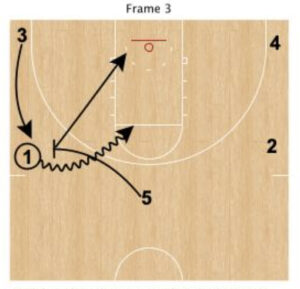 5 sprints into a ball screen after making the pass to 1. This action creates a three-man game on the strong side of the floor. It forces the defense to make decisions on how to cover up the sudden movement.
1 attacks the lane off the ball screen and 5 rolls. 3 lifts from the corner to the wing.
1 reads the defense to determine the next move. 3’s defender might take 5’s roll, leaving 3 open on the wing. If 3’s defender stays home and 5’s defender steps up to hedge the ball screen, 5 will be open on the roll.
If 2’s defender sags to help on the drive, 2 will be open on the wing. Should 4’s defender sags into the lane to help, 4 will be open in the corner.
If this action unfolds quickly enough, 1 might find the lane opens thanks to a still scrambling defense.
Shop Coach Vann’s playbooks here!
Ep: 809. 2 Sided Fast Break Discussion with Coach Vann
If you found this useful, don’t forget to check out additional blog posts at TeachHoops.com. Also, check out TeachHoops on Facebook, Twitter, Instagram and YouTube.
Coaching basketball at the youth level invariably involves dealing with zone defenses. The most common zone, 2-3, allows developing teams to hide certain players on the defensive end. It can also frustrate offenses to no end, especially if the offensive players tend to stick to their spots. So, as zones become more and more common even at the game’s highest levels, it’s integral that every coach knows exactly what they want to do when attacking a 2-3 zone.
One of the most common misconceptions to combating a good zone is the reliance on distance shooting. Teams might have a reliable zone-buster on their team, capable of consistently draining three-pointers. But the reality is most defenses would rather their opponent launch from deep rather than attack for higher percentage shots near the rim.
The first, and perhaps most important, key to attacking a 2-3 zone remains not settling for a three-point shot. Of course, if a three-pointer comes as a clean result of an offensive action, then by all means take it. But too often, teams settle for threes against zones because they can’t consistently pressure the paint. Approaching the zone with a one-pass-shot, or ball-reversal-shot, gets the defense off the hook.
Another key to combatting the zone is movement. Many times, the offensive players stand around and the zone shifts with each pass. The offense occupies set positions during the possession in hopes of finding an opening. The reality is, the openings won’t appear until more than just the ball moves. Accompanying a pass with a hard cut, filling the vacant spots, and forcing the defense to account for the movement stresses the rigidity of the zone.
A forgotten key against a zone defense is offensive rebounding. With defenders occupying designated areas instead of checking specific players, boxing out becomes problematic. Facing any zone creates lanes for offensive players to crash the boards on missed shots. The misses often result in scramble situations which could yield good scoring opportunities.
The final key to dealing with this defensive set up is learning how to screen the zone. While ball screens are typically staple counters against man-to-man defense, learning to screen the zone forces the defense to immediately adjust their alignment. If the defense doesn’t adjust, huge openings appear within the zone itself.
Continuity offenses stand as one of the most valuable approaches to attacking a 2-3 zone. These plays and sets create a rhythm and offensive flow that allows the team to stress the opposing defense. Offensive players know where to go as each pass is made within the continuity. The constant flow forces the defense to adjust, not only to each pass but also to each cut.
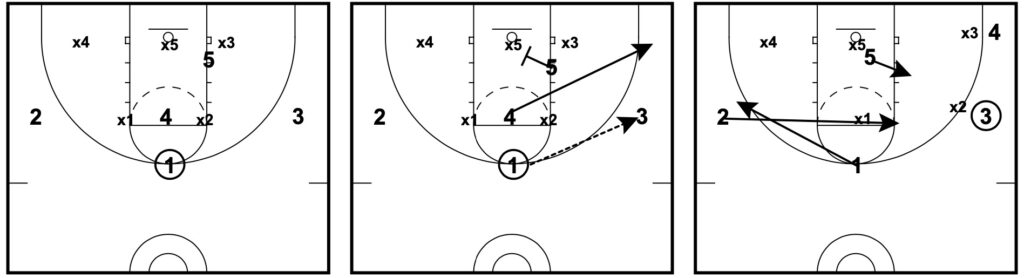
The set up for this continuity involves using a 1-3-1 counter to the 2-3 zone. 1 brings the ball down, with 2 and 3 on the wings. 4 occupies the high post, while 5 takes the low post. The initial action is a pass to either wing. 4 reads that initial pass, then cuts with the ball to that strong-side corner (or short corner).
From there, 5 presents as a low-post option and 2 cuts across from the opposite wing. 2 flashes to the open elbow area, while 1 makes a flare cut to the opposite wing. 3 reads the movement of the defense before making the next pass. If 2 doesn’t immediately receive the ball at the elbow, they lift to the top of the key.
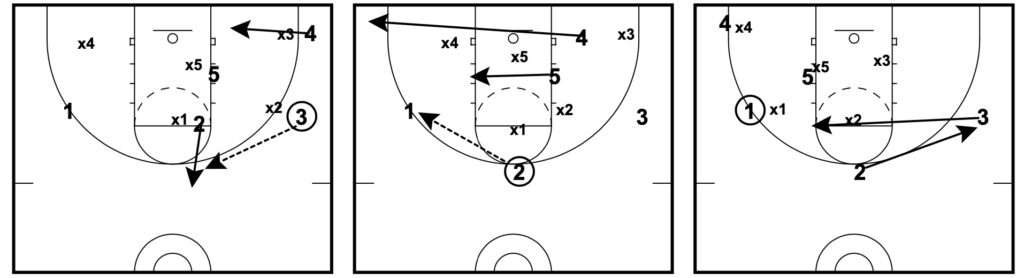
The continuous element of this continuity offense comes if the defense recovers through the initial movement. 3 gets the ball to 2, who reverses to 1. As the ball switches sides, both 4 and 5 cut to the new strong side of the offense. 4 makes the baseline cut behind the zone, while 5 flashes to the opposite low post.
As the ball reverses, 3 makes the cut across, flashing to the open elbow. 2 makes a flare cut to the opposite wing, away from the ball.
A variation for this set could involve 5 cutting to the corner or short corner, then 4 cuts into the low post. This would be an option of the 4 and 5 are interchangeable on offense.
Another variation involves using a skip pass. If the defense overplays the elbow cut, or overplays the potential ball reversal at the top, the wing can use the skip pass to the opposite side. As that skip is happening, 4 and 5 make their cross cuts like normal.
A drawback to running continuity will always be the defense learning the cuts that are coming. Adding a slight variation to the progression might catch the defense off guard. Varying this continuity with an overload option should yield good looks.
In the overload, 1 makes the initial wing pass, but instead of cutting away, 1 cuts to the strong side corner. From there, 5 turns and screens the middle of the zone and 4 flashes to the open low post area. 2 can stay wide for a skip pass or cut up to the top of the key.
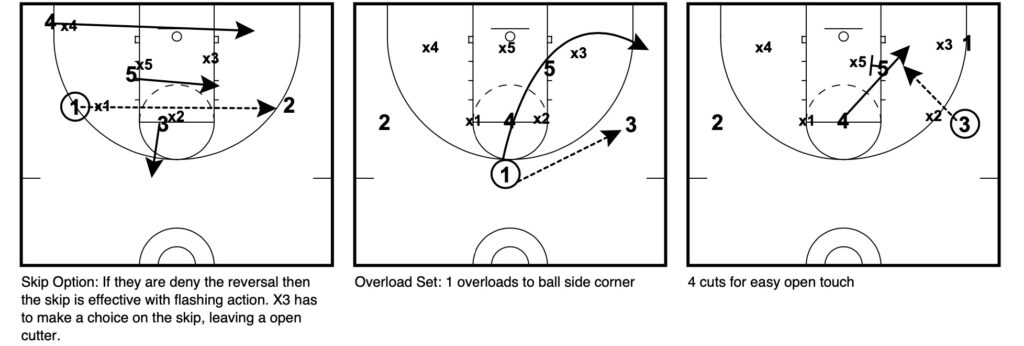
It’s key for the offensive players to be patient when attacking a 2-3 zone. Force the defense to adjust to each pass and cut before settling for a shot. The initial progression through the continuity might not yield openings, but as the offense moves, the defense must remained disciplined. If the defense is slow to adjust, the openings will be there.
Ep: 117 Breaking and attacking a 2-3 Zone

If you found this useful, don’t forget to check out additional blog posts at TeachHoops.com. Also, check out TeachHoops on Facebook, Twitter, Instagram and YouTube.
Coaches with talented playmakers often face a similar defensive set up: high-pressure in the half court. To combat this pressure, a coach might incorporate a high screen to free up the ball handler. But defensive-minded coaches can counter in a variety of ways. Defenses can blitz the pick-and-roll, hard hedge or trap. Enter the Ram and Veer offense.
Each defensive counter is specifically designed to get the ball out of the playmaker’s hands. Once a playmaker surrenders the ball, getting it back within the flow of the offense can prove problematic. The Ram and Veer offensive sets get multiple actions going, so the defense can’t key in on one specific player.
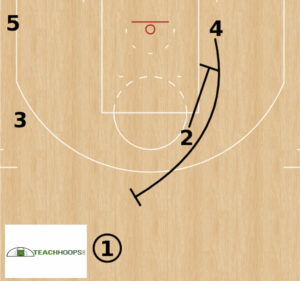 The vast majority of basketball teams, regardless of level, incorporate some sort of pick-and-roll action into their base offense. The pick-and-roll is such a fundamental action in basketball that it filters from the top (as a staple of all NBA offenses) down the the lowest youth level.
But defenses can key on particularly talented playmakers to remove the ball from their hands. To combat potential defensive counters, a coaches can install Ram and Veer offense actions.
“Ram” designates an action where a smaller player screens down on a big’s defender to free the big to set a high ball-screen. This action frees the big to set the screen without his defender immediately engaging in some blitz, hedge or trap.
“Veer” designates an action where a player who has just set a ball-screen, immediately moves into an off-ball screen for another player. The initial screen is sometimes called a “ghost” screen, then, instead of rolling to the basket, the screen moves into a wide pin-down screen for a teammate away from the ball.
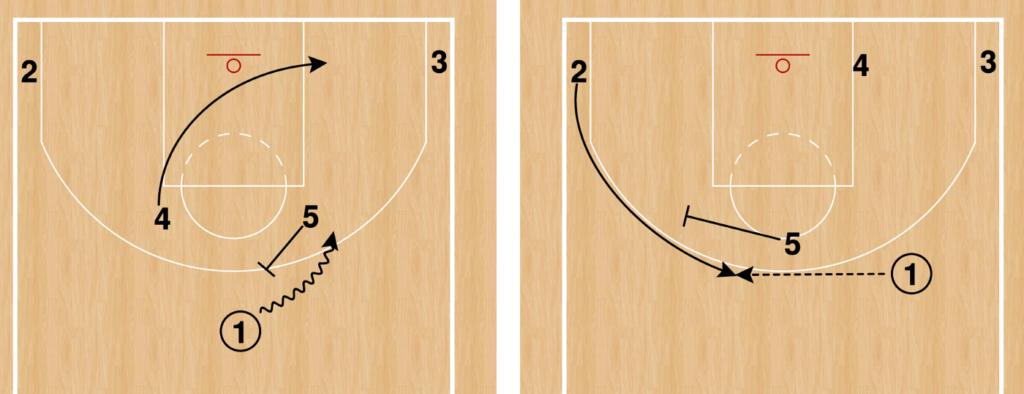
The Veer action preys upon a defense’s “tag” of the roller. In the image above, 5 sets the ghost screen for 1, then immediately moves into the veer action. Typically, 2’s defender is tasked with “tagging” the roll man in a high pick-and-roll, so he’d cheat off his man. But the veer action sets the pin-down screen for 2, freeing him up completely.
Depending upon how aggressive a defense is when handling the initial screen action, Veer also creates the opportunity for the screen to slip for an open layup.
The first play that would be useful against aggressive, trapping defenses, relies mostly on the Ram action. For this play, 3 should be the best shooter on the floor. 1 executes a dribble hand-off (DHO) with 2, which is largely a decoy action. From there, the play progresses quickly.
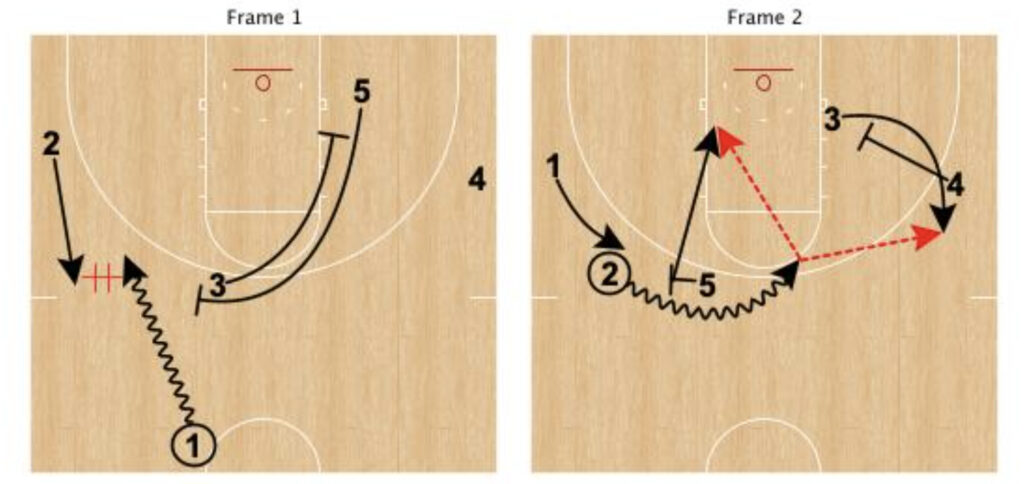
1 and 2 initiate the action with the DHO on the wing, while 3 begins the Ram action with a down screen for 5. 5 sprints to the top of the key, where he completes a ball-screen for 2, who is attacking off the initial action. 5 rolls as 2 turns the corner.
As this action is unfolding at the top of the key, 3 gets a pin-down screen from 4 to free him up on the opposite wing. So, as 2 attacks the lane, his options include 5 as the roll man, 3 for a kick out, or keeping the ball for an elbow jumper or layup. If 4’s defender overplays the pin-down screen, he can slip for a layup. 1 remains an option for the throwback pass as well.
This action is particularly useful at the high school level to combat overly aggressive defenses. This core actions also appear regularly at the NBA level.
This next play option incorporates both the Ram and Veer actions into the offense. The initial set up for this play implements a double-stack under the basket. The shooters execute a floppy cut to get open on the wings, an action that’s particularly effective at the high school level.
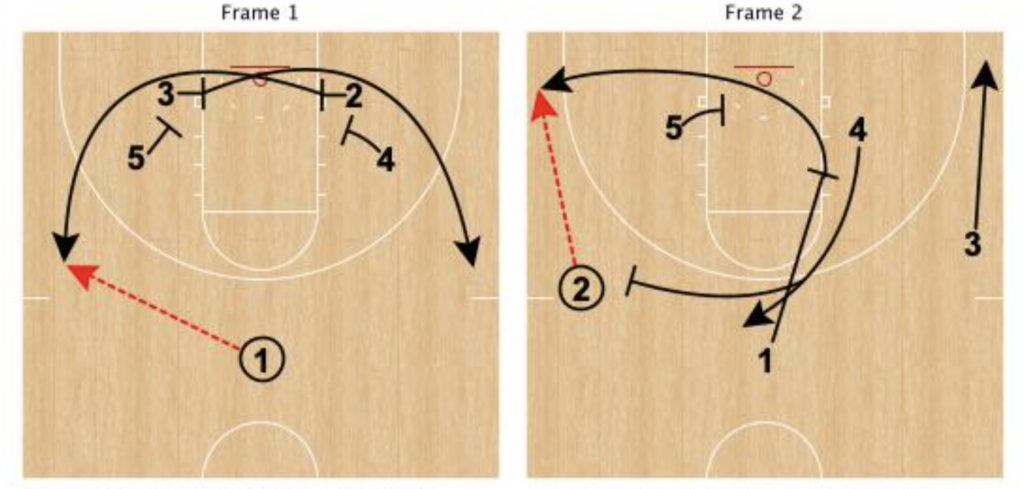
From there, the action of the play unfolds. 1 hits 2 coming off the floppy and immediately initiates the Ram action. 4 races up to set the ball screen for 2. As that’s happening, 1 cuts off a screen from 5 along the baseline and occupies the strong side corner. 2’s first look, before using 4’s screen, should be the corner.
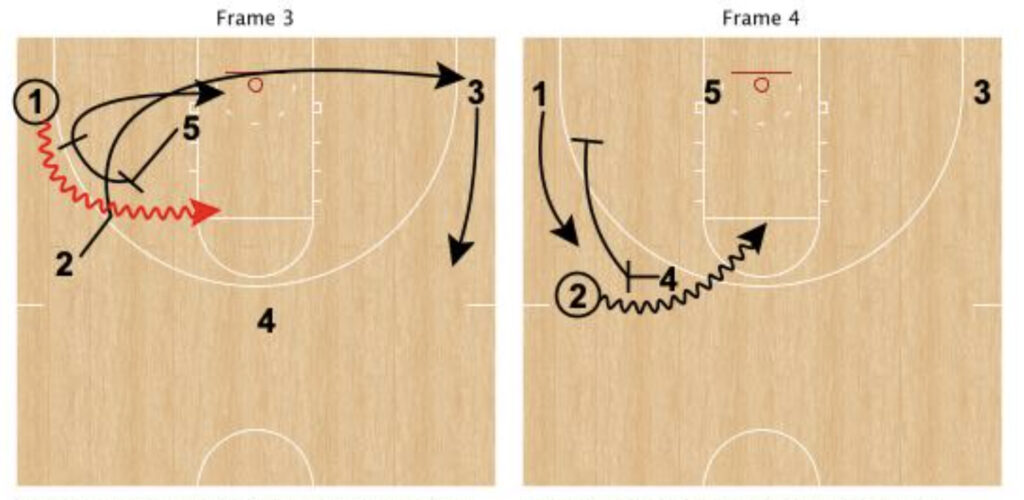
If the corner pass is there, 1 receives and either shoots or immediately attacks the defense. If the shot isn’t there, 5 initiates a back screen for 2, who cuts. After the back screen, 5 enters into a ball screen for 1, who attacks from there.
If the ball doesn’t go to 1 in the corner, 2 has the ball screen from 4 (Frame 4 above). This becomes the Veer action. 4 sets a ball screen, then sprints into a pin-down screen for 1. 2 attacks into the lane as 1 lifts on the wing. 5 can seal his man for either 2’s layup opportunity or for a dump down. 3 occupies the opposite corner.
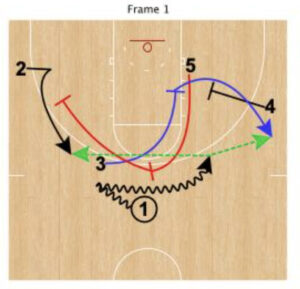 Ram and Veer use several actions to free up ball-handlers and create opportunities on offense. These actions can be particularly useful against overly aggressive defenses that like to blitz, hard hedge or trap screens.
It’s important when teaching screening at practice that the screeners know to sprint into their screens. If a player jogs to the screen, this allows the defense to adjust and defeats the purpose of the screen itself.
This last play option combines the two actions into one quick hitting option. This is a useful after-timeout play call, or even as an end-of-game situation.
The action sees 3, the team’s best shooter, set the Ram screen for 5. 5 sprints into the ball screen and immediately cuts into the Veer action. 5 does a pin-down away from the ball for 2, while 3 receives a down screen from 4 on the opposite wing. 1 uses the initial ball screen and pressures the defense. 1 can pass to either wing off this set, or attack on his own.
Ep: 811 Ram and Veer Offense Discussion with Coach Vann
If you found this useful, don’t forget to check out additional blog posts at TeachHoops.com. Also, check out TeachHoops on Facebook, Twitter, Instagram and YouTube.
Coming up with unique approaches on offense can be some of the most fun for any basketball coach. It’s important, however, for coaches to understand the skill level of their squad before imagining elaborate offensive sets. While the Chicago Action in basketball is widely used at both the NBA and NCAA levels, this offensive set can be integrated at the youth and high school levels with the right team.
Chicago Action involves two common basketball movements, the pin-down screen and the dribble hand-off (DHO). When used together, these two elements can stress any defense and provide the offense with multiple avenues to score. It usually necessitates a talented big who can be an offensive playmaker from the elbow.
This set loads an offense’s three most talented players on one end, while the other two perform decoy actions away from the ball. The beauty of this set remains the multiple variations a team can layer into their attack.
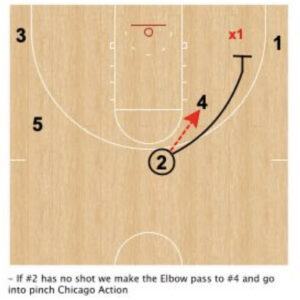 The basics of the Chicago Action involves two fundamental elements: the pin-down screen and the dribble hand-off. This action engages three of the five players on offense. It can be expanded to involve all five.
The set itself can initiate from four-out, five-out or horns sets. Use this set against man-to-man defenses.
In the four-out configuration, 4 pops to the elbow to receive an entry pass. From there, the 2 cuts over the big to set up the pin-down screen.
To make this truly effective, 1 must set up his defender with a jab step from the corner before cutting up off the pin-down.
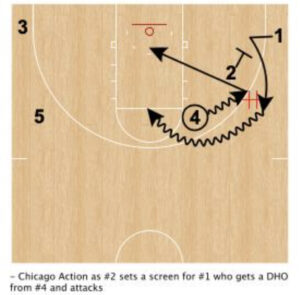
4 turns and immediately enters into a dribble hand-off (DHO) situation. 1 comes off the pin-down to receive the hand off. This action effectively gives 1 a pair of screens and forces the defense to make multiple decisions.
1 now attacks the defense as 4 rolls and 2 lifts from the corner. 1 reads the defense. Who is tagging the roller? Is his defender called a switch or is in lock-and-trail position? Depending upon the reaction of the defense, 1 chooses the next course of action. 1 can attack the rim, feed the roll, kick to the corner for a three-pointer or take an elbow jumper.
Away from the strong side of the floor, 3 and 5 can run decoy actions. There can be another pin-down, or a simple exchange. Something to engage those other two defenders and prevent either from sagging into the lane.
Get your copy of the Chicago Action Playbook by Coach Vann!
If you found this useful, don’t forget to check out additional blog posts at TeachHoops.com. Also, check out TeachHoops on Facebook, Twitter, Instagram and YouTube.
No basketball coach’s playbook is ever complete without a go-to baseline out of bounds play. Sometimes referred to as a BLOB, the baseline out of bounds play serves as a scoring opportunity for most teams. These plays are often quick-hitters with multiple options for the inbound passer.
Coaches can be as creative as they want to be when designing these plays, but they have to keep in mind the skill-level of their team. Another consideration is being able to shift directly into the team’s core offense. Finally, some coaches prefer to install baseline out of bounds sets that have multiple variations from which to attack the basket.
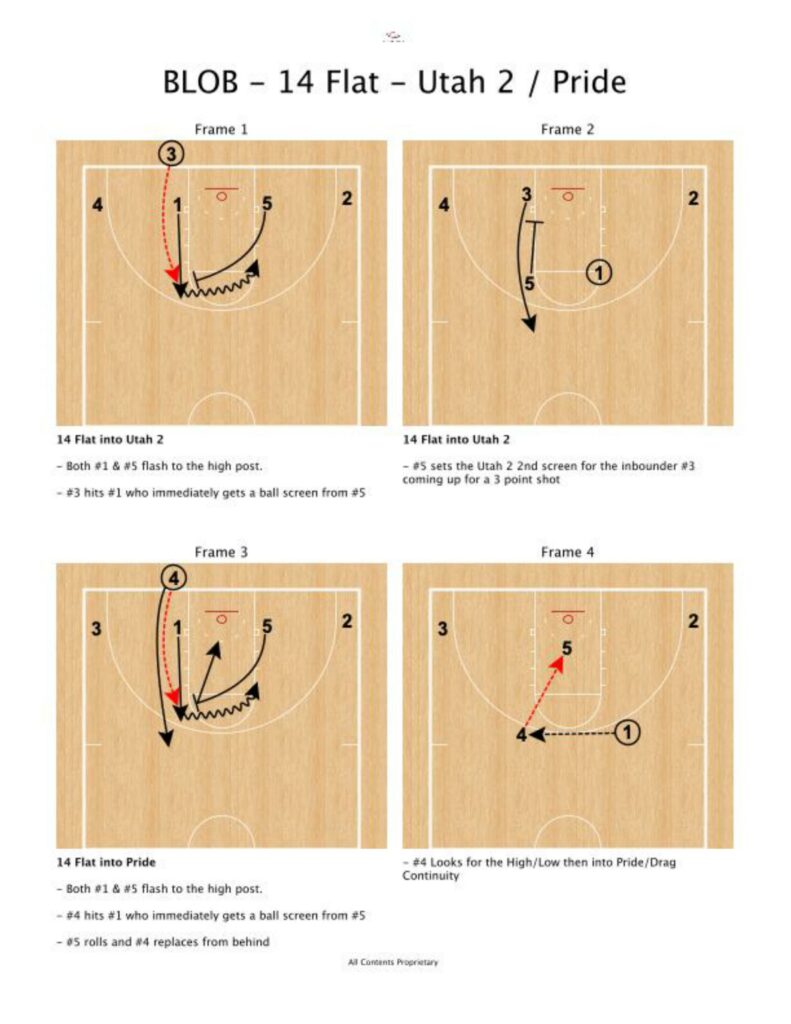
14-Flat features the four players on the floor arrayed along the baseline. Players occupy the three-point corners and the two blocks. The inbounder has a clear line of sight along the baseline and plenty of room to make the necessary reads.
The first action in 14-Flat involves 1 popping from the box to the elbow. As that pass is happening, 5 moves from the opposite block into a ball screen at the elbow. 1 attacks onto the key, with 2 waiting for a kick in the strong-side corner. After setting the initial ball screen, 5 turns and drops into a down-screen for the inbounder. 1 attacks the basket at that point with multiple options, including a layup, corner kick out, back pass and more.
This play should be run against a man-to-man defense.
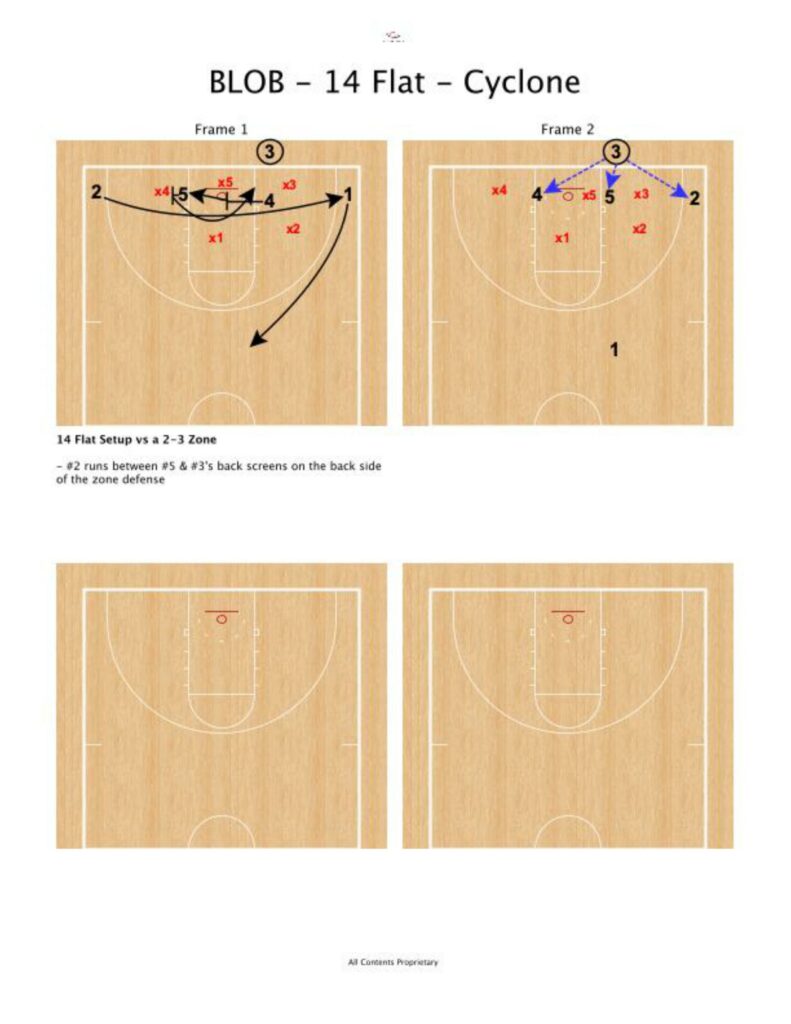
This play is used against a zone defense. For Cyclone, the offense still uses the 14-Flat alignment, with players arrayed along the baseline. This time 1 starts in the strong-side corner and flashes to the top of the key. From there, 2, which started in the opposite corner, cuts across using two screens at the block. Once 2 has cleared both screens, 4 turns and sets another screen, this time across the key. 5 curls toward the inbounder and 4 seals his man, leaving the inbounder with multiple reads.
The key to this play remains the inbounder’s ability to read the progression correctly and make a good interior pass. 1’s cut is a decoy, as is 2’s to the corner. 5’s curl may result in a layup, but the most likely basket often comes on 4’s seal against the backend of the zone. The inbounder must direct the defense away from that action, focusing on the corner with a ball fake. From there, it’s a matter of getting a good feed into the post.
A key consideration for any baseline out of bounds play is the ability to flow into a team’s offensive continuity. Depending upon a team’s base offense, the most effective BLOBs allow the offense to attack quickly. But if a defense covers up the initial actions, the BLOB flows into the normal offense or a specific half court play.
If you found this useful, don’t forget to check out additional blog posts at TeachHoops.com. Also, check out TeachHoops on Facebook, Twitter, Instagram and YouTube.
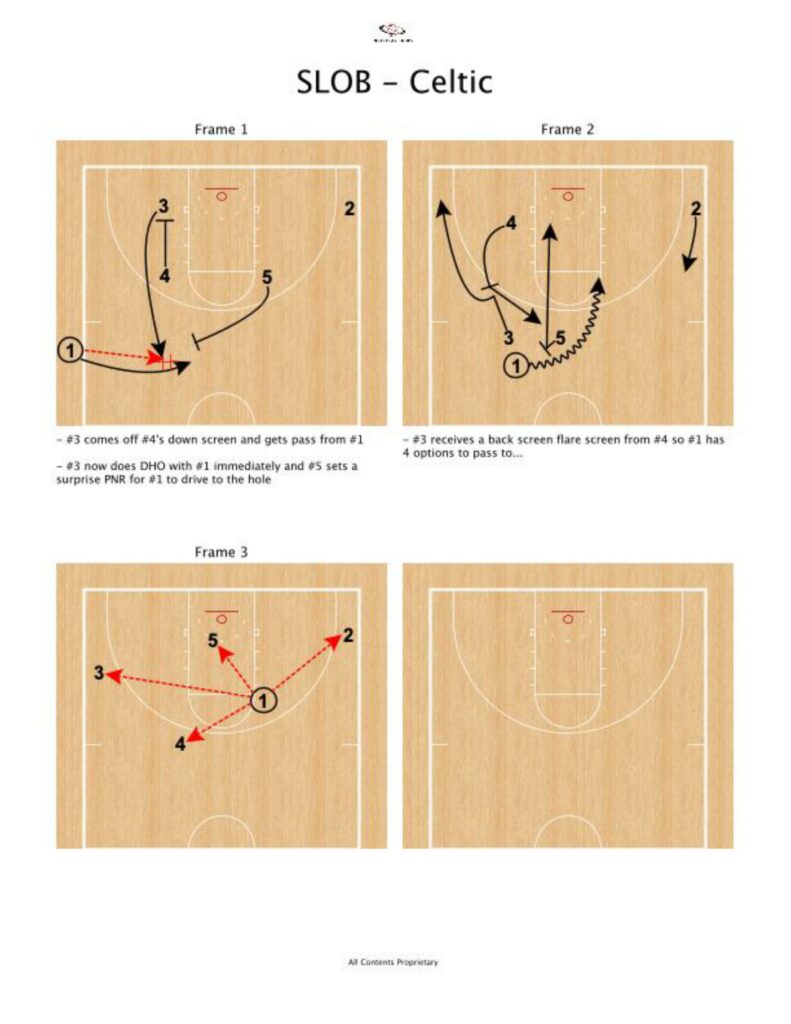
A good basketball playbook must include a solid sideline out of bounds play. Often forgotten or disregarded, these sets can be used in a variety of ways to stress the opposing defense. Sideline out of bounds plays (SLOBs) can initiate attacking actions, be a quick hitter or even as an end-of-game go-to.
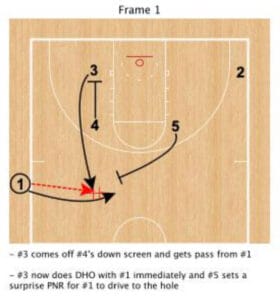
This SLOB starts in a box set. The 2 and 3 set up near the blocks, while the 4 and 5 occupy the elbows to start. 1 serves as the inbounder for this set.
The initial action sees 2 cut hard to the opposite corner to draw his defender away. 4 sets a down screen for 3, who flashes to the top of the key. 1 finds 3 with the inbound pass.
As 3 receives the pass, two things happen simultaneously. 1 immediately cuts seeking a dribble-hand-off (DHO) action. As the DHO is taking place, 5 comes up and sets a hard ball screen.
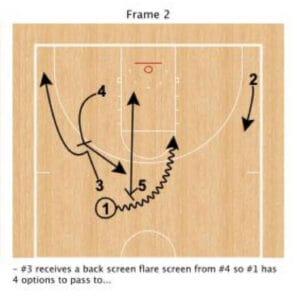
The second progression of this play immediately puts the offense into attack-mode. 1 uses the ball screen at the top of the key, looking to turn the corner.
As the high ball screen is taking place, 4 rotates up and sets a weak-side screen. 3 uses the flare screen to drift to the corner. 4 remains high to be an option for 1 on the drive.
After setting the ball screen, 5 rolls down the lane with hands ready. 2 reads the defender to either stay in the corner or drift high. 2 must present as a kick-out option for 1’s drive.
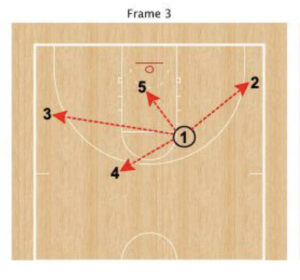
From here, 1 has multiple options to attack the defense. A breakdown may open a driving lane for a layup, or there are four potential passes to make.
Feeding 2 could result in an open corner three-pointer. 5’s dive could be a layup. If 4 is a pick-and-pop big, a pass there could result in a three-pointer or a high-low game between 4 and 5.
The least likely option in this sequence is a pass to 3 in the weak-side corner. Unless 1 gets to the baseline, that’s a hard pass to make.

If you found this useful, don’t forget to check out additional blog posts at TeachHoops.com. Also, check out TeachHoops on Facebook, Twitter, Instagram and YouTube.
Enter your email address to gain access to our FREE video series.