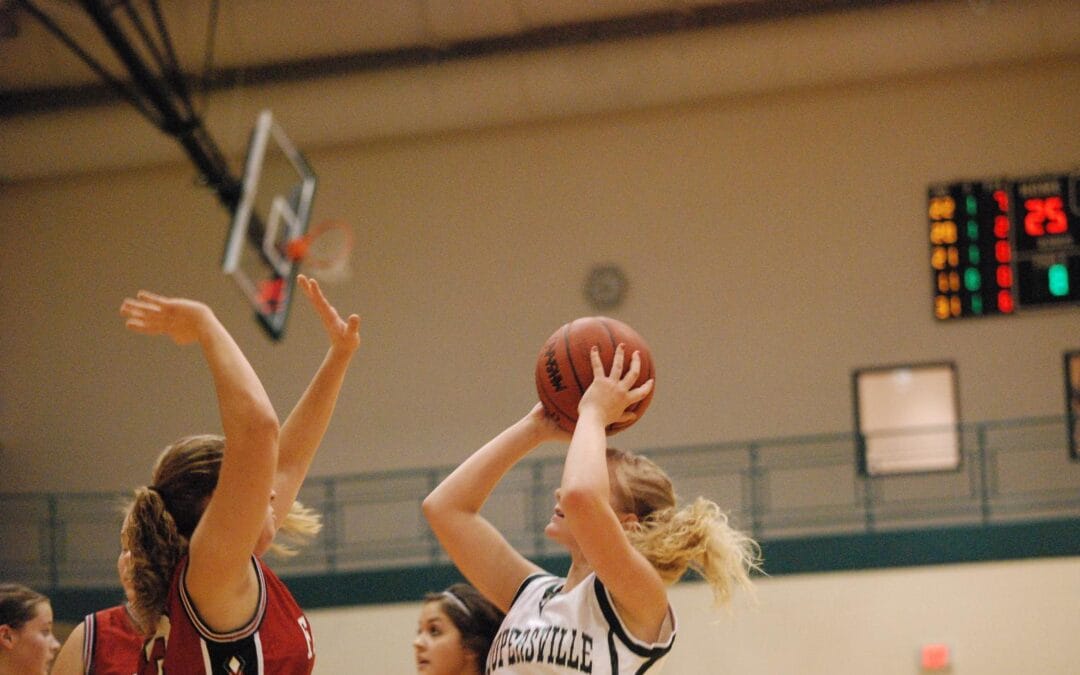
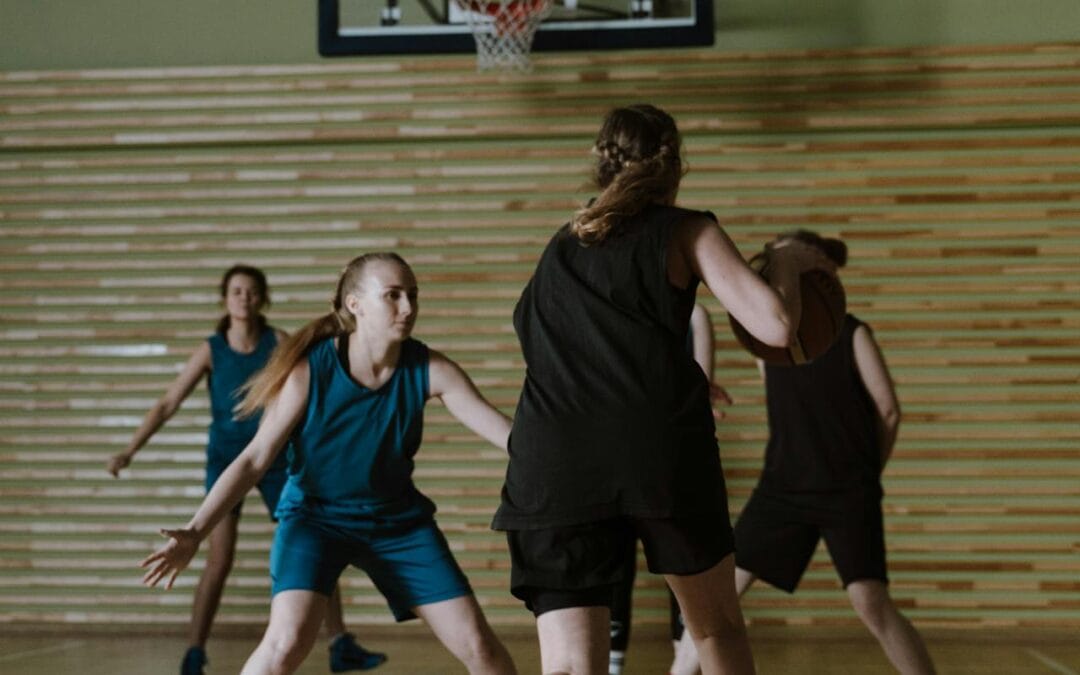
If your players only practice clean looks, they struggle the moment a defender crowds their vision. The distracted shooting drill builds comfort shooting through visual clutter. It is simple to run, affordable to set up, and maps closely to what players see in games.
Why the distracted shooting drill works
When a shooter briefly loses sight of the rim, even for a fraction of a second, accuracy drops. Research on visual occlusion shows that if vision is blocked during the final ~350 milliseconds before release, performance suffers, while having vision restored in those final ~350 milliseconds preserves accuracy.
You can see this principle in the pros. The “Kornet Contest” is a good example, where a 7-footer jumps to momentarily block the shooter’s view. On those shots, opponents made 33.3%, compared with the league-wide “wide-open” average of about 38%. Obscuring vision, even from several feet away, can matter.
Biomechanics studies add detail. When players shoot over higher obstacles, they jump higher and alter entry angles, and their make rate declines compared with smaller obstacles. Training that experience in practice prepares players for real contests.
Finally, teaching athletes where and how to look helps them manage distraction. Quiet-eye training, which stabilizes gaze on a single target location, improves shooting accuracy and transfers under defensive pressure.
Equipment
1–2 pool noodles or a light broom handle
1 ball per shooter
1 partner or coach as the “distractor”
Pool noodles are safe, light, and easy for younger players to handle as they simulate a defender’s hand without contact.
Core distracted shooting drill
Goal: Normalize shooting with a hand in your line of sight.
Setup: Shooter at a wing or elbow. Partner stands an arm’s length away, holding a noodle or hand up to the shooter’s eye line.
How to run it
Catch and shoot with a contest
Partner lifts the noodle to the shooter’s eyeline as the ball arrives.
Shooter locks eyes on the rim through or around the “hand,” then shoots.
Make two and move
Five spots: corner, wing, top, opposite wing, opposite corner.
Shooter makes two at each spot, then rotates.
Switch roles after every spot or two.
Coaching cues
Get your eyes back to the rim early.
Freeze the gaze on one part of the rim before the rise.
Smooth rise, high finish, same follow-through each time.
The contest is visual, not physical. Keep space.
Why it maps to games: Players must reacquire the rim while a “defender” floats in their field of view, which mirrors the momentary occlusion that hurts accuracy if it occurs right before release.
Join the TeachHoops Community
TeachHoops.com offers a unique platform for coaches to share experiences and gain new insights. Learn from others who have navigated similar challenges. It’s an invaluable resource for those looking to:
Partner steps in with the noodle to the eyeline on the gather.
Shooter plants, rises, and hits one pull-up going right, one going left, then rotate spots.
What it trains: Footwork under pressure and quick visual reacquisition at game speed. Taller or longer defenders force higher jumps and different entry angles, which this variation replicates.
2) “Bobby Knight J’s” partner drill
Partner starts at the top with a ball.
Shooter relocates to a spot.
Partner passes, raises a hand or noodle to contest.
Shooter fires, rebounds, and outlets back.
Work five spots, make 2–3 at each.
What it trains: Rhythm into relocation, contested catches, and immediate shot prep.
Teaching the eyes: quick quiet-eye routine
Add this 10-second habit to every distracted shooting drill:
Find the rim as the ball arrives.
Fix your gaze on a single target on the rim.
Keep that fixated spot through the rise and release.
Quiet-eye training produces better accuracy than technique-only instruction and holds up better when a defender adds pressure.
Common fixes
Shots are flat when distracted
Cue “eyes early, soft arc.” If players jump higher to clear a contest, remind them to keep the same release rhythm.
Players rush when the hand appears
Rehearse one calm breath and a steady gaze before the rise. Quiet-eye research supports stable focus under pressure.
Young players shy away from the contest
Keep distance and remind the partner this is visual only. No reach-ins, no contact.
Age-level and space adjustments
Elementary and middle school: Use shorter distances and slower tempos. Hold the noodle higher and farther to reduce crowding.
High school: Add drifts, lifts, and trail threes with a late contest.
Limited space: Run two spots and alternate reps to manage traffic.
Wrap up
The distracted shooting drill teaches your players to see the rim through traffic and keep their form under pressure. Build it into daily shooting. Cycle through spots, add the pull-up series, and finish with “Bobby Knight J’s.” Anchor every rep with a steady gaze, then let the defense blur into the background.
If you’re looking to make your practices more efficient, engaging, and effective, small-sided basketball games for youth coaches are one of the best tools you can add to your playbook. Whether you’re working with beginners or experienced players, this approach keeps kids moving, learning, and competing, all while developing the skills they’ll need at higher levels.
Why Small-Sided Games Work So Well
In real basketball, the game often breaks down into smaller situations. Think 3-on-3 on one side of the floor or a 2-on-2 action out of a pick-and-roll. By focusing on these formats in practice, you:
Give players more touches on the ball.
Improve spacing and decision-making.
Create realistic, game-like situations without overcrowding the court.
The beauty of small-sided games is that you don’t have to constantly teach new drills. Instead, you can use the same game format and change the constraints to target specific skills.
Adding Constraints for Skill Development
Once you have your base game, say, 3-on-3 half court, you can modify it with a variety of rules to work on different fundamentals:
Limit dribbles: no dribble, one dribble, or two dribbles max.
Shot location: only in the paint, only three-pointers, or must have a post-up before a shot.
Passing rules: must screen away after a pass or set an on-ball screen.
Defensive objectives: double-team in specific areas or force baseline drives.
These constraints not only keep the drill fresh but also push players to think, adapt, and execute under different conditions.
Join the TeachHoops Community
TeachHoops.com offers a unique platform for coaches to share experiences and gain new insights. Learn from others who have navigated similar challenges. It’s an invaluable resource for those looking to:
While 5-on-5 scrimmages are valuable, most game action happens in smaller combinations. That’s why many experienced coaches lean heavily on 2-on-2 and 3-on-3 work. These setups:
Encourage players to read and react without getting lost in the crowd.
Allow more opportunities for each player to touch the ball.
Simplify spacing, making it easier for young players to learn movement principles.
If you want players to succeed in full 5-on-5, they need to first master these smaller formats.
Keeping It Competitive
Competition is the fuel that keeps players engaged. When running small-sided games:
Keep score to create urgency.
Add time limits for quick decision-making.
Reward execution, not just scoring. For example, give points for good screens or defensive stops.
When kids feel like they’re “scrimmaging” while actually working on targeted skills, practice becomes both productive and fun.
Final Thoughts
Small-sided basketball games for youth coaches aren’t just a trend, they’re a proven way to build fundamentals, maximize limited practice time, and keep players motivated. By starting with a simple format like 3-on-3 and layering in creative constraints, you can address multiple skills in a single session.
For ready-made practice plans that use these methods and build skills progressively throughout the season, visit CoachingYouthHoops.com. You’ll save time, keep practices focused, and help your players grow one small-sided game at a time.
Coaching a youth basketball tournament weekend can be one of the most rewarding, and exhausting, experiences of the season. Whether it’s your first time or your fiftieth, the logistics, emotional swings, and sheer amount of time in the gym can wear down even the most seasoned coach. So, how to coach a youth basketball tournament weekend and not lose it?
Here’s a practical guide to help you survive and thrive during a tournament weekend with your youth team.
1. Get Ahead of the Chaos with Clear Communication
Before the weekend even begins, communicate with your team families. Ask for RSVPs early and request notes if a player can only make part of the weekend. It’s better to know you’ll be missing two players for Game 3 on Saturday than to find out between games.
Use apps like TeamSnap or LeagueApps and train parents how to respond. A simple, “Johnny can only play the first game on Sunday” goes a long way when you’re planning rotations or scrambling to field five players.
2. Build a Routine and Stick to It
The unpredictability of a tournament weekend makes routine even more important. Establish a consistent warm-up routine, designate meeting spots, and communicate exact times (not just “game’s at 3:00,” but “meet under the tree outside the gym at 2:40”).
This helps players mentally reset between games and keeps them in the right mindset. Over time, it becomes a trigger that says, “It’s game time,” no matter how the last one went.
3. Prepare Parents Like It’s Their First Rodeo
Even if it’s not. Provide a checklist:
Water bottle (full, not empty)
Flip-flops or slides between games
Light snacks for between games
A reminder not to vanish to Starbucks 15 minutes before tipoff
The more organized you are upfront, the fewer mid-day texts you’ll get asking, “What court are we on again?”
Join the TeachHoops Community
TeachHoops.com offers a unique platform for coaches to share experiences and gain new insights. Learn from others who have navigated similar challenges. It’s an invaluable resource for those looking to:
Tournament weekends can bring wild swings, a blowout win in Game 1, followed by a lopsided loss in Game 2. As the coach, you set the tone.
After a big win: Stay grounded. Remind your team the next opponent will be tougher. After a tough loss: Reset. Focus on effort, not outcome. Keep them engaged and optimistic. In either case, use your pregame routine as a reset button to help players (and yourself) move on.
5. Protect Your Own Energy
You’re not sprinting up and down the floor, but you are mentally grinding for hours, strategizing, adjusting, keeping kids locked in. Find small breaks to recharge: step outside for air, delegate responsibilities, or grab five minutes to yourself if you can.
Don’t underestimate how much being “on” all day can take out of you.
6. Plan for the Weird Gaps
Some tournaments are well-run. Others give you an 8 a.m. game followed by a 6 p.m. one. If you’re staying overnight, make sure you’ve thought through check-out times, meals, and how to keep kids from crashing (literally and figuratively) before that last game.
Sometimes, the best move is a mid-day mental break away from the gym.
Final Thought: Organization > Motivation
How to coach a youth basketball tournament weekend tests everything: your planning, your patience, and your players’ resilience. But if you show up with a plan, communicate clearly, and build routines your players can rely on, you’ll have a much smoother ride and maybe even win a few games while you’re at it.
Looking for More Tools to Simplify Coaching?
Check out CoachingYouthHoops.com for full-season practice plans, drills, and resources built by experienced coaches. Whether you’re new to coaching or looking to save time, everything is done for you.
Turn Game Film Into A Game Plan with AI:
Don’t miss our new tech tool launching this fall, designed to streamline practice planning, highlight reels, and individual workouts. Sign up for early access at CoachingYouthHoops.com/AI.
Do you know how to handle parents in youth basketball, especially when they’re yelling from the stands?
Many think their sideline coaching helps their child, but it often creates confusion, stress, and frustration for players and coaches alike. In a recent episode of Coaching Youth Hoops, veteran coaches Bill Flitter and Steve Collins, with more than 50 years of combined experience, explained the real cost of sideline shouting and shared practical strategies that every youth coach should know.
If you’re wondering how to handle parents in youth basketball without causing unnecessary conflict, here’s a clear game plan.
Why You Need to Handle Parents Before the Season Starts
It doesn’t take long for sideline chaos to throw off a game. Even well-meaning parents can derail your team’s rhythm with constant instructions from the bleachers.
Coach Collins recalled losing a close high school game because a player’s dad yelled “Shoot!” from the stands, directly contradicting the coach’s timeout instructions. The player listened to her dad, missed the shot, and the team ultimately lost. All because of mixed messages.
That’s why knowing how to handle parents in youth basketball before the season begins is key. Coach Flitter recommends:
Holding a preseason meeting to explain sideline expectations.
Setting a “one voice” rule for in-game communication.
Making it clear that yelling instructions will result in a warning and possibly their child being pulled from the game.
Subtle but Effective Ways to Handle Parents in Youth Basketball
You don’t need to start a confrontation. Most parents simply need a reminder of how much their involvement affects their child’s performance. Coach Flitter suggests:
Using comparisons: “You wouldn’t want two teachers giving different directions at once.”
Emphasizing the player’s perspective: conflicting messages hurt the athlete more than anyone else.
Reframing it as support: “The best way you can help your kid is to let them focus and listen to one coach.”
When parents understand that their child is caught between two voices, they’re often more willing to step back.
Join the TeachHoops Community
TeachHoops.com offers a unique platform for coaches to share experiences and gain new insights. Learn from others who have navigated similar challenges. It’s an invaluable resource for those looking to:
If sideline coaching continues, the best move might be silent: sit the player. It sends a message without drama and gives both parent and player a chance to reflect. As Coach Collins puts it, “Now you’ve got the rest of the game to talk to them because they’re not going back in.”
This approach protects the team, reinforces your authority, and shows you’re serious about focus and development.
It’s Not Just About Winning, It’s About Teaching
One of the best parts of youth basketball is using games as learning opportunities. When your team is up big, slow things down and practice running the offense. Let players learn game management, not just scoring.
Of course, if you haven’t explained this beforehand, parents may not understand why their child isn’t shooting. That’s why handling parents in youth basketball means constant, clear communication—before, during, and after games.
Final Takeaway
If you’re a coach trying to figure out how to handle parents in youth basketball, remember:
Set expectations early and stick to them.
Use clear, player-focused language to explain your approach.
Don’t be afraid to bench a player if it protects the team’s focus and learning.
Keep reinforcing the bigger picture: development, teamwork, and trust.
Looking for More Tools to Simplify Coaching?
Check out CoachingYouthHoops.com for full-season practice plans, drills, and resources built by experienced coaches. Whether you’re new to coaching or looking to save time, everything is done for you.
Turn Game Film Into A Game Plan with AI:
Don’t miss our new tech tool launching this fall, designed to streamline practice planning, highlight reels, and individual workouts. Sign up for early access at CoachingYouthHoops.com/AI.
A player who can only go one direction or finish with one hand is predictable, and predictability gets you beat. Whether you’re coaching fifth graders or high schoolers, helping players develop their weak hand is one of the most important long-term investments you can make. That’s where off-hand dribbling drills come in.
These drills aren’t just about being flashy with both hands. They’re about creating balance, confidence, and options under pressure. Mastering the off-hand takes deliberate, often frustrating repetition. But once a player begins to trust their non-dominant side, their entire game starts to open up. They become less predictable, more versatile, and far tougher to defend, exactly the kind of player every coach wants on the floor.
In this post, we’ll break down a progression of full-court off-hand dribbling drills perfect for youth practices. These quick daily routines, inspired by TeachHoops.com, will help your players strengthen their weak hand and build habits that last. Whether your team is just starting out or looking to tighten up fundamentals, these drills will raise your practice standards.
Why Off-Hand Work Matters
Great players can attack both sides of the floor, finish with either hand, and make decisions under pressure. Getting there means rewiring the brain and body through thousands of reps. Off-hand development sharpens:
Ball control under pressure
Passing angles in traffic
Finishing moves around the rim
One of the best ways to begin this process is by carving out 2–3 minutes at the start of practice for full-court off-hand dribbling drills.
Daily Off-Hand Dribbling Drill Progression
This simple but effective sequence from TeachHoops.com is built for youth players and can be adapted as they grow. Emphasize head up, control over speed, and consistent left-hand use throughout.
V Dribbles
Use the off-hand only (usually left).
Dribble in a wide “V” pattern while walking or jogging down the court.
Focus: coordination and hand control.
In-Out Dribbles
Fake a crossover using only the off-hand.
Work in rhythm while keeping the eyes up.
Focus: misdirection and ball feel.
Hesitation Dribbles
“Slow and go” move with the off-hand.
Great for learning change-of-pace techniques.
Focus: timing and decision-making.
Half-Court Combo
Baseline to Half Court: Dribble between the legs, off-hand only.
Half Court to Baseline: Dribble behind the back, off-hand only.
For younger players, split the moves across halves. For older ones, run the full court.
Join the TeachHoops Community
TeachHoops.com offers a unique platform for coaches to share experiences and gain new insights. Learn from others who have navigated similar challenges. It’s an invaluable resource for those looking to:
Keep reps short and focused. Quality over quantity.
Progress from walking pace to full-speed over time.
Incorporate passing and finishing drills to round out development (like off-hand bounce passes or left-handed Mikan drills).
Be patient. The off-hand will feel unnatural at first, but that discomfort is part of the growth.
Unlock the Floor with Off-Hand Confidence
Players who commit to off-hand work become harder to guard and more confident in tight situations. Whether it’s blowing by a defender to their weak side or finishing a tough layup through contact, these skills translate to real-game results.
Want more structured drills, personalized support, and a full development roadmap?
Check out TeachHoops.com for one-on-one coaching, office hours, and proven resources, less than a dollar a day, with a 14-day free trial.
Bonus: A Game-Changing Coaching Tool Is Coming Soon
A powerful new AI-driven coaching platform is set to launch later this summer, built specifically for youth basketball teams and families looking for smarter, faster feedback without spending hours breaking down film.
Here’s how it works: Upload a short video clip or a simple stat sheet, and the tool instantly provides coaching insights, suggests next steps, and helps you make real-time adjustments. Whether you’re coaching a third-grade rec team or a middle school travel squad, it’s designed to meet you at your level.
The goal is simple: save time, reduce guesswork, and make the coaching process more efficient and effective. It’s being developed by people who understand youth basketball, practical tools for real coaches, not overcomplicated systems that slow you down.
If you’ve just been “roped into coaching” a youth basketball team and are wondering what you’ve gotten yourself into, you’re not alone. Whether you volunteered on a whim or were the only parent who stepped up, stepping into a coaching role can feel overwhelming, especially if you’ve never coached before. Here’s the good news: You don’t have to be a basketball expert to be a great youth coach. In a recent episode from the Coaching Youth Hoops podcast, veteran coaches Steve Collins and Bill Flitter broke down practical, game-tested advice for new youth basketball coaches especially those who didn’t expect to be on the bench this season.
1. Use Resources That Do the Heavy Lifting
One of the best ways to get up to speed quickly is to rely on trusted tools. CoachingYouthHoops.com offers everything from practice plans to drills to full-season structure, all designed for youth coaches, whether you’re leading a 3rd-grade rec team or a middle school travel squad. There’s even a 14-day free trial and options for one-on-one help.
“I would have killed for a resource like this when I started,” Steve says. “It saves you time and makes coaching enjoyable.”
2. Don’t Coach Alone—Find Your People
Coaching with support makes all the difference. Whether it’s a former player, another parent, or even a high school coach who can’t be at practice but knows the game, having someone you can lean on makes the job more manageable. Even a “team parent” who handles logistics like snacks and tournament fees can free you up to focus on coaching.
“Break up the job into smaller parts,” Bill advises. “There’s usually someone willing to help. You just need to ask.”
Join the TeachHoops Community
TeachHoops.com offers a unique platform for coaches to share experiences and gain new insights. Learn from others who have navigated similar challenges. It’s an invaluable resource for those looking to:
Start by defining goals based on your players’ age and ability. Use video tutorials or look up recommended skill progressions online. The Coaching Youth Hoops platform even lays out what to teach and when, so you’re not left guessing week to week.
“You can even use ChatGPT to find development tips for a 4th grade team,” Bill notes. “There’s no excuse to go it alone anymore.”
4. Say Yes! It’s Worth It
Coaching might feel like a surprise commitment, but it often becomes one of the most rewarding things you’ll do. Steve shared how coaching his son’s 7th-grade team (while also coaching varsity) was exhausting—but unforgettable.
“It was a lot. But the memories I have now? Totally worth it.”
Bonus: A Game-Changing Coaching Tool Is Coming
Steve and Bill didn’t just stop at advice—they also revealed a powerful new AI-driven coaching platform set to launch in late summer. This tool is being built specifically for youth basketball coaches and families who want smarter, faster feedback without having to break down film for hours.
Here’s how it works: Upload a short video clip or stat sheet, and the tool will provide instant coaching insights, suggest your next steps, and help you adjust on the fly. Whether you’re coaching a third-grade rec team or a middle school travel squad, this platform is designed to meet you where you are.
“It’s going to tell you what to do next without you needing a basketball degree,” Steve says.
The goal is simple: save coaches time, reduce guesswork, and improve the experience for players. It’s built by coaches who understand that youth sports require practical solutions, not overcomplicated systems.
Whether you’re brand new or just trying to coach smarter, this tool is shaping up to be a game-changer for youth basketball development.
Final Takeaway: Say Yes and Get the Help You Need
Coaching youth basketball isn’t about being the smartest coach in the room. It’s about showing up, being organized, and building relationships with kids that last. The best advice for new youth basketball coaches? Don’t try to do it alone.
With the right support system, solid tools, and a willingness to learn, anyone can coach. And who knows? It might just change your life.
Ready to get started? Visit CoachingYouthHoops.com for everything you need to run your season with confidence.
If you’re looking for a way to take your ball handling to the next level, a basketball tennis ball workout might be exactly what your training routine is missing.
This unconventional method forces players to push past traditional skill development by training their body and mind simultaneously. The result? Better handles, sharper instincts, and a stronger feel for the ball, even under pressure.
Why Use Tennis Balls in Basketball Workouts?
Tennis balls introduce a layer of complexity that accelerates a player’s development. By engaging one hand with a small, unpredictable object like a tennis ball, whether you’re tossing it, catching it, or dribbling it, you overload your coordination and decision-making systems. That pressure forces your dribbling hand to operate on instinct, helping you build tighter control and quicker reflexes without overthinking.
As Coach Collins explains in one of his core training videos, incorporating tennis balls into ball handling drills teaches your hands to do different things at once. This challenges your hand-eye coordination, balance, and control all at the same time.
Key Tennis Ball Drills for Ball Handling
Start simple with a 3-2-1 crossover drill, where the basketball is the active dribbling hand and the tennis ball acts as the “dummy ball.” Hold the tennis ball steady with your non-dribbling hand and execute three controlled dribbles before crossing over. Once that becomes comfortable, switch roles and use the tennis ball for the dribble, a much harder task due to its size and bounce.
Coach Collins recommends building up to advanced drills, like:
Between-the-legs with a tennis ball as the active dribble
Two-ball dribbling drills while catching a tossed tennis ball mid-drill
Full-court movement drills with tennis ball coordination
These progressions force players to keep their head up, make micro-adjustments, and stay in rhythm, all essential for in-game performance.
Join the TeachHoops Community
TeachHoops.com offers a unique platform for coaches to share experiences and gain new insights. Learn from others who have navigated similar challenges. It’s an invaluable resource for those looking to:
Added Benefits of a Basketball Tennis Ball Workout
Improved fingertip control: The smaller surface area of a tennis ball sharpens your touch.
Enhanced reaction time: Juggling a tennis ball requires quick reads and fast hands.
Game-ready poise: Handling distractions makes you more composed under pressure.
Head-up dribbling: You learn to process your environment while staying in control.
Players and coaches alike have even taken these drills to unconventional surfaces like grass to add even more resistance and unpredictability.
Want a fun, effective way to challenge your players’ coordination and control? Add a basketball tennis ball workout to your next practice. You’ll be surprised how quickly their handle sharpens, and how much more confident they play under pressure.
Final Thoughts
The goal of the basketball tennis ball workout is simple: make handling a basketball feel easy. By switching back to a regulation ball after practicing with a tennis ball, players often feel quicker, more in control, and more confident.
Whether you’re a coach running practice or a player looking to stand out, this workout is a low-cost, high-impact way to raise your skill level.
For more detailed breakdowns and coaching resources, visit TeachHoops.com. Coach Collins offers everything from 1-on-1 calls to full training roadmaps for youth basketball coaches ready to win more games and build stronger teams.
Looking for a Smarter Coaching Tool?
If you’re tired of overpriced software and endless film sessions, check out SportsVisio Coach Mode. This youth basketball coaching tool delivers AI-powered stats, quick highlights, and game insights, all for a price that works for real coaches.
Are you still spending hours breaking down film or paying too much for complicated coaching software? Most youth basketball coaches assume that’s just part of the job. But what if there was a smarter, more affordable way to coach and win?
In a recent TeachHoops episode, Coach Steve Collins sat down with tech innovator Sean O’Connor to talk about SportsVisio’s new Coach Mode, a game-changing youth basketball coaching tool built specifically for the modern sideline leader.
Here’s what you need to know.
Built by Coaches, for Coaches
SportsVisio isn’t just another tech company trying to tap into youth sports. It’s a VC-backed platform that has already found success serving adult leagues. Now, it’s turning that experience into tools designed specifically for youth and high school coaches.
Coach Mode was built based on feedback from actual coaches who asked for:
Advanced stats and film tools that are easy to use
Access via desktop and mobile
Content they can share with parents and players
An affordable product that doesn’t cut corners
Game Highlights Made Simple
Every game generates a 90-second highlight reel with key plays from both teams. These clips can be easily exported and shared on Instagram, TikTok, and other social platforms. It’s a great way to promote your program and keep families engaged.
This isn’t just a back-end tool. It’s something your players and their parents will love too.
Pro-Level Analytics Without the Price Tag
Coach Mode offers:
Interactive shot charts
Clickable heat maps
Full box scores
AI-generated performance insights
It’s like having your own data team, but without the staffing cost. All you need to do is upload your game footage.
Join the TeachHoops Community
TeachHoops.com offers a unique platform for coaches to share experiences and gain new insights. Learn from others who have navigated similar challenges. It’s an invaluable resource for those looking to:
A special early offer drops that to $600 if you sign up by the end of August
The package includes access to the desktop platform and mobile app for coaches, players, and parents
If your team plays more than 20 games or needs scouting coverage, just let them know. They can customize your plan.
Fast Turnaround You Can Count On
Most video and stat packages are returned within 12 to 24 hours.
That means if you play Thursday night, you can review clips Friday morning. It’s a fast, reliable process that helps you stay focused on coaching.
Always Improving Based on Coach Feedback
Coach Mode isn’t a static tool. The team is adding features regularly.
A recent example is the rollout of a 3-on-3 mode to support summer leagues and small-sided games. That change happened after just a few weeks of coach feedback.
Better Coaching Starts Here
With Coach Mode, you can:
Save time on film and stat work
Share meaningful highlights with your team and community
Use performance data to coach smarter
Make the most of your coaching budget
Sean O’Connor summed it up well:
We want to help you win more games, grow your program, and meet your goals—whatever they are.
Ready to Make the Switch?
Coach Mode was built to help you coach more effectively without draining your time or your wallet. If you’re serious about building a better program, this youth basketball coaching tool can help you get there.
Sign up before the end of August to lock in the $600 rate and get started. Visit SportsVisio Coach Mode today!
Solid post play begins with footwork, and no move highlights that better than the drop step. One of the most effective ways to teach this skill is by using a well-designed basketball drop step drill.
Whether you’re coaching youth players or high school forwards, this drill helps athletes understand how to create space, seal defenders, and finish strong.
Why Use a Basketball Drop Step Drill?
The drop step is a foundational move for post players. It relies on balance, body control, and correct foot placement. A basketball drop step drill reinforces all three by isolating the footwork and helping players repeat it under light pressure before progressing to game speed.
At the core of the drop step is understanding the bottom foot, the foot closest to the baseline when the player is in the post. In many drop step situations, this is the foot that swings around to establish position and create an angle to the basket.
Key Components of the Drop Step
To run an effective basketball drop step drill, start by breaking down the movement:
Catch and establish pivot: The player catches the ball with their back to the basket and locks in their pivot foot.
Identify the bottom foot: This is the foot closest to the baseline.
Execute the drop step: The player swings their bottom foot around the defender, stepping hard toward the hoop while using their body to shield the ball.
Finish with power: Emphasize finishing high and through contact, ideally with one strong dribble and a layup or short hook.
Join the TeachHoops Community
TeachHoops.com offers a unique platform for coaches to share experiences and gain new insights. Learn from others who have navigated similar challenges. It’s an invaluable resource for those looking to:
Here’s a basic basketball drop step drill to introduce the move:
Setup:
Place a cone or chair on the left block.
Have players start on the perimeter, catch a pass on the move, and land on two feet.
Designate the right foot as the pivot when catching on the left block.
Action:
Player pivots on the right foot.
Executes a strong drop step toward the baseline using the left foot (the bottom foot).
Finishes at the rim.
Reset and repeat on both sides of the basket.
Coaching Points:
Emphasize balance and body control when pivoting.
Cue players to swing their bottom foot wide around the defender (or cone) to seal properly.
Use one power dribble and keep the ball tight to the body.
Finish with either hand based on positioning.
Progressing the Drill
Once players show confidence with the movement, you can advance the basketball drop step drill by:
Adding a live defender to contest the finish.
Incorporating a help-side defender for decision-making.
Using timed reps to simulate game pace.
Why This Drill Matters
Footwork in the post isn’t flashy, but it wins possessions. Teaching a consistent drop step through focused reps gives players a dependable scoring option in tight spaces. The drop step also teaches physicality, balance, and how to use leverage, skills that translate throughout a player’s game.
Basketball drop step drills are simple to implement but powerful in impact. By focusing on the bottom foot and teaching players how to seal and finish, you’re building habits that lead to success at every level.
For players looking to take their scoring to the next level, learning how to become a better basketball shooter starts with building a strong technical foundation. Shooting is more than just repetition, it’s the result of proper mechanics, consistent targeting, smart practice, and attention to detail.
In this post, we’ll break down the key principles behind becoming a more efficient shooter, with insights from veteran college coach Doug Schakel and time-tested teaching points from coaches across all levels.
1. Master the Mechanics First
Before you can hit shots consistently, you need a reliable and repeatable shooting motion. That starts with:
Balanced base: Feet should be shoulder-width apart, with your shooting-side foot slightly ahead for natural power transfer.
Grip and hand placement: The ball should rest on your finger pads with a visible pocket of space between the ball and your palm. The off-hand guides but does not interfere.
Elbow alignment: Your shooting elbow should be tucked in, forming a straight line from your toe to the rim.
Release and follow-through: Finish high with a relaxed wrist snap, fingers pointing at the rim, and hold your follow-through.
This alignment helps eliminate variables, reduces off-target misses, and increases your margin for error. Without this structure, even the most intense practice won’t result in consistent results.
2. Build Muscle Memory Through Smart Practice
Effective shooters don’t just shoot more, they practice smarter. Start with close-range form shooting to reinforce muscle memory and rhythm. Focus on swishes, not just makes. Then, gradually increase your distance.
Include:
Shooting off the dribble
Coming off screens
Free throws under pressure
Fatigue shooting drills
These game-like reps build your ability to score in realistic conditions. Track makes and misses, analyze patterns, and make micro-adjustments. The best shooters treat practice like performance and their numbers reflect it.
3. Targeting: Where You Look Matters
According to Coach Schakel, targeting plays a key role in distance control and accuracy. While many shooters default to aiming at the front or back of the rim, his preferred method is the bullseye technique, focusing on a tiny imaginary dot in the center of the hoop.
Front rim targeting allows for soft shots to crawl in but may lead to short misses.
Back rim aiming can produce hard bounces due to the lack of give.
Bullseye targeting emphasizes pinpoint accuracy and mentally narrows your aim, much like a marksman hitting the center of a target.
This approach has helped many shooters who struggle with inconsistent depth or streaky performance.
Join the TeachHoops Community
TeachHoops.com offers a unique platform for coaches to share experiences and gain new insights. Learn from others who have navigated similar challenges. It’s an invaluable resource for those looking to:
Another crucial element in shooting success is the launch angle or arc of the shot. A higher arc increases the ball’s entry space into the rim:
A 60° launch angle offers the most room for the ball to drop cleanly through the basket (ideal inside 15 feet).
A 52.5° launch angle is better suited for longer shots where energy conservation and speed matter.
A flat shot (below 45°) drastically reduces makeability, especially from deep.
Schakel even uses a simple PVC arc trainer to help players visualize and train their arc. A higher, softer shot also increases your chances of “deflected makes” and “rim dancers,” reducing hard misses and rim outs.
5. Straight Is Better Than Perfect
Of the three elements, distance, arc, and direction, shooting straight is the most critical. You can be slightly short or long and still make shots, but if the ball veers left or right, it’s almost always a miss.
Coach Schakel emphasizes:
Slight body turn, not a squared-up stance, to promote better elbow and hand alignment.
Lead and trail shoulders help guide the shooting motion naturally.
Use of a vertical “shooting tunnel” formed by toe, knee, elbow, and eye.
He compares it to throwing darts: when the body is properly aligned, the shot travels straight without forcing it.
Track Your Progress With Purpose
One of Schakel’s most effective tools is the free throw accuracy game. Each make is scored based on quality:
3 points: Swish
2 points: One rim touch
1 point: Multiple rim touches
0 points: Miss
By rewarding clean makes, this system teaches players to value precision, not just results. Use it during practice or create a team-wide competition like a “free throw ladder” to track standings and name captains based on performance.
Final Thoughts: Become a Shooter, Not Just a Player
Learning how to become a better basketball shooter requires commitment, structure, and repetition, but more importantly, it demands intention. By pairing proper mechanics with intelligent, focused practice, any player can see significant gains.
Whether you’re a youth player trying to improve your form, a high school guard looking to increase your scoring average, or a coach searching for effective shooting drills, these principles hold true.
One of the most important and most overlooked skills in youth hoops is team play. Scoring is flashy and fun, but passing, spacing, and unselfishness are what separate a group of kids from an actual team. If you’re coaching young players, especially at the 10U level, you’ve probably seen kids try to dribble through traffic instead of passing to an open teammate. That’s where teaching team play in youth basketball becomes essential.
This post breaks down how to build a team-first mentality with simple strategies, drills, and real-life coaching examples.
Why Teaching Team Play in Youth Basketball Matters
It’s easy for young players to equate “good basketball” with “scoring points.” Parents may unknowingly feed that idea by offering rewards based on how many points their child scores. But basketball is a team game, and if we don’t actively teach and celebrate the right behaviors, like making the extra pass or hitting a cutter in stride, we can’t expect kids to pick them up naturally.
At the youth level, teaching team play in youth basketball isn’t just a tactical choice; it’s a developmental must.
1. Recognize the Role of Age and Maturity
Younger kids often hold onto the ball not because they’re selfish, but because they don’t know any better. Coaches at the 10U and 8U levels should expect these habits and patiently coach through them. As players mature into 12U and beyond, their decision-making improves, and they’re more likely to trust teammates, if it’s been reinforced.
The key: Understand that ball dominance early on isn’t malicious. It’s just undeveloped awareness.
2. Coach Behavior with Clear and Consistent Feedback
In one great example from the TeachHoops team, a coach worked with a strong-willed, talented player who kept trying to go coast-to-coast. The coach calmly pulled her aside during multiple games, talked through her decisions, and gave her opportunities to reflect. Eventually, she made a beautiful assist in transition and the bench erupted. That celebration helped reframe her mindset.
The takeaway? When teaching team play in youth basketball, how you respond to unselfish moments matters. Kids notice. Make a big deal out of the right behaviors.
Join the TeachHoops Community
TeachHoops.com offers a unique platform for coaches to share experiences and gain new insights. Learn from others who have navigated similar challenges. It’s an invaluable resource for those looking to:
Another great tip: Communicate your emphasis on teamwork with parents early. Send a text or email letting them know your goal is to build unselfish habits and that there may be growing pains along the way.
When parents understand your coaching approach, they’re less likely to push for points and more likely to reinforce the team message.
4. Practice Strategies That Emphasize Passing
You are what you emphasize and your practices should reflect your values. Use these simple drills to reinforce team-first habits:
3-on-3 No Dribble: Forces players to move without the ball, cut with purpose, and make quick passes.
5-on-5 No Dribble: Great for older or more advanced teams. Helps build trust and timing.
Full Court “Never Touch the Ground”: Try to score in transition without a single dribble or bounce pass.
Drills like these create muscle memory for team play. They also help players experience the joy of moving the ball and seeing their teammates score.
5. Celebrate the Right Things
Scoreboards are loud, but celebrations can be louder. Make it a habit to celebrate assists just as much as buckets. Whether it’s a bench cheer, a clap from the coach, or a shoutout in postgame huddles, that recognition goes a long way.
Teaching team play in youth basketball won’t happen overnight. It takes reps, reminders, and a whole lot of patience. But if you stay consistent, communicate with parents, and celebrate progress, you’ll start to see it click.
And once it does, the game becomes more fun, not just for you, but for every kid on your roster.
Want More Coaching Support? Check out TeachHoops.com for mentoring, resources, office hours, and a proven coaching roadmap. You can also sign up for our upcoming AI film breakdown webinar to learn how technology can help you analyze and improve your team’s play.
Teaching your bigs to run the floor with purpose is critical in today’s fast-paced game. One of the best ways to build those habits is by implementing a transition post drill that focuses on movement, timing, and scoring on the move. If your post players are standing still and waiting for the ball, you’re missing a big opportunity.
This drill not only improves their ability to catch while moving but also reinforces essential passing angles, court awareness, and post positioning. For new and inexperienced youth basketball coaches, this is a great starting point for building confident, mobile post players.
Why the Transition Post Drill Matters
Youth basketball often emphasizes guard play, but the development of bigs can’t be overlooked. The transition post drill gives post players opportunities to move in space, catch the ball in stride, and create scoring chances in game-like situations. In addition, it teaches guards to look ahead and feed the post effectively.
Too often, young players only practice stationary post moves. However, this drill mimics real transition opportunities where timing and movement matter. Even better, it keeps your bigs active and engaged, no more standing around in the paint waiting for a guard to decide what to do.
How to Set Up the Transition Post Drill
Follow these steps to create a productive drill environment:
Two lines: One at half court and one on the opposite wing.
Glass pass: A big starts under the basket and tosses the ball off the backboard.
Sprint and zigzag: A second big (or guard) zigzags through cones toward the wing.
Deliver the pass: That player feeds the big in stride on the block.
Add pressure: Use a coach or teammate with a pad to simulate contact.
This drill works best when players understand spacing. Make sure your post players are aiming to catch the ball above the hash mark, not buried under the basket where they have no angle to finish or pivot.
Key Coaching Points for Success
Catch on the move: Your post player should be catching while running, not standing. This builds comfort finishing in transition.
Pass from an angle: Guards should get wide enough on the wing to deliver a clean, direct pass into the post.
Sprint with purpose: Movement must be game speed to reinforce real transition habits.
Post above the hash: Use the hash mark as a teaching cue. This improves footwork, passing angles, and scoring options.
Vision up court: Guards must develop the habit of lifting their eyes and delivering early passes.
By reinforcing these details each rep, your players will start to internalize the rhythm of transition offense. As a result, they’ll play faster and with more confidence.
Join the TeachHoops Community
TeachHoops.com offers a unique platform for coaches to share experiences and gain new insights. Learn from others who have navigated similar challenges. It’s an invaluable resource for those looking to:
As your team progresses, it’s smart to increase the complexity of the transition post drill. Here are a few ideas:
Add more cones: This forces guards to control the ball through traffic before making the entry pass.
Include a coach with a pad: This simulates real post contact and helps build finishing toughness.
Make moves position-specific: Require different post finishes based on footwork or game scenarios.
Go both directions: Run the drill in both directions to develop left and right-hand comfort.
Additionally, make sure your team is practicing proper spacing during the entire sequence. While the drill emphasizes the post, it also improves guard skills and transition spacing.
Final Thoughts on the Transition Post Drill
This transition post drill is about more than just getting your bigs layup reps. It builds timing, decision-making, and physicality in a way that reflects real games. When done right, your team will run more fluid offense, make smarter passes, and get higher percentage shots.
For youth basketball coaches just starting out, drills like this help form the foundation of a well-rounded team. It encourages teamwork, pace, and awareness, and those are the building blocks of winning basketball.
Keep your bigs moving. Teach your guards to read. And most importantly, create an environment where learning through game-like drills leads to confident, effective players.
When it comes to building strong youth basketball fundamentals, most coaches start with ball handling, passing, and shooting. But there’s one essential skill that often gets overlooked: footwork. Teaching footwork in youth basketball lays the foundation for almost everything players do on the court.
From shooting mechanics to defensive positioning, footwork drives player development, and it’s time more youth coaches give it the attention it deserves.
Why Teaching Footwork in Youth Basketball Matters
You shoot with your feet. Defend with your feet. Move with your feet. Without a solid base, nothing else works. One of the biggest mistakes new coaches make is assuming footwork will come naturally. It doesn’t. It has to be taught, reinforced, and drilled with intention.
When you focus on teaching footwork in youth basketball, you’ll start to notice immediate improvements in how kids move, react, and play. Footwork connects directly to:
Shooting: Proper foot placement before the catch improves balance and shot consistency
Defense: Staying on the balls of their feet keeps players agile and reactive
Cutting and screening: Clean steps on back cuts or screens create space and scoring chances
Ball handling: A player’s first step, pivot, or jab starts with their footwork
Keep It Simple: Starting with the Basics
One of the best things you can do as a new coach is simplify your approach. Footwork does not need to be overly complicated, especially at the youth level. During the first week of practice, spend time teaching:
Pivoting off the left and right foot
Proper stance when catching the ball
Basic footwork for passing and receiving
Light, quick movement in defensive slides
The key is consistency. Every drill should include a footwork focus. It might not be the main point of the drill, but it should always be part of your coaching language.
Join the TeachHoops Community
TeachHoops.com offers a unique platform for coaches to share experiences and gain new insights. Learn from others who have navigated similar challenges. It’s an invaluable resource for those looking to:
Making Footwork Part of Your Everyday Practice Plan
Teaching footwork in youth basketball is not a one-and-done concept. It needs to be layered into your regular practice structure. Here are a few simple ways to integrate it:
Use terminology kids understand. “Happy feet” is a fun phrase for staying active on defense
Break down the footwork involved in common drills, like setting a screen or using a jab step
Give real-life examples. Players love hearing how someone like Steph Curry has already completed his footwork before the ball touches his hands
Use short, focused corrections when players are off-balance or flat-footed
These small reminders help players become more aware of their movement and body control.
The Long-Term Payoff of Teaching Footwork
If you’re serious about player growth, teaching footwork in youth basketball should be near the top of your list. It is one of the fastest ways to improve a player’s game without needing fancy equipment or advanced drills. So once kids learn how to move properly, everything else improves: shooting, spacing, defense, and even confidence.
Look at how your players are using their feet. Make adjustments, and keep it simple. The gains will come.
Final Thoughts
Footwork is one of the most under-taught but impactful skills in youth basketball. By focusing on teaching footwork in youth basketball, you set your players up for long-term success. The changes won’t always be flashy, but they will be noticeable and they’ll stick.
Want more help building your coaching toolkit? Head over toCoachingYouthHoops.comand grab a full-season practice plan. It is now 25 percent off with the code PODCAST250. You’ll find templates, tips, and tools to help you coach with confidence.
The role of summer basketball has shifted significantly over the past two decades. For new and inexperienced youth basketball coaches, it can be difficult to navigate this ever-changing landscape. Between the explosion of AAU programs, the rise of highlight culture, and increased parental expectations, summer hoops now plays a complex and often misunderstood role in a player’s development.
As a veteran coach who has worked in both high school and AAU programs, I want to offer a grounded perspective on how summer basketball can truly help, or hurt, your players.
What Is the True Role of Summer Basketball?
At its best, the role of summer basketball is to supplement a player’s development, not replace it. Summer should be a time for refining skills, expanding basketball IQ, and getting meaningful reps in both structured and competitive environments. But increasingly, the focus has shifted from development to exposure.
Many programs today prioritize tournaments, social media highlights, and stacking up games. While those elements have value in small doses, they often distract from the foundational work that actually helps young athletes get better. Summer basketball is most effective when it balances reps with rest, competition with correction, and training with teaching.
1. Avoid the Trap of Overplaying
One of the biggest mistakes I see youth coaches make is overloading players with games in the summer. When kids are playing three to five games in a weekend and only practicing once during the week, the ratio is all wrong. Development comes from practice. Games are where you showcase what you’ve built.
If you’re running or coaching a summer team, schedule no more than one or two tournaments a month. Use the rest of the time for targeted practices that reinforce individual skill work and team fundamentals. The role of summer basketball should be to build, not burn out.
2. Make Skill Development the Priority
The European model offers a great example: three practices to every one game. Their emphasis is on long-term development, not short-term winning. In the United States, we often flip that model and wonder why players stagnate. Summer is the perfect time to focus on improving shooting mechanics, ball handling, decision-making, and conditioning, not just winning on the weekend.
Encourage your players to set development goals for the summer. Maybe it’s making 10,000 shots, improving their weak hand, or becoming more vocal on the court. Build workouts that support those goals and track progress. The role of summer basketball is to help your athletes return to their school teams as better, more complete players.
Join the TeachHoops Community
TeachHoops.com offers a unique platform for coaches to share experiences and gain new insights. Learn from others who have navigated similar challenges. It’s an invaluable resource for those looking to:
If your athletes are exploring AAU or travel ball, help them vet programs. Not all summer teams are created equal. Some are development-focused, offering honest feedback, quality coaching, and proper practice structure. Others are transactional, more interested in collecting fees than building players.
A reputable summer program should:
Provide qualified and committed coaches
Balance tournaments with practice time
Prioritize player development over win-loss records
Communicate openly with high school coaches
Let your players and their families know that more games don’t always equal more growth. The role of summer basketball should be developmental, not just promotional.
4. Help Players Balance Basketball with Life
One of the healthiest things a young athlete can do during the summer is step away from basketball for a stretch. Encourage them to play other sports, go on family vacations, or just rest. Overuse injuries and mental burnout are real issues in today’s youth sports scene.
As a coach, you can lead by example. Structure your summer plans with recovery time in mind. Whether your players are running track, swimming, or simply shooting around in the driveway, variety helps their overall athletic development. When basketball is mixed with balance, players come back fresher and more focused.
Final Thoughts: Keep the Big Picture in Mind
The role of summer basketball is not to churn out college prospects. It’s to help young people grow, as athletes and as individuals. Most of the kids you coach will never play at the next level, but they can still have an incredible experience learning life lessons through this game.
So when you’re planning your summer, ask yourself:
Are my players developing better habits?
Are they becoming smarter basketball thinkers?
Are we building a culture that will carry over into the fall?
If the answer is yes, then your summer has served its purpose.
One of the most overlooked but essential aspects of coaching young players is teaching them how to talk to each other on the court. Building a culture of constructive communication in basketball helps reduce conflict, boosts performance, and teaches life skills that carry far beyond the gym.
If you want your team to thrive together, it starts with how they speak to one another.
Why Constructive Communication Matters
In youth basketball, communication is often limited to basic instructions like “switch,” “screen,” or “box out.” But when players learn how to give helpful feedback to teammates, it strengthens trust and accountability.
Constructive communication in basketball improves chemistry and reduces finger-pointing after mistakes.
Use Mistakes as Teaching Moments
A common problem with youth players is reacting after something goes wrong. For example, a player might miss a box-out, and a teammate yells in frustration. Instead, teach your players to speak up before the play.
A quick reminder like, “Get low on this one, he likes to spin,” can be the difference between a rebound and a second chance bucket.
Tone and Timing Make All the Difference
Players must understand that how they say something matters as much as what they say. Two players can give the same correction, but one can come off as supportive while the other sounds like an attack.
Emphasize calm, clear, and respectful tone. This helps avoid miscommunication and builds a stronger locker room.
Train It Like a Skill
Communication is not automatic for most kids, especially in today’s screen-heavy world. You have to teach it intentionally. One way to build constructive communication in basketball is to give players role-play scenarios. Use note cards with examples like: “Your teammate didn’t hustle back on defense.”
Have them practice giving feedback that is direct but supportive.
Join the TeachHoops Community
TeachHoops.com offers a unique platform for coaches to share experiences and gain new insights. Learn from others who have navigated similar challenges. It’s an invaluable resource for those looking to:
Being coachable should apply to feedback from both coaches and peers. Ask players to reflect on how it feels when someone offers advice in a helpful way. When they understand the value of peer input, they become more open to growth.
This builds leaders, not just followers.
Reinforce the Right Way to React
Even with the best intentions, mistakes will happen. Help players understand how to respond when they’re on the receiving end of feedback. A calm nod or quick “got it” goes a long way.
Role modeling positive reactions is just as important as teaching corrections.
Don’t Silence Vocal Players, Guide Them
The goal is not to quiet the players who speak up, but to help them do it better. If a player is holding teammates accountable in a harsh way, coach them through it. Let them know their voice matters.
Then, help them learn how to use it in a way that uplifts rather than tears down.
Keep the Gym Loud and Positive
Encourage constant chatter on the court. Callouts like “screen left” or “I’ve got help” are vital. A team that talks well plays well. A team that talks constructively builds something even more important: trust.
Final Thought
Teaching constructive communication in basketball does not happen overnight. It takes reps, reminders, and reinforcement. But once it’s in place, your team will not just play better, they’ll be better. As we always say, a loud gym is a winning gym.
The 2-on-3 Press Break Drill is one of the most effective ways to teach young players how to handle pressure, stay composed, and avoid turnovers. It also trains your defense to trap without fouling and builds team communication. If you’re a youth basketball coach looking to sharpen both ends of the floor, this drill should be in your weekly rotation.
The setup is simple, but the benefits are deep. Below, you’ll learn how to run the 2-on-3 Press Break Drill, what to emphasize, and why it’s a valuable tool for developing smarter, tougher players.
How the 2-on-3 Press Break Drill Works
The drill begins with two offensive players against three defenders. From there, you build into:
3-on-3
3-on-4
4-on-4
4-on-5
And finally 5-on-5
Each progression adds more complexity and game-like pressure. This structure helps players learn how to read traps, move without the ball, and rely on quick passing instead of panicked dribbling.
Two Rules That Build Discipline
To make the 2-on-3 Press Break Drill work effectively, keep the rules simple:
Players cannot dribble until they cross half court.
Players must catch the ball inside the three-point line.
These rules force players to develop strong pivoting skills, maintain proper spacing, and avoid sloppy passes. It also reduces bad habits that often show up in pressure situations.
Defensive Emphasis: Controlled Chaos
The drill also gives your defense a chance to learn trapping technique. Instead of reaching for steals, defenders focus on:
Cutting off passing angles
Forcing mistakes with footwork and body control
Rotating and recovering
Steals are not allowed on the ball during the trap. Instead, the off-ball defender reads the next pass and jumps the lane. This teaches smarter help defense and reduces fouls.
Join the TeachHoops Community
TeachHoops.com offers a unique platform for coaches to share experiences and gain new insights. Learn from others who have navigated similar challenges. It’s an invaluable resource for those looking to:
Although every position improves with the 2-on-3 Press Break Drill, your bigs gain the most. They learn how to:
Protect the ball without panicking
Use proper footwork to pivot out of traps
Square up and look up the court
This is especially useful in games where your bigs may have to handle the ball in high-pressure situations.
What to Emphasize Each Time You Run It
When first installing this drill, you’ll stop play often to correct bad habits. Common points to stress include:
Avoiding the corner when catching the ball
Squaring up as soon as you receive a pass
Keeping your head up to see the court
No lob passes over the top
Trapping with control, not with hands
Run this drill two or three times a week early in the season. Once habits form, it can become a quick five-minute segment to reinforce key concepts.
Real-Game Payoff
One program credits this drill with helping them handle full-court pressure from nationally ranked teams. By emphasizing the 2-on-3 Press Break Drill in practice, they built confidence that showed up in big moments. This kind of preparation helps your team stay calm when the game speeds up.
Final Takeaway with the 2-on-3 Press Break Drill
The 2-on-3 Press Break Drill is more than a practice activity. It’s a teaching tool that develops poise, teamwork, and decision-making under pressure. If you’re looking for a simple yet powerful way to prepare your players for game-speed pressure, this drill delivers.
Try it. Run it consistently. Teach it the right way. Your players will thank you for it on game day.
Every youth basketball coach hits a wall at some point. Whether it’s gym time, funding, or just plain burnout, the job comes with obstacles. That’s why finding real-world solutions for coaching youth basketball is so important.
If you’re a new or inexperienced coach, especially one working with limited resources, this post will walk you through practical ways to stay on track and build something meaningful without breaking the bank.
Use Local Gym Memberships to Offset Costs
One of the best solutions for coaching youth basketball with a tight budget starts with gym space. Renting gym time is one of the biggest expenses for any youth program. One creative coach kept his total per-player cost under $350 by encouraging families to join the local YMCA. That gym membership allowed players to use the court anytime, while the coach was able to use the space twice a week for team practices at no additional cost.
The gym gains more members. The players get extra access to courts and equipment. And the coach avoids a major expense. This setup takes some coordination, but it’s a smart and repeatable model.
Maximize Limited Practice Time with Simple Systems
When you only get the gym two nights a week, you cannot cover everything. High school coaches may have five or six days to implement complex systems, but youth coaches need to keep it simple. That’s where efficient practice planning becomes critical.
A smart solution for coaching youth basketball in limited time is to break the game into teachable chunks. One coach used a “Hot Potato” concept to teach zone offense. Players lined up and passed quickly in a pattern, learning to shift the ball and move defenses without overthinking. It might not be flashy, but it gets the job done.
Youth players benefit from clarity and repetition more than complexity.
Join the TeachHoops Community
TeachHoops.com offers a unique platform for coaches to share experiences and gain new insights. Learn from others who have navigated similar challenges. It’s an invaluable resource for those looking to:
If you’re walking into practice without a plan, you’re already behind. One piece of advice that comes up again and again from veteran coaches: always bring a written practice plan. That plan helps you stay on task, layer skills over time, and avoid wasting minutes.
Go in knowing exactly what you want to accomplish. Break drills down, stick to time limits, and make sure your teaching points stay clear. It’s one of the most underrated solutions for coaching youth basketball effectively and efficiently. There are effective ways to schedule your basketball practice to keep athletes focused.
Cut Costs with Fundraising and Smarter Uniform Choices
Uniforms, tournament fees, and insurance can add up quickly. But you can get what you need without asking families to spend hundreds. Tap into your local community for help. Credit unions, small businesses, and even employers with donation matching can make a difference.
You can also run clinics to raise money while building interest in your team. Traditional fundraisers like shoot-a-thons or even light bulb sales still work. And when ordering uniforms, try going straight to wholesale suppliers. Skipping the middleman saves money and gives you better control over quality.
Build a Supportive Community Around Your Program
One of the best long-term solutions for coaching youth basketball is creating a support network. Parents, neighbors, and local business owners often have resources or connections you wouldn’t know about unless you ask.
Whether it’s backyard hoop access, tournament sponsorships, or discounted gear, the support is out there. You just need to involve them.
Final Thought on Solutions for Coaching Youth Basketball: Be Resourceful and Stay Focused on the Mission
Every youth basketball coach runs into obstacles. What separates the best from the rest is how they respond. When you hit those inevitable challenges, practice space, budget, player gear, etc., pause and look for the most practical workaround. You don’t need perfect conditions to make an impact.
As a veteran youth basketball coach, one of the most crucial aspects of building a successful team is ensuring that your players can score efficiently. One of the best ways to improve your team’s ability to score is through focused shooting drills that replicate in-game scenarios. In this post, we’ll discuss a fantastic shooting drill for scoring that can help your players develop confidence, improve their accuracy, and enhance their competitiveness.
Why a Shooting Drill for Scoring is Essential
In youth basketball, players often lack consistent shooting reps, especially with the rise of shooting machines and less outdoor play. One effective way to combat this is by incorporating a shooting drill for scoring that encourages repetition and healthy competition.
This drill helps players learn how to shoot under pressure, replicate real-game situations, and develop an intuitive understanding of how to score.
The “Up Two” drill is a fun and competitive game that simulates the high-stakes environment of a basketball game. The drill involves players competing head-to-head to score points and outshoot each other.
By introducing this competitive element, you’re not only working on shooting skills but also building mental toughness and focus in your players. This drill can be modified throughout the season to add more challenges as players improve.
Setting Up the Shooting Drill for Scoring
The setup for this shooting drill for scoring is simple, yet highly effective. Begin by dividing the players into two even teams. Have each team line up at the elbow or another shooting spot, depending on the variation of the drill.
The goal is to score points faster than the opposing team. The rules are easy to understand:
The first team to score two points (or three points, if you prefer a more advanced challenge) wins the round.
Both teams shoot at the same time, competing to make their shots and earn points.
If one player makes their shot and the other misses, the shooting team scores one point.
This game-based approach keeps players engaged and encourages them to shoot under pressure. Players enjoy the competitiveness, and it pushes them to perform at their best, which can translate into more efficient scoring in games.
Join the TeachHoops Community
TeachHoops.com offers a unique platform for coaches to share experiences and gain new insights. Learn from others who have navigated similar challenges. It’s an invaluable resource for those looking to:
Modifications to Keep the Shooting Drill for Scoring Fresh
As your players develop their shooting skills, you can increase the difficulty of this drill. Consider moving to the “Up Three” version later in the season for a more challenging experience. The concept remains the same, but the players must now make three successful shots before they can win the round.
Additionally, you can modify the drill to incorporate various types of shots. Players can practice mid-range shots, three-pointers, or even corner shots. This allows you to target different aspects of their shooting game, ensuring they become well-rounded scorers.
One useful modification is to have players focus on specific shooting techniques. For example, you might emphasize the importance of proper form or teach them how to shoot off the dribble. By introducing these small changes, you can tailor the drill to address your team’s unique needs.
Why This Shooting Drill for Scoring Works
The reason why this shooting drill for scoring is so effective lies in its simplicity and competitiveness. First, it’s easy to understand and implement, making it a perfect drill for youth players. Second, the competitive aspect keeps players engaged and motivated to improve their shooting accuracy. Lastly, the drill teaches players how to handle pressure, making them more effective when it matters most in game situations.
As a coach, you can use this drill to break up monotonous practices and bring an element of fun to your training sessions. Players will look forward to it, and you’ll see improvements in their shooting efficiency over time.
Conclusion
If you’re looking for a shooting drill for scoring that encourages both skill development and competitiveness, the “Up Two” drill is an excellent choice. It’s versatile, fun, and can be adapted to suit the needs of your players as they grow and improve. Incorporate this drill into your practice routine, and you’ll see a noticeable difference in your team’s shooting abilities and overall scoring performance.
Let’s face it, shooting is one of the most important skills in basketball, and the more opportunities your players have to practice, the better they’ll become at scoring. Give the shooting drill for scoring a try today and watch your players become more confident, accurate, and competitive on the court.
June and July aren’t just for rest. They’re the most important months for basketball summer skill development. This is the time when players and coaches should focus on improving, not just maintaining.
If you’re still running isolated drills or relying on routines from five years ago, it’s time to update your plan. Summer is where habits are built, shots are refined, and smart decisions get hardwired into players’ games.
Add Decision-Making to Every Summer Drill
Summer workouts shouldn’t look like a layup line or cone gauntlet. Instead, design sessions around decision-making and in-game reads.
Here are a few ideas to build smarter players:
Toss the ball and ask: “Attack baseline or middle?”
Teach players how to read a hedge, switch, or trap on a ball screen.
Use small-sided games that mimic pressure, spacing, and timing issues.
These kinds of drills teach players to react, something isolated reps can’t do.
Basketball Summer Skill Development Must Include Rebounding
Rebounding often gets ignored in offseason workouts, but it needs attention. You don’t need a true center to rebound well, you need urgency, positioning, and consistent reminders.
Build rebounding into your summer development plan by:
Creating drills with consequences (missed box-out = team sprint).
Teaching angles and timing through controlled chaos.
Repeating the phrase: Find, Hit, Get.
Make it part of your culture, not just an afterthought. You don’t need a true center to dominate the glass, just a team that’s committed to it.
Join the TeachHoops Community
TeachHoops.com offers a unique platform for coaches to share experiences and gain new insights. Learn from others who have navigated similar challenges. It’s an invaluable resource for those looking to:
Summer is the best time to refine mechanics, reps, and confidence. But there’s a big difference between being a shooter and being a scorer.
A few summer goals for shooters:
Hit 60% of open threes in an empty gym consistently.
Practice movement shooting, not just spot-ups.
Learn to shoot after contact or closeouts.
Shooting improvement happens in workouts. Scoring shows up when the lights are on. Both start in the summer.
Don’t Forget On-Ball Defense in Your Summer Workouts
Too many coaches overlook ball pressure in their summer sessions. But staying in front of the ball is a skill that can be built—if you prioritize it.
Make sure your basketball summer skill development plan includes:
Lateral quickness drills with resistance or reaction components.
Daily work on closeouts and proper stance.
Reps where defenders must force a player to their weak hand.
Defense wins in the winter, but it’s built in the summer.
Build Game-Like Habits, Not Just Reps
You want players who think fast and adjust in real time. That doesn’t come from doing 100 perfect reps. It comes from 100 imperfect reps under game-like stress.
Here’s what to include in your summer sessions:
Game-speed, game-like reps with variable outcomes.
Partner or group work to simulate pressure.
Drills that include consequences and choices, not just movements.
Basketball summer skill development should feel like practice with a purpose, not a training video.
Final Word: Put in the Time, Build the Habit in Basketball Summer Skill Development
Skill development only works when it’s consistent. Set expectations, track progress, and encourage players to train with intent.
Whether you coach varsity, AAU, or a rising 6th-grade team, use the summer to build habits that translate to wins. And remember: the offseason is where players are made.t practice.
If you’re looking to boost your team’s hustle, court awareness, and communication all in one go, the two ball conditioning drill might be just what you need. It’s a high-energy drill that combines sprinting, tipping, passing, and teamwork. Best of all, it teaches young players how to talk on the floor, something that often gets overlooked.
As a youth coach, you’ll love how this simple setup pushes your players to compete at game speed, without needing to draw up anything complicated.
Why the Two Ball Conditioning Drill Works
The two ball conditioning drill gives you multiple benefits in a short amount of time. First, it forces players to run the floor while staying alert. Then, it adds the tipping and passing element to simulate fast-paced game actions.
Most importantly, it teaches communication. Because players must call out and make decisions on the fly, it creates an environment that encourages talking and teamwork.
Here’s why this drill should be part of your end-of-practice routine:
It’s fast-paced and competitive.
It promotes full-court movement.
It teaches players to communicate under pressure.
It builds cardio without needing suicides or laps.
Drill Setup and Execution
To get started, you’ll need two basketballs and at least 10 players. More is even better.
Setup instructions:
Place one line of players on the right block with a ball.
Place the other line on the opposite right block across the court.
The first player tips the ball off the backboard and sprints to the opposite line.
The next player immediately tips the ball, continuing the cycle.
Once everyone understands the flow, add the second ball into the mix.
Eventually, one player will tip the first ball, then receive a pass from a coach or teammate using the second ball. That second ball then gets passed to the next player in line. While it sounds tricky at first, players usually pick it up after a few reps.
Join the TeachHoops Community
TeachHoops.com offers a unique platform for coaches to share experiences and gain new insights. Learn from others who have navigated similar challenges. It’s an invaluable resource for those looking to:
Coaching Points for the Two Ball Conditioning Drill
To get the most out of this two ball conditioning drill, make sure you’re emphasizing the following points:
Communication is key. Players must call out and let each other know when and where to tip or pass.
No walking. This is a sprint drill. Push effort and pace.
Hold players accountable. If the ball hits the floor or communication breaks down, reset and start over.
Make it a timed challenge. Set a 2-minute clock and tell players the goal is zero dropped balls.
Reinforce technique. Players should tip with control and pass on target.
When to Use the Drill
This drill is ideal to use near the end of practice. It works well as a finisher that builds conditioning and hustle without boring your players.
You can also use it as a team bonding exercise, since success depends on group effort. If your players are slacking on communication or jogging through drills, this will wake them up fast.
Final Thoughts
The two ball conditioning drill is more than just a way to run players. It’s a tool that improves timing, trust, and teamwork. Because it forces everyone to stay involved, no one hides. And that’s what you want in a solid youth basketball drill: constant motion, communication, and purpose.
Add this to your next practice and watch your team grow more vocal, quicker, and more competitive.
If you’re feeling overwhelmed or exhausted during or after your season, you’re not alone. Basketball coaching burnout is a real issue, especially for youth coaches who juggle full-time jobs, family, and practice schedules. But it doesn’t have to derail your love for the game.
As someone who’s coached for over three decades, I’ve learned how to manage stress and stay energized. Here are seven proven strategies to help you avoid burnout and stay passionate about coaching.
1. Step Away When the Season Ends
When the final buzzer sounds, take a real break. This is your moment to rest, not to plan spring workouts or jump into summer schedules.
I always take the month after the season off. No open gyms, no film, no playbooks. Even if I’m still thinking about basketball, I step away from the gym. That time off makes me miss it again, and that’s a good thing.
2. Protect Personal Time with Boundaries
Without boundaries, coaching can creep into every part of your life. Set firm limits. For example, I never let basketball interfere with spring break. That’s family time, period.
It gives everyone something to look forward to, and it keeps relationships strong. Knowing when to shut things off helps you reset.
3. Build a Hobby That Isn’t Basketball
You need something that relaxes you and isn’t connected to the sport. For me, it’s fishing. No phones. No distractions. Just peace.
You might prefer hiking, cooking, or music. The activity doesn’t matter. What matters is the distance from coaching. It’s a way to let your brain rest while still staying active.
Having a personal outlet is one of the best defenses against basketball coaching burnout.
4. Approach the Season Like a Marathon
Coaching isn’t a sprint. Treat it like a long-distance run.
Some days will be tough. Practice will drag. Players won’t respond. But those are part of the journey.
What matters is how you respond to those dips, not how often they happen. Keeping a long view helps you stay calm and clear when things get hectic.
Join the TeachHoops Community
TeachHoops.com offers a unique platform for coaches to share experiences and gain new insights. Learn from others who have navigated similar challenges. It’s an invaluable resource for those looking to:
It’s easy to say yes to more teams, more tournaments, more meetings. But every yes takes time away from something else.
I reached a point where I had to choose. I let someone else handle the admin side of my AAU program so I could focus on coaching. It wasn’t easy, but it kept me in the game.
Cutting back can be the most productive move you make.
6. Give Yourself One Basketball-Free Day a Week
Even during the season, pick a day where basketball doesn’t exist. No emails. No texts. Not even drills. For me, that day is Sunday, at least most weeks. It doesn’t have to be perfect. But the habit matters.
That one day can help you reset mentally and emotionally, and it keeps basketball coaching burnout from piling up unnoticed.
7. Keep Learning and Trying New Things
Coaches burn out when they feel stuck. Trying something new, whether it’s a zone press or a new offensive set. This can reignite your passion.
I find that growth keeps things interesting. It reminds me why I started in the first place.
If you’re learning, you’re not burning out. You’re building momentum.
Final Thought on Basketball Coaching Burnout
You can’t pour into your team if your tank is empty. Basketball coaching burnout doesn’t mean you’re failing, it means you care. So take a breath, recharge, and find the rhythm that works for you. When you care for yourself, your players benefit too.
A smart basketball warm up routine can set the tone for everything that follows in your session. Whether you coach in a high school gym or a church rec league, the principles are the same. Players need structure, movement, and energy from the jump. As a coach, you don’t want kids walking into the first drill cold. You also don’t want to waste time.
This post gives you a fast, effective warm up you can run anywhere, on a court, in a hallway, or even a classroom. You’ll also get key tips on preventing injuries, boosting focus, and improving early-session energy.
Why Your Basketball Warm Up Routine Matters
Too many teams treat warm ups like filler time. That’s a mistake. The warm up sets the tone for effort, focus, and tempo. And at the youth level, it helps prevent avoidable injuries. When done right, your basketball warm up routine becomes a tool for skill reinforcement, not just stretching.
Benefits of a good warm up:
Activates muscles safely
Reduces risk of ankle, knee, and hamstring injuries
Establishes the day’s energy and pace
Builds good habits over time
Creates focus in chaotic environments
Make it part of your culture, not just a routine.
Start with Controlled Movement
Always begin with body control and muscle activation. Avoid jumping right into sprints or high-intensity drills.
Try this simple progression:
Walking Lunges (with a ball):
Go halfway down the court or hallway. Keep it slow and controlled.
Two Steps Forward, One Back (ball overhead):
Promotes rhythm and awareness. Keeps kids active without rushing.
Side Slides (to half court):
Emphasize staying low. Teach players to push off their back foot.
Use these to build a foundation without draining energy early in practice.
Incorporate the Ball in Your Basketball Warm Up Routine
The ball should be in your players’ hands as often as possible, even during warm ups. This isn’t just for guards. Big men benefit from ball handling, too. Let them get touches early.
The ball isn’t just a skill tool, it helps keep kids focused. Distractions go away when their hands are full.
Join the TeachHoops Community
TeachHoops.com offers a unique platform for coaches to share experiences and gain new insights. Learn from others who have navigated similar challenges. It’s an invaluable resource for those looking to:
This part of the basketball warm up routine is often skipped, but it’s one of the most important for injury prevention. I started requiring ankle braces after watching too many kids go down with rolled ankles.
To build ankle strength:
Balance on one foot and touch the ground with the opposite hand
Pick up and replace a ball without letting the off-foot touch down
Try the same with eyes closed or while holding a weight
Add light hops or line jumps to train stability and reaction
Don’t wait for an injury to start focusing on ankle work. Add this in now and build it into your warm up structure.
Make It Fast and Functional
We live in a fast-paced world. Practices should reflect that. Your basketball warm up routine needs to keep moving. If it drags, attention fades.
Here’s how to keep the pace up:
Set time limits for each movement (30–45 seconds max)
Rotate drills quickly and keep a tight order
Skip things that aren’t working and revisit later
Mix in music or rhythm to keep energy high
Players should never feel like the warm up is a punishment. If they’re bored, the pace is off.
Add Jump Work to Prep for Game Action
Jumping drills help simulate the movement players will use in the first few minutes of a game. It also conditions soft landings and proper takeoff form.
Use this jump sequence:
Standard Jumps in Place (5–8 reps)
Rebound Jumps (emphasize timing and high-point technique)
Vertical Leap Focus (try to hit max height with proper form)
360 Spins (challenge balance and core control)
These take less than two minutes total. But they prep your team for rebounding, closeouts, and put-backs before the ball tips.
Keep Your Basketball Warm Up Routine Versatile and Consistent
Your basketball warm up routine should be portable. You won’t always have a court, and warm up windows change constantly at youth events.
Places you can warm up:
School hallways
Cafeterias
Parking lots
Classrooms (cleared space)
Locker rooms
Adapt your routine so your players are never standing around before game time. Once it becomes a habit, they’ll know what to do even when you’re not watching.
Final Thoughts
A consistent basketball warm up routine is one of the simplest ways to improve player health, readiness, and practice energy. You don’t need fancy gear. You just need structure, intention, and a little creativity.
Start by getting players moving. Add ball work. Mix in ankle stability. Finish with jumping. Keep it under five minutes, and your team will be better for it.
When it comes to building strong habits in your players, few tools are more effective than a well-designed youth basketball defensive drill. One of the simplest and most effective drills you can add to your practice routine is called One-on-One in Space.
It teaches on-ball pressure, defensive footwork, and player accountability, while keeping things competitive and game-like. If you’re coaching at the youth level and want your team to become more confident defenders, this drill should be part of your regular routine.
Why This Youth Basketball Defensive Drill Works
This drill isolates your defender and gives them one clear task: do not get beat in three dribbles. That clarity is important, especially when you’re working with younger or less experienced players.
It forces athletes to focus on footwork, body control, and defensive positioning without relying on help defense. Just as important, it gets them used to guarding in space, which is critical in the modern game of basketball.
Because the offense is attacking at full speed, the drill simulates real game pressure. Defenders are learning how to contain the ball under stress, without fouling or overcommitting. It is also an excellent way to condition your players mentally and physically, as it demands full effort on every repetition.
How to Set Up the 1-on-1 in Space Drill
To get the most out of this youth basketball defensive drill, follow this step-by-step setup:
Pair your players with one on offense and one on defense.
Have the offensive player spin the ball out near the top of the key or just inside the three-point line.
They retrieve the ball, pivot, and pass it to their partner who is already moving.
The offensive player catches the pass on the run and attacks the basket, staying on the same side of the hoop.
The defender must contain the drive and try to prevent a layup, foul, or blow-by within three dribbles.
Offensive players should be encouraged to play fast but under control. Defenders must use angles, quick feet, and balance to stay between the ball and the basket. You can run this drill on both wings and in the middle to vary the spacing and angles of attack.
Join the TeachHoops Community
TeachHoops.com offers a unique platform for coaches to share experiences and gain new insights. Learn from others who have navigated similar challenges. It’s an invaluable resource for those looking to:
This youth basketball defensive drill reinforces the mindset that every player is responsible for guarding their own space. We call this “guarding your yard.” It sends the message that players cannot always rely on a teammate to help or clean up their mistakes.
In many game situations, defenders will be isolated, and this drill gives them the reps to build confidence in those moments.
Instead of steering players toward help, this drill teaches them to square up, move their feet, and wall up without reaching. It also builds better communication as teammates on the sideline start to recognize good defensive technique and effort.
Variations to Increase the Challenge
Once players get the hang of this youth basketball defensive drill, you can raise the difficulty to keep it fresh and challenging. Here are a few ways to do that:
If the offensive player gets into the paint, the defender automatically loses that round.
Introduce a charge element, where defenders try to absorb contact legally and stay vertical.
Keep score in short sets, like best of five or first to three stops, to add a competitive edge.
Restrict offensive players to one side of the court, reinforcing the concept of working within tight space.
You can also reward great defensive efforts with praise or small team privileges. Players respond well to recognition, especially when it is tied to effort.
Final Thoughts on Using This Youth Basketball Defensive Drill
Defense is about more than just stopping your man. It is about positioning, toughness, anticipation, and effort. This drill teaches all of that in a fast-paced, game-like format. It also gives your players the chance to learn from failure, adjust, and improve over time.
Incorporating this youth basketball defensive drill into your practices will lead to better individual defenders and a stronger team defense overall. Stick with it, coach it daily, and watch your players grow on the defensive end.
Starting out as a basketball coach can feel like jumping into the deep end without a life jacket. There’s pressure to run smooth tryouts, plan efficient practices, develop players, and manage parents, all while building a positive team culture. If you’ve ever asked yourself, “Where do I even begin?”, the Basketball Coaching Roadmap is the answer.
This free guide from TeachHoops gives you the structure, tools, and confidence you need to coach with clarity from day one.
Coaching Can Feel Overwhelming. This Roadmap Makes It Simple.
If you’re new to coaching basketball, the pressure to have everything figured out can feel intense. From organizing tryouts to managing game prep, there’s a lot to juggle. Without a plan, it’s easy to feel behind before the season even begins.
Created by experienced coaches, this roadmap breaks down the full basketball year into manageable phases. It shows you what to focus on at every stage, and when you sign up with your email, you’ll get a downloadable version packed with tools to help you succeed.
What You Get When You Sign Up
When you enter your email, you’ll receive the complete 13-page Basketball Coaching Roadmap, which includes:
Tryout forms to keep evaluations organized
Practice planning templates to save time and stay focused
Pre-made workouts to help players develop
Editable spreadsheets to track progress and goals
And much more
It’s everything a new or inexperienced coach needs to stay organized and confident, right from day one.
A Full-Season Blueprint You Can Actually Use
The roadmap breaks the year into four key parts:
Pre-Season – Set your philosophy, define roles, finalize schedules, and plan tryouts.
In-Season – Run effective practices, manage team culture, and handle unexpected challenges.
Post-Season – Evaluate player growth and team progress.
Off-Season – Focus on player development, new ideas, and long-term goals.
You’ll also learn the 4 E’s of coaching: Envision, Enact, Evaluate, and Enhance. These pillars help guide your decisions and structure your year with intention.
Why New Coaches Love This Resource
This isn’t just a generic checklist. The roadmap gives you real structure, guidance, and support to:
Stay organized throughout the season
Build your coaching philosophy and team culture
Develop players while managing your time
Plan smarter and coach with more confidence
Know what to do each month without guessing
Built by Coaches, for Coaches
TeachHoops isn’t a corporate-run site. It’s led by actual coaches who are still in the game. We know the challenges new coaches face, and we’re here to walk with you.
In addition to the roadmap, TeachHoops members get access to:
A full video library
One-on-one mentoring sessions
Downloadable drills and workouts
A private coaching community that’s supportive and real
Start Coaching with a Plan Today
Don’t head into another season without a clear strategy. CLICK HERE and sign up now to get your free 13-page Basketball Coaching Roadmap and start coaching with confidence.
It’s free. It’s practical. And it’s exactly what new coaches need to start strong.