The Read and React is a great basketball offensive system. The only issue I have come across in our time running it is it can be difficult to get points quickly out of it. I did some research and playing with the Read and React and utilized the principles of this basketball offense to create some set plays out of it.
These should offer good opportunities to score quickly out of the look while the opposing team thinks you’re still just running your offense. Even if you don’t run Read and React, these looks could still be utilized as great set play options to get good movement and looks at the basket.
Read and React Basketball Offense: 5-Out Post Look
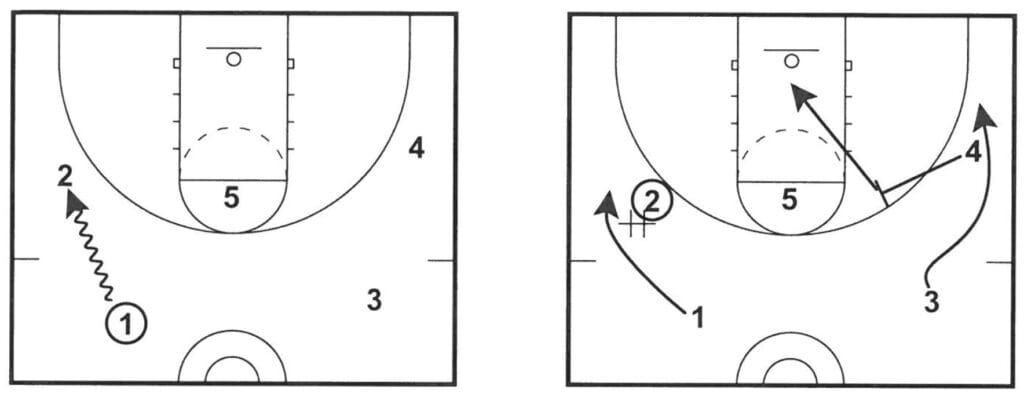
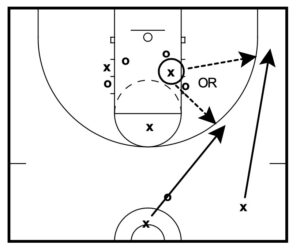
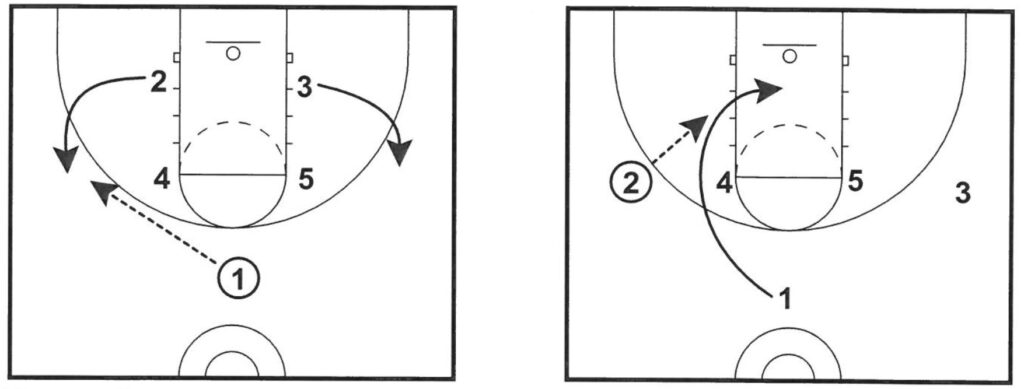
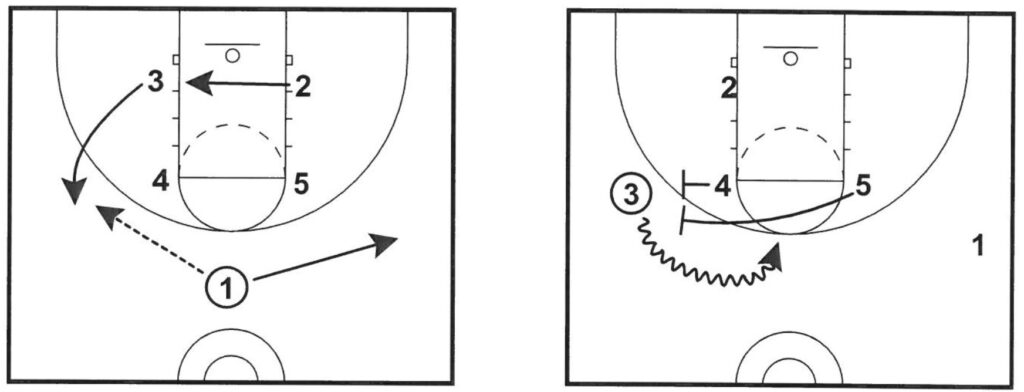
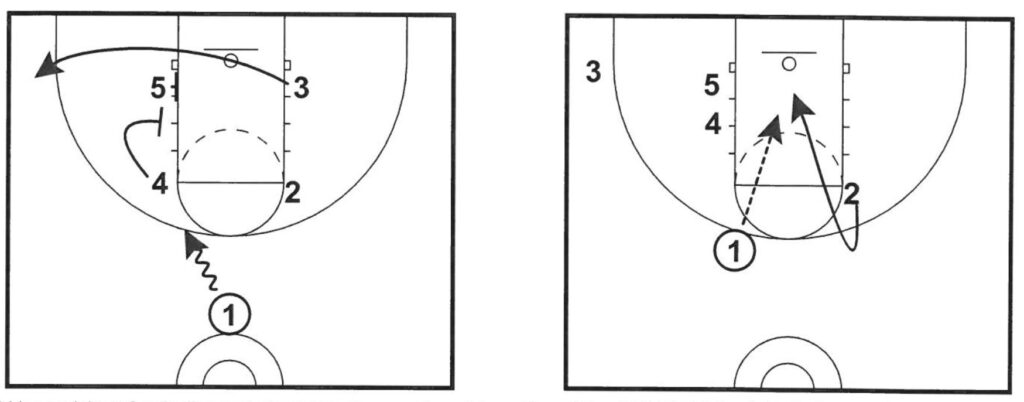
If you have a very good post player or just someone that is good at finishing around the rim, this is a good look for them. It starts with a dribble-at to initiate the offense to clear out the right side a little bit. We have action happening on the weak side to keep everyone busy and hopefully get a good look for the 5 in the paint.
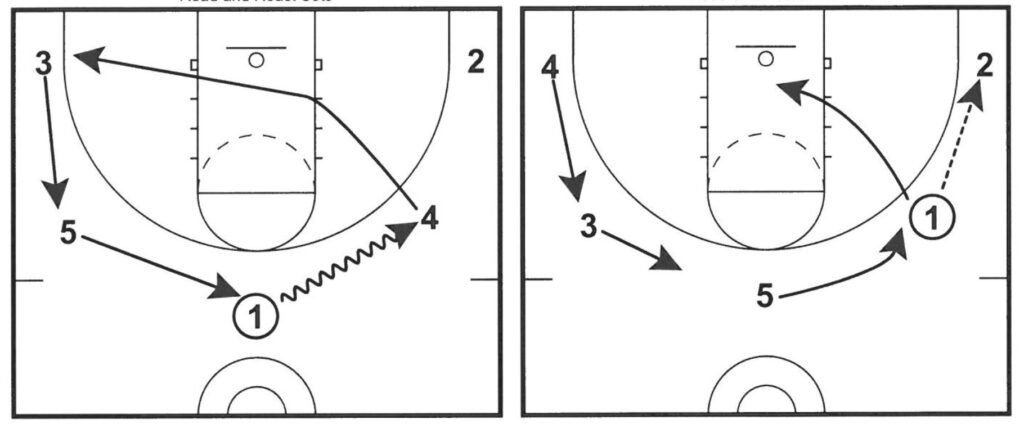
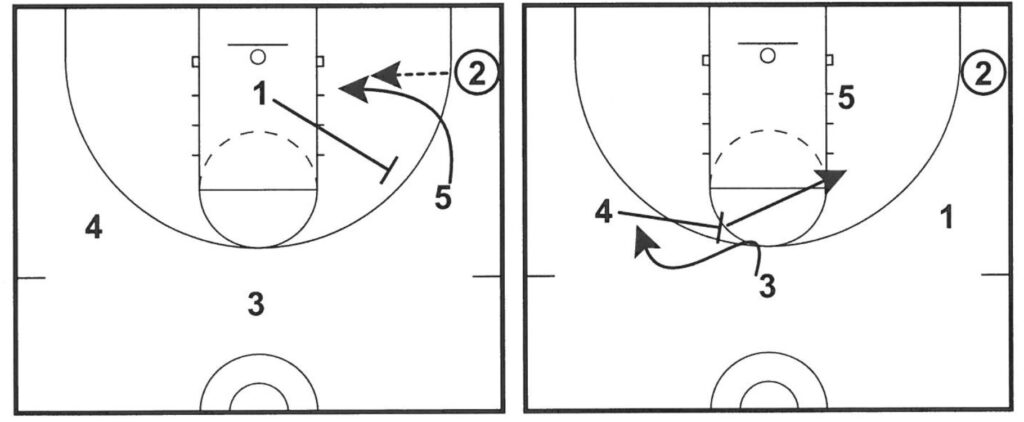
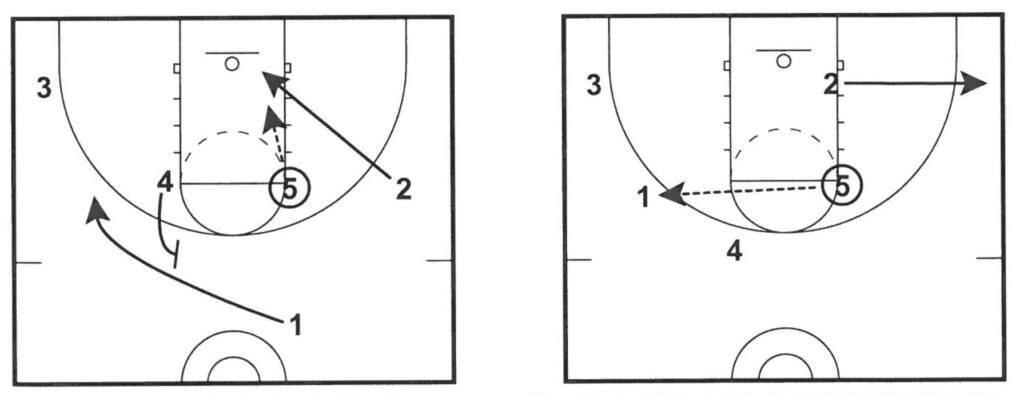
This read and react play begins with your basketball team using a 5-out set. The point guard dribble hard at the wing toward Player 4, who cuts toward the basket. 4’s cut finishes in the opposite corner. As Player 1 fills the wing, Players 5 and 3 rotate up one spot along the perimeter.
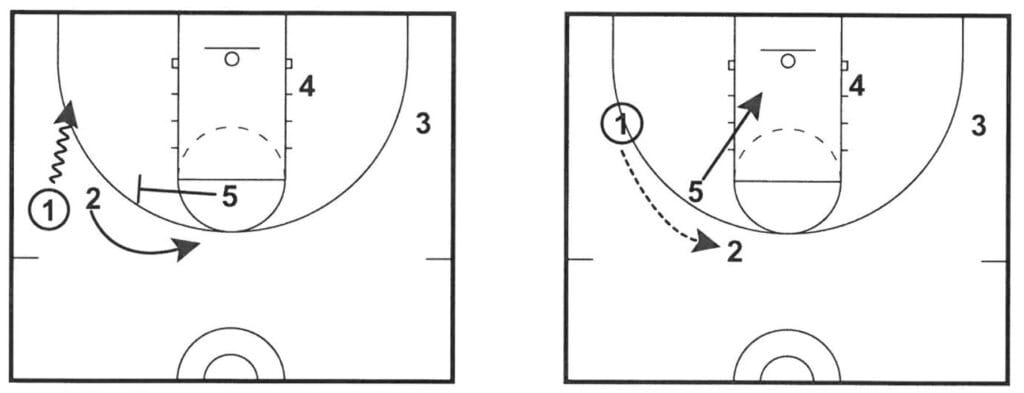
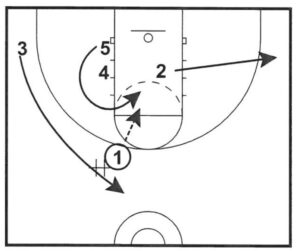
From there, Player 1 makes a pass to Player 2 in the corner. Player 1 then cuts, calling for the ball as he does so. Players 5, 3, and 4 all rotate to fill the open spaces on the perimeter. Player 1 gets into the paint but stops his cut under the basket.
1 reverses his course and sets a back screen for Player 5 on the wing. Player 5 makes his cut toward the basket. At this point, Player 2 can either hit 5 with a pass on the cut or wait for 5 to post up on the block.
On the weak side of this read and react play, the Player 4 sets a flare screen for Player 3 then cuts to the strong-side elbow. If Player 5’s cut was covered, Player 2 can throw a skip pass to Player 3. He can also clear the ball to Player 1 or hit Player 4 on the elbow. If Player 4 gets the ball, this set creates a high-low opportunity with Player 5.
The Read and React is a great basketball offensive system. The only issue I have come across in our time running it is it can be difficult to get points quickly out of it. I did some research and playing with the Read and React and utilized the principles of this basketball offense to create some set plays out of it.
These should offer good opportunities to score quickly out of the look while the opposing team thinks you’re still just running your offense. Even if you don’t run Read and React, these looks could still be utilized as great set play options to get good movement and looks at the basket.
Read and React Basketball Offense: Pin Screens
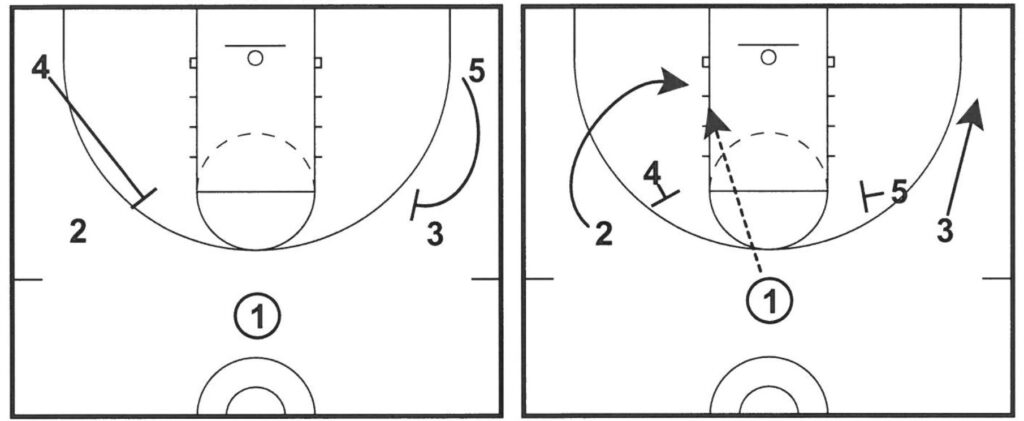
This is a VERY quick set, especially if you need a quick 2-point basket. The player on the left wing will receive a pin screen and they’ll curl to the block. For this play to be most effective, the player setting the pin screen on the left wing needs to be a knockdown shooter.
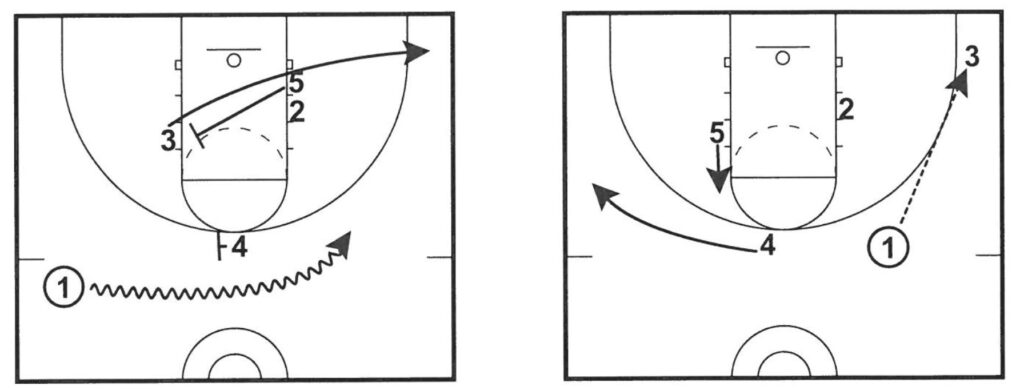
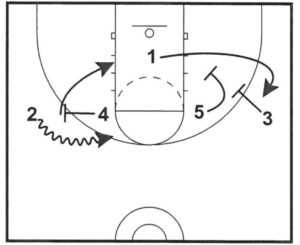
The initial action of this read and react basketball offense set play involves your two bigs setting pin screens for your wings. Of these two bigs, Player 4 should be a better outside shooter than Player 5. When setting these screens, Player 4’s back should face the corner while Player 5’s back faces the sideline.
As the screens are set, Player 2 curls toward the basket. Player 3 fades to the corner. The first look for your point guard should be for the layup. If not, the second read is for the shooter in the corner.
The second phase of this read and react basketball set involves a series of cuts for the offense. If neither Player 2 nor Player 3 are open on the pin screens, Player 4 flares to the wing. Player 2 cuts to the corner, and Player 5 cuts to the basket.
Another option here would be a high-low action with Players 4 and 5. In that option, Player 2 and Player 5 make still make their cuts, but Player 4 remains at the elbow. Player 1 makes an entry pass to 4 and clears to the opposite wing.
Player 4 would then look down low for Player 5, who has ideally sealed his defender when he made his cut.
Summer stands out as one of most integral points for any basketball program from year to year. This stretch of time allows for both individual and team-wide development, depending upon your set up. No matter if you’re participating in summer basketball team camps or simply conducting workouts, giving your players specific summer basketball development drills will make all the difference come next season.
However, like teams, not all developmental drills are created equal. Coaches need to scale the drills to optimize the success for their players. Provide your team with different phases to progress through as the summer moves on, and this will allow your basketball players to maximize these developmental drills.
Summer Basketball Individual Development Drills: The Basics
The first phase of your summer basketball development drills should address the basic skills your players need to master. This set of exercises remains particularly useful for youth basketball teams, especially those with younger players just getting into the sport. The drills here help players with the familiarization of necessary skills for competitive play. (Court length is 94 feet from baseline to baseline.)
Full Court, Right-handed Dribble
You should go down go down and back the court without losing control once before switching to the next drill. If you lose control, start over. Practice maintaining control, balance and stability in dribbling.
Full Court, Left-handed Dribble
You should go down go down and back the court without losing control once before switching to the next drill. If you lose control, start over. Practice maintaining control, balance and stability in dribbling.
One-handed layups, right side
You should make at least 70 percent before finishing. Don’t run for these layups, stand under the basket and use the backboard. This is a variation of the Mikan Drill.
One-handed layups, left side
You should make at least 60 percent. Don’t run for these layups, stand under the basket and use the backboard.
One-handed form shooting
Start within 2-3 feet of the basket standing in the paint. Practice same form every shot. Once you’ve made three in a row, take one step back, and do the same process. Must make three in a row to move back. Continue until you reach the free throw line.
Free Throws
Complete the same pre-shooting routine every time. Take a deep breath before you shoot and don’t move over the line. Start with 20 free throws and keep track of how many you make.
Summer Basketball Individual Development Drills: Intermediate Work
The next phase of your summer basketball development drills should up the skill-level necessary to complete each exercise. This intermediate work stands to sharpen each player’s skill if completed correctly and consistently.
Full Court, Crossover Dribble
You should go down go down and back, using a crossover dribble to switch hands every two dribbles, without losing control once before moving on to the next drill. If you lose control, start over. Practice maintaining control, balance and stability in dribbling.
Wing Layups
Start from the three-point line and complete slow, half, and full speed layups where you finish under the basket. From the right side, make at least 70 percent of your shots. From the left, at least 60 percent. Use the backboard with each layup attempt.
Elbow Shooting
Start on the right side, free throw line extended. Similar to the form shooting drill from the basics phase, practice same form every shot. Once you’ve made three in a row, shift to the left side and do the same process. Add a set number for completion.
Spot Shooting
Find a spot on the court within the three-point arc. Start 8-10 feet away from that spot, dribble quickly to it, pull up and shoot. Focus on stopping and shooting with good form. Complete a walk through the first couple of times if necessary. Do this for the same spot at least 15 times and keep track of how many shot you make.
Free Throws
Complete the same pre-shooting routine every time. Take a deep breath before you shoot and don’t move over the line. Start with 20 free throws and keep track of how many you make.
Individual Development Drills Progression
These summer basketball development drills can be completed both individually or within a team setting. The beauty of these basic and intermediate exercises is they can be incorporated into team workouts or players can complete them on their own at a neighborhood park or with at their basketball hoop at home.
Over the summer, players should look to complete these drills at least five times a week, unless they’re involved in other sports. But even if a player is participating in summer training for another sport, they should crave out time to complete these summer basketball development drills so as to not fall behind.
A well-conditioned team is a team that has an opportunity for great success on the basketball court. To become this kind of team though, basketball conditioning must take place. There are a variety of ways to do this: sprints, distance running, tough drills to improve game conditioning, or a combination of the previously mentioned activities.
While we do complete longer distance running, that is something we do the least amount of. That’s because when playing basketball, rarely do you jog or run for a really long distance. We prefer to implement more conditioning through wind sprints and drills that promote conditioning. Below are 3 wind sprint drills that are different from doing basic down/back line touches or suicides.
Basketball Conditioning: the Basketball Mile
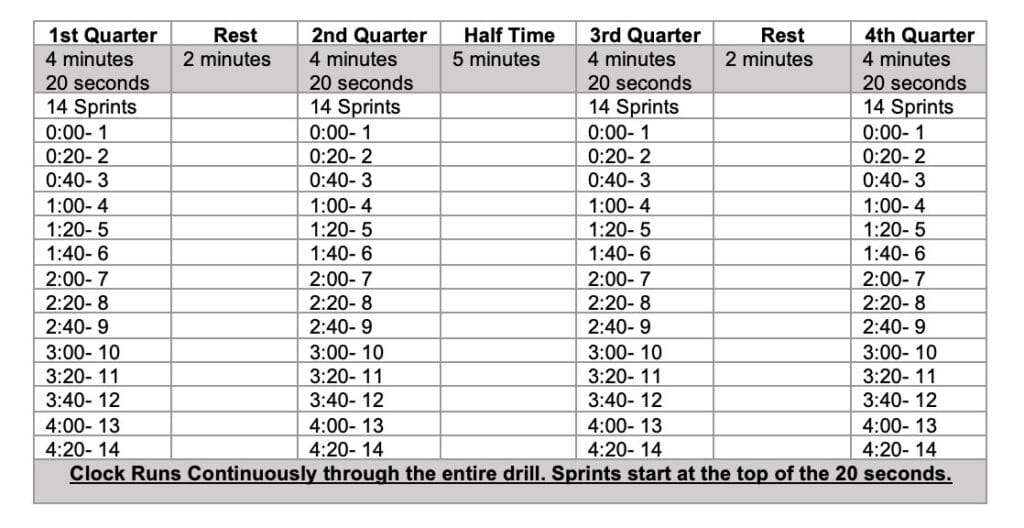
This is a great conditioning drill that we got from PGC Basketball. Basketball is divided into four quarters, so the basketball mile is divided into four quarters. The premise behind the basketball mile is the players do run a mile. But they do it in shorter spurts/springs to mimic basketball actions.
To successfully complete this, you need a running clock. At each interval on the clock, coaches must hit the buzzer and players start. The faster they run in the allotted time, the longer rest they get. The slower they run in the allotted time, the shorter amount of rest they receive. A table below shows the breakdown of basketball mile.
Basketball Conditioning: Champion Runs
This is a run that I ran in my high school under my coach Andy Elkins. It is a long sprint where if you don’t give 100 percent effort, it is impossible to complete.
The Champion Run consists of the following: 1 valley (see note in intro paragraph) followed by 5 full court touches (full court touch= start at 1 baseline and sprint to opposite baseline is 1). Coach Elkins always said the beauty of the Champion Run is that you will end up on the opposite baseline from where you started, so you might as well run two Champion Runs!
We do these runs when we don’t make free throws like we should, commit too many turnovers, or for just some good old-fashioned conditioning. We time these. Boys, especially guards and wings, should complete a Champion Run in the 1:00-1:07 range. Girl basketball players should complete a Champion Run in the 1:10-1:16 range.
Basketball Conditioning: the Riley Test
This is a conditioning test from the Xavier Newsletter #198. This is a great conditioning exercise because it is tough but achievable for players to accomplish.
The Riley Test is five “down and back” runs. The players start on the baseline and must run those five down and back sprints. It is best to group your players by position. After each set the players get a 2:30 break.
The goal for high school boys has always been anywhere from 1:05-1:10 per set and for the girls has been 1:10-1:20. This can decrease as you go throughout the season or get more conditioned. We always started with 3 sets but never did more than 6 sets.
Getting good looks at the basket remains the primary focus of most offenses. Although there’s value in developing intricate offensive sets, sometimes in a close basketball game, getting a quick hitter releases the pressure and allows your team to thrive. A good basketball playbook features a number of options across a variety of situations, and having a consistent quick hitter is an absolute must. Sometimes, getting your best basketball players going downhill toward the basket with a pistol action helps create easy looks.
This is especially true as a season winds down or teams begin their postseason tournaments. You’re team’s already been well-scouted at this point, and you may have matched up with your opponents more than once. So it’s important to keep your opponents on their toes with a fresh playbook. The tricky part remains how to add to our repertoire without providing an extra burden on our players.
Enter the Basketball Quick Hitter series. These simple sets afford any offense release valves that players learn in a matter of minutes.
The basketball pistol play refers to an early offense action between the point guard and a wing player, with a post player at the top of the arc. The two main Pistol options to start a play are a dribble handoff and a pick and roll. In the Pistol action, the offense attempts to catch the defense before it sets in hopes to find optimal mismatches or blown coverage by a lack of defensive rotation, which makes it one of the best basketball quick hitters.
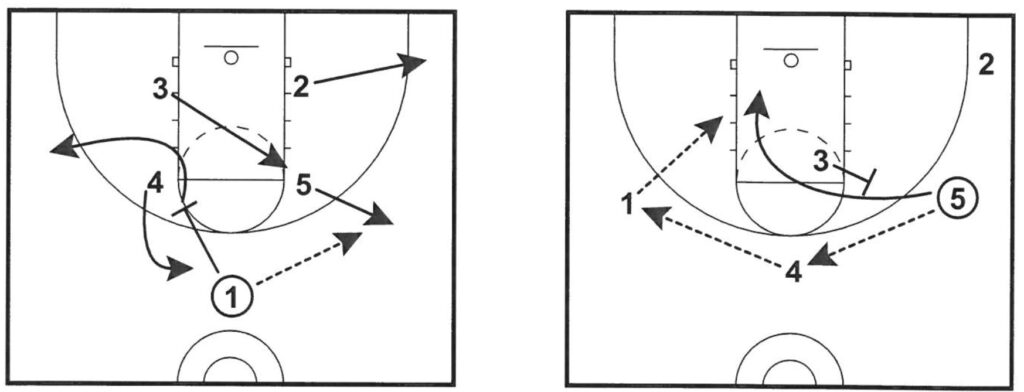
The sequence of this play begins with your point guard hitting ahead quickly to the wing. From there, Player 1 follows his pass and sprints into a dribble handoff with Player 2. As this pistol action develops, Player 4 sets a screen for Player 3 on the weak side. 4 rolls to the basket while 3 slips to the corner.
Player 1 needs to sprint up the basketball court into this pistol action. Completing the dribble handoff creates the quick-hitter here, because 1 is now going downhill to the basket at full speed.
If the defense covers this initial pistol action, the secondary scoring option unfolds for your basketball team. Player 2 cuts off a flare screen from Player 5. Player 1 on the wing has two options at this point: a pass to Player 2, who will have either a shot or a drive.
After setting the flare screen, Player 5 dives toward the hoop, drawing the defense down with him. While all that action is going on, 4 and 3 can screen for each other on the weak side to keep the defense honest.
Getting good looks at the basket remains the primary focus of most offenses. Although there’s value in developing intricate offensive sets, sometimes in a close basketball game, getting a quick hitter releases the pressure and allows your team to thrive. A good basketball playbook features a number of options across a variety of situations, and having a consistent quick hitter is an absolute must. Sometimes, a simple quick backdoor cut provides all the offense you need.
This is especially true as a season winds down or teams begin their postseason tournaments. You’re team’s already been well-scouted at this point, and you may have matched up with your opponents more than once. So it’s important to keep your opponents on their toes with a fresh playbook. The tricky part remains how to add to our repertoire without providing an extra burden on our players.
Enter the Basketball Quick Hitter series. These simple sets afford any offense release valves that players learn in a matter of minutes.
Basketball Quick Hitter: Quick Backdoor Cut
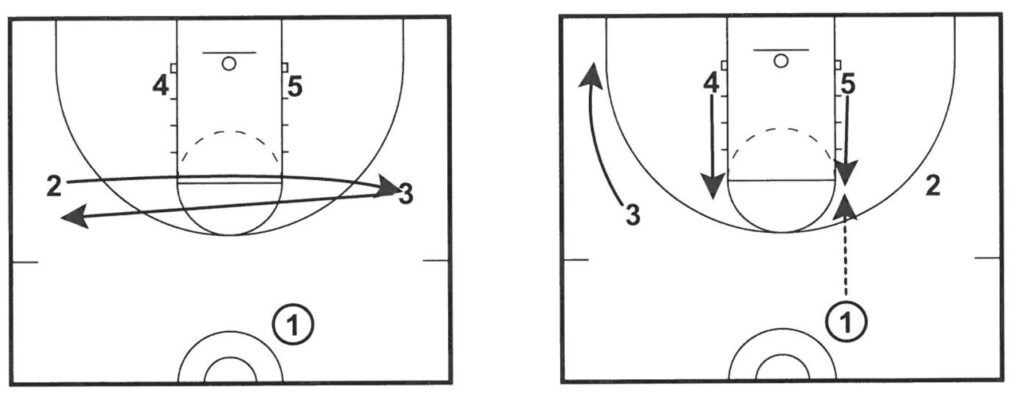
This quick hitter generates a great, quick backdoor cut opportunity for your offense. The play requires precise timing to ensure maximum efficiency. You’ll want to design this play with the player you want shooting the ball on the left wing.
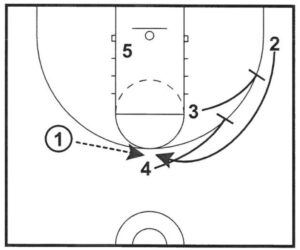
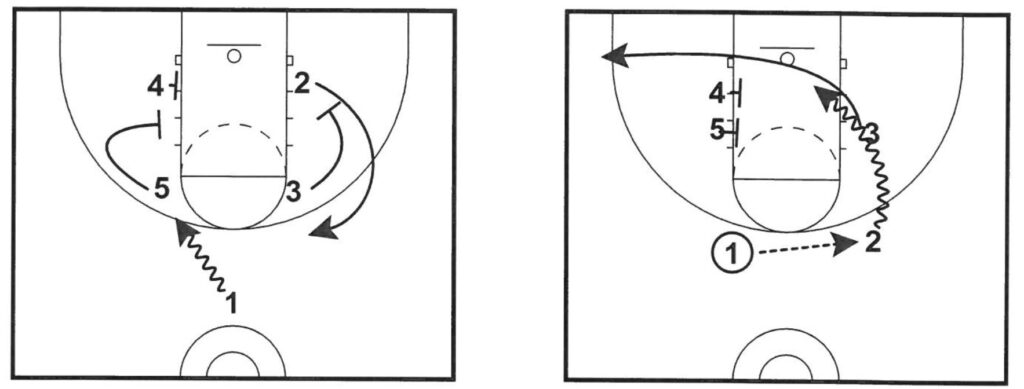
The play opens with a fairly traditional set up, with both bigs starting down low and the shooters occupying the wings. The point guard brings up the ball, and as he crosses half court, the action of this quick hitter begins. The wings exchange positions on the floor, with Player 3 starting the movement and Player 2 waiting until 3 passes the right elbow. Player 3 initiating the movement draws the eyes of the defense away from Player 2.
Once the wings have exchanged, the bigs cut up to the elbows. The point guard, Player 1, can lead the defense to the left with his dribble before an entry bounce pass to Player 5 at the elbow. Player 3 clears from the wing and floats to the weak side corner at this point.
This is where the quick-hitting element of this quick backdoor cut takes place. As Player 5 receives the ball at the elbow, Player 2 starts his quick backdoor cut. Player 2 can set up his defender with fake or hard step toward the top of the key before his backdoor cut. 5 looks for 2 on the cut. 5 should use his peripheral vision to read the play.
As the pass happens, Player 4 sets a flare screen for Player 1, who cuts to the left wing. Should the defense cover Player 2’s cut, 5 should look to skip the ball to 1 on the wing. This secondary action keeps multiple actions occupying the defense.
Getting good looks at the basket remains the primary focus of most offenses. Although there’s value in developing intricate offensive sets, sometimes in a close basketball game, getting a quick hitter releases the pressure and allows your team to thrive. A good basketball playbook features a number of options across a variety of situations, and having a consistent quick hitter is an absolute must.
This is especially true as a season winds down or teams begin their postseason tournaments. You’re team’s already been well-scouted at this point, and you may have matched up with your opponents more than once. So it’s important to keep your opponents on their toes with a fresh playbook. The tricky part remains how to add to our repertoire without providing an extra burden on our players.
Enter the Basketball Quick Hitter series. These simple sets afford any offense release valves that players learn in a matter of minutes.
The play begins with your point guard coming up the left side of the basketball court, and Player 5, the quick hitter target, on the opposite block. 1 uses a high-ball screen from Player 4. As that happens, 5 comes across to screen for Player 3.
After the ball screen, 4 pauses at the top of the key. 1 begins a dribble penetration and looks for Player 3, who cut to the right corner. Player 5 acts like he’s setting a cross-screen near the elbow as Player 4 clears to the wing. 1 makes the pass to 3 in the corner.
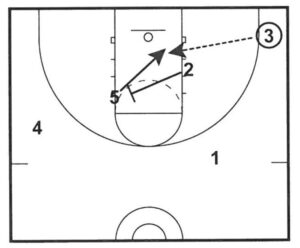
From there, Player 2 sets a cross screen for Player 5. Player 3 looks for 5 as he cuts to the hoop. It’s important that Player 5 cuts to the rim and not the opposite block since this is a basketball quick hitter.
If 2 sets a solid cross screen, 5 should be open for a clean touch down low and a layup. Player 3’s pass must hit 5 in the hands to minimize the time needed to get the shot up.
If you have a left-handed post player, you can reverse this play. The important part of this play is you want to have the player that screens across for the post (2 in this play) to be a major scoring threat. You want the defense to respect this player and not cheat off onto your post.
Coaches Steve Collins and Bill Flitter have joined forces for a new basketball podcast: Coaching Youth Hoops! This latest venture joins Coach Collins’ portfolio of popular podcasts on coaching basketball, both youth hoops and high school. These coaches bring a wealth of knowledge from their experiences in the game of basketball, developing talented players across the spectrum of talent levels.
If you’re new to coaching youth hoops, or perhaps an experienced coach looking to cut through the noise, this is the podcast for you! Coach Steve and Coach Bill will provide weekly episodes to simply your processes. They’ll help you avoid wasting time and money learning to coach basketball players from as young as kindergarten.
Goal of the Podcast
This podcast is designed to help volunteer coaches, or coaches getting a small stipend, that jump in and try to figure it out in their spare time. Join these seasoned youth basketball coaches as they give you the blueprint you need to succeed on and off the court. In each episode, you’ll discover easy-to-implement tips and techniques that you can apply to your next practice.
As Coach Flitter says in the first the first episode:
“I want to help one million kids learn the game of basketball. But how do you do that? By helping the coaches.”
The episodes for the show will drop on Tuesday mornings. They’re designed to educate coaches from rec leagues all the way to competitive youth leagues. It doesn’t matter if you have a team of third graders who can’t dribble, or a group of eighth graders being recruited. You’ll find something helpful here.
Check out the dedicated Facebook group right now. As the podcast grows, you’ll find downloadable resources and deep dives into the nitty-gritty of coaching youth basketball. Subscribe today!
At some point in your career, if not your season, a situation will arise where you are down three points with two free throws on tap. Or, you could be down two points with one free throw. In these situations, you’ll need a missed free throw play for a chance to extend or win the game.
The question is: Are you ready for this situation? Is this a situation you have worked on in practice? While this does not need to be a huge part of your practice planning, it is something that should find a place. This is especially true as you head into your postseason tournament.
Below is a play that we implement each season called Desperado. In it, we work on a missed free throw play to give us a chance to tie or maybe even win the game! This is not something we work on a ton, but we will sprinkle it in at times throughout the season to ensure we are ready for this situation.
Missed Free Throw Play: Desperado
Situation: A free throw shooter MUST miss a free throw at end of a game.
Process:
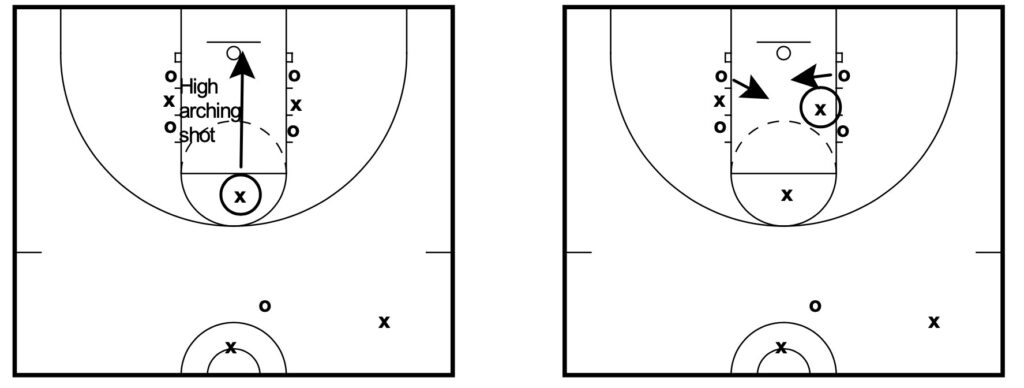
Run this on side of shooter’s arm (R handed shooter= R side, L handed shooter= L side).
Shooter must line their shooting hand up with the vertical side of the backboard square.
Shooter will shoot a high a high arching shot to ball banks off backboard and onto top of rim. This will cause a long rebound for offensive rebounder on 2nd block.
If down 2, rebounder gets it and attempts a shot quickly.
If down 3, rebounder either boards and passes out or tips it out to shooter for 3.
Shooter will go to top of key and 1 guard at top will go to ball side corner while other will got to ball side wing.
The two players at the top need to start moving on the flight of the ball but need to be sure not to cross the top of the key extended until ball is released to avoid a violation. Once ball is released, these players must sprint to their spots.
We like to overload the rebounding side to give us multiple looks for a shot.
In addition to running this play in a situation, you need to find time to allow all of your players to work on missing a free throw in this way. In addition to practicing missing the free throw, practice players grabbing the rebounding for a quick putback or receiving a tip back for a 3 point shot. Just make sure you are prepared for all situations!
Kyle Brasher Gibson Southern High School
Social Studies Teacher
Lady Titans Basketball Coach
As coaches, it is vital that we check in our players frequently, but especially at certain points during the season. We schedule three basketball team meetings with our players throughout the basketball season. These go beyond just the simple evaluation of a single basketball game. The check-ins allow us to connect with our players and make expectations clear. It provides a forum for open communication, which is always important.
Basketball Team Meetings
The first meeting is the Beginning of Basketball Season Team Meeting. We will always have a beginning of the season meeting where we inform them of what team they will currently be on and what their role will be. This meeting allows us to make our expectations clear, so the players understand how best to improve their games and help the team succeed.
Our second sit down for a team meeting comes in the middle of the basketball season. During this meeting, we review the team and player performances thus far. By the middle of the season, we have a decent sample size for statistics, so that data is helpful. This meeting will consist of going over their stats. We discuss what they’re doing well and areas to make sure they are focusing on for improvement going into the second half of the season.
The final basketball team meeting of the season comes after we’ve completed our schedule. This meeting consists of a season-long review, going over what went well and what the next steps in development are. This post-season meeting provides a launching point for our team’s off-season work.
The Post-Season Team Meeting
The post-season team meeting provides coaches and players an opportunity to reflect on the season. You can touch on the highs and lows of the season, both the good and the bad. This is particularly useful for your returning athletes Improving as individuals and as a collective unit needs to be the emphasis for your off-season plans.
It is important to motivate players about where they currently are and hope to be over the upcoming off-season to prepare for next season. As coaches, we must engage in this dialogue and realize the important role we play. We need to make sure our players can state specific goals and ambitions they hope to achieve to become the best basketball player they can be.
Goals of “getting better,” “getting shots up,” and “getting into the gym” just will not cut it. We need our players to be specific about their goals and ambitions. Think of goals like:
“I want to make 10,000 shots this off-season,”
“spend 3 hours a week working on ball handling,” or
“increase my squat max by 35 pounds.”
These are tangible, specific goals that can be measured. The more specific we can be with our athletes and make them the main character in their story the better player they will become and the bigger impact they will have on our program.
Post-Season Basketball Team Meeting Handouts
In addition to thinking about the physical side of the game, we must consider the mental and leadership side of our players as well. In these basketball team meetings, we strive to get our players reading leadership material. Anything from Jon Gordon will resonate with any high school athletes. Some of the best we have given include “The Energy Bus“, “The Hard Hat“, and “Positive Dog“. We want to make sure we are molding and building our future leaders to help take our program to the next level.
With the reading of the book, we also include a short assignment for them to complete as well to help in their learning of leadership qualities.
Handout 1- Off-season player handout.
We will go through this chart with each player, fill it out together, and they get a copy to take home with them.
Player:
22/23 Grade:
Spring:
3 Success from Season:
3 Areas of Improvement:
What do you want from basketball?
Plan to accomplish?
Handout 2– Spring Leadership Book Assignment.
This is a short assignment they can complete over the leadership reading of their choice.
Assignment: In a 1 page double-spaced paper, answer the following 2 questions:
Summarize the book. What are important lessons/themes you learned from this book? Be sure to provide some examples.
How can you take what you have learned from this book and apply it to both your teams and life at large? Be sure to provide 3 examples of how you plan on applying these principles in your life.
We are anxious to see what you learn from this reading!
At the end of the day, we need to make sure our players are improving as much as possible. We need to be their guide on their journey and make them become the main character in their story.
The season is over and spring workouts are starting to commence. It’s now time to start thinking about your Summer Basketball plans. As your players ease into their time off from school, summer stands out as the perfect opportunity to improve their game. It’s never too early to prep for next season!
As you prepare for the next season, it’s important to remember every other team will be doing the same. Communicate to your players that teams are planning and working towards defeating them on the floor. It’s up to them to be ready for the next challenge. Urge them not to wait until the next school year. Definitely tell them not to wait until September to physically prepare. Impress upon them the value of being the person that’s going to work harder than everyone else to improve. Your journey starts with summer basketball prep, so ignore the noise, embrace the grind, and love the challenge!
Consider these elements to help streamline the summer basketball prep work and to help have a great off-season.
Returning Opponent Data
Our staff loves to go through our upcoming opponents for next season and start gathering data on them. Summer is a great time to start this basketball scouting work. We look at their previous season record, returning players and starters. We also look at offensive average and defensive average.
By doing this, we consider what the strengths and weaknesses of our opponents are. This helps us think about the main question of our program: What do we have to do to be better than our opponents?
The answer to that question will help dictate what we focus on starting in our summer basketball practices.
Promote Basketball Summer Camp
The youth/feeder program is the lifeline of any successful high school program. It is important to have these upcoming athletes coming into your gym.
There are a variety of ways to run a summer basketball camp, but the most important thing is to find one that best fits you and your players schedules. With this ever-changing world, it is important to have all hands on deck. If your school requires service hours for their students, using your players as counselors for the youth summer basketball camp might fill that graduation requirement for them. It also keeps them busy and in the gym!
After locking in a date for your camp, promote it! Get into the schools to talk to your future campers, create a YouTube video, promote on social media, do whatever it takes to get as many people in the gym as possible.
Schedule Summer Basketball Games & Practices
This is something that needs to be done with your high school athletes, but you may want to even consider doing practices and games with your middle school athletes, too. Communication is key at either level, especially with parents. Make your expectations clear for the involvement with summer basketball work in your program.
Chat with your returning players about their schedules, get a feel on where they’d like to play games, and find ways to make these as fun but as cost effective as possible. Find local games against your local high school opponents but also consider an out-of-town trip to bring about some extra bonding with your team.
In addition to practicing with your high school players, find time to get into the gym with your middle school players, too. They can start to hear your voice, hear your philosophies, and start prepping them to be part of the high school program.
Overnight Summer Basketball Camp Trip
If possible, find a team summer basketball camp that is out of town. Get a hotel and find some activities to enjoy as a team. Take your players to cities they have never been to. Partake in activities they’ve never done (escape rooms, billiards, bowling, etc.). Eat at restaurants they haven’t been to, and play games against opponents they otherwise may never see.
These activities provide valuable team building opportunities that will strengthen the bonds between players and coaches. Summer basketball trips often create life-long friendships and memories that your players will cherish.
If you have some players with aspirations of attending college to play basketball, find schools they may be interested in attending after high school.
10K Shot Club
Motivate your players to get shots up on their own. As all high school coaches know, you can never have enough shooting. Encourage your players to log their shot attempts and track this. Reward them in the fall with prizes, recognition, food, whatever it may be. Do a shooting program not only for your high school athletes but your feeder athletes, too.
The Box Set offense in basketball stands out as a popular offense because it is purposefully designed to get easy buckets. This offense requires precise movement and timing, but when properly executed, the box set leads to scoring opportunities. These sets incorporate both on-ball and off-ball screens, and can be deployed against both man-to-man and zone defenses. This box set uses a UCLA cut for a quick-hitting first action.
Some of the most famous coaches throughout the history of basketball, including Chuck Daly, Mike Krzyzewski, and Dean Smith, used variations of the box set offense at different points in their careers. Box allows the ball to flow into the hands of your best playmakers in sports on the floor where they will be successful.
Box Set Offense: UCLA Cut
Unlike the Box Set Isolation play, this set uses multiple actions to create good shots. This set, like the others in the Box Set Series, begins with the same alignment. This helps prevent opposing defenses from immediately recognizing the play. Having the same set up also makes scouting your team more difficult.
This box set is designed purposefully as a quick-hitter with the initial UCLA cut. If the opposing defense covers up that cut, the second action of this play creates a pick-and-roll opportunity on the strong side. It also adds a weak side stagger screen to a potential jump shot. This play is great if you want to isolate a post defender on a ball screen and/or if you have a player that is great coming off a ball screen. This play is very effective because it keeps both sides of the floor busy to really allow that ball screen to get as open of a look as possible, either on the drive or roll.
Box Set UCLA Progression
This set starts with the same alignment as the Box Set Three-Pointer play, with your team’s two big men occupying the elbows. Your wing players, 2 and 3, start on the low blocks.
The play begins with both Player 2 and Player 3 popping to the wings. The point guard passes to the open wing. Depending upon the defensive coverage, Player 1 can pass to either wing. Another variation to this play could have Players 2 and 3 cut to the opposite wings from the low blocks.
The Box Set UCLA cut comes following the first pass. If Player 1 passes to Player 2, he cuts off an elbow screen from Player 4. 2 immediately looks at the cutter for this quick-hitter opportunity.
If the defense covers this box set’s UCLA cut, then Player immediately moves into a ball screen on the wing for Player 2. As that’s happening on one side, Player 1 uses stagger screens on the opposite wing as well.
Player 2 can attack the lane, hit Player 4 on the roll, or look to kick the Player 1 on the weak side wing. Another layer for this could see either 3 or 5 slip the screen and cut.
This play works in either direction. All the box set offense plays can easily be flipped to either side of the court and with them all starting out of the same base look. It makes scouting your set plays that much harder.
The Box Set offense in basketball stands out as a popular offense because it is purposefully designed to get easy buckets. This offense requires precise movement and timing, but when properly executed, the box set leads to scoring opportunities. These sets incorporate both on-ball and off-ball screens, and can be deployed against both man-to-man and zone defenses. The box set can also create solid low-post looks.
Some of the most famous coaches throughout the history of basketball, including Chuck Daly, Mike Krzyzewski, and Dean Smith, used variations of the box set offense at different points in their careers. Box allows the ball to flow into the hands of your best playmakers in sports on the floor where they will be successful.
Box Set Offense: Low-Post Look
Unlike the Box Set Isolation play, this set sports multiple actions to create good shots. Ideally, this set begins with the same alignment as other Box Set plays in your playbook. This helps prevent opposing defenses from immediately recognizing the play. Having the same set up also makes scouting your team more difficult.
This box set is designed purposefully to get an open low-post look for your best post player. If the opposing defense covers up that shot, the second action of this play creates an open look for your team’s best shooter. It’s imperative to stress the importance of cutting hard for both the post and the guard in this set.
Box Set Low-Post Progression
This box set play begins with the same alignment as the Box Set Three-Pointer play, with your team’s two big men occupying the elbows. Your wing players, 2 and 3, start on the low blocks.
The play starts with a series of cuts. Player 5 pops from the right elbow to the left wing and receives the initiating pass from Player 1. The point guard then cuts down to set a screen for Player 4, who curls to the top of the key. Following the screen, Player 1 cuts to the weak side wing. As this action unfolds, Player 2 cuts to the strong-side corner, and Player 3 moves from the left block to the right elbow.
The next action involves 5 reversing the ball. Player 4 receives the centering pass and reverses to Player 1 on the wing. As those passes occur, Player 3 sets a back-screen for Player 5 at the elbow. Player 5 uses that screen and cuts down the lane. Player 1 can either hit Player 5 on the cut to the basket, or once 5 establishes himself on the low-post.
The second action for this box set low-post play creates an opportunity for your team’s best shooter.
If Player 1 can’t get Player 5 the ball, the next movement begins. Player 3 and Player 4 set stagger screens on the weak side for Player 2. The shooter cuts up from the corner, curling along the three-point line.
In this box set, Player 1 can ball-fake to the low-post before passing to the shooter. Player 2 uses the stagger screens and receives the pass at the top of the key. He can either take that shot, or attack the lane. A hard dribble drive could draw Player 5’s defender, leaving the low-post open for a drop off pass.
The Box Set offense in basketball stands out as a popular offense because it is purposefully designed to get easy buckets. This offense requires precise movement and timing, but when properly executed, the box set leads to scoring opportunities. These sets incorporate both on-ball and off-ball screens, and can be deployed against both man-to-man and zone defenses. The box set can also create certain three-pointer opportunities.
Some of the most famous coaches throughout the history of basketball, including Chuck Daly, Mike Krzyzewski, and Dean Smith, used variations of the box set offense at different points in their careers. Box allows the ball to flow into the hands of your best playmakers in sports on the floor where they will be successful.
Box Set Offense: Three-Pointer
Unlike the Box Set Isolation play, this set is designed purposefully to get an open look at a three-pointer for your team’s best shooter. Ideally, this set begins with the same alignment as other Box Set plays in your playbook. This helps prevent opposing defenses from immediately recognizing the play. Having the same set up also makes scouting your team more difficult.
This box set three-pointer generates a wipe open look for your team’s best shooter when executed correctly. The most important part of this set is that the screeners must be shoulder-to-shoulder on both screens. If that happens, your shooter will be open a lot.
Box Set Three-Pointer Progression
This box set begins with your two bigs, players 4 and 5, occupying the elbows. Your two wings, players 2 and 3, start off on the low blocks.
The point guard dribbles up and the box set three-pointer play starts with player 3 popping to the wing. Player 1 passes 3 the ball and cuts to the opposite wing. As the pass takes place, 2 fills the strong-side low block vacated by 3.
Once 3 has the ball on the wing, player 5 sprints across and stands shoulder-to-shoulder with player 4 at the elbow, free throw line extended.
3 uses the double ball screen and puts pressure on the lane, with 1 spread out wide for a potential kick out. 3 can attack the basket at this point if the defense overplayed on the wing.
The box set three-pointer play’s progression continues with players 4 and 5 pivoting to set a second screen.
4 and 5 stay shoulder-to-shoulder and drop to set another double screen, this time for player 2, ideally your team’s best shooter. The key to this second screen is setting it well below the three-point line to give your shooter space behind the arc.
Player 2 uses the double screen and curls up the floor. The shooter must have his hands ready to receive. This is a catch-and-shoot opportunity.
Player 3 drives toward the land, but picks up his dribble and reverses his stance. He hits player 2 coming up following the off-ball screen.
If players 4 and 5 set their screen properly, this box set should get your best shooter a wide open look at a three-pointer. Player 1 can drop for an offensive rebound opportunity. Player 3 remains high as an outlet to reset the offense if the defense covers the shot.
The Box Set offense in basketball remains one of the more popular offenses because it is purposefully designed to get easy buckets. This offense requires precise movement and timing, but when properly executed, the box set leads to scoring opportunities. These sets incorporate both on-ball and off-ball screens, and can be deployed against both man-to-man and zone defenses. The box set can also create certain isolation opportunities.
Some of the most famous coaches throughout the history of basketball, including Chuck Daly, Mike Krzyzewski, and Dean Smith, used variations of the box set offense at different points in their careers. Box allows the ball to flow into the hands of your best playmakers in sports on the floor where they will be successful.
Box Set Offense: Isolation
Unlike the Box Set Backdoor play, this set is designed purposefully to get an isolation opportunity for your team’s best attacker. Ideally, this set begins with the same alignment as other Box Set plays in your playbook. This helps prevent opposing defenses from immediately recognizing the play. Having the same set up also makes scouting your team more difficult.
This is a great box set isolation play to get your best penetrator a cleared side of a court. The key to this play is the player that gets the ball for the isolation must make a quick move. We have always coached our players up to do a quick jab to the middle of the court and go towards the baseline side. If you have a left handed player, this play could easily be flipped to the other side.
Box Set Isolation Progression
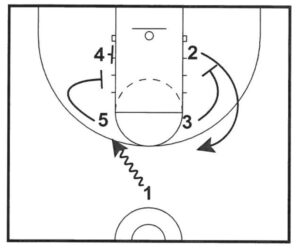
This box set isolation play begins with the two bigs, players 4 and 5, on the left box and elbow. 2 and 3 complete the box set on the opposite side.
The point guard, player 1 in this figure, dribbles hard toward the left, stopping at the three-point line elbow-extended. 1 picks up his dribble and looks to pass.
As that action happens, player 3 sets a down screen for player 2, who is the team’s best isolation player. 2 uses the down screen and pops up to the three-point line on the weak side of the floor.
As 2 pops up to the top, player 5 slides down beside player 4 in order to set up a double-screen along the baseline.
This box set isolation play continues as player 2 cuts to the right wing.
After setting the down screen, 3 then cuts to the strong side corner. 3 uses the double-screen set by players 4 and 5 along the baseline to draw the defense.
1 can ball fake to the corner before finding 2 with a pass on the right wing. From there, 1 holds his position to flood the left side, leaving 2 to operate along the right with this opportunity.
The box set isolation design creates an open side of the floor for your team’s best attacker to create off the dribble. 2 should look to penetrate hard, knowing he has a drop off on the opposite block as well as an outlet in the weak side corner. As player 2 begins his drive, the point guard can float toward to right wing to provide his teammate with a safety valve.
The Box Set offense in basketball remains one of the more popular offenses because it is purposefully designed to get easy buckets. This offense requires precise movement and timing, but when properly executed, the box set leads to scoring opportunities. These sets incorporate both on-ball and off-ball screens, and can be deployed against both man-to-man and zone defenses.
Some of the most famous coaches throughout the history of basketball, including Chuck Daly, Mike Krzyzewski, and Dean Smith, used variations of the box set offense at different points in their careers. Box allows the ball to flow into the hands of your best playmakers in sports on the floor where they will be successful.
Box Set Offense: Backdoor Lay-Up
This play out of the box set offense is designed purposefully to create a quick and east backdoor lay-up opportunity. When facing a man-to-man defense, this set can be used once or twice a game, depending upon how disciplined the opposing defense is. The key to running this play is misdirection.
This box set offensive play begins with the two bigs, 4 and 5, on the left box and elbow. 2 and 3 complete the box set on the opposite side.
The point guard initiates the play with a hard dribble drive toward the left elbow. As he makes that move, 4 slides down to create a double screen for 3, who races to the string-side corner. As 3 makes his cut, he yells “Ball!”
While this action takes place, 2 steps back to the three-point line. 1 picks up his dribble and does a ball fake to the corner. With all eyes and flow heading toward the left, 2 executes a backdoor cut at that point. 1 hits 2 with a bounce pass as he cuts down the lane.
Box Set Offense Progression
If 2’s cut gets covered up by the defense, the progression out of this box set offense remains simple.
First, 2 must clear to the right side corner. Then, 4 sets a screen for 5, who curls into the lane. If neither of those players is open on their cuts, 3 must sprint up from the left corner to take a handoff from 1.
This variation allows the offense to flow into another set if need be, or create a scramble situation if 3 can attack an open lane.
The box set offense stands out as an adaptable set for almost any team. These plays can be quick-hitters, or designed to generate open three-point looks.
One of the benefits of using the box set offense can make scouting difficult for opposing teams. Using the same starting look with the set keeps the defense from immediately knowing the progression of the play, even if they’ve scouted well. Check back for more on the box set series.


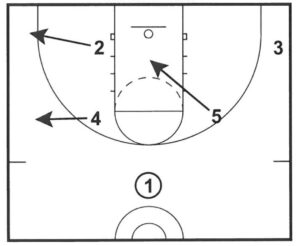 The second phase of this read and react basketball set involves a series of cuts for the offense. If neither Player 2 nor Player 3 are open on the pin screens, Player 4 flares to the wing. Player 2 cuts to the corner, and Player 5 cuts to the basket.
 From there, Player 2 sets a cross screen for Player 5. Player 3 looks for 5 as he cuts to the hoop. It’s important that Player 5 cuts to the rim and not the opposite block since this is a basketball quick hitter.
 2nd Episode:
 If the defense covers this box set’s UCLA cut, then Player immediately moves into a ball screen on the wing for Player 2. As that’s happening on one side, Player 1 uses stagger screens on the opposite wing as well.
 The second action for this box set low-post play creates an opportunity for your team’s best shooter.
 The box set three-pointer play’s progression continues with players 4 and 5 pivoting to set a second screen.
 This box set isolation play begins with the two bigs, players 4 and 5, on the left box and elbow. 2 and 3 complete the box set on the opposite side.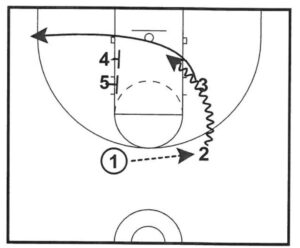
 If 2’s cut gets covered up by the defense, the progression out of this box set offense remains simple.