
If you found this useful, don’t forget to check out additional blog posts at TeachHoops.com. Also, check out TeachHoops on Facebook, Twitter, Instagram and YouTube.

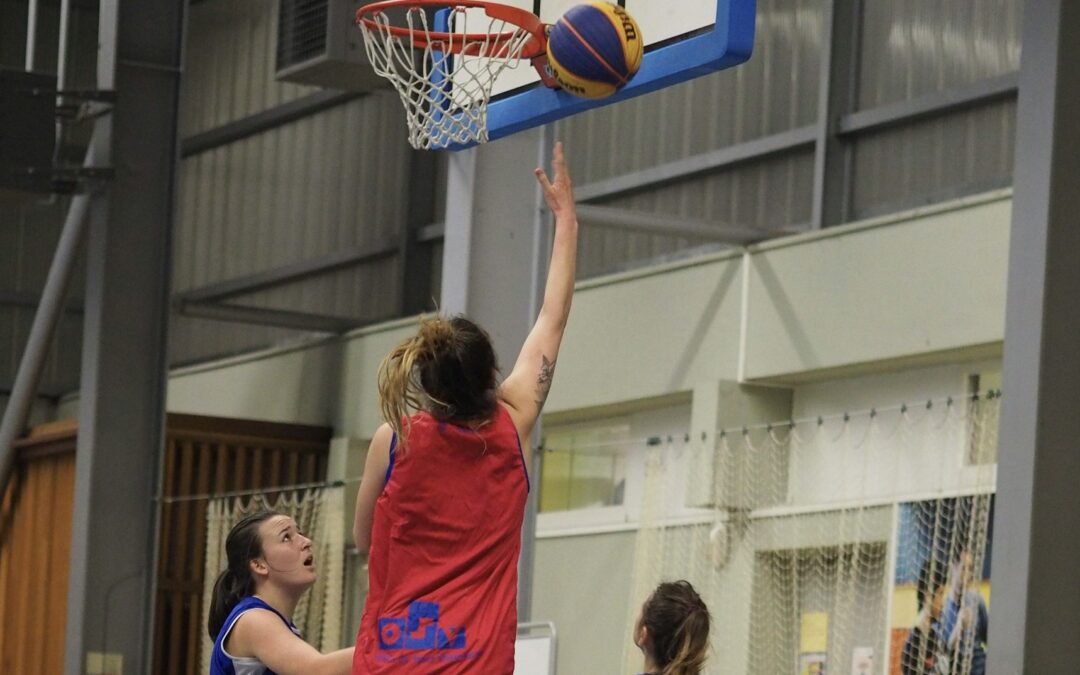
As a veteran basketball coach, I’ve seen firsthand the transformative power of well-designed drills in shaping young players’ skills and game understanding. One such drill that has consistently yielded remarkable results is the 3-on-2 Continuation Basketball Drill. In this article, I’ll delve into the specifics of this drill, its benefits, and how you can effectively implement it with your youth basketball team.
The 3-on-2 Continuation Drill is designed to enhance players’ transition offense and defense skills while promoting quick decision-making and teamwork. It involves two defensive players and four offensive players, with continuous three-on-two scenarios occurring up and down the court.
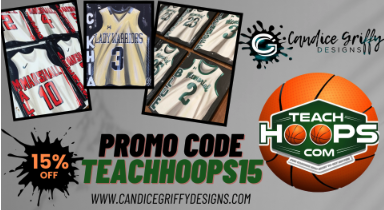 The Best Senior Night Gifts!
Make an impact with your players this year! This is a made to order painting on stretched canvas signed by the artist, Candice Griffy. Choose your own colors, name and number for this unique piece of artwork! The canvas has stapled back and is ready to hang directly on the wall so there is no need for further framing!
Use promo code TEACHHOOPS15 for 15% off at CandiceGriffyDesigns.com!
When introducing the 3-on-2 Continuation Drill to your youth basketball team, consider the following tips:
Integrating the 3-on-2 Continuation Drill into your coaching regimen offers numerous benefits for youth basketball players:
The 3-on-2 Continuation Basketball Drill is a game-changer for youth teams looking to elevate their skills and performance on the court. By incorporating this drill into your coaching repertoire and focusing on key elements such as pace, tracking, defensive variations, and transition movement, you can empower your players to reach their full potential and achieve success in game situations.
Coach Unplugged Podcast:
If you found this useful, don’t forget to check out additional blog posts at TeachHoops.com. Also, check out TeachHoops on Facebook, Twitter, Instagram and YouTube.
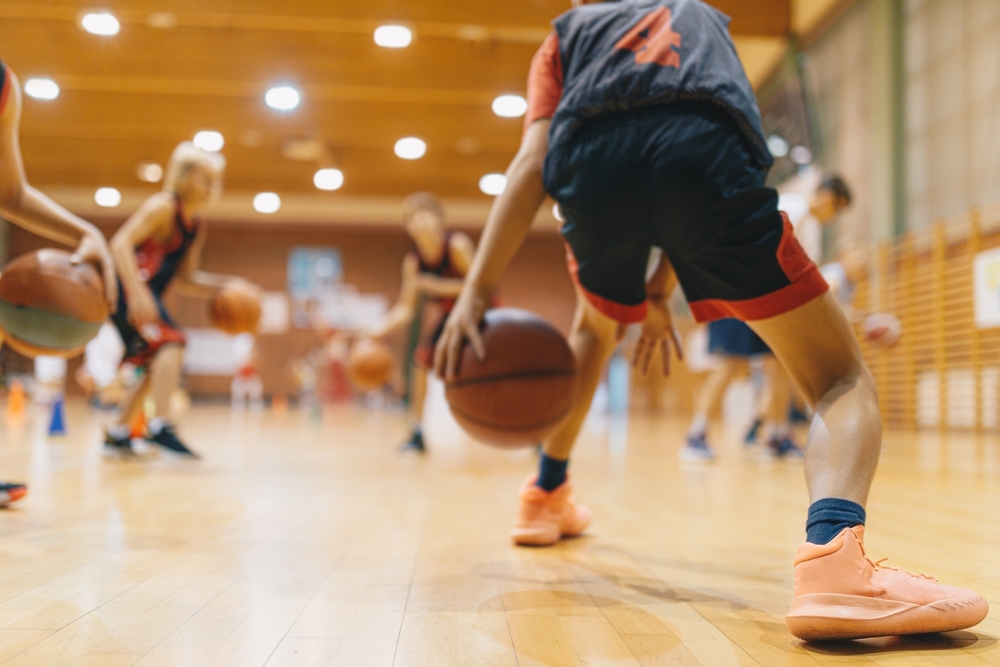
Incorporating the right basketball drills for kids makes all the difference for coaches at the youth level. Coaches need to gauge the skill and talent they’re working with, instituting a practice plan to maximize the development of these young players. Finding the right balance for your practice is key. You want your players to practice hard, hone their skills, and become better basketball players. But you also want them to have fun.
Coaching at the youth level takes plenty of patience and positivity. You’ll need to incorporate a fast pace and keep your players occupied and engaged, especially during potentially monotonous skill development drills. Developing focus and fun at practice remains an integral effort for coaches at the youth level of the game.
While there’s no magic formula for practice planning or picking drills, leaning on your experience as a head coach often shows the right path for your players. Here’s a look a some of the best basketball drills for kids.
Developing simple, fun, and effective drills for kids at the youth basketball level might be one of the most difficult parts of the job for any coach. When dealing with beginners, it’s important to layer skill development and not overwhelm the kids with complicated basketball drills. Coaches often zero-in on the basics, which include dribbling, passing, rebounding, and shooting.
Children, especially competitive ones, love the game Red Light, Green Light. This basketball dribbling drills plays off that popular kids game. Assuming you’ve worked with the basic form for dribbling, this game engages the young players on two fronts, control and vision. It teaches players to keep control of the ball while keeping their head up.
The coach stands on one end of the court while the players lineup on the opposite baseline. Each player has a ball and begins dribbling in place. The goal of this drill is to be the first player to make it to the opposite end of the floor while controlling his dribble.
While the original game has someone call out “red light” or “green light,” this version works best if the coach has colored sheets of paper red, green, and yellow. The red paper represents “stop,” which signals the players to control their dribble in place. The green paper represents “go,” which signals a speed dribble forward. The yellow paper can then represent “reverse,” which signals a retreat dribble.
Using the colored papers forces the players to look up at the coach while they’re dribbling. If a player performs the wrong action, they have to return to the baseline.
At time-honored tradition before and after practices, Knockout represents more than just a silly, time-killing tradition. For young, competitive players, this drill helps develop quick shooting skills and in-game concentration. Kids learn to shoot under pressure and with a heightened sense of urgency in this basketball drill.
Coaches need two balls to start this drill. Each participating player lines up starting at the free throw stripe, with the first two players holding the balls. The game begins when the first player shoots the ball. The second player then follows with his shot.
What happens next depends upon whether or not the shots drop. If the first shooter makes his free throw, he retrieves the ball and passes to the next person in line. Then he joins the back of the line. If he missed his shot, he must grab the rebound and make a layup before the next shooter makes their attempt. Should the first shooter can make a layup before the second player scores, he’s still in the game. If the second shooter makes a shot before, the first player is eliminated.
Each time a player takes and misses a shot, the next player in line shoots to try to knock them out. Hence the name of the game. The drill continues until only one player remains, the winner.
There are several points of emphasis for this drill. Each player should maintain proper mechanics and form when shooting. Keep your head up and be aware of other players. Coaches can also stress form with layup attempts and return passes.
Another engaging basketball drill for kids is one called Passing Tag. In this drill, the passers are “it” and try to tag the other team while working off only their pivot foot. Passing Tag incorporates basic passing skills, as well as footwork and communication. Players also learn how to move without the ball.
The set up here can use either the half court or only the space inside the three-point line. Coaches create two teams, the passers and the runners. The passing team should start with only two or three players, whereas everyone else can be a runner. Coaches call for the start of this drill and runners immediately move through the designated space.
Passers look for each other and pass at strategic points. When a player catches the ball, he can pivot to try and tag one of the runners with the ball. If the tag is made, that runner can either be out or added to the passers team.
Points of emphasis for this drill include moving without the ball and making the right pass. Players learn to use their pivot foot and avoid traveling. Coaches can shrink the playing area as the drill continues. Coaches can also add a defensive layer to this drill where the runners can knock or intercept passes for points or to add players back to their team.
 5 Things I Wish I Had Known About Coaching Youth Hoops
The Skills Needed for K-2 Players
Thoughts on Running A Youth Basketball Camp
Basketball Skills for Grades 3-5
If you found this useful, don’t forget to check out additional blog posts at TeachHoops.com. Also, check out TeachHoops on Facebook, Twitter, Instagram and YouTube.
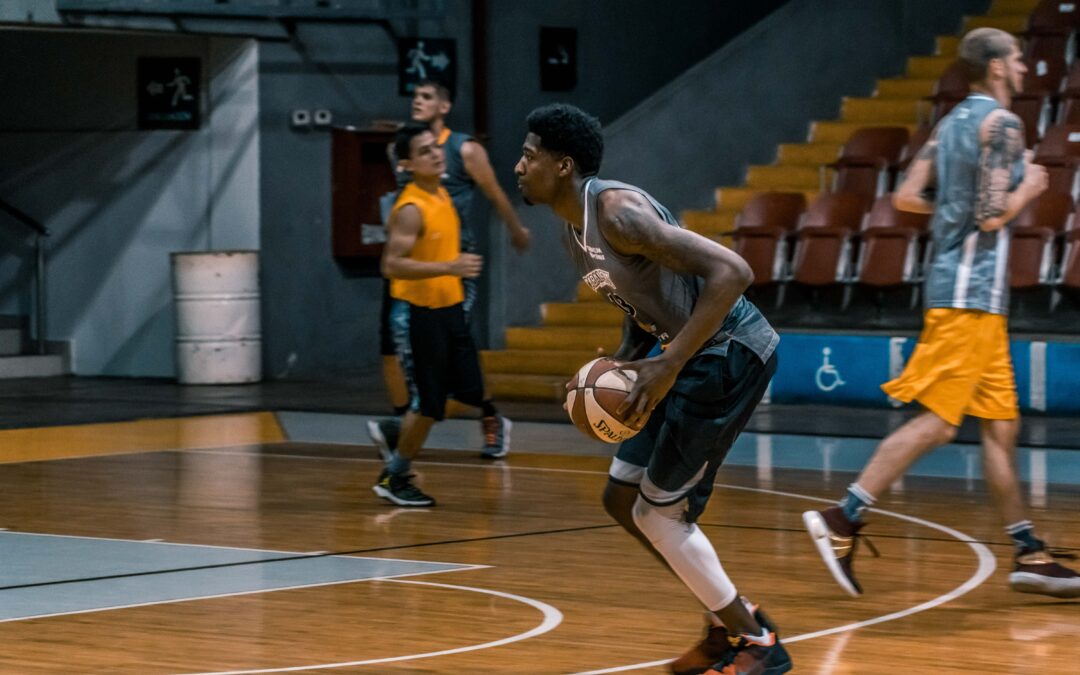
Developing a practice plan can be one of the most daunting tasks for a coach at any level. Coaches need to consider the talent of their team when assembling the plan. They also need to keep in mind how they want their team to improve over the course of the season. That improvement gets jumpstarted in practice with targeted drills. Coaches often have a set of their favorite basketball practice drills aimed to do just that.
Here are Coach Steger’s 2 Favorite Practice Drills and a couple of videos below to show their use.
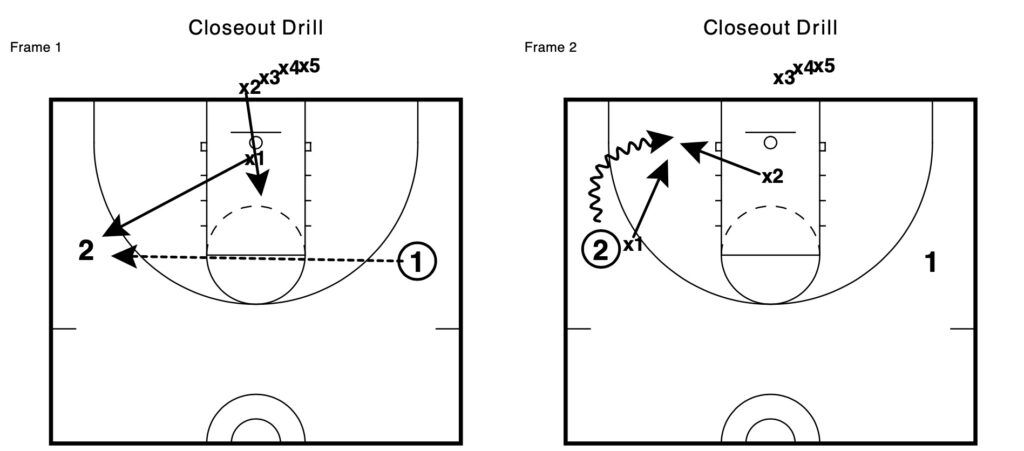
The first basketball practice drill that holds a great deal of value is a basic close out drill. This drill should be a regular for any team playing man-to-man defense. In addition, this drill aids in the instruction of help-side defense.
In this drill, two players start on the floor, occupying the wings. The defenders wait in a line beneath the rim and one positions himself in the “help side” spot in the lane. The drill begins with a skip pass from one wing to the other. The defender is expected to run from his help side position to close out on the shooter.
This drill can use a coach as the passer, or rotate players into that position. Coaches should emphasize defensive placement and positioning when integrating this drill. The close out defender should not over-run the shooter, but stop just before with one hand up.
This drill can be altered to force the shooter to drive baseline. The drill can incorporate another defender at that point, who also moves into help side positioning.
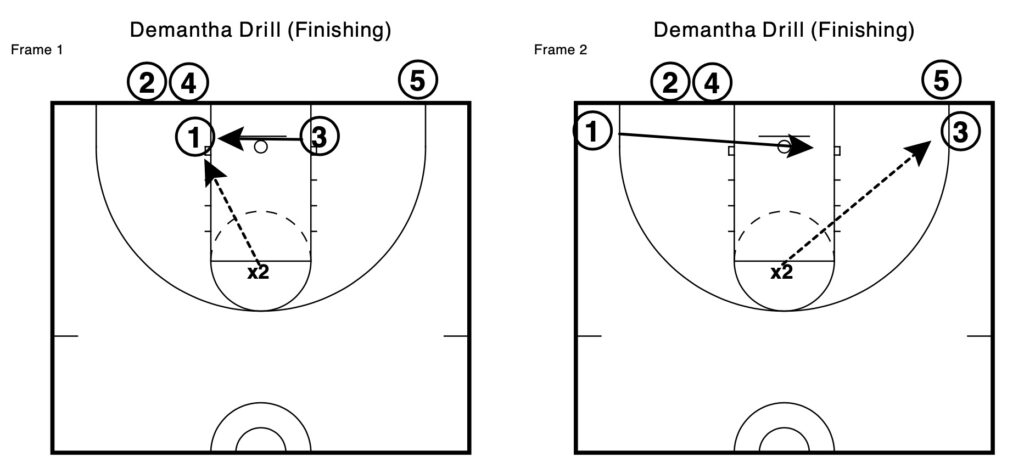
The next of Coach Steger’s favorite basketball practice drills is the DeMatha Finishing drill. This drill can be particularly valuable as both a practice drill and as a pregame warmup drill.
This drill pits two players against one another in a simple clash of offense and defense. It’s a high-impact, fast-paced drill where the offensive player attacks the basket and the trailing defender needs to recover. The drill features two lines and usually a coach for passing. Players can stand in for the coaches as passers if need be.
The drill itself can be situated in a number of different spots on the floor. Where the drill starts can be dictated by the coach and what the team needs are.
The drill itself is simple. The passer feeds the offensive player, who must finish at the rim from their starting point. The offensive player can try a dunk or layup. The defender, meanwhile, must contest the shot as best they can. Physical play can be encouraged for the defense to help the offense improve finishing through contact.
Ep: 376 3 Favorite Practice Drills from Coach Steger
If you found this useful, don’t forget to check out additional blog posts at TeachHoops.com. Also, check out TeachHoops on Facebook, Twitter, Instagram and YouTube.
Developing the right series of basketball shooting workouts remains one of the most important aspects for any basketball coach. No matter the level of the team, the correct drills that teach and reinforce fundamental skills stand as valuable part of any practice plan.
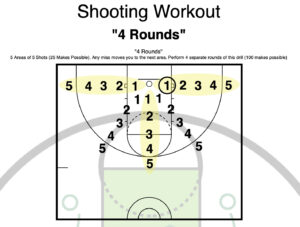
The first drill to consider incorporating into your basketball shooting workouts is called “4 Rounds.”
This drill can be done individually or within a small group setting.
For this drill, the shooter progresses through a series of spots in the half court, focusing on form and rhythm.
The first two shots from any of the sections remains a form-shooting attempt. The player should use only one hand and focus specifically on release and spin.
The next two shots build on the form-shooting element, now incorporating the guide hand. But with these shots, the shooter still does not leave the floor with the attempt. For the final shot in the section, the shooter steps beyond the three-point line and shoots from there. That attempt should incorporate all of the fundamentals for proper form, elevation and release.
As the shooter progresses through this sequence, they must keep track of their makes. Any miss moves the shooter to the next section. The goal of the drill is to make as many attempts as possible while maintaining proper form throughout.
The name “4 Rounds” comes from the drill’s set up, since every shooter progresses through the drill four times. 100 stands as the most points a shooter can score.
One way to stress proper form with this drill is to require “perfect shots” with the first two attempts in each section. A “perfect shot” is one that’s made without touching the rim. This can also be adapted to be a useful competitive practice game.
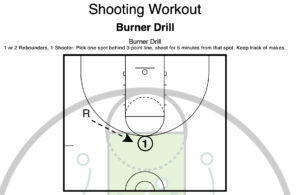 The next drill a coach should consider adding to their basketball shooting workouts is called the “burner drill.”
The “Burner Drill” stands as a useful sequence either in pre-practice warm up or in post-practice wrap up.
For this drill, a single shooter takes three-pointers for five minutes. One or two additional players provide rebounding and passing support for the shooter.
As the shooter navigates the five minute time limit, he or she should focus on form and elevation. The shooter must set his or her feet before each shot attempt. Shooters should also get in the habit of preparing to shoot before the ball even arrives in their hands.
Shooting for five consecutive minutes often leaves the shooter gassed. The drill “burns” the shooters energy. But it’s important for the shooter to maintain the proper form even in the closing moments of the drill.
This drill can be adapted to be an individual workout as well, with the shooter retrieving the ball after each shot attempt. In that case, the shooter can take shots from a variety of spots along the three-point arc. This, too, can be adapted to be a competitive practice game.
If you found this useful, don’t forget to check out additional blog posts at TeachHoops.com. Also, check out TeachHoops on Facebook, Twitter, Instagram and YouTube.
Finding an identity for a team stands as one of the most unique challenges for coaches. Building a Basketball Brand, Culture and Program, not matter the level, must be done on a solid foundation. Without clear principles, the program might drift along listless and without direction. For coaches, creating an environment to empower the student-athletes remains one of the most important undertakings.
Coach Heath Neal joined Coach Collins to discuss Building a Basketball Brand, Culture and Program on the Teach Hoops YouTube channel and Coach Unplugged podcast.
In this wide ranging interview, Coach Neal discussed his journey to becoming the head girls basketball coach at Pea Ridge High school, in Pea Ridge, Arkansas. Neal went from Arkansas State University to the US Navy. He served for five years and deployed all over the world. That military training still informs much of his coaching approach.
After the military, Neal returned to the University of Arkansas to finish his degree. There, he became a student athletic trainer for the Razorback football team, then led by Bobby Petrino.
In his five years coaching at Pea Ridge, Neal’s compiled a 78-47 record overall and a finish in the elite eight of the state tournament.
An important foundation for any program to build upon is a definitive set of values. These core values inform everything within the program, from commitment to the players, to communication with families.
For Coach Neal, the core values that support his program are: Truth, Trust, Togetherness, Integrity, Competitiveness, Competition, Effort and Intensity.
Neal notes building a basketball brand players and the community will be excited for is key. He says:
“Confidence is earned through detailed preparation.”
In addition, Neal says building the program relationship driven. Connections within the community help build excitement. And that excitement ultimately leads to positive support.
Coaches must remember the importance of their position. A coach remains one of the most influential individuals in society. A coach will influence more people in one year than most people in a lifetime.
Check out the interview in the resources below.
If you found this useful, don’t forget to check out additional blog posts at TeachHoops.com. Also, check out TeachHoops on Facebook, Twitter, Instagram and YouTube.
Most basketball coaches often search for staples for their practices. These staples always make it on the practice plan, no matter what the focus of that day might be. Players become comfortable with these progressions and often master specific skills over the course of the season. One of the most valuable basketball practice staples is 4-on-4 Cut Throat.
4-on-4 Cut Throat stands as a favorite drill among young players because of its game-like nature. For coaches, 4-on-4 Cut Throat provides each basketball practice with the opportunity to stress and develop specific elements of the game.
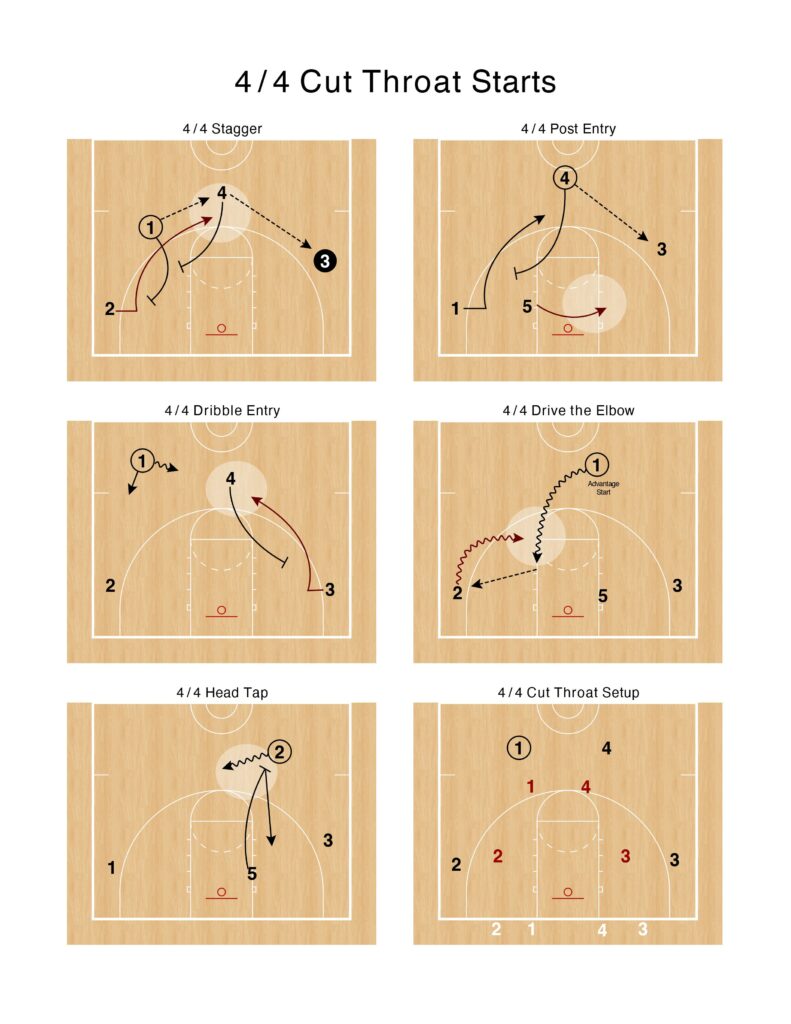
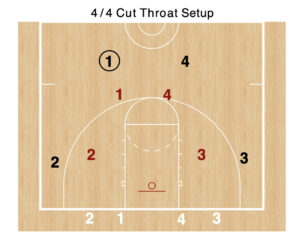 4-on-4 Cut Throat is a high-energy, high-movement drill. Coaches divide their teams into sets of four, with two groups on the floor at all times. Through each progression, players navigate the possession, looking to score or get a stop. As each possession ends, the successful team (the one that scored or made the stop) stays on the floor, while the losing group comes off. The waiting team comes on and fills the vacancy.
Coaches can allow the players to free play, or can install specific needs in a possession. The free-flowing nature of the drill allows players to learn on the fly. Whatever a coach decides to emphasize in the drill often translates directly to the game.
Once the players are on the floor, coaches layer specific commands into a possession. If a coach wants to focus on spacing, they might outlaw ball screen. If a coach wants to focus on movement, maybe players must pass and pick away. There are any number of layers that can be added to this drill.
The emphasis of this drill is to build solid offensive and defensive habits. The goal for each team remains staying on offense. Although this drill can be altered to be 5-on-5 or 3-on-3, the 4-on-4 set up might be the most effective for incorporating specific offensive elements. 5-on-5 tends to get bogged down in the half court, especially with good defensive teams. And 3-on-3 often provides the offense with too much space.
The hidden value of this drill remains the opportunity for coaches to provide direct instruction to the teams that lose a possession. As the losing team comes off the floor, a coach can immediately pull them aside and talk through what went wrong while the other two teams progress through the drill.
Ep: 818 Drill of the Day with Coach Lynch (4-on-4 Cut Throat)
If you found this useful, don’t forget to check out additional blog posts at TeachHoops.com. Also, check out TeachHoops on Facebook, Twitter, Instagram and YouTube.
One of the most important elements to designing a valuable practice plan is deciding what core basketball elements you’ll concentrate on. So when deciding between basketball practice warm up drills, it’s important for a coach to know where the focus will be. Getting your players warmed up and ready to compete needs to happen at the start of every practice. So why not use that segment to instill core elements to your offense and defense?
Many practices begin with traditional layup lines and jump shots. But how often are the players simply going through the motions of those drills? Installing the right warm up drills will vastly improve the efficiency of your practice.
Coaches always love drills that do double duty. When a drill that incorporates multiple basketball elements can be used, it helps maximize the value of that practice segment. Drills that develop specific skills and other elements like conditioning and/or communication are inherently more valuable than single-focus drills.
Argentina Passing sports that layered value because players progressing through the drill develop their passing skills, as well as hand-eye coordination, communication and conditioning. Passing drills in general get players mentally focused, and this one gets them moving as well.
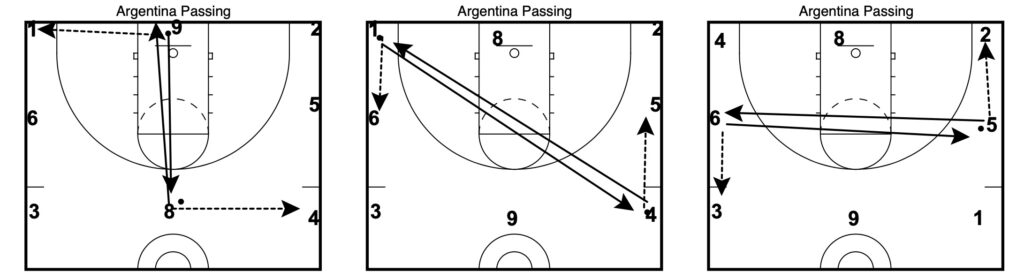
Eight players start on the court for this basketball practice warm up drill. Each player stands partnered with the teammate directly across or diagonally across from them in the half court. The two balls start with the center players and those players pass to their right. Immediately after a player passes, they cut across the court and exchange places with their partner.
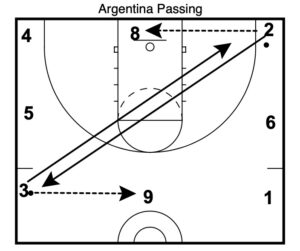
This drill rises above a normal passing drill because the players are sprinting through once they’ve made their pass. Players must concentrate on the catch, using a reverse pivot to open their hips on the catch.
Passes exclusively run to one side, meaning the players are always either passing to the right or the left. Coaches can focus on specific pass types. Coaches can also reverse the drill after a set amount of time.
Players work on passing, foot work, communication and conditioning through the drill.
Star Passing is common one in many gyms, but this version of the drill incorporates the necessary element of finishing with a made basket. This doubles well not only as a basketball practice warm up drill, but also as a game warm up.
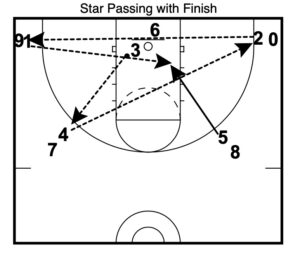
The drill begins with players arrayed in a star across the half court. The ball starts with the line under the basket. There are lines in the corners, as well as on the wings.
The first pass goes from under the basket to the left wing. The passer follows their pass and joins the end of that line. From there, the left wing passes to the right corner and follows. Right corner makes a baseline pass to the left corner and follows.
The final move in this initial turn through the drill involves the left corner feeding the player that cuts from the right wing. That player receives the pass and finishes the turn with a layup.
Variations of the drill can incorporate a number of additional basketball elements. Coaches can require that the ball never hits the floor. They can reverse the flow of the drill to work on left-hand layups. Coaches can have a defender waiting at the rim to challenge the finisher. The list goes on an on.
The final basketball practice warm up drill here is called Pivot Passing. While this drill remains a staple at the youth level, there are practical elements here that can be incorporated into the practice plan of more advanced teams.
This drill stresses the specific development basic footwork. Players pair off and stand in four lines. If the players start on the baseline, they explode out with an attack dribble to the free throw line extended area. From there, the players jump stop, reverse pivot then pass to their partner at the baseline. The partner receives the pass an immediately explodes into the dribble.
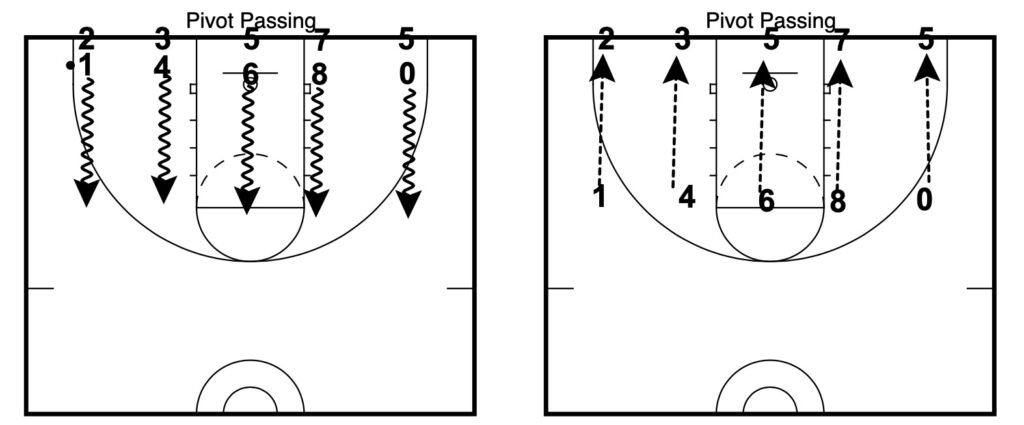
The reverse pivot helps practice creating space, a necessary skill for any level of player. Coaches can layer shot fakes, step throughs, rips, etc. Change the specific pivot foot for the players and force them to adjust. Even the most athletic players may struggle with this seemingly basic drill because it layers specific movements and does so quickly.
Ep. 39: Coach Steger, 3 Favorite Practice Drills
If you found this useful, don’t forget to check out additional blog posts at TeachHoops.com. Also, check out TeachHoops on Facebook, Twitter, Instagram and YouTube.
Basketball coaches everywhere are constantly searching for new Competitive Practice Games. Keeping young players engaged throughout a practice period often means mixing up physical warm-ups and stretching, technical drills and competitive contests. Coaches need to layer the information and embed key skills before introducing and installing specific sets.
But running through the same drills over and over can result in bored, disengaged players. Yes, they need to master the basic layup. But running through the same two-line drill every practice might have players check-out on their coach.
Enter the competitive practice games.
These games aren’t teaching drills per-say. The goal of competitive games is to get your players practicing key skills within the controlled environment of the closed gym. Here, the players are learning as they make their way through the progressions and reads, relying on their teammates to pick them up.
It’s important for coaches to allow their players to play through their mistakes and learn as these competitive practice games to unfold. These controlled situations and scrimmages also provide plenty of information for coaching staffs to digest. They’re learning the strengths and weaknesses of their teams.
This is a full-court competitive game that allows coaches to install a specific play or set, while also practice key defensive principles. In the half court, the offense runs their first action against a full compliment of defenders. If this action results in a basket, then the offense and defense switch. But if the defense gets a stop, then it’s a full court game.
The defensive stop flows into transition offense as that squad seeks to score. Only points scored off of defensive stops count in this competitive practice game. This game should flow back and forth for several minutes before coaches change anything.
Emphasis: Defense. Basketball coaches that incorporate this competitive practice game look to establish the mindset that the team needs to focus on getting defensive stops before getting to the offensive end of the floor.
RELATED: Youth Basketball Development, Practice Planning and Drills
One of the most frustrating elements of coaching at seemingly any level is dealing with unbalanced teams. Having a starting five that’s far more talented than their teammates forces a coach to come up with different ways of maximizing practice time. Since a starting five typically sports a team’s top players, scrimmaging the first five against any combination of the rest of the roster might not produce the practice results coaches are looking for.
And on those teams where there’s a dramatic split in playing level between the first five and the next five, scrimmages can often become just as frustrating for the players. But it’s also important for the best players in the rotation to get practice time together on the floor.
“Perfection” ultimately handicaps the competition, evening the practice floor to make it more interesting and engaging. The idea with this competitive practice game is for the “strong” team to play like normal. They need to be “perfect” and they get points for scores or anything else a coach is looking for. The “weaker” team, meanwhile, has access to all of the normal points, but also could get points for specific accomplishments, like offensive rebounds, forced turnovers, etc.
Emphasis: Attention to detail, competitive balance. While the top players might be more talented than their teammates, this competitive practice game can balance the scales to a certain extent and keep all parties engaged throughout. Afterwards, and this is true of any basketball competitive practice game, it’s important that coaches debrief with their players to emphasize specific elements.
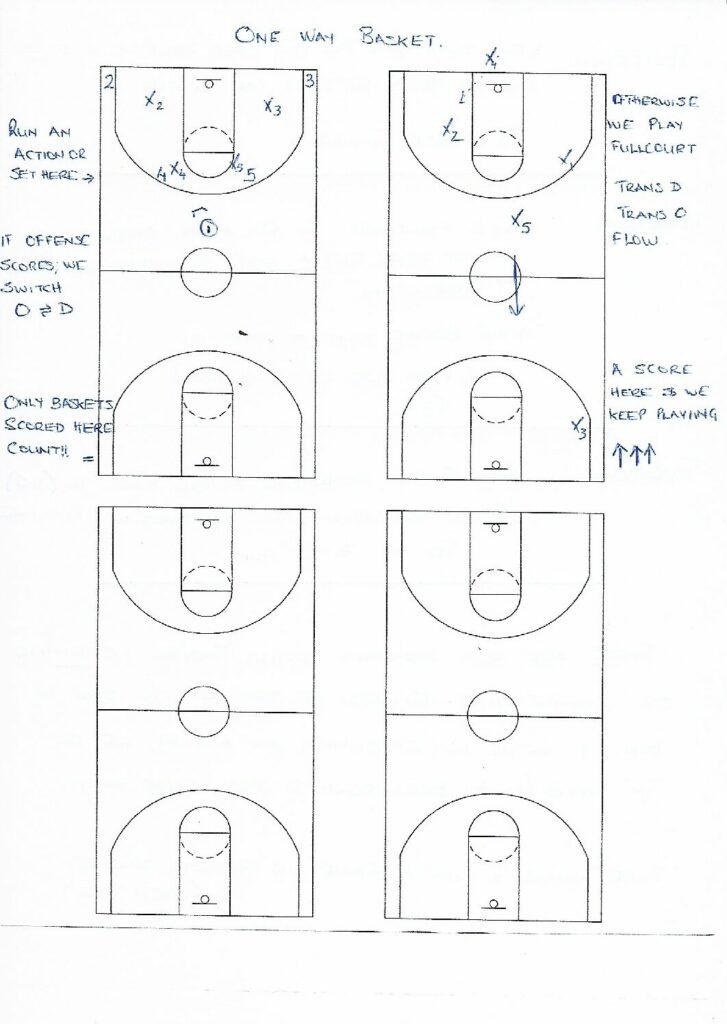
One Way Basket Basketball Competitive Practice Game
If you found this useful, don’t forget to check out additional blog posts at TeachHoops.com. Also, check out TeachHoops on Facebook, Twitter, Instagram and YouTube.
Monday Morning Assist( Taking a Summer break)
This also can be found on itunes
Check out teachhoops.com
“Lessons Learned From The 2018 NBA Playoffs”
*S.E.O. Words: Intensity, Desperation, Motivation
Year after year, the NBA Playoffs offer us all a front row seat to the game of basketball being played at it’s highest level. However, even the top seeded teams can often fall short of that level when it comes to playing with maximum effort. In any given game, most NBA Teams can be trusted to play their hardest, but in a “best of 7” series, there are far more opportunities for human nature to sink in. Following a loss, the most common NBA Playoff Team adjustment is usually not schematic, but simply to play with more energy and determination.
Coaches have used several different buzz words over the years to describe either how an abundance of effort led to victory, or how a lack of effort led to defeat. In the past, the most frequently used buzz word was “desperation”, which has graced the narrative of many post-game press conferences and off-day interviews. However, in 2018, the new buzz word appears to be “force”, which ironically has been used most by Head Coach Steve Kerr of the Defending Champion Golden State Warriors. Regardless of whether “desperation” or “force” best describes maximum effort. What’s most important is why it alludes a team to begin with, and how to get it back when it does.
Overconfidence is the most common contributing factor, and also the most damaging. Overlooking any opponent brings about consequences that often cannot be reversed. Coaches of all levels can learn a valuable lesson from this years NCAA Tournament, in which a #16 seed beat a #1 seed for the first time ever. The concept of “rest vs rust” is also a major factor, when a team is affected by having either too much rest, or not enough. Lastly, is a lack of 3-dimensional preparation. Most preparation is based on 1-D and 2-D tendencies, such as preparing for an opponent that plays fast, or tries to dominate the paint. An example of 3-D preparation would be discovering that your opponent has a hidden motivation, such as a team member dealing with a tragedy, or perhaps a hidden revenge angle. That hidden motivation could make this game extra emotional for them, causing them to play with maximum effort and increased intensity. That could be huge problem if you as a coach are unaware of it, and your players enter the game at only a standard motivation level. Bottom line, there are infinite reasons why a team can lack effort in any game, at anytime, at any level. These are just a few details to keep an eye on.
JOIN TEACHHOOPS.COM
First, I want to say thank you to Coach Collins for asking me to do this Blog for Teach Hoops. Two things you need to know about me is that I am not all knowing, and I am always learning how to better myself as a coach.
Right now at the college, we are just kinda at a wait and see period for some recruits with an attempt to find that gem that went under recruited by the 4 year schools. Yes, I am assistant at junior college in Wisconsin, but before that I coached 5 years as a varsity boys coach and I almost coached every level below that since my coaching journey started in 2005. As I sit typing my Blog in the sun over Memorial Day Weekend, I ponder the question….why are coaches so busy in the summer?
First, I think it’s important to know that all coaches are not busy in the off-season. For example, I consider myself as a college coach to have a lot of free time. But, my position is much different from when I coached Varsity Boys Basketball at the high school level. My current summer commitments reside in help running two youth camps and support supervision for open gyms. But, I know how much work consist in the summer for High School coaches in the summer. And in reality without summer, I think it would be impossible for coaches to function without it. Summer is a time for development, trial and error, and logistics. Here is a list of items I have done in one summer as a head coach.
Coach summer league games
Support and watch JV summer league games
Open and supervise skill sessions 3-4 times per week
Plan and Run 3 different youth basketball camps
Watch and review 8 different basketball coaching dvds
Organize and host summer fundraiser
Attend overnight summer tournament with players
Coach summer tournament at a local high school
Plan fall fundraiser
Complete practice schedule for HS program
Weekly open gym
Plan out special game nights for the season: Goldout, Parents’ night, Throwback Night, and etc
Rank and evaluate talent for the upcoming season
Plan and meet with youth program board monthly to plan for fall registration, budget, and other agenda items
Facilitate 10,000 Shot Club
Host HS Summer Camp
Diagram and review old sets for all situations
Try and tweak new sets, defenses, offenses with team opportunities
Meet with High School staff weekly
Plan and organize online shoe and apparel stores for upcoming season
Wow! I forget how much I did in the summer for preparation for the upcoming season. The question you really asking is why? Winning is hard work, and frankly my tenure at my previous job had only small moments of success. I worked harder than most of my players. Personally, I saw more growth in the youth program with future players coming up the ranks in next the 5 years. But, building a program takes time and making the right decisions through the journey. The worst decision I made was not facilitating the workload to others to provide more time for my own team. My advice to young coaches is create a pipeline of people to work under you. Build and maintain positive relationships with other coaches, parents, and community members to support building your program. Your support system comes down to finding individuals that believe in your program and our invested in the program not their child. Again, the process takes time to build a program, which you have to be careful about picking the right job. That is something I can address in a later Blog.
Summer is a period of time for coaches to eliminate clutter during the season. It’s impossible to do the items above plus coach your team during the season. It would be overload. I feel the many of items on my list provide clarity and direction for the season to come. You can learn about your players and how they respond to certain offense and defensive schemes. The regular season has not enough for trial and error and building your identity. 10 practices and your competing in your first game.
Finally, coaching isn’t a full-time job that pays the bills unless you make it to the big time. I currently still teach 5th grade and coach other sports as well. Without using summer, I believe no one could function during the regular season, unless your single and retired. Please email with questions regarding my blog at [email protected].
This is one of many letters I received about the video and podcast I did concerning my son not playing AAU and summer basketball. I thought I would share
Steve,
Appreciate your views on this and agree with much of it. However a few observations:
I train my son and his skill development has exploded in the last few years. But, as you know, there are tons of kids who can “kill a drill” but can’t perform when there’s 10 guys on the court. When you have defensive pressure and lots of decision-making in a game situation, those skills can all of a sudden look a lot different. You just can’t simulate that environment in the quiet of a gym while developing skills. I know every good trainer tries to develop an athlete’s skills while doing “game-like” drills. But it is just not the same. Actual “games” must be played and it’s becoming really hard to find them outside of the AAU tourney scene.
In AAU ball, my son has learned “toughness” that he never had before, and would have never developed, in a training session in any kind of drill. There’s a clock, there’s a scoreboard, there’s fans, there’s referees, and there’s personal “pride” at stake. When he was getting beat up in an AAU game, he either had to fight back or get crushed. He chose to fight back and it has served him so well. He hasn’t turned into an aggressive maniac, but acquired just the right amount of toughness and aggressive mentality that will enable him to play high school basketball. I guarantee he would not be in the same place at this moment without AAU basketball. (He’ll never be a college recruit, but he setting himself up to have a ton of fun playing HS basketball.)
It’s really difficult to supplement skills training with “games” without having a place to actually play games. You and I know there aren’t a lot of parks or gyms that young athletes use to play meaningful “pickup” games that aren’t tied to their schools. We’ve tried playing in the local clubs and the games are mostly garbage for development purposes. Please don’t take this personally, but being a father who is a head coach gives your son access to a gym and I’m only assuming a place where players can get together to play decent pickup games (if WIAA allows, which I believe it does) during the summer. Not everyone has that.
I do agree that AAU travel is ridiculous. I myself coach a boys AAU team and my HS daughter plays AAU and I see that the competition 1 hour away is not substantially different than competition 4+ hours away. I also agree it’s way more games in a weekend than necessary. But of course, the tournaments are making money and they aren’t going to set up tournaments where you only play 2-3 games — which in my opinion would be plenty to supplement skill development.
AAU is ridiculous for kids under 12 years of age (and maybe that’s too young). The most physically mature kids dominate and nothing real productive gets done an AAU format for those young kids. But parents are feeling good that their kid “played AAU”.
I assume the birth of AAU must have been to get the very best players exposure for college. And it probably then trickled down to younger and younger age groups.
Bottom line — I think there’s value in AAU but I think it’s overhyped. At the same time, in order to become a better basketball player, it takes more than reps in the gym. Those skills have to be tested in a game format. I played DI college baseball and there was plenty of guys who hit .300+ in “batting practice” but in a game, for some it was a completely different story. It’s all a “balance” (skills practice + games) which I know is what your message is all about.
Thanks for making your video and providing quality content on Teachoops.com !!!
Regards,
Concerned Father
Eating For Performance:Training
Fruits & Vegetables
• Eat 2 different colored vegetables AND 2 different colored fruits per day- Have > 5-6 servings from these groups per day.
• Eat a salad at least 4-5x/week. Added bonus – Use Extra Virgin Olive Oil to boost healthy fat content
• Try 1 new vegetable or fruit every 2-3 weeks.
• Frozen vegetables/fruits are usually as high of quality as fresh ones & much cheaper
Protein
• Aim for 0.6-lg/lb/day
• Red meat and eggs (yolks) are HEALTHY
• Unless dairy allergies/intolerances are present or you have chosen a vegetarian lifestyle for personal reasons, select a whey protein powder post workout
Dietary Fats
• Aim for 0.3-0.5g/lb/day
• Realize that dietary fats DO NOT cause fat gain on their own
• Healthy sources include avocado, olive oil, peanuts/natural peanut butter, nuts (almonds, etc).
• Use Butter, NOT Margarine
• Avoid the following vegetable oils: Corn, Cottonseed, Soy
Fluids
• Best Bets – Milk, Water
• Be mindful of fruit juices & Sport Drinks They can be sugar bombs. If consumed, try to make sure it’s 100% fruit juice & consume close to the workout time period. Sport Drinks (Gatorade,) often not needed
• Avoid – Soda; Really Avoid —Alcohol (impairs post exercise muscle recovery, dehydration issues, etc)
• Realize energy drinks (Monster, Red Bull, etc) =/= sport beverages (Gatorade, etc). Keep sport beverage consumption only around
Power Granola Bars
2 cups rolled oats
½ cup crushed walnuts
½ cup unpacked raisins (2 oz)
4 tbsp. whole fax seed
4 scoops vanilla whey
2 tbsp. honey
¼ tsp. salt
¼ tsp. vanilla extract
¾ cup of maple syrup
Directions:
1. In a large bowl combine the oats, walnuts, flax seeds, raisins and whey.
2. Add the honey, syrup, vanilla and salt. Stir until everything is thoroughly mixed. At first, it will seem too dry, but continue stirring and it will blend.
3. Coat a clean, dry 8×8 inch baking dish with olive oil cooking spray, then press the mixture in the bottom of the dish. The mixture should extend to all corners evenly, and It should be about 1-inch thick. You can also use a smaller baking dish for thicker and chewier bar.
4. Bake at 350 degrees fro 10-12 minutes.
Top Portable Basketball Hoops
We’ve spent time blogging about our gear (socks, shoes) and once you look good you need to be able to play. Of course, to do that… you need a hoop! Because of affordability I am looking at portable hoops only; you’re more than welcome to search for in-ground hoops ($400+)
Spalding 54” Angled Portable Backboard System w/ Starter Pack.: According to google this is their best seller and can be purchased for around $200 at Wal-Mart. Spalding products are durable, strong, and weather well. This pack is one of the best out there; easy to move as well.
Aosom 10′ Adjustable Height Indoor / Outdoor Portable Basketball Hoop: Much, much more affordable at just $142 or so, but this hoop reflects the price in its durability. The Aosom hoop doesn’t have as big of a backboard; it is also not as durable. It is nice to have wheels to roll easily around. Great hoop to shoot around and play small games on, but not a lot more.
Spalding NBA 68395R Portable Basketball Hoop with 54 Inch Polycarbonate Backboard: One of the more expensive hoops that I’m willing to put on here at $275, but portable and strong. Three poles make this hoop, adjustable from 7.5-10 feet, breakaway rim. Also has a free pole pad. If you know you’re going to be lowering/raising the hoop for dunks or for a youth to shoot.. This is the way to go.
Aosom 10′ Clear Acrylic Adjustable Height Indoor / Outdoor Portable Basketball Hoop B6-000: Another Aosom hoop, a little bit stronger/sturdier than the cheaper version. This one comes in around $170+. As I mentioned it’s sturdier, has a better backboard, and is more stable than the other hoop. Also has wheels to roll around and move when needed.
Spalding Vault 44″ Portable Basketball Hoop Blue/Orange: $200. Not like the other Spalding hoop posted a little above but reliable and strong. Another adjustable hoop from 7.5-10 feet. Features a breakaway rim, easy to adjust the rim and move the hoop. Blue/orange color theme so if you’re worried about looks as well, this could sway or push you away!
Lifetime Pro Courtside 48″ Portable Basketball System with Basketball: $185. Like most appears to be sturdy and strong. Doesn’t have some of the other features like the breakaway rim/adjustable. Will still be strong and fun to shoot on for hours.
Lifetime 1221 Pro Court Height Adjustable Portable Basketball System, 44 Inch Backboard: $110! $40 off on amazon right now and an adjustable hoop, sturdy, strong rim. Backboard is cheap but works for the price and especially for younger kids. If you have young kids and are working to get them to play; I would strongly consider this hoop because of the price and benefits!
Spalding NBA “The Beast” Portable Basketball System – 60″ Glass Backboard: Just kidding. $1000+. I mean if you can afford it, just click the link and see why you’d want it.
Top Basketball Socks
If you’re anything like most players; you’re a freak about your feet. Shoes and socks have to be perfect; we covered shoes recently, so next is socks. I’ve gone through many different types of socks for different reasons (running marathons requires the right sock and more to fight off blisters). Basketball is the same way!
We will not cover all the types of socks, but I will try to pick a few to focus on from the different sizes.
Ankle/Quarter:
NBA Logoman: Most reviews show this sock as extremely comfortable and easy to wear. (Ever tried to put on a sock that sticks to your feet or bunches up? Logoman doesn’t do that!) The best part is how thick the sock is and how that saves your feet from those blisters we all get especially in workouts/practices early in the season.
Jordan Low Quarter: Durable, athletic, wicking, protection for your feet from blisters. Extremely efficient low sock that people seem to love for the reasons above. One drawback: rather expensive as most Jordan brand appears to be.
Crew Socks:
Asics Resolution Crew Sock: There seems to be a little bit of blowback on feedback of this sock because people bought sizes that were too small. Know this but do not be turned off to this sock! Buy bigger and enjoy one of the more underrated socks on the basketball market. Asics is primarily a running product and the socks are tighter as such. Basketball players initially aren’t used to how tight these socks can be, so again, BUY BIGGER! Despite this, Asics knows plenty about wicking, blisters, and toe protection. I’ve used these to run and also just grabbed and used them as basketball socks and were pleasantly surprised at the different forces and how they’re able to handle. Don’t be afraid to experiment with Asics and basketball!
Nike Elite Crew Dri-Fit Basketball Sock Review: One of the most popular sport socks on the market and for good reason. Handles sweat easily, thick and durable, good fit. Nike is built off basketball so their products normally are able to handle more than other brands. These socks are no different and seem to be one of Nike’s most trusted and popular brands.
Over the Calf:
Thorlo B-15s: Over the calf socks aren’t dead; they’re probably going to make a major comeback soon, as a matter of fact. (I don’t actually know or anticipate this) A lot of us wore socks like this in the late 90s/early 2000s because they looked cool. The Thorlo doesn’t really look cool at all, but it is extremely solid basketball sock. You will not find a thicker sock than these, so if sweat wicking is your major concern then probably not for you. That being said, if blisters are a concern and don’t mind hiking a bland sock over your calf; then these are for you!
UA Over-The-Calf-Team Sock: Little more flashy than the Thorlo’s and not nearly as thick. These socks are flashy (bright colors) and more wicking protection as well. The socks help evaporation more quickly than other socks. Arch support to help your feet and UA has a special block that protects your feet from those nasty basketball odors. Another great sock to check out.
I know I didn’t cover 10 socks, but several options at each length should be plenty to find a great sock or dig a tad deeper into another sock. Nike, Jordan, UA and Adidas are the most well known brands but don’t forget about Asics and even Thorlo depending on the length of sock you prefer.
High School Shot Clock
Cut Throat Drill/Defense and Competition
You will need more than one for this drill, coachmarket.net shows a great example here of a nice drill with just four. He also explains that you can do this drill up to 5 on 5, so set it up how you’d like! 2 points for offensive rebounds, 3 points for taking a charge, 1 point for making a shot, 1 point for running the offense, and maybe my favorite (arguing or fouling a point goes to the other team), turnovers and the other team gets 2 points!
The rules alone put a great emphasis and focus on the drill. Defensive rebounds kill teams (watch the NBA Playoffs or any game ever), they extend possessions, give you more chances to score, draw fouls, limit the other team’s possessions and so on. Offensive rebounds are HUGE to get and backbreakers to give up. Coaches always want their teams to play great position and help defense, taking charges is an emphasis here. It creates a turnover and draws a foul elsewhere. Notice you only get one point for making a shot, the same amount you get for running the offense. Again, it shows where the emphasis is, take care of the basketball, rebound misses, and then score!
The drill is called “Cut Throat” because if the whistle doesn’t blow, you keep playing. How often do you think fouls are called? Coach runs the drill based on emphasis and in different situations: offense, quick hitters, out of bounds, zone offense. Think of the possibilities in your own practices! You could even stretch the drill to fast break, secondary break, and so on. The whole key to the drill is to create competition, focus on defense, take care of the basketball, and call it the way you’ve been or anticipate being officiated.
You can also do this drill with a small group of your friends, as a kid. This helps play through fouls, create competition, and more importantly.. Learn there’s more to basketball than scoring! Coaches year after year, play kids that can’t score because they crash the glass and defend. If you’re watching the finals, take a look at Tristan Thompson for the Cavs.. Andrew Bogut and even Draymond Green for the Warriors; these guys would excel at this drill.. And guess what: They all make 10+ million and don’t really score a whole lot!
John Wooden’s First Lesson
John Wooden was born in Martinsville, IN, one of four sons. He started playing basketball in elementary school. His coach was also his school principal, a man of stern but warm character. Each day before practice (their court was outside, beneath tall maple and oak trees) Wooden and the other players had to pick up sticks and rocks, to clear the court for play. The basketball they used was a large rubber bladder which barely fit inside a leather shell, such that after a few minutes of use the players had to take out the bladder, blow it back up with their own lungs, then squeeze it back inside the leather.
Ironically, this led to the team utilizing an uptempo practice, for the secret was to get the bladder in the ball and use it in as many repetitions as possible, before the ball would empty again. Whoever held it at the time had to blow it up–hence, the need to make quick passes to others.
When Wooden was later inducted into the Basketball Hall of Fame (he was the first person to be inducted into the HOF 2-X, first as player, then as coach), Wooden said his remarkable ballhandling skills were in part due to the fact he had a learn how to dribble an oblong-shaped ball that lost air on rocks, sticks and in the holes of his outside court in elementary school.
The first lesson Wooden learned in basketball happened at this same elementary school. He never forgot it; in fact, it became a cornerstone of his own coaching years later, at UCLA, when his teams won an astonishing 10 National Championships.
Wooden was the star of his elementary school basketball team. One day he forgot to bring his uniform to school when he left his farmhouse in the morning. Then, after school, he decided he would not walk home to get it. Instead, he would play dumb when it came time to play that evening’s basketball game. As the game neared, Wooden fessed to his coach that he did not have his uniform. Expecting that the coach would feel some sort of sympathy for him as the star, or at least have a strong desire to win that night’s game with him at the helm, Wooden was pleased when his coach asked the worst kid on the team, “Do you have your uniform for tonight’s game?” When that kid answered yes, Wooden expected his coach to tell him to let Wooden wear his unform that night. Instead, Wooden received the shock of his young life, when the coach said, instead: “Good, because you will play for Johnny tonight.”
Wooden’s face fell. He took off sprinting to his house, and back, arriving in uniform just seconds before the game started. But his teachable moment was not over. His coach said to him, “I am sure you are tired, so sit down.” Wooden sat there, watching his team lose the game, knowing it was his fault.
The 2 lessons he learned that day, are these: 1) The player is not above the team. 2) As a coach, the bench is your friend.
Terry Boesch is a teacher in Martinsville, IN (home of John Wooden), and also coaches girls basketball. Feel free to email him at [email protected], or call/text at 317-643-6042
My Thoughts on the shot clock in High School Basketball
Discussion of Halves, Urban vs Rural, and much more
Here is the Podcast
Click Here
Failing has never been so fun.
I pen these words while sitting in 92-degree weather, watching the worst soccer I have seen in my life. Players stand flat-footed, in packs, unmoving, with no position play, passing, cutting, or moving of any planned sort. Instead, kids smash the ball with their feet as hard and wild as they can kick, then run there to do the same thing. “Defense” is piling the team’s worst kids together en masse to stand in front of the goalie box. My wife made a brilliant comment to me (shared below). But, first, to basketball…
Is today’s cry for ‘fun’ in youth sports a cover for weak coaching, and low parental expectations? Is fun today’s Loser’s Limp? where we pretend we COULD have done better, but for the fact that winning doesnt matter? By “fun” do we really mean that we want no pressure placed upon us as parents and coaches, and a guarantee that, above all else, our kid will never lose?
It may come as a shock to some, but EVERY game ever invented has had as it’s very basic, core objective to win. Every board game, every table game, every card game, every video game, and yes, every sports game, is designed to be won. But, it seems, in today’s youth basketball.
AAU is going the way of Rec League. It used to be that “fun” was spoken of in Rec League, where kids do little and are praised for it. “Everyone is a winner,” the banner said. But in the past 5 years travel basketball has gone the way of Rec League, with its same emphasis on casualness, not keeping score, occasional practices, everybody playing, and so on. AAU is now following suit, such that only the so-called “Elite teams” is where the real sport of basketball is found. Many AAU clubs now hold so-called tournaments for their own teams. As a sport, it appears to me we are pushing “competitive” ball upward to only the highest, smallest top-most part the large pyramid of youth basketball.
But, why?
Back to my wife. As we both watched the horrific soccer together, we heard the coach keep yelling out banal cheerleader-esque cliches like, “Good Hustle!” “Keep Trying!” and “Go Hard!” It was silly, even to his own standing, untrained players (who got killed in the game). My wife looked at me, and said, “From now on our daughters will play competitive sports, or nothing. This is teaching them nothing. I dont want to watch this anymore.”
Of the 100s of things required of youth coaches today, let me be among the few to say, publicly, that “making the game fun” is not one of your requirements. It is not the judge’s job to make obeying the law fun; it is not the surgeon’s job to make triple bypass surgery fun, and; it is not my job to somehow make this sport fun for your child. To be sure, none of us want Hitler as our kids’ coach. So let us quit painting this false extreme as a rallying cry for demanding “fun” above all else.
Fun is subjective; one person cannot make something fun for someone else. Consider our teenagers, for example, who define “fun” as sitting in a room with friends, texting friends who are NOT in the room. I dont get it; that is definitely not fun for me. Fun is also fleeting, fickle and impossible to define. The purpose of life is not for others to somehow guarantee your level of fun. This is true of teachers, coaches, principals, officials, and of employers. Instead of seeking fun an end of sport, I believe as coaches we should teach that fun is IN the sport. For example, working hard is fun, mastering a skill of play is fun, trying is fun, learning is fun, being part of a team is fun, practicing is fun, sweating is fun, and, yes, being pushed, made, broken down–then rebuilt better–to WIN–this is really, really fun!
Bob Knight cared nothing about fun. Neither did John Wooden. Both won 13 national championships, and raised up incredibly mature, responsible men. Instead each push incredibly hard, in very different coaching styles, to get at player perfection, high standards, personal responsibility, and above all else, team. Today, what are we about as coaches in terms of our standards of expectations and excellence in youth ball?
I am tired of watching crappy play, allowed in the name of our kids supposedly having fun.
Coaches (parents!), we are fun-ning our sport to death.
Terry Boesch is a teacher in Martinsville, IN (home of John Wooden), and also coaches girls basketball. Feel free to email him at [email protected], or call/text at 317-643-6042
Things I Don’t Coach Anymore (Stop the Slide)
Let me ask you a question as fellow-coach: How do we think our defense player is going to move as fast sliding sideways, as his approaching dribbling offense player is going to move sprinting toward him?
I have watched 100+ coaches teach players to shuffle side-to-side on defense. That this is somehow going to “close the door” to the basket for a penetrating offense player on the dribble. I confess, for 25-years I repeated this same mantra to my players. But why? Because I assumed every coach had to say it this way. Not a good reason.
This is now the second thing I no longer teach on Defense–to shuffle-step left and right to stop an offense player from penetrating the ball. To be sure, we should teach our defense player to position his legs wide, and square, in front of the offense player, on the hope this deters him from going around us. But after that, then what? Our human bodies are MADE to sprint forward, not to slide to the side.
Two seasons ago I began to de-emphasize shuffling, and to teach instead an inside-full leg step around method to get in front of an offense player who has gotten around us. It is difficult to explain in words, but easier to see demonstrated on the court. After a couple tries, most players get it, though still some want to revert to their old coaching, and slide.
I call it the Step-Around move.
The player on defense, if beaten to the outside, takes a full step with his inside leg in the direction of the offense player. At the same time he swings his hip and upper body around, planting that foot straight behind him in the direction where the offense player is moving, i.e., toward the basket. Then when he takes his next step, and lands it too on the floor behind him, he immediately pivots on that foot toward the offense player. This results in his body being in a solid defense position between the offense player and the basket. It also happens so quick that I have seen a number of offense players take a charge running into our defensive player.
If the offense player goes to our right, we step around with our left leg; if he goes to our left, we step around with our inside leg. Give it a try, see what you think.
P.S. In this photograph I include, you can tell the green defense player is beaten. She tried to slide her right foot over to get in front of the offense player; it did not work. So now the green player is totally beaten, with no ability to recover.
Terry Boesch is a teacher in Martinsville, IN (home of John Wooden), and also coaches girls basketball. Feel free to email him at [email protected], or call/text at 317-643-6042
Coaching is a learning profession. The coach who humbles himself to learn, will grow. The one who fossilizes himself around fixed points, especially of his own imagination, will not.
Here is 1 thing I no longer teach on basketball defense. First, let me say, growing up in Indiana I thought this rule was inviolable, like the 11th Commandment in the Bible. I share this with you, to ask you to think about it yourself (if you still teach this?). Also, to ask you to share something on defense that you no longer teach as a basketball coach. I almost feel like I need to apologize to Coach Bob Knight for saying this,..
Here it is. I no longer teach “Denial” of the pass to the player one-pass away from the player with the ball. I think it fair to say that every coach in America has told his players on defense, I know I have, many times, when coaching the Defense Shell Drill, “WE must do 3 things: We must Stop Penetration, We must Deny the Pass to the player one-pass away, and We must play Helpside Defense.” To paraphrase Meatloaf, “2 outta 3 aint bad,” for the first and last points are true. But the second? I dont think so. Here is why.
As a matter of logic we should never as coaches expect our players to do that which is impossible for them to do. Watch any basketball game, at any level, and you will see it is impossible to deny the pass from the player at top of key to either wing player of his choice, or vice versa. If they want to make the pass, they will make it, even if the player without the ball has to circle high above the 3-pt line to get it, or go way out on the wing for the catch. Truth is, that pass WILL be made 95% of the time. Thus it cannot be “denied.” We are creating frustration and unreasonable expectations in our players’ minds when we scream out to them, “Deny the pass!” when it simply cant be done. To deny means to prevent, stop and render impossible. It is impossible to stop the pass from being made.
More importantly, there are at least TEN (10) times where we WANT the other team to make the pass! In these instances, we should never deny it, but instead, ENCOURAGE it.
For example, we never want to deny passes that move the ball away from the basket; passes to players standing outside their shooting range; passes when the other team is inside the final 5 seconds of a shot clock; passes to the corner, where we can trap the player; passes East & West that accomplish nothing, and which dont hurt us; passes into the post where we can quickly double-team the post player from high and low (stripping the ball); passes from their best ballhandler to a lesser dribbler; passes from their best shooter to a weaker shooter; passes to a player with a low Free throw shooting % near the end of a half or game; passes to any player on the other team who is their #7-8-9-10 on the bench.
We should never Deny these passes–we should ENCOURAGE them. Why?
This is why now I teach “Stop, Steal and Sag” on Defense. The Stop means to stop penetration, while the Sag means to play helpside defense (just like we were always taught). The Steal however means that I place my best, quickest defenders (with best judgment), out on the points of our defense at the high-elbow/3-pt line area on the court (where their best players are positioned). There I teach my players to lay back far enough away from their player to entice a pass (which also helps block penetration lanes), but close enough to steal the ball once it is in the air. I teach players to read the eyes, and body language, of passers. They never lie. I also reinforce to players that as coach I will never blame them if they go for the steal, but come up short. But I will hold them accountable if they go for the ball with less than full intentionality and speed. In other words, the worst thing a player can do is kinda, sorta go for a steal, while still trying to play it “safe.” It is all-in, or nothing. We spend time in practice on how to steal a ball, and how to deflect it. But I also teach, “If you are going for the steal, I better see you flying to get it, at all costs!. For there are no half-steals in basketball.”
Again, my apologies to Coach Knight. But I think “Deny the ball” is impossible to do, is unwise to do in at least 10 instances, and in approximately 4-6 times per game we can steal it–if we read the body language well and truly throw ourselves into it.
So, what do you no longer teach on Defense that you once did as coach?
“Terry Boesch is a teacher in Martinsville, IN (home of John Wooden), and also coaches girls basketball. Feel free to email him at [email protected], or call/text at 317.643-6042
How to Save High School Basketball (HSB)

All organizational failure begins, and ends, with leadership failure.
Some predict the death of high school basketball in 10-years; I believe this is definitely true in girls BB especially, and most likely true in boys hoops. To save HSB, the most important place to begin is at the top, the Athletic Director (AD). The AD must create and staff a new position, to report direct to AD, called a Development Program Director (DPD). The DPD is also matrixed to the respective girls and boys high school basketball head coaches.
The DPD is a heavy part-time job, set forth on the ECA schedule as is the case with most sports positions within a school corporation. The role of DPD is to be fully funded by the school board. The work of the DPD is 4-fold: First, to bring new kids into the sport, beginning in 3rd grade. Second, to recruit and train volunteer parent-coaches. Third, to create an area league of teams in which student-athletes play competitive, organized team ball. And, fourth, to align the sports teams generally to the style of play of the sitting head coaches. I note “generally” because the key is player development, not running systems or memorized plays. Kids need to be trained as athletes, not programmed as robots.
The greatest weakness of AAU basketball can become the greatest strength of school-based basketball—the development of player skills, which are essential to improvement and advancement in higher levels of competition in this sport. This AAU does not do, or at least, does not do well. Sadly, many school systems are failing also in this crucial piece of basketball. Yet with simple adjustments, schools can reclaim this high ground.
The challenge is to bring players into the sport, then to train them in creative ways to get them to know how to play each position on the court, in defense, in offense, in transition, in full court press situations, and on the free throw line. This starts with the philosophy to build each kid from the court-up, on how to stand, how to pivot, how to dribble, how to screen, how to play helpside defense, etc.
Schools must reclaim the mantle of being basketball development experts. If we in schools do this, we will save our school teams (and jobs). If not, we will soon lose this entire sport to private clubs, and private trainers.
The basketball DPD must continually cast his/her net broad to find, then develop, volunteer parent-coaches. I suggest USA Basketball youth coaching licensure program as a place to start, though the customer service of USAB is among the very worst. Joining Positive Coaching Alliance and National Association of Youth Sports are good ideas, as is joining solid basketball coaching websites like teachhoops.com.
The state of Indiana boasts the largest girls travel basketball program in the country. Called Indy Girls Hoops League, it may serve as an excellent model for forming a similar league in your area of the country. Teams run from 3rd-8th grades, with three levels of competition (A (best), B, C(weakest)) in each grade. All girls on an IGHL team must be from the same school corporation (to keep from recruiting players to your team from outside your school district). Games are officiated by real referees. Teams play every other Sunday, and there is a Fall League, Winter League, and Spring League (a team can play in 1, 2 or all 3 of these if they wish). Almost all teams are coached by parents.
With IGHL there are generally 2 models followed by school systems. Either the school system “owns” its IGHL teams and appoints subordinate coaches, while dishing out gym times at area schools. Or, parents do their own thing, while wearing the name of that school corporation on the kids’ jerseys. Each model has its strengths and weaknesses.
The second major requirement to save HSB is to professionalize and broaden the skill sets of subordinate middle school coaches, many of whom have been coaching the same school grade teams for many, many years. Schools must eliminate family members of coaches from becoming assistant coaches, as this is leading to a death spiral of poor quality in middle school basketball. The DPD can create a basketball curriculum across grades, based on LTAD in Canada or the work of USA Basketball. Practice plans can then be organized from the curriculum. Also, player development and mastery of skills can be recorded each year in a simple, digital format. Statistics can be kept, and videos taken of practice and/or games.
The DPD must also use all means permitted within your state’s high school athletic association, to make basketball fun again, particularly outside traditional “basketball season.” This includes 3-v-3 tournaments, particularized clinics taught inside area elementary schools, basketball sleepovers with high school players inside a high school gym, field trips to area places of basketball interest, and special guest speaker events hosted with other school systems of current players at the collegiate and professional levels. I also advocate aggressive use of college tours, and behind the scenes player meetings with college players in your area.
Other local efforts of the DPD include branding and merchandising your school program, hosting special tournaments for other teams to come to your facilities, and creating buzz for your school system’s combined basketball programs through social media. I suggest the DPD not be a coach, but instead someone whose skills sets range from project manager on one side, to marketing and sales guru on the other. Coaches, I find, are too limited by ancient thought forms, and narrow, crabbed definitions of team, player and program.
The point is to make HSB (and MSB and ESB—i.e., middle school & elementary schools) the greatest developer of basketball players in the world. If we do this, we will save high school ball. I frankly do not care if our players wish to play AAU after us; I just want them to be able to, should they so decide.
Terry Boesch is a teacher in Martinsville, IN (home of John Wooden), and also coaches girls basketball. Feel free to email him at [email protected], or call/text at 317.643-6042
Enter your email address to gain access to our FREE video series.