If you found this useful, don’t forget to check out additional blog posts at TeachHoops.com. Also, check out TeachHoops on Facebook, Twitter, Instagram and YouTube.
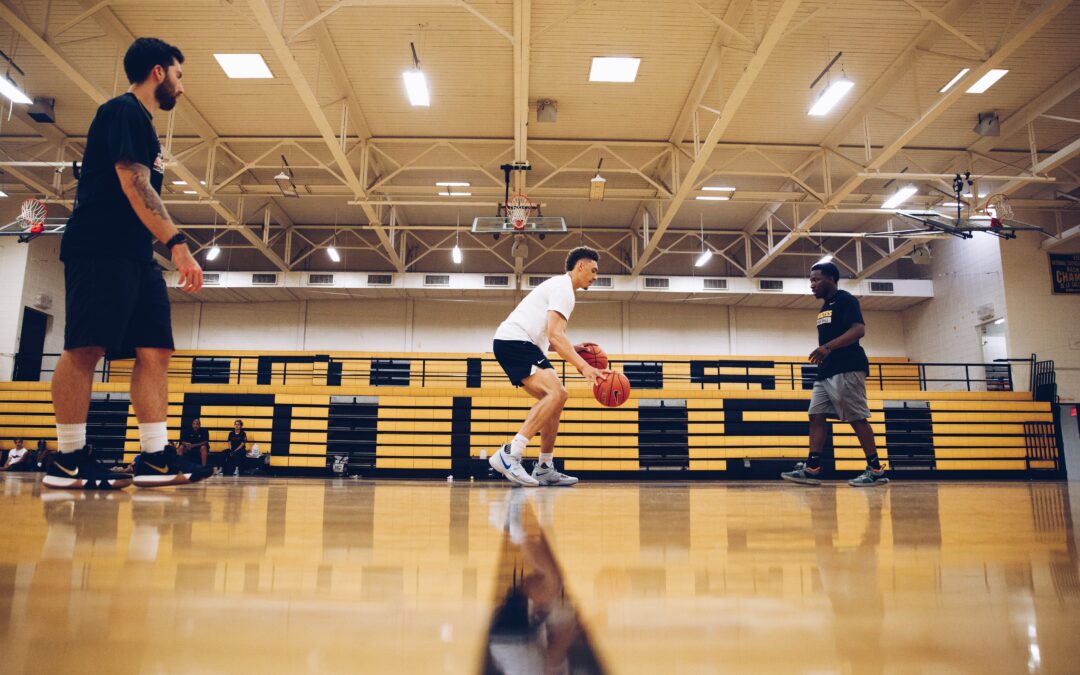
Planning any program’s basketball practice remains one of the most important aspects of coaching. No matter if it’s a preseason workout, in-season session, or postseason shoot around, a well-organized practice produces meaningful results.
Coach Collins sat down recently with veteran basketball coach Sean Doherty to discuss his approach practice planning. Coach Doherty currently serves as the head boys coach at Hamden Hall Country Day. Doherty sports more than 20 years experience coaching basketball, including stops as a former Division-1 assistant at Holy Cross, Western Kentucky and Quinnipiac. In addition to those duties, Doherty also served as a top assistant at Division II powerhouse Assumption College, as well as being the former head coach at Salem State.
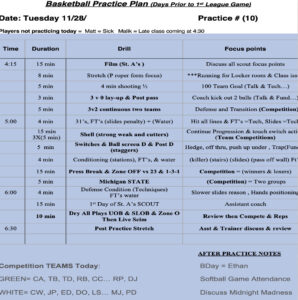 Coach Doherty urges all other basketball coaches to be organized. He suggests meeting with staff to discuss daily and weekly practice plans. If coaching without a staff, he still recommends detailed planning, including a written plan for players to see such as a “Daily Improvement Sheet.”
He calls it integral that coaches have a firm understanding of plays/drills need to be cover during season heading into their first practice.
Doherty also recommends a weekly plan for the team, which includes off the court events. He likens this to lessons plans for classroom teachers.
Doherty says: “Practice is where we create our winning culture.” He calls for accountability should be in all segments. He also recommends tracking Effort Stats. Part of the culture development includes teaching “great teammate” elements, such as: run to guys who fall/take charge, make a huge hustle play, bench up and down, high fives, emotion at right time, etc.
Check out the full interview with Coach Doherty from the Teach Hoops YouTube Channel below.
PDF Handouts: EFFORT STAT SHEET

If you found this useful, don’t forget to check out additional blog posts at TeachHoops.com. Also, check out TeachHoops on Facebook, Twitter, Instagram and YouTube.
Developing the right series of basketball shooting workouts remains one of the most important aspects for any basketball coach. No matter the level of the team, the correct drills that teach and reinforce fundamental skills stand as valuable part of any practice plan.
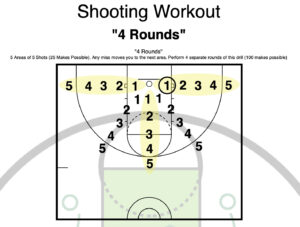
The first drill to consider incorporating into your basketball shooting workouts is called “4 Rounds.”
This drill can be done individually or within a small group setting.
For this drill, the shooter progresses through a series of spots in the half court, focusing on form and rhythm.
The first two shots from any of the sections remains a form-shooting attempt. The player should use only one hand and focus specifically on release and spin.
The next two shots build on the form-shooting element, now incorporating the guide hand. But with these shots, the shooter still does not leave the floor with the attempt. For the final shot in the section, the shooter steps beyond the three-point line and shoots from there. That attempt should incorporate all of the fundamentals for proper form, elevation and release.
As the shooter progresses through this sequence, they must keep track of their makes. Any miss moves the shooter to the next section. The goal of the drill is to make as many attempts as possible while maintaining proper form throughout.
The name “4 Rounds” comes from the drill’s set up, since every shooter progresses through the drill four times. 100 stands as the most points a shooter can score.
One way to stress proper form with this drill is to require “perfect shots” with the first two attempts in each section. A “perfect shot” is one that’s made without touching the rim. This can also be adapted to be a useful competitive practice game.
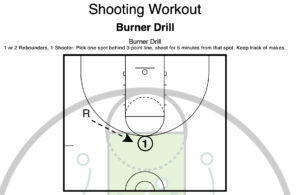 The next drill a coach should consider adding to their basketball shooting workouts is called the “burner drill.”
The “Burner Drill” stands as a useful sequence either in pre-practice warm up or in post-practice wrap up.
For this drill, a single shooter takes three-pointers for five minutes. One or two additional players provide rebounding and passing support for the shooter.
As the shooter navigates the five minute time limit, he or she should focus on form and elevation. The shooter must set his or her feet before each shot attempt. Shooters should also get in the habit of preparing to shoot before the ball even arrives in their hands.
Shooting for five consecutive minutes often leaves the shooter gassed. The drill “burns” the shooters energy. But it’s important for the shooter to maintain the proper form even in the closing moments of the drill.
This drill can be adapted to be an individual workout as well, with the shooter retrieving the ball after each shot attempt. In that case, the shooter can take shots from a variety of spots along the three-point arc. This, too, can be adapted to be a competitive practice game.
If you found this useful, don’t forget to check out additional blog posts at TeachHoops.com. Also, check out TeachHoops on Facebook, Twitter, Instagram and YouTube.
Developing the right defensive approach can often be one of the most difficult tasks for coaches at any level. Defense often directly leads to wins. As the cliche goes: Defense wins championships. So when a coach is faced with the decision to develop a pressure system for the team, there are a number of choices. Among them, the 1-2-2 basketball press stands as an effective option, especially for coaches with developing teams.
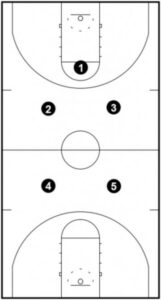 The good thing about the 1-2-2 basketball press is that it’s fairly easy to coach. This press also stands as a relatively safe option for coaches who don’t want to leave the back line of the defense open. This press also becomes particularly effective when the player at the top can provide ample pressure on the ball.
This defensive alignment takes advantage of a team’s best athletes. The primary strength of this press remains the constant application of ball pressure. This press also allows the defense to control the tempo and flow of the ball game. It can be particularly useful in places that incorporate a shot clock.
The 1-2-2 press allows the defense to trap along the side line. It often forces the offense into awkward counter alignments, which can lead to mistakes and turnovers.
While other full court presses, like the 2-2-1 or “diamond” press, try to leverage the back court to force a turnover, those alignments often leave the back end lightly covered. The 1-2-2 press keeps a pair of players back, doubling that back line.
This press can be useful in breaking an opponent’s offensive rhythm. It can also be folded back into several different half court zones or even a man-to-man.
Coaches must stress protecting the middle of the floor when implementing this press. Coaches should also stress trapping along the side line.
Communication is key with this press, like any other, because each offensive pass will require a defensive realignment on the floor.
Watch the video below where Coach Collins and Coach Jaryt Hunziker talk through all of the alignments and permutations of this press.
If you found this useful, don’t forget to check out additional blog posts at TeachHoops.com. Also, check out TeachHoops on Facebook, Twitter, Instagram and YouTube.
Youth player development can be an avenue for coaches to share their love of the game. But if a team is going to be successful, it takes more than just love. Coaches are tasked with improving players both individually and within the context of the team. And during the planning stages, including a favorite basketball drill might make practice all the more enjoyable.
Coach Nabil Murad has been working in the Education & Sports Sector for more than 10 years. Nabil has a proven track record of developing players to achieve their full potential using tailored development programs and a variety of motivational methods. Murad is currently in Austria working with Gmunden Swans youth basketball program to develop players along the player development pathway.
Murad joined Coach Collins to discuss practice planning, youth player development and his favorite basketball drill.
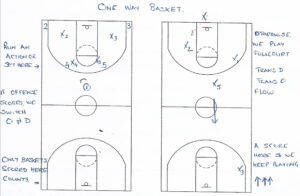 This is a full-court competitive practice game that allows coaches to install a specific play or set, while also practice key defensive principles. In the half court, the offense runs their first action against a full compliment of defenders. If this action results in a basket, then the offense and defense switch. But if the defense gets a stop, then it’s a full court game.
The defensive stop flows into transition offense as that squad seeks to score. Only points scored off of defensive stops count in this competitive practice game. This game should flow back and forth for several minutes before coaches change anything.
Emphasis: Defense. Basketball coaches that incorporate this competitive practice game look to establish the mindset that the team needs to focus on getting defensive stops before getting to the offensive end of the floor.
Ep: 676. Drill of the Day – Coach Nabil Murad Favorite Drill(s)
If you found this useful, don’t forget to check out additional blog posts at TeachHoops.com. Also, check out TeachHoops on Facebook, Twitter, Instagram and YouTube.
Finding an identity for a team stands as one of the most unique challenges for coaches. Building a Basketball Brand, Culture and Program, not matter the level, must be done on a solid foundation. Without clear principles, the program might drift along listless and without direction. For coaches, creating an environment to empower the student-athletes remains one of the most important undertakings.
Coach Heath Neal joined Coach Collins to discuss Building a Basketball Brand, Culture and Program on the Teach Hoops YouTube channel and Coach Unplugged podcast.
In this wide ranging interview, Coach Neal discussed his journey to becoming the head girls basketball coach at Pea Ridge High school, in Pea Ridge, Arkansas. Neal went from Arkansas State University to the US Navy. He served for five years and deployed all over the world. That military training still informs much of his coaching approach.
After the military, Neal returned to the University of Arkansas to finish his degree. There, he became a student athletic trainer for the Razorback football team, then led by Bobby Petrino.
In his five years coaching at Pea Ridge, Neal’s compiled a 78-47 record overall and a finish in the elite eight of the state tournament.
An important foundation for any program to build upon is a definitive set of values. These core values inform everything within the program, from commitment to the players, to communication with families.
For Coach Neal, the core values that support his program are: Truth, Trust, Togetherness, Integrity, Competitiveness, Competition, Effort and Intensity.
Neal notes building a basketball brand players and the community will be excited for is key. He says:
“Confidence is earned through detailed preparation.”
In addition, Neal says building the program relationship driven. Connections within the community help build excitement. And that excitement ultimately leads to positive support.
Coaches must remember the importance of their position. A coach remains one of the most influential individuals in society. A coach will influence more people in one year than most people in a lifetime.
Check out the interview in the resources below.
If you found this useful, don’t forget to check out additional blog posts at TeachHoops.com. Also, check out TeachHoops on Facebook, Twitter, Instagram and YouTube.
Coaches are great thieves. Resources, materials and terminology are often swapped online, at clinics, and even during basketball games. But where coaches can introduce the most unique elements comes in the specific development of a program’s culture. Building a basketball program comes down to what commitments a coach wants to make.
Coach Collins sat down with Coach Burton Uwarow to discuss building a basketball program. In this video on the Teach Hoops YouTube channel, the two went through the ins and outs of establishing an identity. This establishment involved specific commitments and focuses coaches need to consider when starting their programs.
Coach Uwarow, from Greenville, South Carolina, said the coaches he played for growing up and coached with greatly influenced his coaching philosophy. Uwarow also listed resources from Bob Hurley, Mike Krzyzewski, Pat Summitt, John Wooden and Morgan Wootten as significant influences as well.
Uwarow called commitment and passion his driving forces. He also acknowledged building a program also involves gathering resources. Supplementing budgets from an athletic department through fundraisers stands as an unwelcome but important task for any program.
Among the most important elements he named, Uwarow stressed organization, player discipline and parent-coach relationships.
Check out the full interview with Coach Uwarow below.
If you found this useful, don’t forget to check out additional blog posts at TeachHoops.com. Also, check out TeachHoops on Facebook, Twitter, Instagram and YouTube.
Developing the right basketball shooting drill remains one of the key elements for any successful coach. Considering the sometimes wild variation of skill level within a team, it’s important that these exercises can maximize any player’s potential. Coaches sift through hundreds of options and seemingly countless variations, hoping to find something that works for their team.
Coaches know that not every player can do everything on the floor. Players have their strengths and weaknesses. And it’s the task of a good developmental coach to find the right drills to improve upon those weaknesses while growing those strengths.
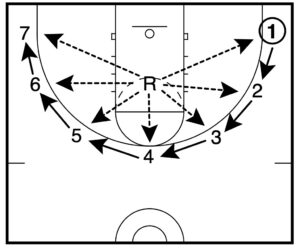 Around the Horn is a useful basketball shooting drill for players at any level. This drill also provides coaches with the ability to set up individual workouts as well as integrate team elements.
Players might recognize a version of this drill as the old playground game “around the world.”
This drill emphasizes repetition. The shooter progresses through seven spots, arrayed around the perimeter of the floor.
Depending upon the skill level of the shooter, this drill could being near the key, in the midrange, or beyond the three-point arc.
As an individual exercise, this drill involves the shooter taking their shot, then tracking down the rebound. This drill can be adapted to include a rebounder and a passer. Those additional players would also find value in this drill, considering they get to work on other skills as well.
To implement this drill well, the shooter must maintain the proper shooting form throughout. Getting their feet set and hands ready to receive the pass also stand as important elements to this drill.
Adding the timing element allow for the player to focus and provide max effort through the progression. This could also become a competitive practice game.
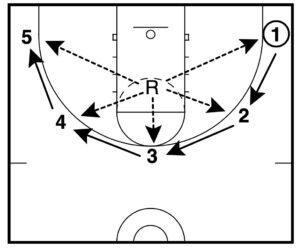 Another valuable basketball shooting drill is the M-Drill. In this sequence, a shooter navigates a timed progression of shots while a teammate rebounds and feeds the ball.
The shooter moves through five perimeter spots on the floor, taking a shot from each one. The shooter can’t move on to the next spot until they’ve made a shot at each stop.
This drill adds an element of urgency through the one-minute time limit. Shooters must progress quickly and efficiently, concentrating on their form, foot work and movement.
The M-Drill is designed to be a multi-round set. The goal for each shooter is to make it to the next round. Round one involves the shooter making one shot from each spot. Round two increases the number to two makes from each spot. The subsequent rounds also increase in makes, but the time never does.
The goal for each shooter is to remain focused and disciplined despite the time crunch. This drill can help in developing end-of-game situations as well.
If you found this useful, don’t forget to check out additional blog posts at TeachHoops.com. Also, check out TeachHoops on Facebook, Twitter, Instagram and YouTube.
Preparing for end of game situations are crucial for basketball coaches at any level. Often times, however, this remains overlooked when developing their practice plans. Coaches continually drill aspects of an offensive set or a defensive approach, but sometimes forget those end-of-game scenarios.
Competitive practice games stand as one useful tool. These drills inject energy into practice that’s usually reserved for game nights. Competitive games, especially ones where the losing team feels the consequences, allow coaches to bring a high-level of energy to the practice floor.
Another thing basketball coaches should consider is developing specific in-practice scenarios to prepare for those end of game situations. These scenarios might play out during a controlled scrimmage. But adding specific elements like time and score will aid in that preparation. Something like, asking a team to hold a single-digit lead for three minutes. Or maybe the “best” player is not available due to foul trouble. Options are only limited by the coach’s creativity.
Check out the YouTube link below for a specific discussion between coaches on how to deal with end of game situations. In this segment, coaches use real game footage to talk through the options available.
Ep: 912. Basketball Coaching Situations
If you found this useful, don’t forget to check out additional blog posts at TeachHoops.com. Also, check out TeachHoops on Facebook, Twitter, Instagram and YouTube.
For any coach, practice planning and building culture are keys for any successful basketball program. How a coach integrates these elements into their team approach speaks to their preparation and expectations. In this extended episode of the Coach Unplugged podcast, Coach Collins sits down with Coach Jeremy Thompson of Monroe College to discuss the approaches within his program.
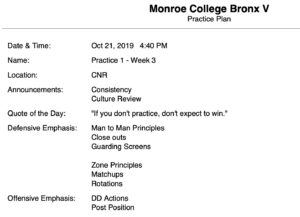 Coach Thompson stresses consistency and culture in his approach to practice planning. He often integrates quotes of day, like “If you don’t practice, don’t expect to win.” His plans often include both offensive and defensive emphasis points.
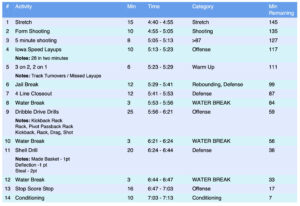
Thompson will break down his practice into smaller segments with a specific focus for each. Warm up exercises build upon one another and progress toward larger team-wide drills. In addition, the drills fall into different categories which deal with specific basketball skills.
Thompson enters his third season with the Monroe Express women’s basketball program in 2021-22. In his first season with the program in 2019-20, Thompson led the Express to a 19-13 overall record. It stands as the team’s second-ever Region 15 Championship Tournament win.
 Thompson was previously with City College of New York (CCNY) as associate head coach. In his final season with the Beavers, Thompson helped lead the team to a CUNYAC Final Four appearance.
Thompson began his women’s basketball coaching career at Staples High School in Westport, Conn. He served as the head freshman coach in 2013-14 and the assistant varsity coach in 2014-15. Thompson coached the freshmen to the No.-1-ranking in the Fairfield County Interscholastic Conference (FCIAC) among freshman teams in 2014. The varsity team made the FCIAC playoffs in 2015 under Thompson’s tutelage.
DNA of the Express Word List (1)
Ep: 689 Interview with Jeremy Thompson Head Women’s Basketball Coach Monroe College-Bronx / (Part 1)
Ep 690 Interview with Jeremy Thompson Head Women’s Basketball Coach Monroe College-Bronx / (Part 2)
Coaching basketball at any level often means teaching situational awareness. The out of bounds play stands as a key situation any basketball offense must master. These sets afford a team with a quick-hitting opportunity, as well as a chance to enter into the normal offensive flow.
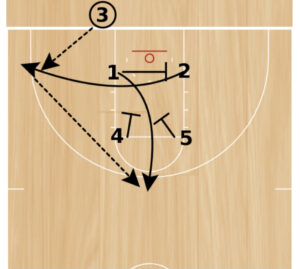
Designing a useful Out of Bounds Play provides coaches with multiple options. A good set allows the offense to immediately attack the defense with a series of calculated cuts. And if the initial quick-hitting action doesn’t produce a scoring opportunity, the set seamlessly flows into a normal offensive action.
For this play, the initial set up calls for a Box formation. This formation puts the bigs, 4 and 5, at the elbows. 1 and 2 man the low blocks to start.
In the first action, 1 provides a cross screen for 2. 2 cuts to the strong side corner. The inbounder looks to make this corner pass first.
After setting the initial cross screen, 1 cuts up the court in a zipper action. 4 and 5 provide the screens in this elevator action. From the corner, 2 looks to pass to 1.
The permutations of this set might see an open three-pointer from 2 in the corner, or an open three-pointer from 1 near the top. If the defense overplays 2’s pass to 1, there might be an opportunity for a slip from one of the bigs. If both of those opportunities are covered up, the offense might flow into a continuity set.
Another option might be a down screen from 2 for the inbounder. 3 can pop to either corner after the entry pass for an open look.
Ep: 696: Out of Bounds Play of the Week
If you found this useful, don’t forget to check out additional blog posts at TeachHoops.com. Also, check out TeachHoops on Facebook, Twitter, Instagram and YouTube.
When talking about basketball full court presses, coaches refer to the defensive tactic of applying pressure on the offense the entire length of the floor. Depending upon the style of the press itself, a defense might pressure the ball before it’s even been inbounded. Well-drilled teams often find the use of a full court press to be a game-altering proposition.
Before deciding on a press, coaches must understand the limitations of their team. The defense must be well-conditioned and disciplined in order to effectively use a full court press. If not done well or correctly, the full court press might surrender easy scoring opportunities on the other end.
The reasoning behind implementing any style of basketball full court presses remains applying pressure to the offensive unit. Presses allow the defense to control the pace of a game. Presses also allow for the defense to create transition opportunities on offense.
If a team is trailing in a game, a full court press might provide the best chance at scoring quick buckets. The press could result in a turnover, or it might force the offense into a quick shot on the other end. Either of those outcomes provides the defense with another opportunity.
In states where the games are played with a shot clock, using a full court press can burn valuable seconds off the clock. Presses often result in lob passes across the court, which rob the offense of their time.
Implementing a consistently, high-energy full court press also affords the coach with the ability to expand the team’s rotation. Having 10 to 12 players capable of performing at a high level will leverage these high-energy attacks.
While there are a number of variations available and different vocabularies, basketball full court presses often boil down to a few basic set ups.
A full court man-to-man press creates a chaotic, scramble environment that allows the defense to control the pace of the game. This option can incorporate a ball-denial approach for every player, or for specific offensive players. An initial overplay might dictate where the ball gets entered. From there, the man-to-man press allows for multiple trapping opportunities in both the full court and half court.
A soft version of the man-to-man full court press might simply force a zig-zag break from the offense, which would burn valuable seconds and might disrupt play timing.
Common zone full court presses include the 2-2-1 and 1-2-1-1 (sometimes called the “diamond press”).
The 2-2-1 press might be particularly valuable to a team that uses a 2-3 zone, or some other configuration, as its base half court defense. The 2-2-1 full court easily folds back into a half court zone. It also applies pressure to the ball and forces the offense to use the sidelines. This pressure moves the offense into potential trapping areas and tries to key to ball out of the middle of the floor.
The 1-2-1-1 or “diamond” seeks to trap the initial offensive pass. This press often allows the offense to initiate the action to a specific spot, then converges from there. The trap applies immediate pressure deep on the floor, so any turnover can be quickly turned into an offensive opportunity.
Coaches must evaluate their roster before deciding which full court press will be most beneficial. Some of the other considerations include: when to press, and when to remove the press.
Many presses are implemented following a made field goal, made free throw or off a dead ball. Coaches might mix and match their approach, but those are typically the options. The decision to remove the press usually comes when either the opponent easily navigates the pressure, or the defense is not running it properly. Zone presses often fold back into half court zones at a given point.
Beyond those considerations, others include denying the entry pass and protecting the rim. Denying the entry pass might make an initial trap difficult, and this can be beat with a pass over the top. Protecting the rim might use a safety, or a player rotation.
Trapping the basketball provides the defense with its most high-leverage play in any of the full court presses. But coaches must be clear regarding the expectations for their team when trapping, both on and off the ball. Are there specific areas on the floor that always signal a trap? What do the weak side defenders do?
As with anything, communication is key to a successful full court press.
Click Here for Coach Ted Anderson’s Pressing and How to Teach It PDF packet.
Ep: 717 Pressing How and Why with Ted Anderson (Part 1)
Ep: 718 Pressing How and Why with Ted Anderson (Part 2)
If you found this useful, don’t forget to check out additional blog posts at TeachHoops.com. Also, check out TeachHoops on Facebook, Twitter, Instagram and YouTube.
Every basketball coach needs to be clear on their vocabulary for their team. Some basketball terms are interchangeable, while others are wholly unique. When discussing the concept of basketball entry plays, a coach might think of an inbound play like a SLOB or a BLOB. But an “entry” can also be considered any play that gets the offense going, providing both quick hitting options as well as getting into a continuity offense.
Sometimes, these plays are described as “false motions” or “decoy motions.” Regardless of the terminology, coaches need plays that deal specifically with pressure. Pressure-release plays must combat defenses that overplay or deny passes to the wings or the post.
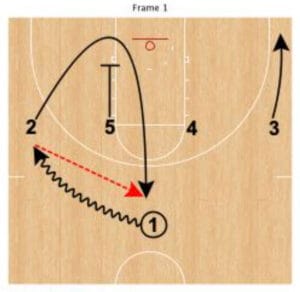 This play begins with using the 1-4 High set.
1 starts with a dribble entry to the wing. As 1 makes his way to the wing, 2 imitates a zipper or loop cut.
2 cuts down and loops around 5, who provides the down screen.
As that action is taking place, 3 cuts to the corner as a decoy action.
This initial action might get an open look for 2 at the top of the key.
Any defensive overplay might result in a dump down pass to 5 for a layup.
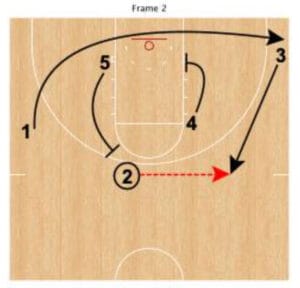
3 pops up from the corner to receive a pass on the wing.
1, meanwhile, cuts from the opposite wing to the strong side corner. He cuts along the baseline, receiving a screen from 4 at the block to free him.
2 reverses the ball to 3 on the wing. Once that pass has happened, 5 provides a flare screen for 2.
This action might get an open shot for 3. It might also get an open shot for 1 in the corner, or 4 on the block.
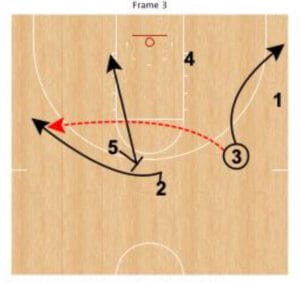
The final sequence of this play sees 3 make the decisions. He might be open, or 1 in the corner, or 4 on the block.
3 can also skip pass to 2, whose flair screen might see him open on the opposite side. Depending on how the defense plays it, 5 might slip the screen for an open layup as well.
The value of a play like this one remains the pressure-release aspect. If a defense overplays or denies certain passes, preventing a team from initiating a continuity offense, then a set like this one provides a useful counter attack.
If this sequence hasn’t produced a good look, the offense can immediately shift into a continuity offense set.
Ep: 797: Basketball Entry Plays
If you found this useful, don’t forget to check out additional blog posts at TeachHoops.com. Also, check out TeachHoops on Facebook, Twitter, Instagram and YouTube.
The fast break stands as of the most exciting plays in basketball. Regardless of a team’s skill level, the fast break injects a level of energy and excitement to any game. Coaches constantly scheme for ways to incorporate a fast break offense for their team, and the 2-Side Fast Break allows them to do just that.
The 2-Side Fast Break Offense loads a pair of players on the weak-side of the floor, the “two-side.” One player takes the weak-side corner, while the other takes the weak-side wing. The ball handler attacks from the opposite end, which features an empty corner. One of the bigs fills the rim runner role, while the rebounder who outlet the ball occupies the trail position.
This approach to fast break offense avoids players racing to balance the floor. Instead, the 2-side spaces the floor completely for the ball handler, allowing that player to dictate how the play unfolds. The ball handler attacks the paint, forcing the defense to choose which of the weak side options on the “two-side” will be left open.
The ball handler always looks to pressure the paint on the break, and if that means kicking the ball ahead, he makes the pass.
With the numbered break, the ball centers and the wings are occupied by runners. Sometimes, based on how a defensive possession played out, one of the wings would find themselves out of position. That player might cut across the floor, ultimately ruining some of the timing of the fast break. That relocating might short circuit the flow of the break and ruin whatever opportunities had presented themselves.
Not every fast break opportunity will result in a basket, or even a good shot attempt. It’s important for players to understand that just because they’re on a break doesn’t mean they need to take a fast shot. Sometimes, the transition defense covers up any openings and the offense is forced to run a half-court set.
If the defense prevents a score or shot attempt, teams using the 2-side fast break set up can easily flow into a base offense.
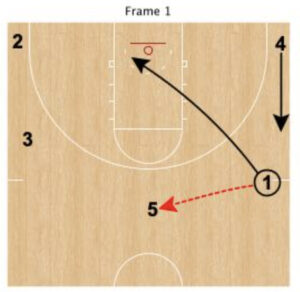
The break itself saw the 2 and 3 both run the weak-side of the floor. 2 takes the corner and 3 the wing. 4 started as a rim runner on the break, but since nothing materialized, he cleared to the strong-side corner.
1 probed the defense, but ultimately is forced to run a set. To initiate this set, 1 finds the 5 man, who was trailing the fast break. The 2-side fast break flows immediately into a 5-out offensive set.
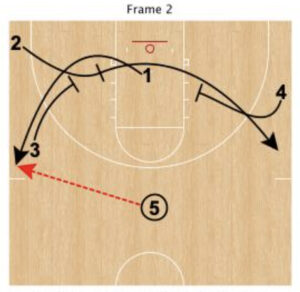 After making the centering pass to 5, 1 cuts through the lane.
As 1 makes his cut, he receives two screens away. 2 comes in to set the first screen, then 3 lowers to set another one.
This “floppy” action allows 1 to potentially get a look at a three-pointer on the wing. 2 cuts after his screen, and runs off a single screen from 4 on the opposite side.
From here, 5 looks to get the ball to 1 on the wing as he’s curling off the two screens.
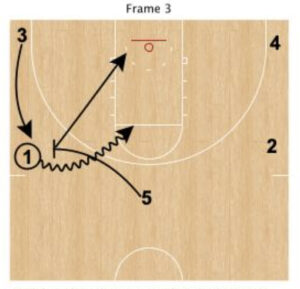 5 sprints into a ball screen after making the pass to 1. This action creates a three-man game on the strong side of the floor. It forces the defense to make decisions on how to cover up the sudden movement.
1 attacks the lane off the ball screen and 5 rolls. 3 lifts from the corner to the wing.
1 reads the defense to determine the next move. 3’s defender might take 5’s roll, leaving 3 open on the wing. If 3’s defender stays home and 5’s defender steps up to hedge the ball screen, 5 will be open on the roll.
If 2’s defender sags to help on the drive, 2 will be open on the wing. Should 4’s defender sags into the lane to help, 4 will be open in the corner.
If this action unfolds quickly enough, 1 might find the lane opens thanks to a still scrambling defense.
Shop Coach Vann’s playbooks here!
Ep: 809. 2 Sided Fast Break Discussion with Coach Vann
If you found this useful, don’t forget to check out additional blog posts at TeachHoops.com. Also, check out TeachHoops on Facebook, Twitter, Instagram and YouTube.
Coaching basketball at the youth level invariably involves dealing with zone defenses. The most common zone, 2-3, allows developing teams to hide certain players on the defensive end. It can also frustrate offenses to no end, especially if the offensive players tend to stick to their spots. So, as zones become more and more common even at the game’s highest levels, it’s integral that every coach knows exactly what they want to do when attacking a 2-3 zone.
One of the most common misconceptions to combating a good zone is the reliance on distance shooting. Teams might have a reliable zone-buster on their team, capable of consistently draining three-pointers. But the reality is most defenses would rather their opponent launch from deep rather than attack for higher percentage shots near the rim.
The first, and perhaps most important, key to attacking a 2-3 zone remains not settling for a three-point shot. Of course, if a three-pointer comes as a clean result of an offensive action, then by all means take it. But too often, teams settle for threes against zones because they can’t consistently pressure the paint. Approaching the zone with a one-pass-shot, or ball-reversal-shot, gets the defense off the hook.
Another key to combatting the zone is movement. Many times, the offensive players stand around and the zone shifts with each pass. The offense occupies set positions during the possession in hopes of finding an opening. The reality is, the openings won’t appear until more than just the ball moves. Accompanying a pass with a hard cut, filling the vacant spots, and forcing the defense to account for the movement stresses the rigidity of the zone.
A forgotten key against a zone defense is offensive rebounding. With defenders occupying designated areas instead of checking specific players, boxing out becomes problematic. Facing any zone creates lanes for offensive players to crash the boards on missed shots. The misses often result in scramble situations which could yield good scoring opportunities.
The final key to dealing with this defensive set up is learning how to screen the zone. While ball screens are typically staple counters against man-to-man defense, learning to screen the zone forces the defense to immediately adjust their alignment. If the defense doesn’t adjust, huge openings appear within the zone itself.
Continuity offenses stand as one of the most valuable approaches to attacking a 2-3 zone. These plays and sets create a rhythm and offensive flow that allows the team to stress the opposing defense. Offensive players know where to go as each pass is made within the continuity. The constant flow forces the defense to adjust, not only to each pass but also to each cut.
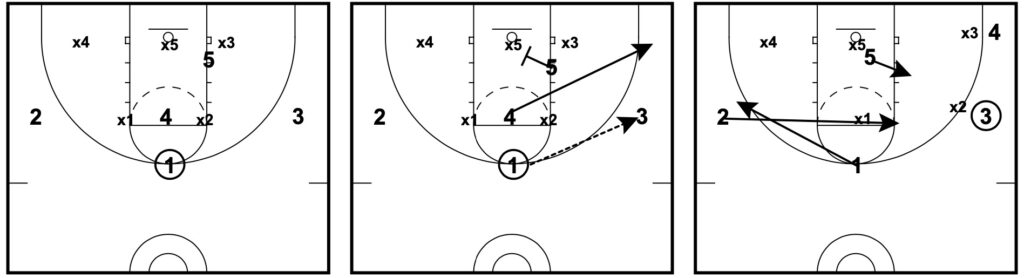
The set up for this continuity involves using a 1-3-1 counter to the 2-3 zone. 1 brings the ball down, with 2 and 3 on the wings. 4 occupies the high post, while 5 takes the low post. The initial action is a pass to either wing. 4 reads that initial pass, then cuts with the ball to that strong-side corner (or short corner).
From there, 5 presents as a low-post option and 2 cuts across from the opposite wing. 2 flashes to the open elbow area, while 1 makes a flare cut to the opposite wing. 3 reads the movement of the defense before making the next pass. If 2 doesn’t immediately receive the ball at the elbow, they lift to the top of the key.
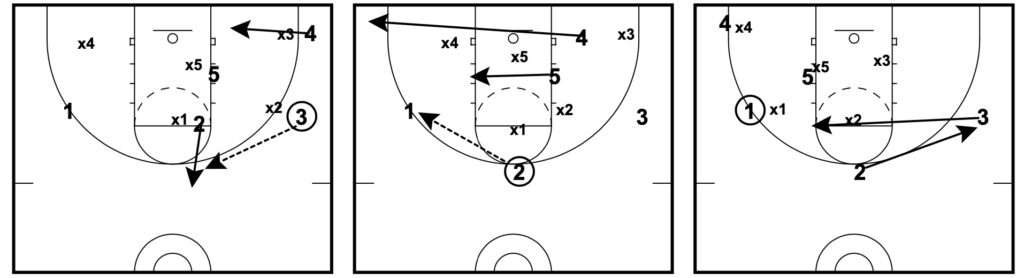
The continuous element of this continuity offense comes if the defense recovers through the initial movement. 3 gets the ball to 2, who reverses to 1. As the ball switches sides, both 4 and 5 cut to the new strong side of the offense. 4 makes the baseline cut behind the zone, while 5 flashes to the opposite low post.
As the ball reverses, 3 makes the cut across, flashing to the open elbow. 2 makes a flare cut to the opposite wing, away from the ball.
A variation for this set could involve 5 cutting to the corner or short corner, then 4 cuts into the low post. This would be an option of the 4 and 5 are interchangeable on offense.
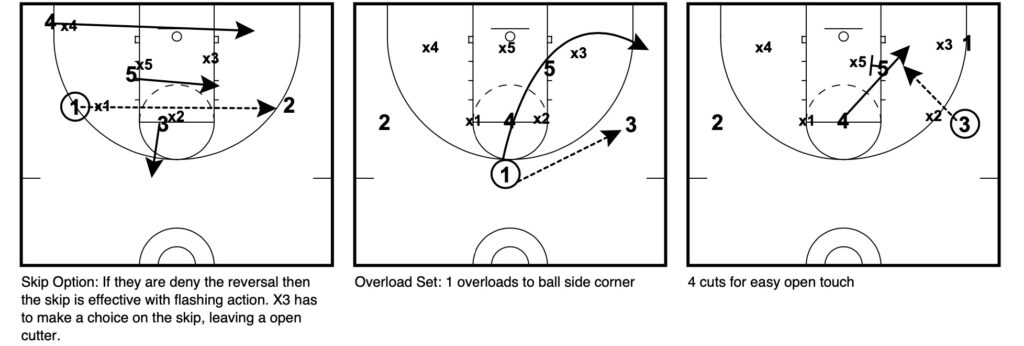
Another variation involves using a skip pass. If the defense overplays the elbow cut, or overplays the potential ball reversal at the top, the wing can use the skip pass to the opposite side. As that skip is happening, 4 and 5 make their cross cuts like normal.
A drawback to running continuity will always be the defense learning the cuts that are coming. Adding a slight variation to the progression might catch the defense off guard. Varying this continuity with an overload option should yield good looks.
In the overload, 1 makes the initial wing pass, but instead of cutting away, 1 cuts to the strong side corner. From there, 5 turns and screens the middle of the zone and 4 flashes to the open low post area. 2 can stay wide for a skip pass or cut up to the top of the key.
It’s key for the offensive players to be patient when attacking a 2-3 zone. Force the defense to adjust to each pass and cut before settling for a shot. The initial progression through the continuity might not yield openings, but as the offense moves, the defense must remained disciplined. If the defense is slow to adjust, the openings will be there.
Ep: 117 Breaking and attacking a 2-3 Zone

If you found this useful, don’t forget to check out additional blog posts at TeachHoops.com. Also, check out TeachHoops on Facebook, Twitter, Instagram and YouTube.
Coaches with talented playmakers often face a similar defensive set up: high-pressure in the half court. To combat this pressure, a coach might incorporate a high screen to free up the ball handler. But defensive-minded coaches can counter in a variety of ways. Defenses can blitz the pick-and-roll, hard hedge or trap. Enter the Ram and Veer offense.
Each defensive counter is specifically designed to get the ball out of the playmaker’s hands. Once a playmaker surrenders the ball, getting it back within the flow of the offense can prove problematic. The Ram and Veer offensive sets get multiple actions going, so the defense can’t key in on one specific player.
 The vast majority of basketball teams, regardless of level, incorporate some sort of pick-and-roll action into their base offense. The pick-and-roll is such a fundamental action in basketball that it filters from the top (as a staple of all NBA offenses) down the the lowest youth level.
But defenses can key on particularly talented playmakers to remove the ball from their hands. To combat potential defensive counters, a coaches can install Ram and Veer offense actions.
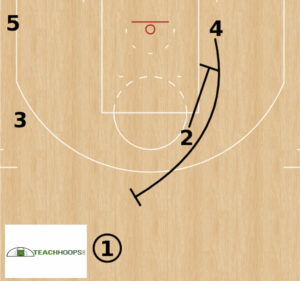
“Ram” designates an action where a smaller player screens down on a big’s defender to free the big to set a high ball-screen. This action frees the big to set the screen without his defender immediately engaging in some blitz, hedge or trap.
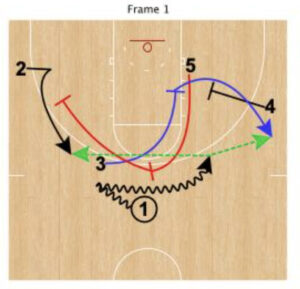
“Veer” designates an action where a player who has just set a ball-screen, immediately moves into an off-ball screen for another player. The initial screen is sometimes called a “ghost” screen, then, instead of rolling to the basket, the screen moves into a wide pin-down screen for a teammate away from the ball.
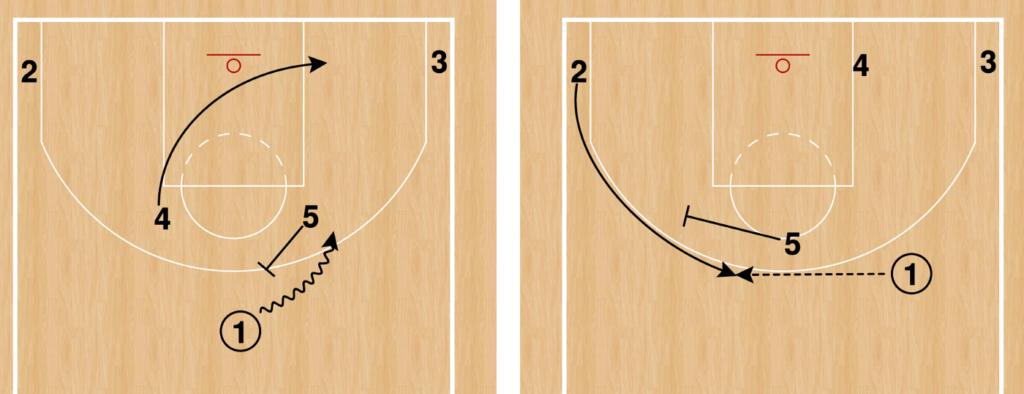
The Veer action preys upon a defense’s “tag” of the roller. In the image above, 5 sets the ghost screen for 1, then immediately moves into the veer action. Typically, 2’s defender is tasked with “tagging” the roll man in a high pick-and-roll, so he’d cheat off his man. But the veer action sets the pin-down screen for 2, freeing him up completely.
Depending upon how aggressive a defense is when handling the initial screen action, Veer also creates the opportunity for the screen to slip for an open layup.
The first play that would be useful against aggressive, trapping defenses, relies mostly on the Ram action. For this play, 3 should be the best shooter on the floor. 1 executes a dribble hand-off (DHO) with 2, which is largely a decoy action. From there, the play progresses quickly.
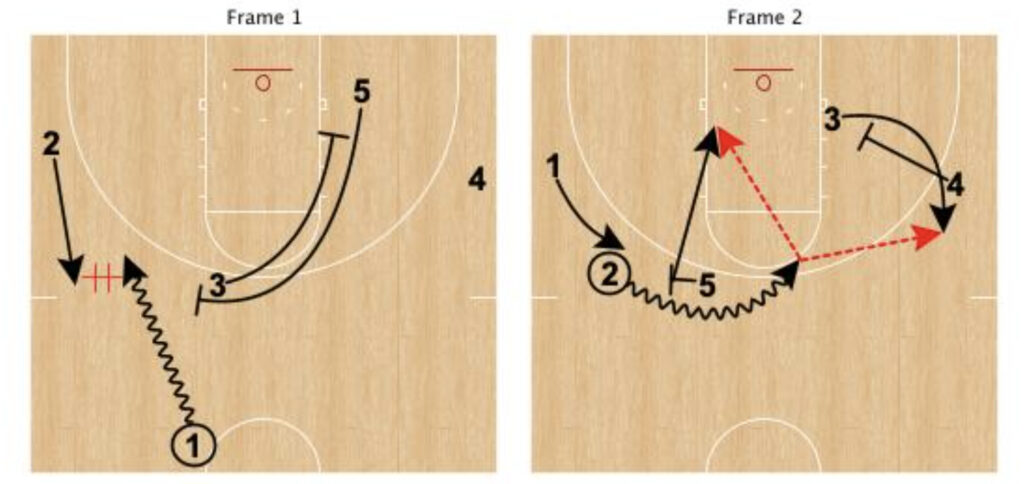
1 and 2 initiate the action with the DHO on the wing, while 3 begins the Ram action with a down screen for 5. 5 sprints to the top of the key, where he completes a ball-screen for 2, who is attacking off the initial action. 5 rolls as 2 turns the corner.
As this action is unfolding at the top of the key, 3 gets a pin-down screen from 4 to free him up on the opposite wing. So, as 2 attacks the lane, his options include 5 as the roll man, 3 for a kick out, or keeping the ball for an elbow jumper or layup. If 4’s defender overplays the pin-down screen, he can slip for a layup. 1 remains an option for the throwback pass as well.
This action is particularly useful at the high school level to combat overly aggressive defenses. This core actions also appear regularly at the NBA level.
This next play option incorporates both the Ram and Veer actions into the offense. The initial set up for this play implements a double-stack under the basket. The shooters execute a floppy cut to get open on the wings, an action that’s particularly effective at the high school level.
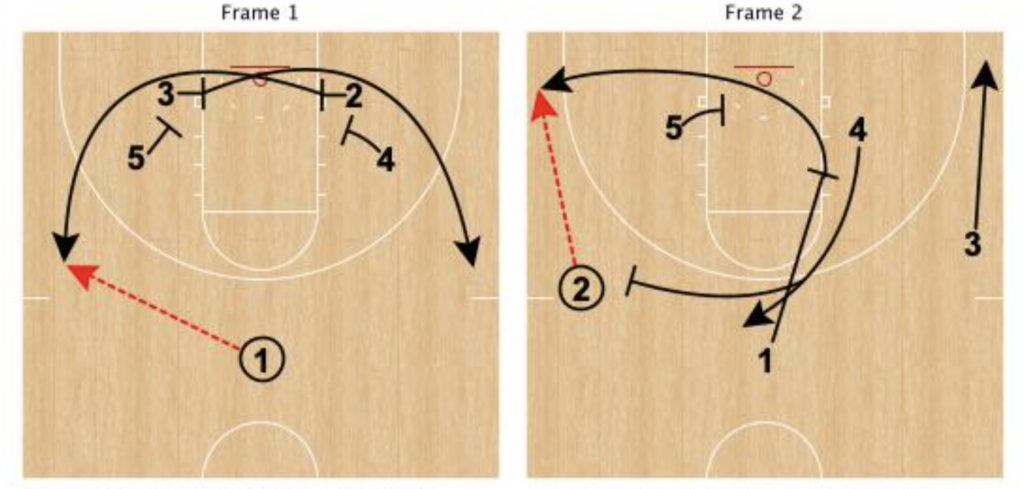
From there, the action of the play unfolds. 1 hits 2 coming off the floppy and immediately initiates the Ram action. 4 races up to set the ball screen for 2. As that’s happening, 1 cuts off a screen from 5 along the baseline and occupies the strong side corner. 2’s first look, before using 4’s screen, should be the corner.
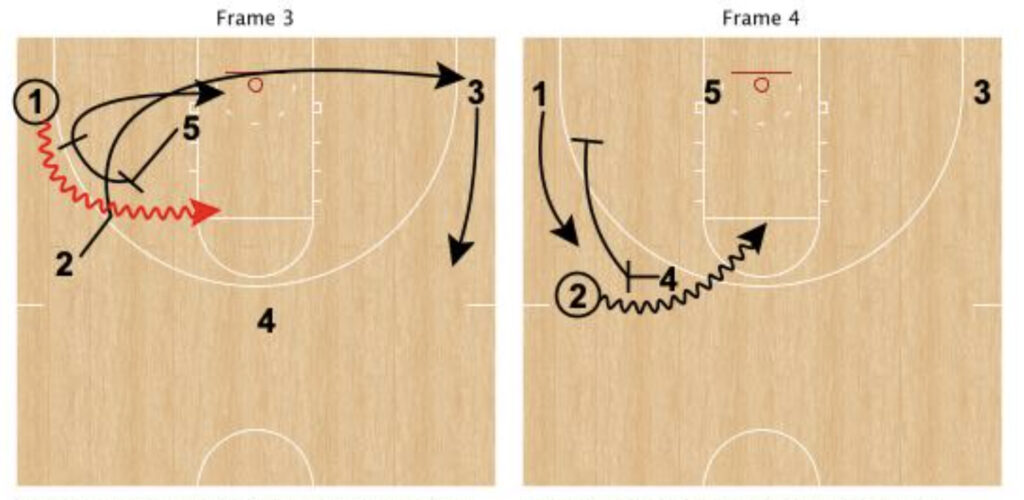
If the corner pass is there, 1 receives and either shoots or immediately attacks the defense. If the shot isn’t there, 5 initiates a back screen for 2, who cuts. After the back screen, 5 enters into a ball screen for 1, who attacks from there.
If the ball doesn’t go to 1 in the corner, 2 has the ball screen from 4 (Frame 4 above). This becomes the Veer action. 4 sets a ball screen, then sprints into a pin-down screen for 1. 2 attacks into the lane as 1 lifts on the wing. 5 can seal his man for either 2’s layup opportunity or for a dump down. 3 occupies the opposite corner.
 Ram and Veer use several actions to free up ball-handlers and create opportunities on offense. These actions can be particularly useful against overly aggressive defenses that like to blitz, hard hedge or trap screens.
It’s important when teaching screening at practice that the screeners know to sprint into their screens. If a player jogs to the screen, this allows the defense to adjust and defeats the purpose of the screen itself.
This last play option combines the two actions into one quick hitting option. This is a useful after-timeout play call, or even as an end-of-game situation.
The action sees 3, the team’s best shooter, set the Ram screen for 5. 5 sprints into the ball screen and immediately cuts into the Veer action. 5 does a pin-down away from the ball for 2, while 3 receives a down screen from 4 on the opposite wing. 1 uses the initial ball screen and pressures the defense. 1 can pass to either wing off this set, or attack on his own.
Ep: 811 Ram and Veer Offense Discussion with Coach Vann
If you found this useful, don’t forget to check out additional blog posts at TeachHoops.com. Also, check out TeachHoops on Facebook, Twitter, Instagram and YouTube.
Coming up with unique approaches on offense can be some of the most fun for any basketball coach. It’s important, however, for coaches to understand the skill level of their squad before imagining elaborate offensive sets. While the Chicago Action in basketball is widely used at both the NBA and NCAA levels, this offensive set can be integrated at the youth and high school levels with the right team.
Chicago Action involves two common basketball movements, the pin-down screen and the dribble hand-off (DHO). When used together, these two elements can stress any defense and provide the offense with multiple avenues to score. It usually necessitates a talented big who can be an offensive playmaker from the elbow.
This set loads an offense’s three most talented players on one end, while the other two perform decoy actions away from the ball. The beauty of this set remains the multiple variations a team can layer into their attack.
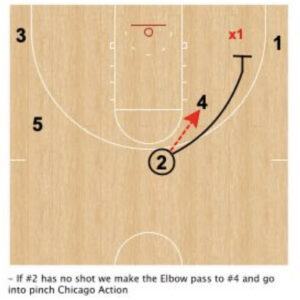 The basics of the Chicago Action involves two fundamental elements: the pin-down screen and the dribble hand-off. This action engages three of the five players on offense. It can be expanded to involve all five.
The set itself can initiate from four-out, five-out or horns sets. Use this set against man-to-man defenses.
In the four-out configuration, 4 pops to the elbow to receive an entry pass. From there, the 2 cuts over the big to set up the pin-down screen.
To make this truly effective, 1 must set up his defender with a jab step from the corner before cutting up off the pin-down.
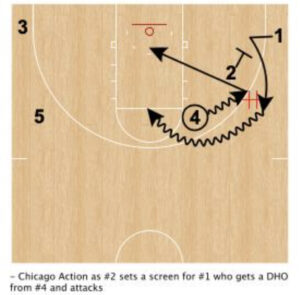
4 turns and immediately enters into a dribble hand-off (DHO) situation. 1 comes off the pin-down to receive the hand off. This action effectively gives 1 a pair of screens and forces the defense to make multiple decisions.
1 now attacks the defense as 4 rolls and 2 lifts from the corner. 1 reads the defense. Who is tagging the roller? Is his defender called a switch or is in lock-and-trail position? Depending upon the reaction of the defense, 1 chooses the next course of action. 1 can attack the rim, feed the roll, kick to the corner for a three-pointer or take an elbow jumper.
Away from the strong side of the floor, 3 and 5 can run decoy actions. There can be another pin-down, or a simple exchange. Something to engage those other two defenders and prevent either from sagging into the lane.
Get your copy of the Chicago Action Playbook by Coach Vann!
If you found this useful, don’t forget to check out additional blog posts at TeachHoops.com. Also, check out TeachHoops on Facebook, Twitter, Instagram and YouTube.
Developing basketball defensive systems stands as one of the most important aspects for any coach out there. While designing offensive plays might be more fun, crafting the right defensive system might make more a difference between winning and losing. A good defense feeds directly into offense and it makes scoring that much easier.
Many coaches believe it’s better to sport a simple offense and complex defense, rather than the other way around. How a coach crafts their team’s defensive approach often dictates the very identity of the team. Also, not all players, particularly at the youth level, will have the same natural abilities on the offensive end, but most players can be taught complex defensive schemes and excel.
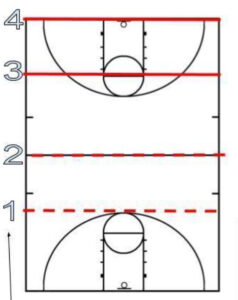 One key consideration for any coach, when creating their basketball defensive systems, should be the capability of the team. Depending upon the skill level of the players, a coach needs to adapt their system to fit what the team can actually do. The system itself becomes the terminology the coach decides upon, and what each call represents for the players on the floor.
One particularly useful approach when designing a defensive system is to divide the court into quarters. “Four” represents full court. “Three” represents three-quarter court. “Two” represents half court. And “One” represents the three-point line.
Dividing the court in this way allows for the defensive system to have clear calls from the sideline. This concept is also very simple for players to understand.
From there, a coach needs to decide what defensive approaches are best suited for the team.
What makes a defense complex isn’t the core concept itself, but the constant variations. If a team were to run the same base defense through each possession, it’s only a matter of time before the opposing offense feels comfortable and adjusts. This is increasingly true as the competition improves.
So when a coach decides upon their defensive approaches, most will settle on a base defense, but also install variations and special attacks. For example, a team’s base defense might be man-to-man, but a coach will also install a half court zone, as well as some sort of press. Some coaches layer multiple defensive approaches as a season progresses.
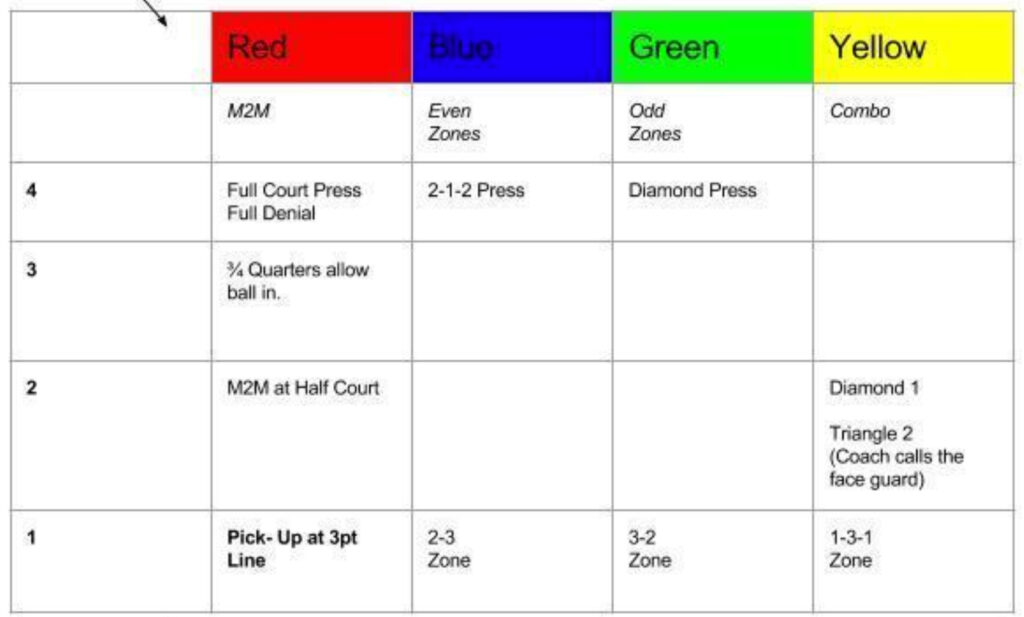
Once the base defenses are installed, players run through the different progressions to understand the key principals. A coach will have a man-to-man defense, then perhaps zones with even fronts and odd fronts. Players practice with each approach and learn the specific terminology. From there, it’s a matter of bringing the system together.
The calls from the sideline would combine the defensive approach and the pickup point. So one call might be: “Red 4” which would signal to the players a full court, man-to-man press. Another call might be “Blue 2”, which would be a half court, 2-3 zone.
Coaches can play with the terminology and defensive approaches, but the optionality is what makes these basketball defensive systems complex. Constant changes frustrate opposing offenses and create opportunities for the defenses.
Ep: 118. Basketball Defensive Systems
If you found this useful, don’t forget to check out additional blog posts at TeachHoops.com. Also, check out TeachHoops on Facebook, Twitter, Instagram and YouTube.
Most basketball coaches often search for staples for their practices. These staples always make it on the practice plan, no matter what the focus of that day might be. Players become comfortable with these progressions and often master specific skills over the course of the season. One of the most valuable basketball practice staples is 4-on-4 Cut Throat.
4-on-4 Cut Throat stands as a favorite drill among young players because of its game-like nature. For coaches, 4-on-4 Cut Throat provides each basketball practice with the opportunity to stress and develop specific elements of the game.
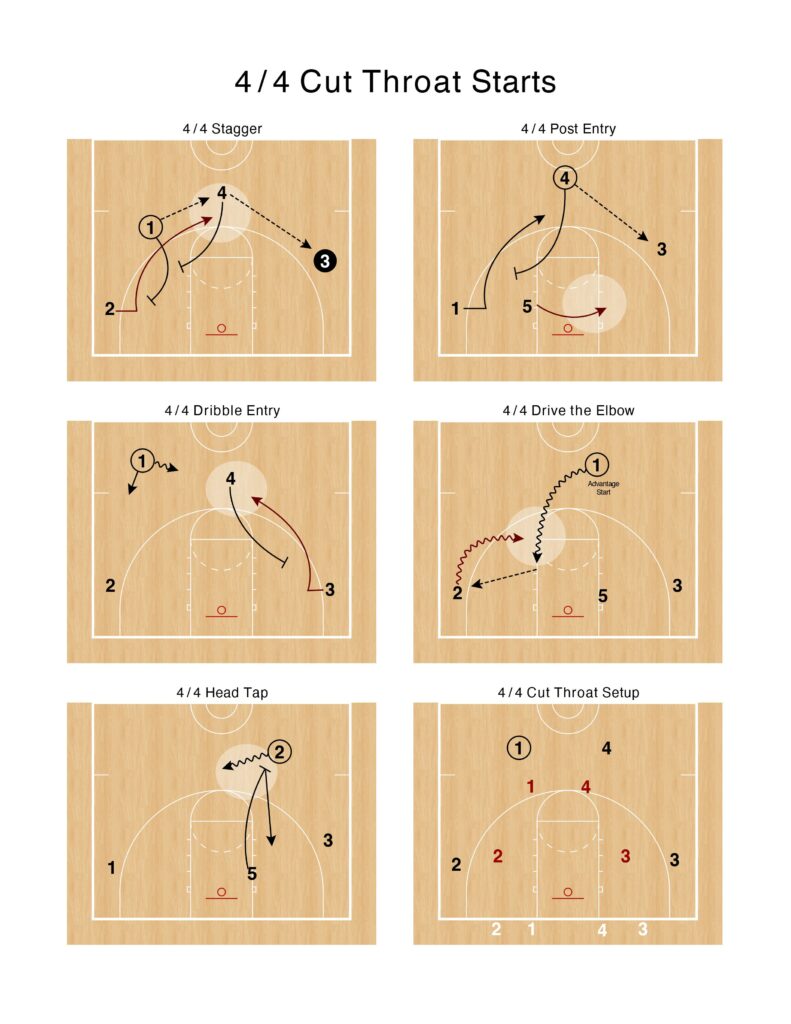
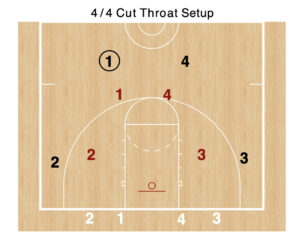 4-on-4 Cut Throat is a high-energy, high-movement drill. Coaches divide their teams into sets of four, with two groups on the floor at all times. Through each progression, players navigate the possession, looking to score or get a stop. As each possession ends, the successful team (the one that scored or made the stop) stays on the floor, while the losing group comes off. The waiting team comes on and fills the vacancy.
Coaches can allow the players to free play, or can install specific needs in a possession. The free-flowing nature of the drill allows players to learn on the fly. Whatever a coach decides to emphasize in the drill often translates directly to the game.
Once the players are on the floor, coaches layer specific commands into a possession. If a coach wants to focus on spacing, they might outlaw ball screen. If a coach wants to focus on movement, maybe players must pass and pick away. There are any number of layers that can be added to this drill.
The emphasis of this drill is to build solid offensive and defensive habits. The goal for each team remains staying on offense. Although this drill can be altered to be 5-on-5 or 3-on-3, the 4-on-4 set up might be the most effective for incorporating specific offensive elements. 5-on-5 tends to get bogged down in the half court, especially with good defensive teams. And 3-on-3 often provides the offense with too much space.
The hidden value of this drill remains the opportunity for coaches to provide direct instruction to the teams that lose a possession. As the losing team comes off the floor, a coach can immediately pull them aside and talk through what went wrong while the other two teams progress through the drill.
Ep: 818 Drill of the Day with Coach Lynch (4-on-4 Cut Throat)
If you found this useful, don’t forget to check out additional blog posts at TeachHoops.com. Also, check out TeachHoops on Facebook, Twitter, Instagram and YouTube.
One of the most important elements to designing a valuable practice plan is deciding what core basketball elements you’ll concentrate on. So when deciding between basketball practice warm up drills, it’s important for a coach to know where the focus will be. Getting your players warmed up and ready to compete needs to happen at the start of every practice. So why not use that segment to instill core elements to your offense and defense?
Many practices begin with traditional layup lines and jump shots. But how often are the players simply going through the motions of those drills? Installing the right warm up drills will vastly improve the efficiency of your practice.
Coaches always love drills that do double duty. When a drill that incorporates multiple basketball elements can be used, it helps maximize the value of that practice segment. Drills that develop specific skills and other elements like conditioning and/or communication are inherently more valuable than single-focus drills.
Argentina Passing sports that layered value because players progressing through the drill develop their passing skills, as well as hand-eye coordination, communication and conditioning. Passing drills in general get players mentally focused, and this one gets them moving as well.
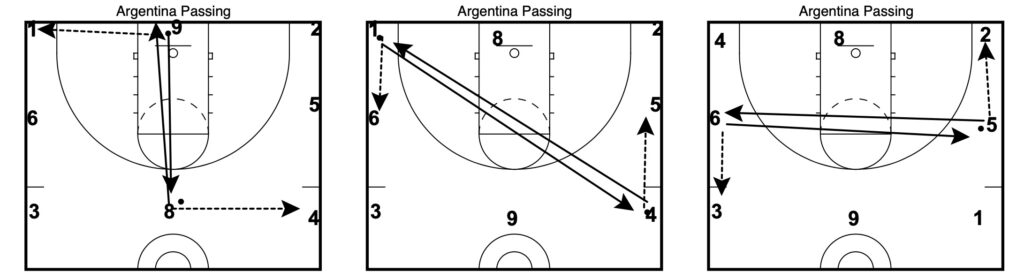
Eight players start on the court for this basketball practice warm up drill. Each player stands partnered with the teammate directly across or diagonally across from them in the half court. The two balls start with the center players and those players pass to their right. Immediately after a player passes, they cut across the court and exchange places with their partner.
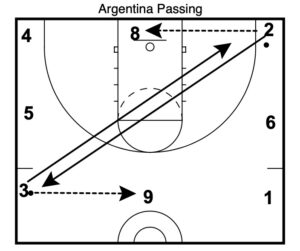
This drill rises above a normal passing drill because the players are sprinting through once they’ve made their pass. Players must concentrate on the catch, using a reverse pivot to open their hips on the catch.
Passes exclusively run to one side, meaning the players are always either passing to the right or the left. Coaches can focus on specific pass types. Coaches can also reverse the drill after a set amount of time.
Players work on passing, foot work, communication and conditioning through the drill.
Star Passing is common one in many gyms, but this version of the drill incorporates the necessary element of finishing with a made basket. This doubles well not only as a basketball practice warm up drill, but also as a game warm up.
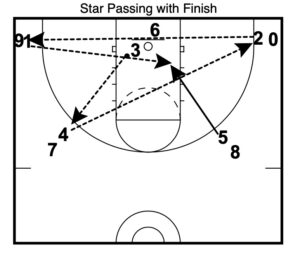
The drill begins with players arrayed in a star across the half court. The ball starts with the line under the basket. There are lines in the corners, as well as on the wings.
The first pass goes from under the basket to the left wing. The passer follows their pass and joins the end of that line. From there, the left wing passes to the right corner and follows. Right corner makes a baseline pass to the left corner and follows.
The final move in this initial turn through the drill involves the left corner feeding the player that cuts from the right wing. That player receives the pass and finishes the turn with a layup.
Variations of the drill can incorporate a number of additional basketball elements. Coaches can require that the ball never hits the floor. They can reverse the flow of the drill to work on left-hand layups. Coaches can have a defender waiting at the rim to challenge the finisher. The list goes on an on.
The final basketball practice warm up drill here is called Pivot Passing. While this drill remains a staple at the youth level, there are practical elements here that can be incorporated into the practice plan of more advanced teams.
This drill stresses the specific development basic footwork. Players pair off and stand in four lines. If the players start on the baseline, they explode out with an attack dribble to the free throw line extended area. From there, the players jump stop, reverse pivot then pass to their partner at the baseline. The partner receives the pass an immediately explodes into the dribble.
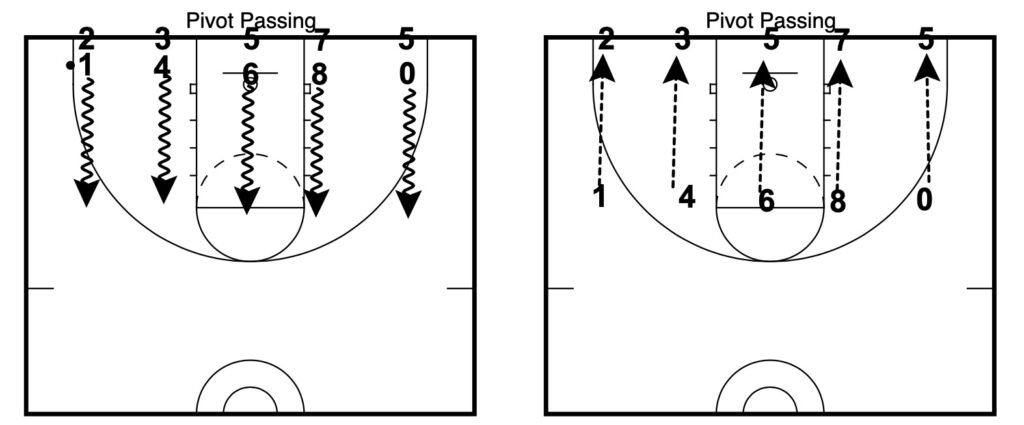
The reverse pivot helps practice creating space, a necessary skill for any level of player. Coaches can layer shot fakes, step throughs, rips, etc. Change the specific pivot foot for the players and force them to adjust. Even the most athletic players may struggle with this seemingly basic drill because it layers specific movements and does so quickly.
Ep. 39: Coach Steger, 3 Favorite Practice Drills
If you found this useful, don’t forget to check out additional blog posts at TeachHoops.com. Also, check out TeachHoops on Facebook, Twitter, Instagram and YouTube.
For many coaches, the quest for new and engaging basketball pre-game warm up drills seems like it’s never ending. And for the coaches who are tired of doing the same old things, sifting through all of the resources online can feel like a daunting task.
The key to any pre-game warm up routine is to get the players physically and mentally prepared. The traditional layup lines can certainly provide movement and the chance to practice an important shot. But too often, this drill engages just two or three of the players on the team. There’s a lot of standing around and waiting, and that’s not what you want your team to be doing in the run up to a game.
RELATED: Youth Basketball Development, Practice Planning and Drills
The reality is, pre-game is often an underutilized part of the game for many coaches. Instead of passively moving through a series of routine drills, coaches should approach pre-game with the same intensity and focus that’s expected of the game itself. The following drills should engage and prepare players of any age or ability.
In this episode from the TeachHoops YouTube channel, Coach Collins and Coach Vann talk through a couple great options for any team.
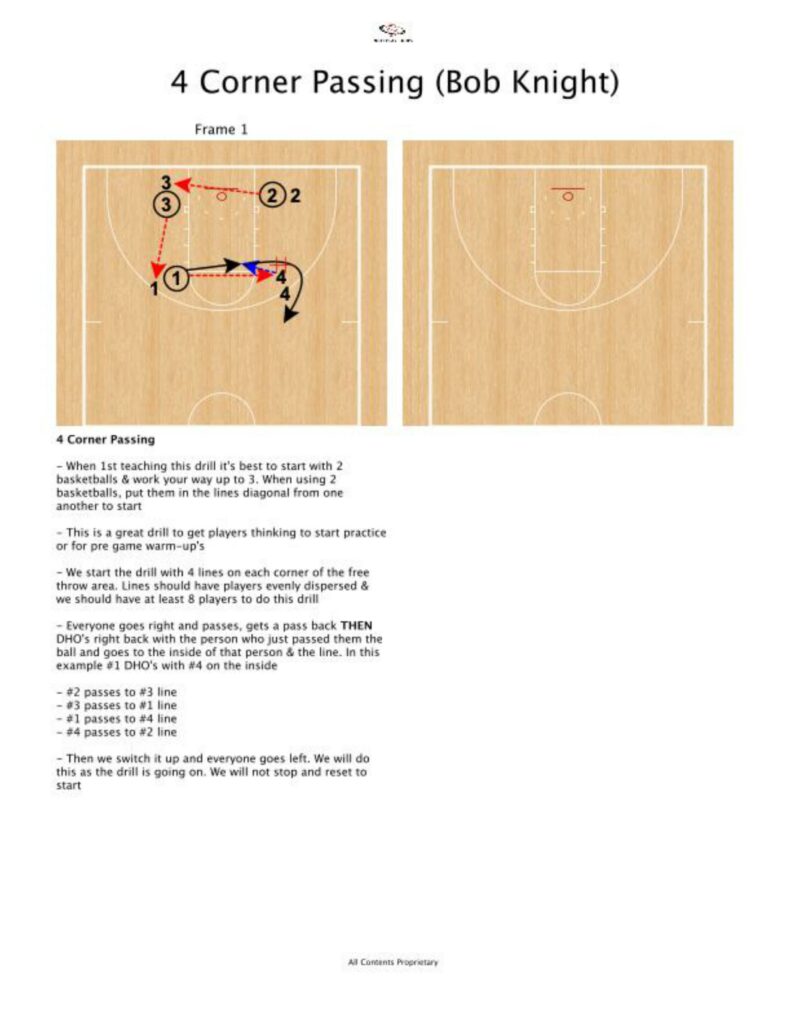
Four Corner Passing has been a stable of so many coaches, thanks to the great Bobby Knight. While chaotic at first, this drill gets multiple players moving and practicing a key skill. Starting with four lines (two on the blocks and two at the elbows), players pass to the right, receives a pass back and runs through a dribble hand-off (DHO). Players rotate and the lines keep moving. This drill can go right or left and multiple balls can be added as the players improve.
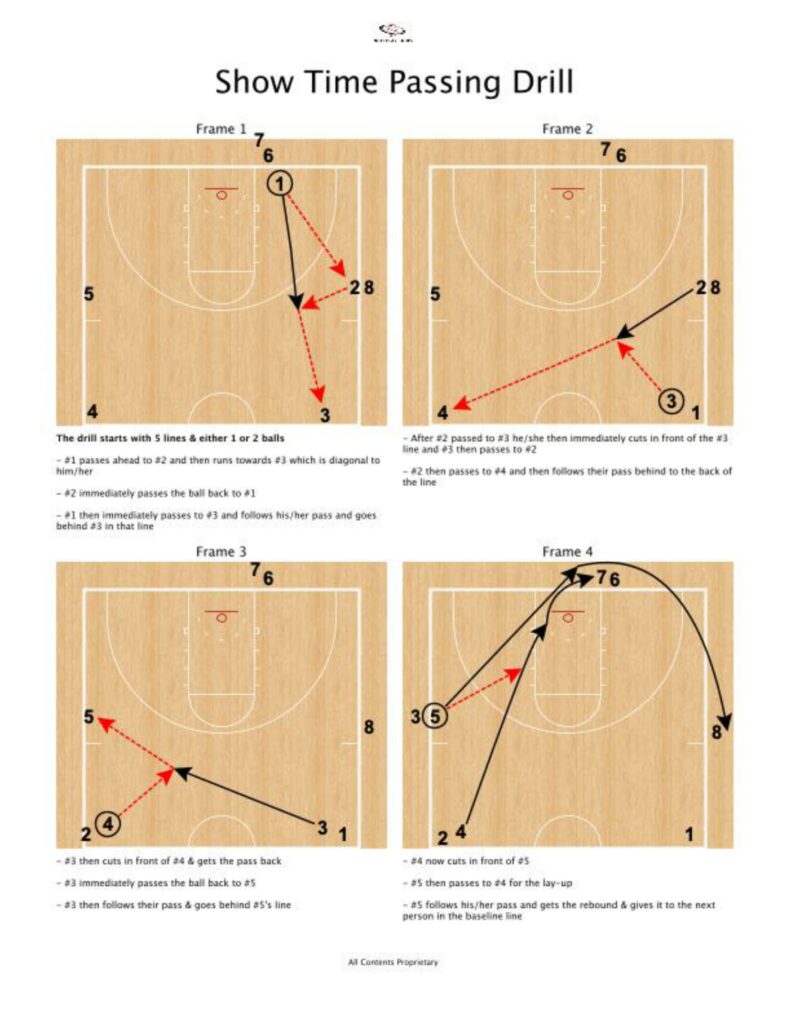
Show Time Passing is another active drill that gets the players moving and thinking. The five line set up features near constant movement from the players, and involves the basic pass-and-cut, give-and-go action that’s integral to good team basketball.
This quick video below demonstrates a few pre-game warm up drills, including drive-and-kick for layups and baseline curl shot sequences.
This video provides an extended look at additional basketball pre-game warm up drills. A solid defensive sequence involves 3-on-3 close outs. It focuses on help-side responsibilities on defense and attacking the basket on offense. In addition, there’s a 5-on-5 walk through of offensive sets and a basic, four-person shooting drill.
If you found this useful, don’t forget to check out additional blog posts at TeachHoops.com. Also, check out TeachHoops on Facebook, Twitter, Instagram and YouTube.
Basketball coaches everywhere are constantly searching for new Competitive Practice Games. Keeping young players engaged throughout a practice period often means mixing up physical warm-ups and stretching, technical drills and competitive contests. Coaches need to layer the information and embed key skills before introducing and installing specific sets.
But running through the same drills over and over can result in bored, disengaged players. Yes, they need to master the basic layup. But running through the same two-line drill every practice might have players check-out on their coach.
Enter the competitive practice games.
These games aren’t teaching drills per-say. The goal of competitive games is to get your players practicing key skills within the controlled environment of the closed gym. Here, the players are learning as they make their way through the progressions and reads, relying on their teammates to pick them up.
It’s important for coaches to allow their players to play through their mistakes and learn as these competitive practice games to unfold. These controlled situations and scrimmages also provide plenty of information for coaching staffs to digest. They’re learning the strengths and weaknesses of their teams.
This is a full-court competitive game that allows coaches to install a specific play or set, while also practice key defensive principles. In the half court, the offense runs their first action against a full compliment of defenders. If this action results in a basket, then the offense and defense switch. But if the defense gets a stop, then it’s a full court game.
The defensive stop flows into transition offense as that squad seeks to score. Only points scored off of defensive stops count in this competitive practice game. This game should flow back and forth for several minutes before coaches change anything.
Emphasis: Defense. Basketball coaches that incorporate this competitive practice game look to establish the mindset that the team needs to focus on getting defensive stops before getting to the offensive end of the floor.
RELATED: Youth Basketball Development, Practice Planning and Drills
One of the most frustrating elements of coaching at seemingly any level is dealing with unbalanced teams. Having a starting five that’s far more talented than their teammates forces a coach to come up with different ways of maximizing practice time. Since a starting five typically sports a team’s top players, scrimmaging the first five against any combination of the rest of the roster might not produce the practice results coaches are looking for.
And on those teams where there’s a dramatic split in playing level between the first five and the next five, scrimmages can often become just as frustrating for the players. But it’s also important for the best players in the rotation to get practice time together on the floor.
“Perfection” ultimately handicaps the competition, evening the practice floor to make it more interesting and engaging. The idea with this competitive practice game is for the “strong” team to play like normal. They need to be “perfect” and they get points for scores or anything else a coach is looking for. The “weaker” team, meanwhile, has access to all of the normal points, but also could get points for specific accomplishments, like offensive rebounds, forced turnovers, etc.
Emphasis: Attention to detail, competitive balance. While the top players might be more talented than their teammates, this competitive practice game can balance the scales to a certain extent and keep all parties engaged throughout. Afterwards, and this is true of any basketball competitive practice game, it’s important that coaches debrief with their players to emphasize specific elements.
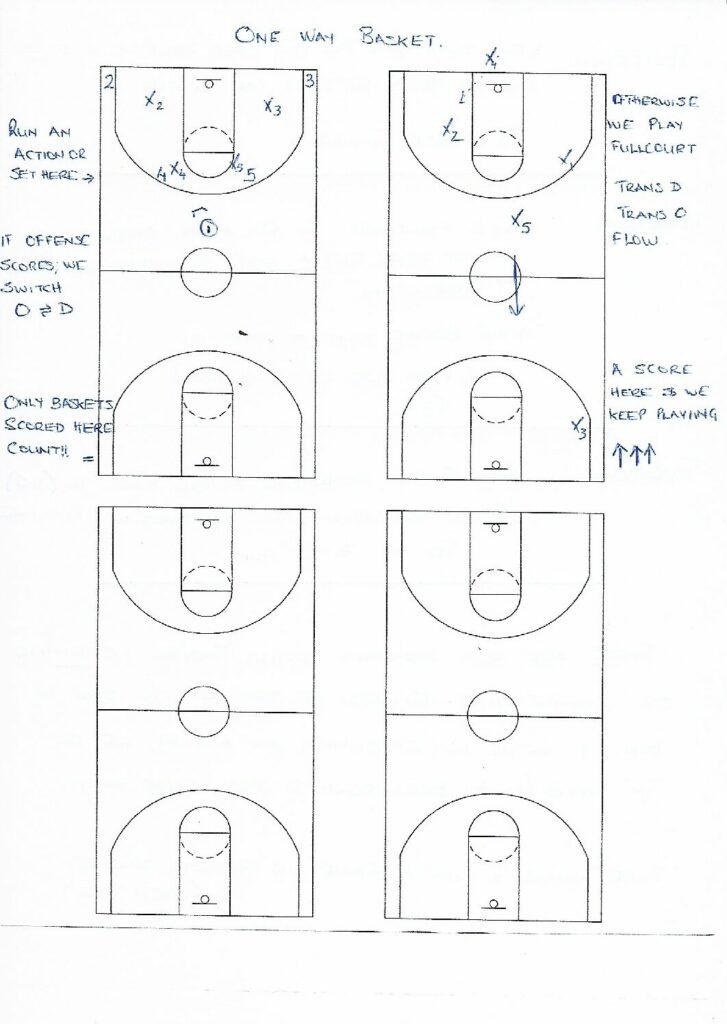
One Way Basket Basketball Competitive Practice Game
If you found this useful, don’t forget to check out additional blog posts at TeachHoops.com. Also, check out TeachHoops on Facebook, Twitter, Instagram and YouTube.
One of the most important parts of any coach’s practice plan is the incorporation of basketball shooting drills. These drills are valuable no matter the level of the team or the talent of the individual player. Shooting remains a key aspect of the game, and only through repetition and focus can a player improve.
For coaches, finding the right drills for your team can be frustrating. Depending on the team’s level and the talents of the gathered players, coaches sift through dozens of drills, searching for the right series. It’s important for a coach to understand their team’s ability and continuously push them to improve.
When developing shooting drills, a good coach must consider what types of shots they want to focus on. Drills should reinforce the skills that will help the players perform within the context of a game. So shooting drills should be designed around shots that would normally result from a team’s offensive actions. The best basketball shooting drills are representative of a team’s base offense.
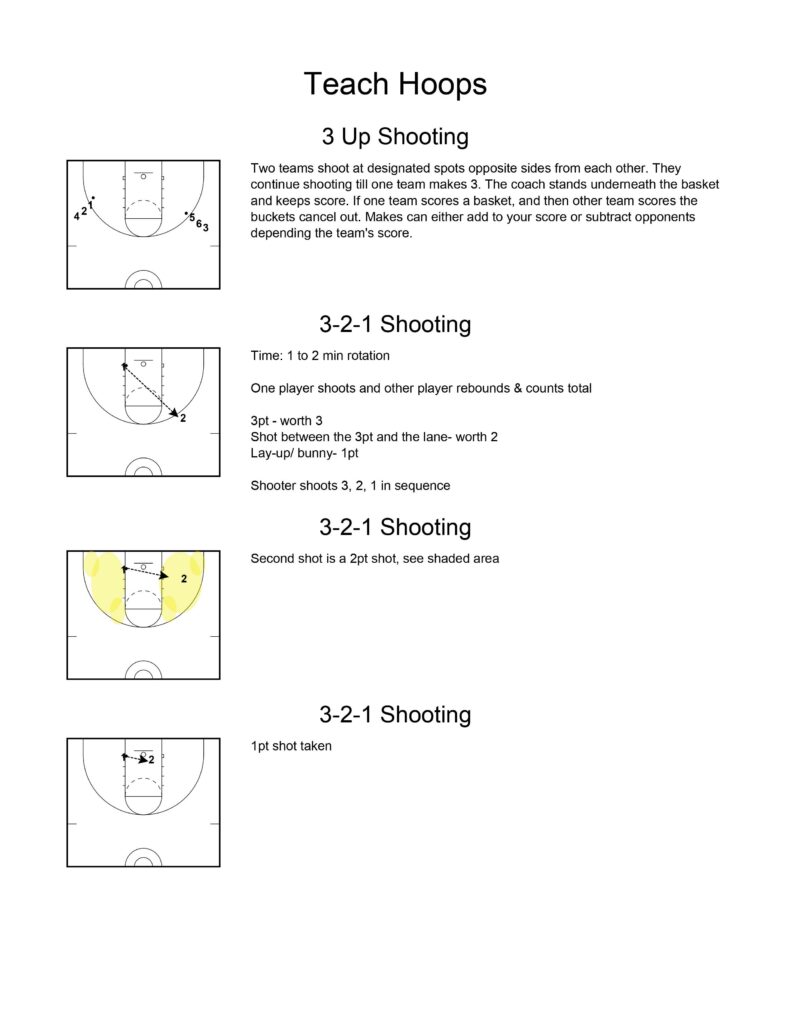
This drill involves at least two players and is a high-volume, high-repetition practice. Over the course of one or two minutes, non-stop, a single shooter progresses through a series of jump shots. The other player rebounds and feeds the shooter from near the hoop.
The shooter begins behind the three-point line for their first shot. From there, the shooter moves into the midrange for their second shot. The last shot in the sequence is a layup (which is worth one point). The rebounder keeps track of the shooter’s score as their teammate progresses through the drill. After the time is up, the players switch roles.
This shooting drill provides valuable practice for any shooter, regardless of talent-level. The shooter must move, set their feet and find a repeatable release. Even the other player gets reps at securing rebounds and making solid passes.
This drill can incorporate internal competition as well. The two partnered players can compete with one another, or with another pair at another hoop.
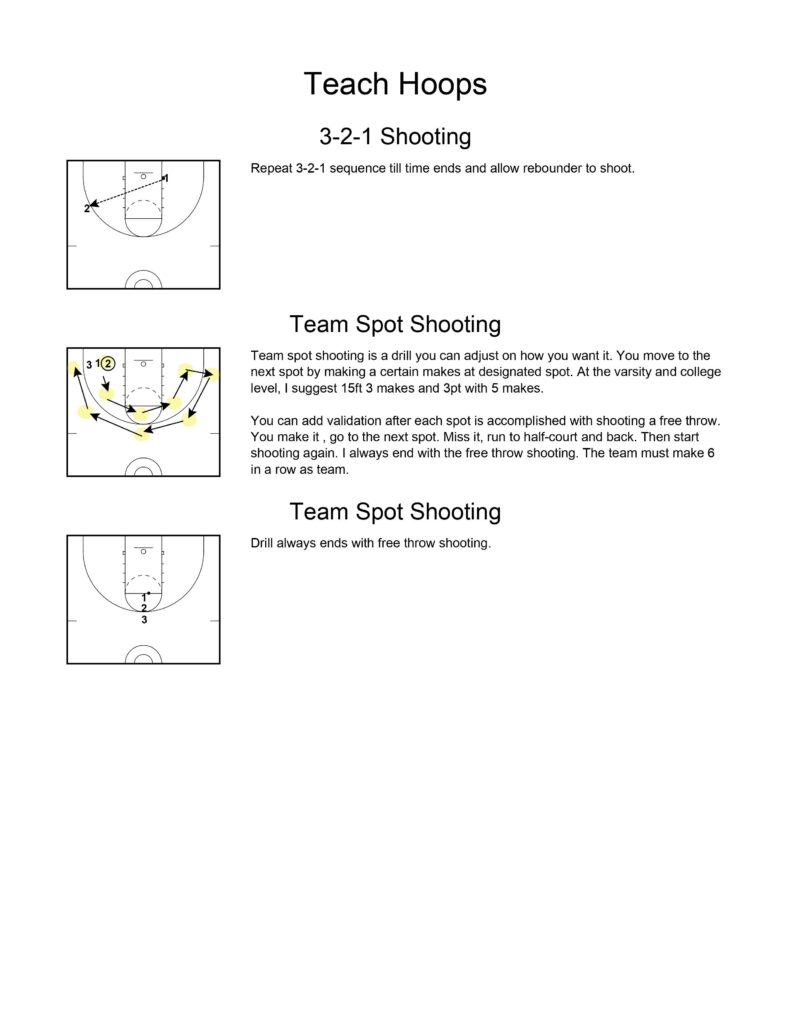
Team Spot Shooting is one of the most valuable basketball shooting drills. This practice sequence emphasizes form shooting and positioning, all within the framework of a team competition.
This drill involves a set number of players progressing through a series of shots on the floor. The group might start at the short corner, then move to the elbow, free throw, opposite elbow and opposite short corner. In order to progress to the next spot, the group needs to make a designated number of shots in a row. Once the group has made three from the short corner, for example, they move to the elbow. But if they miss at the elbow, a coach can signal either that the team runs or returns to the previous spot.
This drill can be redesigned as a practice game as well.
If you found this useful, don’t forget to check out additional blog posts at TeachHoops.com. Also, check out TeachHoops on Facebook, Twitter, Instagram and YouTube.
No basketball coach’s playbook is ever complete without a go-to baseline out of bounds play. Sometimes referred to as a BLOB, the baseline out of bounds play serves as a scoring opportunity for most teams. These plays are often quick-hitters with multiple options for the inbound passer.
Coaches can be as creative as they want to be when designing these plays, but they have to keep in mind the skill-level of their team. Another consideration is being able to shift directly into the team’s core offense. Finally, some coaches prefer to install baseline out of bounds sets that have multiple variations from which to attack the basket.
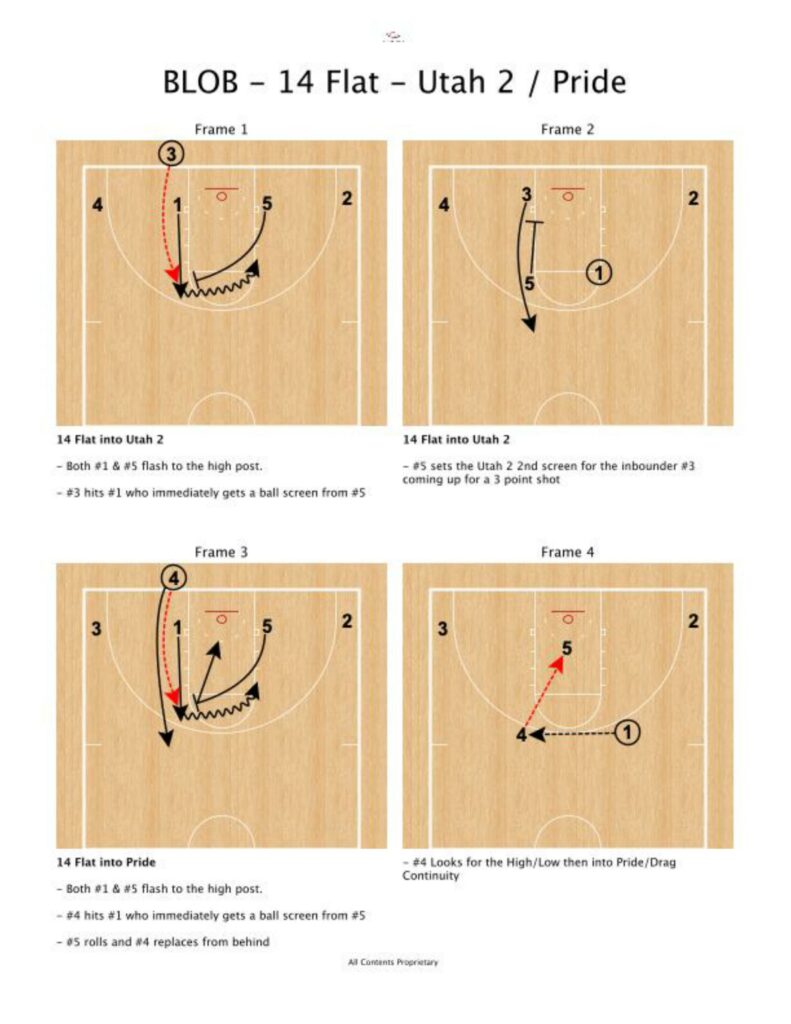
14-Flat features the four players on the floor arrayed along the baseline. Players occupy the three-point corners and the two blocks. The inbounder has a clear line of sight along the baseline and plenty of room to make the necessary reads.
The first action in 14-Flat involves 1 popping from the box to the elbow. As that pass is happening, 5 moves from the opposite block into a ball screen at the elbow. 1 attacks onto the key, with 2 waiting for a kick in the strong-side corner. After setting the initial ball screen, 5 turns and drops into a down-screen for the inbounder. 1 attacks the basket at that point with multiple options, including a layup, corner kick out, back pass and more.
This play should be run against a man-to-man defense.
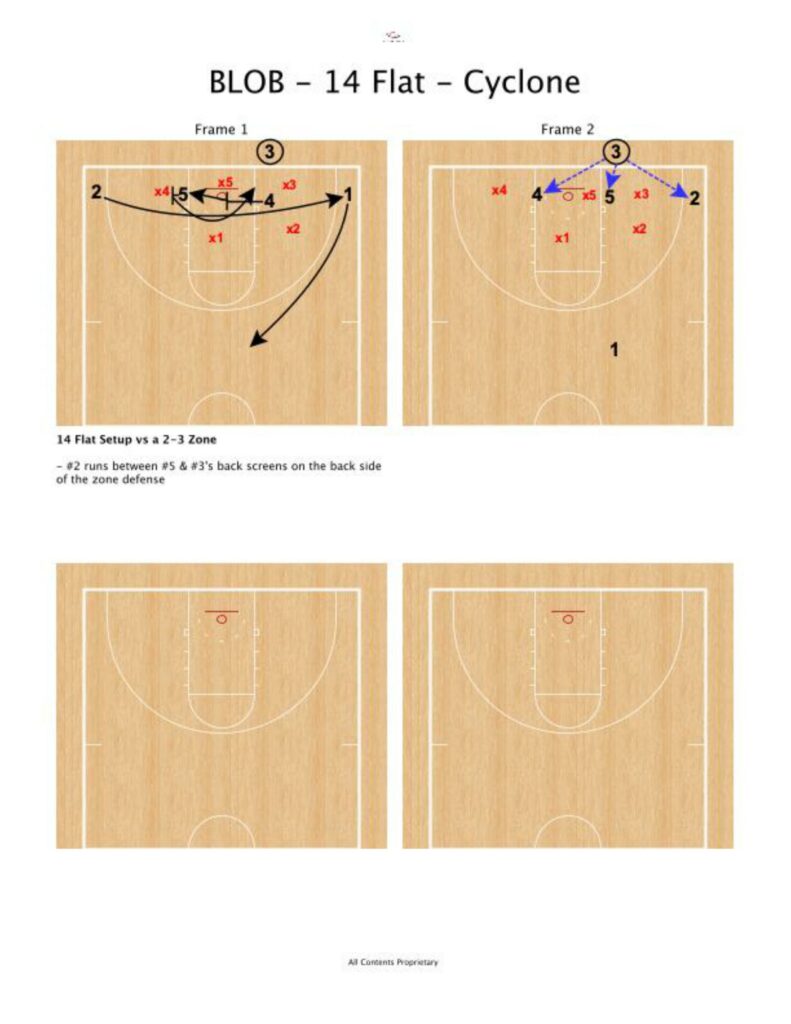
This play is used against a zone defense. For Cyclone, the offense still uses the 14-Flat alignment, with players arrayed along the baseline. This time 1 starts in the strong-side corner and flashes to the top of the key. From there, 2, which started in the opposite corner, cuts across using two screens at the block. Once 2 has cleared both screens, 4 turns and sets another screen, this time across the key. 5 curls toward the inbounder and 4 seals his man, leaving the inbounder with multiple reads.
The key to this play remains the inbounder’s ability to read the progression correctly and make a good interior pass. 1’s cut is a decoy, as is 2’s to the corner. 5’s curl may result in a layup, but the most likely basket often comes on 4’s seal against the backend of the zone. The inbounder must direct the defense away from that action, focusing on the corner with a ball fake. From there, it’s a matter of getting a good feed into the post.
A key consideration for any baseline out of bounds play is the ability to flow into a team’s offensive continuity. Depending upon a team’s base offense, the most effective BLOBs allow the offense to attack quickly. But if a defense covers up the initial actions, the BLOB flows into the normal offense or a specific half court play.
If you found this useful, don’t forget to check out additional blog posts at TeachHoops.com. Also, check out TeachHoops on Facebook, Twitter, Instagram and YouTube.
A good basketball playbook must include a solid sideline out of bounds play. Often forgotten or disregarded, these sets can be used in a variety of ways to stress the opposing defense. Sideline out of bounds plays (SLOBs) can initiate attacking actions, be a quick hitter or even as an end-of-game go-to.
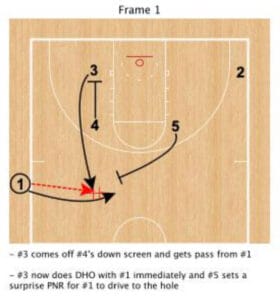
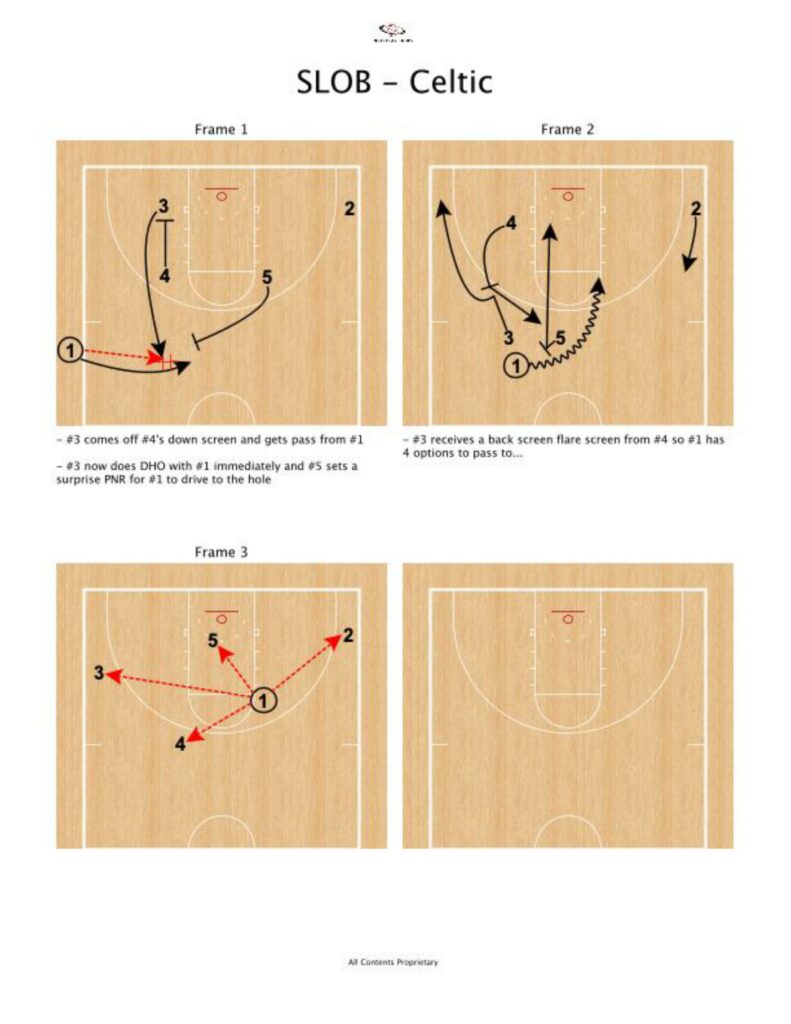
This SLOB starts in a box set. The 2 and 3 set up near the blocks, while the 4 and 5 occupy the elbows to start. 1 serves as the inbounder for this set.
The initial action sees 2 cut hard to the opposite corner to draw his defender away. 4 sets a down screen for 3, who flashes to the top of the key. 1 finds 3 with the inbound pass.
As 3 receives the pass, two things happen simultaneously. 1 immediately cuts seeking a dribble-hand-off (DHO) action. As the DHO is taking place, 5 comes up and sets a hard ball screen.
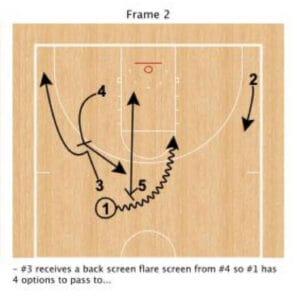
The second progression of this play immediately puts the offense into attack-mode. 1 uses the ball screen at the top of the key, looking to turn the corner.
As the high ball screen is taking place, 4 rotates up and sets a weak-side screen. 3 uses the flare screen to drift to the corner. 4 remains high to be an option for 1 on the drive.
After setting the ball screen, 5 rolls down the lane with hands ready. 2 reads the defender to either stay in the corner or drift high. 2 must present as a kick-out option for 1’s drive.
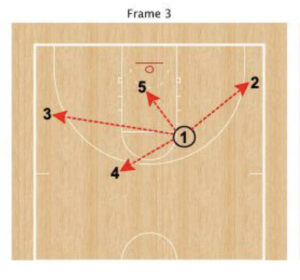
From here, 1 has multiple options to attack the defense. A breakdown may open a driving lane for a layup, or there are four potential passes to make.
Feeding 2 could result in an open corner three-pointer. 5’s dive could be a layup. If 4 is a pick-and-pop big, a pass there could result in a three-pointer or a high-low game between 4 and 5.
The least likely option in this sequence is a pass to 3 in the weak-side corner. Unless 1 gets to the baseline, that’s a hard pass to make.

If you found this useful, don’t forget to check out additional blog posts at TeachHoops.com. Also, check out TeachHoops on Facebook, Twitter, Instagram and YouTube.
Enter your email address to gain access to our FREE video series.