Promoting your basketball program might not be front and center in the minds of coaches heading into a new season. However, this concept remains an integral part to the long-term health of your program. Developing a culture of excellence that produces results on the court stands obviously as the most difficult part of a coach’s job. But branding can often provide that promotional push to get your program to the next level.
So the question becomes: how to promote your basketball program? The answer stretches from your school community to social media.
Promote Your Basketball Program on Local News Outlets
One of the simplest, and most time-honored, ways to promote your basketball program comes from providing key information to local news outlets. Although traditional media continues to evolves, local newspapers often rely on high school content to fill out their sports sections. This can be as simple as sending a schedule and roster to start the season, in hopes of regular game coverage.
Once the season starts, send statistics and game recaps after every game. This will help establish a rapport with the local beat writer covering high school sports and make your program more likely to be featured. Consistent coverage could get your program’s names in front of more eyes. This can also help expose talented players for potential college recruitment.
You can pitch unique ideas for potential feature pieces to promote your basketball program. And should the news outlet provide an on-site reporter, make sure you and some of your players are available for comment.
Promote Your Basketball Program Through Community Involvement
Another way to promote your basketball program is to have your players and coaches engage within the school and local community. Many students need service hours helping charitable organizations as part of school or scholarship requirements. Some schools are encouraging their student athletes to average 15 to 20 hours per semester helping community organizations.
Getting your players involved benefits them in that regard and it can help with team-building. Some of the options for community involvement include:
clothing drives
food drives
holiday toy drives
volunteer hours at homeless shelters
basketball clinics for middle or elementary school players
Engaging in these activities will provide a boost to team morale and help those in need in your community. Be sure to notify local news outlets for coverage to extend the promotional reach of these activities. Any feature pieces that come from these events showcase your basketball program in a positive light.
Clinics also provide a platform to introduce local young talent to your program and your coaching style. It cultivates a beneficial relationships within the local basketball community and may give you an inside track for up-and-coming athletes.
When possible and appropriate, your players should wear their uniforms or other team paraphernalia to help promote the program and demonstrate unity.
Promote Your Basketball Program on Social Media
Perhaps the best way to promote your basketball program these days comes via social media. Instagram, Snapchat, TikTok, Twitter, and YouTube, even Facebook, provide platforms where teenagers and some parents remain active. According to the American Academy of Child and Adolescent Psychiatry, surveys show that 90 percent of teens between the ages of 13 and 17-years-old use social media.
The best way to promote your basketball program on social media comes with consistent fan engagement. Some of the best ways to do this include:
Posting season schedules
Reminding fans of game days and encouraging fans to attend
Showing some of your team’s game highlights
If you’re not tech or social media savvy enough, or lack a comfort level with this platform, there’s no doubt the players themselves will have ideas of what and how to post. Perhaps putting this responsibility on a team manager or young assistant coach would work.
With social media, it’s important to be consistent and engaging with fans and your school community. Never go extended periods without posting on some platform. This engagement can be a fun and exciting way to promote your basketball program, and to do so on platforms where students and the school community will undoubtedly see it.
Any basketball coach knows the pressure of conducting fair and effective tryouts. No matter skill level, age, or competitive setup, picking the right players to populate your team stands as one of the most challenging choices to make. That’s why having the right basketball player evaluation form is integral for your tryouts.
Often times, developing your tryout can be more difficult that even setting up a playing rotation. Tryout day stands as one of the hardest yet most important days on the calendar. How a coach assembles to roster has wide ranging implications for the season.
Basketball Tryouts Form Opinions for Key Player Evaluation
The first question any coach needs to ask themself is: what type of team will you have? The answer to this question will largely influence the types of drills you select. These drills will be staples of any practice plan, but they’ll also be valuable evaluation tools during tryouts.
Key aspects to consider are skill and athleticism.Transition drills often provide an effective measure for these areas. In these drills, players need to demonstrate how well they run and what type of shape they’re in, as well as how they control the ball and finish. From there, higher level transition drills can evaluate decision making skills as well.
Station work tends to give coaches the opportunity to measure specific basketball skills for individual players. This becomes particularly effective for coaching staffs with multiple members. That said, even if you’re working alone, having the players rotate through stations gives you a glimpse of each player’s skill level in a given area. These stations can include ball handling, form shooting and free throws, among other things.
Grouping players together for small competitive games also provides basketball coaches with solid information for the player evaluation form. Organize players into 2-on-2 or 3-on-3 competitions to see how they operate in a team environment. In these small group environments, it’s harder for players to “hide.”
Another important element to consider exists outside the basic skill and athleticism evaluation. The intangible skills of communication and teamwork often separate a player’s effectiveness on the floor. Incorporating drills that push these skills to the forefront provide coaches with important information about each player. These drills or situations can shine a light on players with leadership potential.
Areas of Evaluation
The Basketball Player Evaluation Form provides space for coaches to consider several different skills and traits for each player. Among those areas are offensive skills like shooting, dribbling, and passing. In addition, defense and rebounding skills need measurement. Other general areas on the form include athletic ability, coachability, and game play. Finally, the form provides space for overall strength evaluation.
Basketball Player Evaluation Form Downloadable PDFS:
Coaching basketball at the youth level invariably involves dealing with zone defenses. The most common zone, 2-3, allows developing teams to hide certain players on the defensive end. It can also frustrate offenses to no end, especially if the offensive players tend to stick to their spots. So, as zones become more and more common even at the game’s highest levels, it’s integral that every coach knows exactly what they want to do when attacking a 2-3 zone. Using a continuity offense often helps.
One of the most common misconceptions to combating a good zone is the reliance on distance shooting. Teams might have a reliable zone-buster on their team, capable of consistently draining three-pointers. But the reality is most defenses would rather their opponent launch from deep rather than attack for higher percentage shots near the rim.
Continuity Offense Attacking a 2-3 Zone
Continuity offense stands as one of the most valuable approaches to attacking a 2-3 zone. These plays and sets create a rhythm and offensive flow that allows the team to stress the opposing defense. Offensive players know where to go as each pass is made within the continuity. The constant flow forces the defense to adjust, not only to each pass but also to each cut.
The set up for this continuity offense involves using a 1-3-1 counter to the 2-3 zone. 1 brings the ball down, with 2 and 3 on the wings. 4 occupies the high post, while 5 takes the low post. The initial action is a pass to either wing. 4 reads that initial pass, then cuts with the ball to that strong-side corner (or short corner).
From there, 5 presents as a low-post option and 2 cuts across from the opposite wing. 2 flashes to the open elbow area, while 1 makes a flare cut to the opposite wing. 3 reads the movement of the defense before making the next pass. If 2 doesn’t immediately receive the ball at the elbow, they lift to the top of the key.
The continuous element of this continuity offense comes if the defense recovers through the initial movement. 3 gets the ball to 2, who reverses to 1. As the ball switches sides, both 4 and 5 cut to the new strong side of the offense. 4 makes the baseline cut behind the zone, while 5 flashes to the opposite low post.
As the ball reverses, 3 makes the cut across, flashing to the open elbow. 2 makes a flare cut to the opposite wing, away from the ball.
Keys to Attacking a 2-3 Zone
The first, and perhaps most important, key to attacking a 2-3 zone remains not settling for a three-point shot. Of course, if a three-pointer comes as a clean result of an offensive action, then by all means take it. But too often, teams settle for threes against zones because they can’t consistently pressure the paint. Approaching the zone with a one-pass-shot, or ball-reversal-shot, gets the defense off the hook.
Another key to combatting the zone is movement. Many times, the offensive players stand around and the zone shifts with each pass. The offense occupies set positions during the possession in hopes of finding an opening. The reality is, the openings won’t appear until more than just the ball moves. Accompanying a pass with a hard cut, filling the vacant spots, and forcing the defense to account for the movement stresses the rigidity of the zone.
A forgotten key against a zone defense is offensive rebounding. With defenders occupying designated areas instead of checking specific players, boxing out becomes problematic. Facing any zone creates lanes for offensive players to crash the boards on missed shots. The misses often result in scramble situations which could yield good scoring opportunities.
The final key to dealing with this defensive set up is learning how to screen the zone. While ball screens are typically staple counters against man-to-man defense, learning to screen the zone forces the defense to immediately adjust their alignment. If the defense doesn’t adjust, huge openings appear within the zone itself. Using a continuity offense helps.
Variations to this Continuity Offense
A variation for this set could involve 5 cutting to the corner or short corner, then 4 cuts into the low post. This would be an option of the 4 and 5 are interchangeable on offense.
Another variation involves using a skip pass. If the defense overplays the elbow cut, or overplays the potential ball reversal at the top, the wing can use the skip pass to the opposite side. As that skip is happening, 4 and 5 make their cross cuts like normal.
A drawback to running continuity will always be the defense learning the cuts that are coming. Adding a slight variation to the progression might catch the defense off guard. Varying this continuity with an overload option should yield good looks.
In the overload, 1 makes the initial wing pass, but instead of cutting away, 1 cuts to the strong side corner. From there, 5 turns and screens the middle of the zone and 4 flashes to the open low post area. 2 can stay wide for a skip pass or cut up to the top of the key.
It’s key for the offensive players to be patient when attacking a 2-3 zone. Force the defense to adjust to each pass and cut before settling for a shot. The initial progression through the continuity might not yield openings, but as the offense moves, the defense must remained disciplined. If the defense is slow to adjust, the openings will be there.
When athletes enter the weight room, what is one of the first things they want to work on? A lot of times, they want to develop their arm definition. While this is important, from an athletic perspective one of the most underrated muscles are the hamstrings. For any basketball player, no matter the level, hamstring stretches remain key to strengthening an important muscle and avoiding injury.
Let’s start with this basic question: What must all athletes (particularly basketball players) be able to do? Run, jump, stop on a dime, etc. Hamstrings play a very important role in all of those athletic movements!
On top of all of those things all athletes need to do, one thing all coaches and athletes want to avoid is injury. A good pre-practice warm-up routine is key. Strong hamstrings help the knee bend and absorb shock from the variety of athletic movements that all athletes perform.
With all of that being said, it is important that when athletes enter the weight room they are performing movements to help strengthen their hamstrings. For our program, we try to hit the hamstrings as much as we can from our daily stretching to our strength training exercises. What this article is going to do is provide some of our favorite basketball hamstring stretches and strengthening exercises with some videos attached to show how to properly perform these movements in the weight room.
Basketball Hamstring Stretches Movement 1: Squat
There are 2 main types of squats: Backsquat and Front Squat (you can also start your front squat from the rack too which this video does not show). While the squat is more targeting the quads, the hamstrings are also getting hit as well in stabilizing the athlete when they are getting out of the squat. We have performed both the backsquat and front squat in our program.
The squat in general is one of our favorite exercises to do due to the fact it targets so many lower body muscles, including the hamstrings.
Basketball Hamstring Stretches Movement 2: Deadlift
Romanian Deadlift (RDL for short). The RDL is slightly different from the traditional deadlift in that it is specifically targeting the hamstring. The lift looks fairly similar to the deadlift with the variant being you are holding the barbell the entire time, sliding the bar down your legs to your shin area, and bringing the weight back up all while keeping your back straight.
It is important in this exercise to stress keeping a straight back and not arching it.
Basketball Hamstring Stretches Movement 3: Leg Curl
The Lying Leg Curl can be done in 1 of 2 different ways: If you have a machine, you can utilize the machine that is specifically designed for these leg curls. What we started to do recently in our lifting is using our long resistance bands to do our lying leg curls (we made this change because our machine is broken at the moment).
This movement is designed specifically to isolate the hamstrings to help build up their strength.
Basketball Hamstring Stretches Movement 4: Kettlebell Swings
Kettlebell Swings not only work the hamstrings in the squatting movement but they also helps build up strength in the upper body too while being up some cardio.
The important thing to remember when performing a kettlebell movement is to get great depth on your squat like also keeping your back straight.
Basketball Hamstring Stretches Movement 15: Bridge
You can perform the Glute Bridge in a variety of ways: traditional glute bridges, weighted glute bridges, or banded glute bridges. The glute bridge is great because it’s not only targeting the hamstring. It also targets the glute, abs, and lower back. It is great for athletes who may have some back pain to help ease some of the burden off the back. We have implemented glute bridges in our daily stretching routine to help build hamstring strength.
There are a multitude of movements that are centered around strengthening the hamstring. It is important that you have movements that you enjoy teaching, your athletes enjoy performing, and at the end of the day, getting athletes that are getting stronger.
Kyle Brasher | Gibson Southern High School
Lady Titans Basketball Coach
Summer is winding down and back to school shopping has commenced. That can only mean one thing: We are getting closer to the start of basketball season! With the hurry to prep for the new school year, it’s easy to forget this point remains pivotal for most programs. So having a back to school checklist for basketball coaches comes in handy.
Girls basketball practice in Indiana starts in the middle of October. So when school starts, that means we are about 9 weeks from the start of practice. There are certain things that need to be completed at the beginning of the school year, and those things need to start happening when the school year begins. Here are 5 things a basketball coach needs on their checklist to kickstart a successful basketball season.
Back to School Basketball Checklist: Set Up Fall Workouts
In Indiana during the fall sports season, we are allowed two days a week, up to two hours per day, to work with basketballs on the court. We are allowed any number of days for strength and conditioning.
It is important to communicate with those girls who are going to be participating in the fall workouts, your coaching staff, and any other personnel to decide on the best days that will be the most successful for your program. While these are opportunities, it is important to not over-schedule yourself. Don’t over-schedule your athletes either! You want to make sure you are fresh for when the season begins.
Back to School Basketball Checklist: Meeting With Parent Leader
We all know the importance of parents in our programs. They are our number one fans and want what is best for our athletes. We always schedule a fall meeting with our parent leader(s). Here we discuss pre-game meals, surprises for our team during the season, and any other important matters that may come up.
This is a fairly quick meeting, but a lot of important information is discussed and shared to make sure everyone is on the same page.
Back to School Basketball Checklist: Gear Selection
It is important to make sure all of your gear is ready to be ordered in a timely manner so that it is there for game one. We make sure our gear rep has great shoe selections, travel sweatsuits, t-shirts, polos, etc.
It is important to have the deadline from your rep to make sure everything is in your possession for the first game.
Back to School Basketball Checklist: Fall Athlete Schedule
We all have winter athletes who play a fall sport. It is important to let them know you care about them even when they are not playing basketball.
Find a system that works for you to have all those fall schedules laid out and try to make a game of all your fall athletes. Hit up a soccer game, volleyball match, football game, etc. to show those athletes you care about them more than just as basketball players.
Back to School Basketball Checklist: Make it Fun
At the end of the day, we are all getting a chance to coach the great game of basketball and be around some great young people. Enjoy your time doing this, as not many get this great opportunity. Do everything with a smile on your face and be passionate about what you are doing!
The Box and 1 Defense stands out as possibly the most well-known “junk” defenses available to basketball coaches. This defensive strategy tries to limit the scoring opportunities of your opponent’s best player. This is accomplished by installing a combination defense that relies on both man-to-man and zone principles.
A Box and 1 takes your team’s best defender and task him with disrupting the playmaking opportunities of your opponent’s top perimeter scorer. At the same time, the additional four defenders will play a zone in the form of a box, hence “box and 1.” This defense requires excellent athleticism and anticipation on the part of the single defender, while emphasizing communication and rotation for the box players.
This defense stands built around the chaser’s ability to hound an opponent. The zone defenders cover the perimeter areas adjacent to their respective side of the floor or implement weak side defensive principles.
Pros and Cons of the Box and 1
The Box and 1 defense can be a polarizing topic among coaches. And, like other defensive schemes, this approach comes with advantages and disadvantages.
The most obvious pro to this defensive approach is trying to neutralize, or at least render inefficient, your opponent’s top offensive player. This remains particularly effective against teams whose offense is predicated around one player scoring the majority of points. The ball-denial aspect of this defensive approach often short-circuits an offensive possession, something that comes in handy in games using shot clocks or in end-of-game situations.
Another pro to using a box and 1 is it’s also very effective against squads with below average perimeter shooting abilities.
One significant con of this defensive strategy arises when your team’s best perimeter defender is also your team’s best offensive player. The chaser’s defensive responsibilities eat up his energy, which limits his offensive effectiveness. This approach leads to fatigue for the chaser, so ideally, this player isn’t your top scorer as well.
Perhaps the biggest con of installing a box and 1 defense comes from the formation itself. The middle of the floor often opens wide for the opposing offense, especially in ball reversal situations. One clear point of weakness is the high-post area. If the offensive team is able to get the ball into the high post, then the box and 1 becomes vulnerable to offensive tactics such as corner skip passes or high low action near the basket.
Other cons with this defense include isolating post defenders from help and creating potentially easier scoring opportunities for secondary playmakers.
Basic Rotations in a Box and 1 Defense
The basic formation of the box and 1 defense features the “chaser” matched up on the perimeter while the other defensive players set up the box on defense. This initial set up covers the elbows and well as both low blocks. Depending upon the initial offensive actions, the defense must communicate and rotate to cover.
The graphic below shows X2 as the “chaser” defender, matched up with offensive Player 2.
The initial offensive action in the figure above results in a pass to the wing. The box defenders prevented a dribble drive and forced that first pass. X1 follows the pass on the first rotation, while X3 rotates to the high-post or “nail” defensive position. X4 fronts a low post pass while X5 slides into the lane. X2 can shift into help-side position, but with the box and 1 defense, ball denial remains his main focus.
A pass to the corner involves additional defensive rotation. X4 applies ball pressure, while X1 slides to help side. X3 remains covering the nail and X5 covers any low post cuts. X2 remains tethered to Player 2.
Points of emphasis for these defensive rotations include: quick closeouts and communication. Defenders need to contest open jump shots, as well as prevent dribble drives.
If the offense gets the ball into the high-post area, the box and 1 becomes vulnerable to breaking down. The defense needs to adjust its rotations accordingly.
The primary method of mitigating that is to have one of the bottom zone defenders sprint up the lane to quickly cover the player with the ball. For this case, X5 covers 5 while X4 stays back to protect the basket.
In addition, one or both of the top zone defenders can help double team or triple team the ball to encourage the high post player to pass it to the perimeter.
The chaser, which is X2, shouldn’t sag off the target because the ball is in the high post. In other words, if X2 were to sag off, then Player 2 could easily receive the ball from 5 such as with a corner skip.
Players must communicate in this defensive setup. If they don’t, they will fail. Forcing players to talk and think on their feet as they scramble is making practice harder than what they will likely face in a game situation. Defenders must be aware of the ball handler. The ultimate goal is to stop the offense from scoring, so help defense must be alert and stop the ball when necessary.
During the offseason, coaches often work on more efficient ways to use their practice time. One of the top approaches in this regard remains combining skills within certain drills. Layering concepts within specific exercises helps speed the process along for some players. One good examples of this is defensive drills designed to improve help side positioning and rotation.
If your players cannot closeout effectively on defense, your Help Defense scheme won’t really matter. Poor closeouts can destroy any defense. When developing your defensive drills, keep in mind how they want their team to improve over the course of the season. That improvement gets jumpstarted in practice with targeted exercises. Coaches often have a set of their favorite basketball practice drills aimed to do just that.
Here’s a look at three great defensive drills to improve the help and rotation for your defense next season.
Defensive Drills: Overload Scramble
For most basketball offenses, putting the defense at a disadvantage is often the aim. These situations require a scramble mentality from the defensive players in order to recover. This manifests on the court in rotations and notably in transition to matchup. The overload scramble stands as one of the most effective defensive drills to teach just that.
Overload scramble forces your defensive players to communicate and rotate throughout the drill. The setup involves a 4-on-3 advantage for the offense, meaning someone will always be open. But defenders can keep things under control with good positioning and effort throughout the rep.
The ball starts on the wing, and the defenders leave the backside offensive player open. Defender 2 should shade toward the ball to negate a drive, while Defender 3 should sag back in more of a help-side position. As the ball is passed, defenders have to leave their player, scramble to cover the ball or be in a good help position. The ball can be skipped and players are allowed to dribble penetrate in their areas (but are mostly stationary early on as you learn rotation).
Points of emphasis for this drill include: Effective Close Outs and Effort. Your defenders should be going all out on closeouts, but stopping short to prevent dribble drives. Defenders should also put forth maximum effort. Make sure they are sprinting to areas. This drill can also be done as a 5 on 4 type of drill.
Defensive Drills: No Paint Penetration
The next one of the great defensive drills is called No Paint Penetration. This exercise aims to eliminate dribble drives into the lane. The mentality for the defense focuses on protecting the painted area and not letting the ball handler enter this space. Defenses that allow too much dribble penetration find themselves collapsing then rushing for closeouts.
The No Paint Penetration drill also allows defenders to practice proper defensive habits and rotations. This drill’s setup features four offensive players on the wing and four defensive players. The coach starts with the ball as the defenders matchup along the perimeter. Coach starts drill with a pass from the top. The object of the game is to keep the ball from penetrating into the lane.
With each pass, defenders should slide into either on-ball or help-side position. The offensive players should look to drive after the catch, and kick to another teammate if covered up. Offense gets a point if they penetrate into the lane, while defense gets a point for each turnover. The first side to three points win the set.
Points of emphasis for this drill include: Effective Close Outs,Effort, and Avoiding Excessive Fouls.Your defenders should be going all out on closeouts, but stopping short to prevent dribble drives. Defenders should also put forth maximum effort. Make sure they are sprinting to areas.
Defensive Drills: Whistle Change
The last of these defensive drills is called the Whistle Change. This drill incorporates the scramble mentality, but emphasizes communication above all. Often, the scramble matchup happens in transition, however, here it’s done in a half-court set.
The drill begins with a simple five-on-five setup where the offense tries to score on a possession. Defense should work in a man-to-man scheme, focusing on help-side positioning throughout.
When the coach blows the whistle, the offense puts the ball down and switches to defense. The defense quickly switches to offense. But here’s the twist, the players are not allowed to matchup with the one they were previously guarding/facing.
Someone on defense (anyone but the on-ball defender at the time), rushes to pick up the ball. The other defenders move to offensive roles, while the previous offensive players become defenders. However, the new defenders can’t matchup with the person who was previously guarding them.
Points of emphasis for this drill include: Communication and Stopping Penetration. Players must communicate in this drill. If they don’t, they will fail. Forcing players to talk and think on their feet as they scramble is making practice harder than what they will likely face in a game situation.Even though players are matching up in the drill, they must be aware of the ball handler. The ultimate goal is to stop the offense from scoring, so help defense must be alert and stop the ball when necessary.
During the offseason, coaches often work on more efficient ways to use their practice time. One of the top approaches in this regard remains combining skills within certain drills. Layering concepts within specific exercises helps speed the process along for some players. One good examples of this is defensive closeout drills.
Developing a practice plan can be one of the most daunting tasks for a coach at any level. Coaches need to consider the talent of their team when assembling the plan. They also need to keep in mind how they want their team to improve over the course of the season. That improvement gets jumpstarted in practice with targeted drills. Coaches often have a set of their favorite basketball practice drills aimed to do just that.
Basketball Practice Drills: 1-on-1 Closeout
If your players cannot closeout effectively on defense, your Help Defense scheme won’t really matter. Poor closeouts can destroy any defense. This one of the defensive drills helps improve individual closeout technique, much like the next one.
The 1-on-1 closeout drill remains fast-paced, keeping playing contesting shots and preventing dribble penetration. It forces individual defenders to practice within a game-like setup. Making this drill 1-on-1 adds a layer of accountability for each player.
The setup for this drill puts the defenders near the basket while the offensive players stand on the win. The defenders start with the ball and passes to the wing, following their pass. Each defender’s job is keep the ball out of the lane and force a contested jump shot. Following that, the defender must box out and rebound.
Points of emphasis for defenders in this drill include: Sprint To Eliminate Offensive Advantage, Keep Your Hands Up, and Position Appropriately. Variations of this drill can involve the passes coming from different angles and/or the “loser” staying on defense.
Basketball Practice Drills: Basic Defensive Closeout
The first basketball practice drill that holds a great deal of value is a basic close out drill. This drill should be a regular for any team playing man-to-man defense. In addition, this drill aids in the instruction of help-side defense.
In this drill, two players start on the floor, occupying the wings. The defenders wait in a line beneath the rim and one positions himself in the “help side” spot in the lane. The drill begins with a skip pass from one wing to the other. The defender is expected to run from his help side position to close out on the shooter.
This drill can use a coach as the passer, or rotate players into that position. Coaches should emphasize defensive placement and positioning when integrating this drill. The close out defender should not over-run the shooter, but stop just before with one hand up.
This drill can be altered to force the shooter to drive baseline. The drill can incorporate another defender at that point, who also moves into help side positioning.
Rebounding can be the key between a win and a loss. Furthermore, rebounding can be the key to winning a championship. So when building out your practice plans, it’s important to incorporate rebounding drills. This remains especially true at the youth level.
A defensive rebound signals the end of a possession. The ball has changed hands and now the court flips. If you’re allowing your opponents to grab offensive rebounds, you’re extending those defensive possessions. Giving up offensive rebounds hurts momentum and often leads to surrendering easy baskets.
But rebounding isn’t only integral on defense. Offensive rebounds lead to put backs and help build your team’s confidence. If you can grab just five more offensive rebounds per game, that could equate to as many as 15 points more per contest. That’s something that can help your team win the majority of its games.
So here’s a look at three developmental rebounding drills for your youth basketball practice.
Rebounding Drills: Teach Technique
The key to becoming a good rebounder is understanding the form and technique. There’s more to becoming the next Dennis Rodman (from a rebounding perspective) than just jumping and trying to grab the ball. You need to find a player to box out, make contact, then explode to secure the rebound.
For this rebounding drill, set up two lines on either elbow at the free throw stripe. Each line has its own ball. The players will toss the ball off the backboard, then race forward to secure the rebound. After grabbing the rebound, the player should plant, pivot, and pass to the next man in line.
This drill sets up a controlled environment in which the players can focus completely on the task of rebounding. Points of emphasis for this drill include instructing your players to leap as high as possible when going for the rebound. It’s important to high-point the ball. Players should land in a wide stance, with both hands securing the basketball.
Rebounding Drills: Outlets
The next of these three rebounding drills adds a layer of progression. The outlet pass remains one of the most important developmental skills for a rebounder. These passes can easily jumpstart an offensive possession. The best outlet passes get ahead of a defense and allow for a fast break.
The set up for this drill mimics the previous one. However, in addition to the lines at the elbows, two more lines exist on the wings. The wing lines receive the outlet passes.
As with the first drill, the first two players will throw passes off the backboard and go get the rebound. Rebounders will pivot out and make a crisp outlet pass to the wing. The wing player then fires a pass to the next person in line.
Points of emphasis for this drill include rebounders going up strong with two hands, chinning the basketball on the grab, then landing with a wide base. The wing player should call for the ball by yelling “Outlet! Outlet!” from their spot on the perimeter. A variation of this drill might involve having the wing player start along the baseline or another spot, then running to the wing to receive the pass.
Rebounding Drills: Zone Boxout
The last of these rebounding drills involves using a zone defense set up. Rebounding stands as one of the weaknesses of a zone defense. Zones can be susceptible to allowing offensive boards if the proper rebounding technique isn’t used. This happens because offensive players come at different angles against a zone than a man-to-man defense.
This drill forces the defenders to find and contact their offensive counterparts before securing a rebound. Even if your team doesn’t run zone defenses very often, the principles of this drill remain valuable.
For this drill, five offensive players stand on the perimeter, while two defenders await inside near the basket. Each player on offense is given a number, 1 thought 5.
The coach calls out two of those numbers as he attempts a shot. The defenders must find the two crashing offensive players and box them out before securing the rebound. In the graphic, the coach said 1 and 4. The defenders meet the offensive player and block them out, then crash the boards. You can rotate the groups as needed. This drill can also be completed with fewer players, including an option for three on offense and one defensive rebounder.
For youth basketball players, the offseason remains a time for personal improvement. You want to get bigger, stronger, and faster for your upcoming season. You also want to develop those important skills to take your game to the next level. To improve during your basketball offseason, you’ll need focus and a clear plan.
Summer remains a pivotal part of the season for more than just the coaches looking to make the most of the offseason. It’s during spring and summer where developing players can sharpen their basketball skills ahead of tryouts in the fall and the winter’s regular season.
While there are ways to maximize training, when looking to improve during your basketball offseason, you should consider these five key areas.
Rest and Recover
Following the end of your basketball year, the first step to improve during the offseason is to rest and recover. This remains especially true if you sustained an injury during the season. However, even if you made it through your schedule without getting hurt, your body still needs time to recuperate.
Coming off an injury, it’s important to check in with your doctor to see if you’re healthy enough to compete in summer league or AAU basketball. The last thing you want to do is aggravate a pre-existing injury which could harm your availability for the coming season.
Heading into your basketball offseason, one of the best ways to improve is to take a timeout. Don’t jump right in to strength training and conditioning. Shift your focus to another hobby or outlet. After a period of rest and recovery, even consider playing another sport to help further develop your body.
Strength Training to Improve This Basketball Offseason
Th next key area to improve during this basketball offseason is strength training. No matter your current level, working on your body can only help your performance. This is especially true if you’re playing up a level in youth basketball. And ideal offseason development program sees three days of strength training per week.
A full-body workout three times a week stands as perhaps the best way to improve during the basketball offseason. A program of this style provides more volume that a normal “arm day” and “leg day” split. Doing a full-body routine three times weekly allows for greater development at a more consistent pace. You should be focused on growing your muscles at this point.
Make sure your workout program starts with a decent warm up exercise to get your blood flowing. From there, consider the following exercises to help you improve this basketball offseason. Some of the best exercises for this include Goblet Squats, Dumbbell Bench Press, Pull-Ups, Standing Overhead Press, and Bicep Curls.
Your routine should include three sets of a weight you can handle with good form. Consider eight to 12 reps per exercise. Rest a minute between sets. As you progress through your program, add weight once you notice you can complete 12 reps with good form. The ideal schedule to improve this basketball offseason sees you workout on three, non-consecutive days per week. (Tuesday-Thursday-Saturday, for example.)
Skills to Improve This Basketball Offseason: Ball Handling
Ball handling stands as one of the most important skills for basketball players at any level. So, it makes sense that to improve this offseason, you work on your handle. Developing a solid dribbling routine helps maximize your improvement efforts, especially since you don’t need a gym to practice this skill.
A good place to start with ball handling skills is control. Make sure you can manipulate the ball equally well with both hands in stationary dribbling exercises. To level up in this process, add a second ball to your stationary work. This improves awareness, control, and focus. Another exercise to incorporate is dribbling with one hand while tossing a tennis ball with the other.
Once your stationary work is compete, move on to ball handling drills on the move. Use cones if you have them and weave up and down a set space. Progress to crossovers, pull-backs, and back-the-back dribble moves. Incorporate hesitation moves as well. Once you’ve got that down, add more advanced dribbling practice.
Skills to Improve This Basketball Offseason: Shooting
The next step in your offseason program to improve for your next basketball season is shooting. If you want to see the floor consistently next season, you must be able to knock down shots when you’re open. Your ability and position should dictate some of the aspects to your shooting regimen.
Each shooting workout should consist of at least 100 jumpers. These shot attempts should be spread out to different areas of the floor, but it’s important to get shots up. Shooting is a repetitive motion, so you’re developing muscle memory with each workout. Work on developing rhythm to your shot attempts, focusing on repeating good form. Step into your shots with proper footwork. Remember, bring your weak side foot forward first.
Make sure your shot attempts come from spaces on the floor you would find yourself in a game. It makes little sense to perfect a post game if your coach never sets you there. If you can partner with a teammate for rebounding and passing, that might make things simpler. This also help with catch-and-shoot practice.
Finish your shooting workout with a set of at least 20 free throws. Make sure you repeat the same motion and routine to perfect your form.
Agility and Conditioning
As your basketball season draws closer, it’s time to incorporate agility and conditioning drills. These exercises help you improve during the offseason and give you a head start for the next basketball season. Don’t double up agility and condition with your strength training. These exercises should come on those days you’re not working through your strength training program.
One good agility drill to try is called the “Lane Agility Test.” This begins with you on the left elbow of the floor. Start by sprinting from the free throw elbow to the baseline. From there, laterally shuffle to the right lane line. Then, backpedal to the free throw line. Finally, laterally shuffle to your original starting point.
Complete this exercise at least three times. Make sure you’re facing the baseline throughout each rep. Don’t shift or lean your shoulders. Try to complete each rep as quickly as possible.
When you shift your focus to condition, consider High Intensity Interval Training. If you’ve been working to improve throughout the basketball offseason, you should be in pretty good shape at this point.
For this exercise, start on one baseline and sprint the length of the court to the opposite baseline. Turn and sprint back to complete the first rep. One set of this exercise includes four reps, or four sprints up and back. As you continue through your program, add more sets to this training exercise. But don’t forget to include a rest time, ideally 45 seconds, between sets.
In this ever changing world of trying to find ways to separate yourself from your opponent, it is important to take any step necessary to give yourself an edge over the opponent. We run Rick Torbett’s Read and React offensive system in our program and have enjoyed what it has brought to our players. The Read and React sets like the ball screen shooter lift can be tailored to get touches in specific areas of the floor.
One area where we as a staff felt like were falling short for our players was in a lack of set plays. We always know those times where we are going to need those quick hitters to get a quick bucket, but we wanted to avoid totally changing our system to just throw in a few quick hitters. What we decided to go with was sets using the principles of the Read and React.
What these sets did was allow us to get quick buckets using our offensive principles. But even if we did not need a quick bucket, it still got our players moving within our offensive parameters.
Read and React Sets: Ball Screen Shooter Lift
This play was inspired by watching the NCAA tournament a few years back. And we just applied Read and React principles to it. It is a simple ball screen look. However, while everyone is watching the ball screen action, you bring a shooter up on the backside behind the pick and roll. That player should get a good look at the basket.
This Read and React set also begins with a 5-Out formation. The point guard, Player 1, initiates the action with a dribble-at move toward Player 5 on the wing. Player 2 keeps his defender spread wide by standing in the corner.
After Player 5 slips the dribble-at, Player 1 pull dribbles on the wing to bring Player 5 back for a ball screen.
The second action of this read and react set looks to get the shooter in motion. Player 1 utilizes the ball screen on the wing and attacks the lane. After setting the screen, Player 5 makes a hard roll to the basket.
Player 1 penetrates into the middle, with Player 5 occupying the defense with his roll. The defender for Player 2, the shooter in this read and react action, might help down if the defense tries to trap the ball handler.
After getting into the lane, Player 1 completes the throwback pass to Player 2 on the wing. This is a catch-and-shoot opportunity for Player 2.
The pick-and-roll action clears the backside along the wing for Player 2, who moves into the space following that action. This play can be run from either side of the floor, depending upon the set up of the defense and the hand preference of the driver.
Kyle Brasher | Gibson Southern High School
Lady Titans Basketball Coach
Be sure to check out that episode for some great content on the journey of Coach Torbett, how Read and React came about, and the philosophy behind the offense.
In this ever changing world of trying to find ways to separate yourself from your opponent, it is important to take any step necessary to give yourself an edge over the opponent. We run Rick Torbett’s Read and React offensive system in our program and have enjoyed what it has brought to our players. The Read and React sets like the 5-Out Attack can be tailored to get touches in specific areas of the floor.
One area where we as a staff felt like were falling short for our players was in a lack of set plays. We always know those times where we are going to need those quick hitters to get a quick bucket, but we wanted to avoid totally changing our system to just throw in a few quick hitters. What we decided to go with was sets using the principles of the Read and React.
What these sets did was allow us to get quick buckets using our offensive principles. But even if we did not need a quick bucket, it still got our players moving within our offensive parameters.
Read and React Sets: 5-Out Attack
This Read and React 5-Out set gets the ball swinging side-to-side with lots of action to keep the defense occupied. If you have a player who is great at screening and slipping, this play will get them a look in the middle of the paint. If that look is not open, the ball ends up in the hands of a player who is great in a pick and roll look.
This Read and React set begins with a 5-Out formation. All five offensive players begin outside the three-point line to spread the defense out. This is effective against man-to-man defenses, particularly ones that like to deny passes and overplay.
Player 1 initiates the action with a pass to the wing. After the pass, Player 1 sets a weak side screen for Player 4. Once he’s set the screen, Player 1 cuts to the weak side corner as Player 3 fills up on the wing.
The second action for this set sees Player 2 center the ball with Player 4 at the top of the key. Once that pass is made, Player 5 and Player 1 both set pin screens on the perimeter. This action could create open looks for the shooters on the wing.
The next sequence of action involves Player 5 slipping the pin screen for a lay-up opportunity. Player 5 dives to the middle of the lane looking to post up his defender. Player 1, meanwhile, pops to the open space on the wing.
If those moves are covered by the defense, Player 4 passes to Player 1 then cuts away to screen for Player 2 in the corner. As Player 1 receives, Player 5 comes up the floor to set a ball screen.
This becomes a basic pick-and-roll action from the wing at this point. Player 1 can drive for a scoring opportunity or pass to a number of teammates. Player 2 will be shaping up on the wing, while Player 3 should do the same on the opposite side. The ball screener, Player 5, can roll while Player 4 sets up in the short corner.
Kyle Brasher | Gibson Southern High School
Lady Titans Basketball Coach
Be sure to check out that episode for some great content on the journey of Coach Torbett, how Read and React came about, and the philosophy behind the offense.
In this ever changing world of trying to find ways to separate yourself from your opponent, it is important to take any step necessary to give yourself an edge over the opponent. We run Rick Torbett’s Read and React offensive system in our program and have enjoyed what it has brought to our players. The Read and React sets like the Dribble Handoff can be tailored to get touches in specific areas of the floor.
One area where we as a staff felt like were falling short for our players was in a lack of set plays. We always know those times where we are going to need those quick hitters to get a quick bucket, but we wanted to avoid totally changing our system to just throw in a few quick hitters. What we decided to go with was sets using the principles of the Read and React.
What these sets did was allow us to get quick buckets using our offensive principles. But even if we did not need a quick bucket, it still got our players moving within our offensive parameters.
Read and React Sets: Dribble Handoff (DHO)
If you have a player that is a great downhill driver, this is the set for you! It gets every player on the court moving to confuse the defense. What’s more, this Read and React set allows that downhill player an opportunity to make a quick move/decision using the a dribble handoff. This move is also known as a “DHO.”
This Read and React dribble handoff set begins with a 5-Out look. This spread formation forces the defense into help side coverage and creates multiple driving lanes.
The set starts with Player 1 making a pass to Player 4 on the wing. Once he initiates the action, Player 1 cuts to the weak side corner, away from his pass. As Player 1 makes his cut, Players 3 and 2 should fill up along the perimeter.
The second action in this set sees Player 4 center the ball to Player 3, then immediately sets a down screen for Player 5. This action occupies the defense on that side of the floor to set up the attacking action of this play.
The attacking action of this Read and React set comes following a dribble handoff. Player 2 should be your team’s best creator using a ball screen. The movement of this set brought him to the wing and has opened the lane for a drive.
Player 3 initiates the dribble handoff move with a dribble-at toward the wing. Instead of cutting away from the ball, Player 2 receives the handoff and immediately works downhill to pressure the defense. At this point, both corners should be occupied by shooters. If Player 4 doesn’t have three-point range, he can slide up to the short corner. That move, though, could bring a help defender sooner.
As Player 2 attacks the lane, he can drive to the rim, kick out to shooters, or pull up for an elbow jumper.
Ideally, this 5-Out set involves your best shooters to space the floor. Player 2 should be your best decision maker with the ball. Also, this set can be run from either side of the floor to give the downhill driver access to their dominant hand.
Kyle Brasher | Gibson Southern High School
Lady Titans Basketball Coach
Be sure to check out that episode for some great content on the journey of Coach Torbett, how Read and React came about, and the philosophy behind the offense.
In this ever changing world of trying to find ways to separate yourself from your opponent, it is important to take any step necessary to give yourself an edge over the opponent. We run Rick Torbett’s Read and React offensive system in our program and have enjoyed what it has brought to our players. The Read and React sets like 4-Out can be tailored to get touches in specific areas of the floor.
One area where we as a staff felt like were falling short for our players was in a lack of set plays. We always know those times where we are going to need those quick hitters to get a quick bucket, but we wanted to avoid totally changing our system to just throw in a few quick hitters. What we decided to go with was sets using the principles of the Read and React.
What these sets did was allow us to get quick buckets using our offensive principles. But even if we did not need a quick bucket, it still got our players moving within our offensive parameters.
Read and React Sets: 4-Out, 1-In
This Read and React set is utilizing the 4-Out, 1-In look from the Read and React System. The set provides a player who’s good working off a ball screen to isolate on one side of the floor.
For this Read and React 4-Out set, start with Player 4 on the inside. This puts your best post finisher, Player 5, in the corner to begin. Your point guard initiates the action with a pass to Player 2 in the corner. Player 2 should be your best pick-and-roll creator.
Once Player 1 makes the pass, he receives a back screen from Player 4 and makes a UCLA cut to the basket. As this happens, Player 5 sets a pin screen for Player 3 on the weak side. For Player 2, this first action can also be a catch-and-shoot opportunity.
The second action of this Read and React 4-Out set involves a ball screen. Most of the strong side has been cleared for this action to take place along the wing. Player 4 should pop to the corner or short corner once he’s set the screen. On the weak side, Player 1 sets a back screen for Player 5, to get the big man in post position.
The last sequence for this set leaves the decision-making to Player 2. After using the ball screen, Player 2 can attack the rim looking for a shot. Another option is kicking back to Player 4 in the corner or short corner.
As Player 2 drives, Player 3 should complete the Read and React Circle Movement into the weak side corner. That could be a clean look if the opposing defense shifted in help-side coverage.
Player 1 sets up on the wing for a catch-and-shoot opportunity, while Player 5 establishes post position on the weak side block. This set can be run from either side of the floor so that the driver uses his dominant hand on the take.
Kyle Brasher | Gibson Southern High School
Lady Titans Basketball Coach
Be sure to check out that episode for some great content on the journey of Coach Torbett, how Read and React came about, and the philosophy behind the offense.
In this ever changing world of trying to find ways to separate yourself from your opponent, it is important to take any step necessary to give yourself an edge over the opponent. We run Rick Torbett’s Read and React offensive system in our program and have enjoyed what it has brought to our players. The Read and React sets we use on offense can be tailored to get touches in specific areas of the floor.
One area where we as a staff felt like were falling short for our players was in a lack of set plays. We always know those times where we are going to need those quick hitters to get a quick bucket, but we wanted to avoid totally changing our system to just throw in a few quick hitters. What we decided to go with was sets using the principles of the Read and React.
What these sets did was allow us to get quick buckets using our offensive principles. But even if we did not need a quick bucket, it still got our players moving within our offensive parameters.
Read and React Sets: Post Finish
This one of the Read and React sets looks to get your best post player with an opportunity around the rim. Using specific ball movement and screening, the play creates space for a post finish. It helps when Player 1 in this diagram stands as a knockdown shooter. This keeps the opposing defense honest.
The play begins in a five-out set up. Player 1 drives hard to the wing at Player 4. This dribble-at move forces a basket cut by Player 4, who clears to the opposite corner. The other players behind 1 fill the empty spaces on the perimeter.
The next part of this set sees Player 1 pass to Player 2 in the corner. After making the pass, Player 1 cuts to the basket and touches the paint. Players 5, 3, and 4 must rotate to fill the empty spots on the perimeter.
Once the rotation happens, Player 1 reverse course and sets a back screen for Player 5. Player 2 can hit Player 5 with a leading pass as the post player makes the cut to the hoop. After setting the back screen, Player 1 should shape up for a jump shot.
On the weak side of the floor, another action takes place. Player 4 sets a pin screen for Player 3, who sets to shoot. Player 4 then flashes to the elbow. Should the post pass be defended, Player 2 has options: Player 1 for a three, a skip pass to Player 3, or an elbow entry for Player 4.
Kyle Brasher | Gibson Southern High School
Lady Titans Basketball Coach
Be sure to check out that episode for some great content on the journey of Coach Torbett, how Read and React came about, and the philosophy behind the offense.
The offseason remains a time rest and reflection for some basketball coaches. This is a time when you can gather your thoughts and plan what the next season will look like. Coaching a basketball team can be an all-encompassing undertaking. Being a coach takes time and devotion. To do it well, you need both a micro and macro approach. Coaches need to do more than game plan or practice plan. Coaches must remember they are leaders, and the offseason provides a chance for you to become a better leader.
Here’s a look at five ways to become a better leader for next season.
Have Confidence
You have complete power over your attitude, which will have an impact on everything you do in life. Having an optimistic outlook fosters confidence. Without appearing haughty or smug, you must have a strong sense of self-worth and confidence in your talents. It may sound cliche, but a successful leader is someone who feels good about themselves.
Nobody will follow a person who doesn’t have confidence in themselves. A strong work ethic and preparation lead to confidence. You know you didn’t do what was required to prepare if you go into a game and aren’t confident you can win.
Have Compassion
Compassion and empathy are crucial for effective leadership. Selfishness is incompatible with successful leadership. To be a better leader, even in the competitive world of basketball, you must have compassion.
Do you play for the scoreboard or the scorebook if you are a player? Do you compete for the name on the back of the jersey or the one on the front? As a coach, do you pay attention to the opinions and suggestions of your players?
Show your respect for and genuine concern for your teammates and opponents.
Raise Expectations
You can anticipate it from people you lead if you do everything to the best of your ability. You can count on your teammates and players to do the same for you if you consistently arrive on time, put in a lot of effort, and give your all during every practice, exercise, and game. But you have to have faith that your athletes and teammates can live up to this expectation.
A good leader will inspire their followers to follow their example. You want to be the kind of leader who elevates everyone else’s performance. Set a high standard, then guide people toward it.
Lead By Example
“Do as I say, not as I do” is an outdated proverb in today’s society. If you want to become a better leader, you must expect as much of yourself as your players. You want the people you are leading to expect it of you. Before you can hold anyone else accountable, you must first hold yourself up to that bar.
You must arrive on time if you want your athletes or teammates to do the same. Get to know your players if you want them to know every play in your playbook. People gravitate toward leaders, so act like one.
Learn From Your Mistakes
Becoming a better leader means taking risks you might not have planned on before. Taking these calculated risks might lead to mistakes along the way. But if you want to be an effective leader, you need to allow those mistakes to happen. The key is to learn from them. Discover what went wrong and way. After that, it becomes a matter of making sure those same mistakes don’t happen again.
f you have listened to Steve’s podcasts with Rick Torbett, you will know that Coach Collins utilizes the Read and React offense. But before installing this offensive system for your team, you’ll need to develop the specific skills to help your players leverage scoring opportunities. These Read and React exercises, like the circle movement drills, layer these skills so your players can excel with this system.
The Read and React offense incorporates a specific concept known as Circle Movement. This action involves offensive players moving along the perimeter in reaction to a teammate’s dribble drive. Generally, the players move in a circle motion in the direction of the drive. This creates additional space from help defenders and opens passing lanes for the offense.
Read and React: Circle Movement Drills Drive and Kick
Layering the motion and skills for the read and react offense remains an integral part of developing this system. The Circle Movement drills incorporate the specific cuts practiced in the Drift and Lift Drills.
The set up for this drill involves two offensive players against one defender. The ball begins at the top of the key with the ball handler. A shooter is set wide on the wing. The defender starts with the shooter.
Here, the ball handler begins his dribble drive attack, pressuring the lane. This forces the defender into a help-side position. As the defender slides over to help the penetration, the shooter completes the circle movement necessary for the read and react offense.
By drifting to the corner, the shooter creates a new angle for both the pass and the defensive recovery. This drill provides the shooters with a catch-and-shoot opportunity on the wing. The shooter should drift within their range. A corner three-pointer can be attempted, or a short corner jumper.
Coaches can add a defensive layer to this circle movement drill by making the help defender complete a hard close-out on the shooter.
The set up for this drill can be moved to different portions of the floor to practice different passing angles and drifts. Starting from the wing forces the shooter to slide from the top of the key to the opposite wing. Starting from the corner can create skip-pass opportunities.
Read and React: Circle Movement Drills Safety Valve
The next layer of these circle movement drills involves the safety valve. The perimeter rotation in the read and react offense sees each player adjust their positioning based on the dribble drive.
The strong side of the court sees the offensive players drift with the penetration drive. On the weak side of the court, the offense players lift into the empty spaces on the perimeter to keep the floor balanced. This lift also creates a safety valve for the dribbler should the initial drive-and-kick opportunity be covered up by the defense.
The set up for this drill uses three offensive players without any defenders. The ball handler starts at the top of the key, flanked by teammates on the wing. The driver begins his dribble penetration and watches the wing on the strong side drift to the corner. The wing on the opposite side should lift and fill at the top of the key.
The ball handler need to stop, reverse his momentum, and pass to the top of the key. This drill can incorporate ball fakes and provides a good opportunity to develop a guard’s footwork.
The drill provides a catch-and-shoot opportunity and can be run from multiple spaces on the floor. This drill can also incorporate two or more defenders to help create realistic game conditions.
Implementing Read and React
We utilize the Read and React in our program at Gibson Southern in Fort Branch, Indiana. We love the unpredictability and freedom it provides our players while still having certain rules for them to follow. The various layers in these drills are the same as Coach Torbett’s system. They can be easily implemented if you are running the Read and React system.
As all coaches know, it is important to prepare your athletes both mentally and physically for how to react in certain situations when games roll around. These drills simulate those situations in 3 or 4 player groups. We have implemented these drills with female basketball players from 5th grade all the way up to 12 grade.
Kyle Brasher | Gibson Southern High School
Lady Titans Basketball Coach
Be sure to check out that episode for some great content on the journey of Coach Torbett, how Read and React came about, and the philosophy behind the offense.
If you have listened to Steve’s podcasts with Rick Torbett, you will know that Coach Collins utilizes the Read and React offense. But before installing this offensive system for your team, you’ll need to develop the specific skills to help your players leverage scoring opportunities. These Read and React exercises, like the basketball drift and lift drills, layer these skills so your players can excel with this system.
The basketball drift and lift drills incorporates an action central to the Read and React offense known as Circle Movement. This action involves offensive players moving along the perimeter in reaction to a teammate’s dribble drive. Generally, the players move in a circle motion in the direction of the drive. This creates additional space from help defenders and opens passing lanes for the offense.
Read and React Basketball: Drift and Lift Drills
The first layer of these basketball drift and lift drills involves a coach standing in the lane with a line of shooters on the wing. Action for this drill begins with an entry pass to the coach from the wing. The offensive player then drifts from the wing to the corner. The drift motion here isn’t a sprint or a cut.
This drill provides a catch-and-shoot opportunity for the offensive players. Those players with three-point range can attempt their shots as corner threes. Other players can drift to the short corner for their shot attempts. This drill should work from both sides of the floor.
The second layer of these basketball drift and lift drills practices another motion for the read and react offense. This drill starts with a line of offensive players in the corner. Again, the coach stands in the lane and receives an entry pass from an offensive player.
Once the player makes the entry pass, they lift to the next spot along the perimeter. This mimics the circle movement of the read and react offense. Each player performs a catch-and-shoot attempt here, based on their shooting range.
Implementing Read and React
We utilize the Read and React in our program at Gibson Southern in Fort Branch, Indiana. We love the unpredictability and freedom it provides our players while still having certain rules for them to follow. The various layers in these drills are the same as Coach Torbett’s system. They can be easily implemented if you are running the Read and React system.
As all coaches know, it is important to prepare your athletes both mentally and physically for how to react in certain situations when games roll around. These drills simulate those situations in 3 or 4 player groups. We have implemented these drills with female basketball players from 5th grade all the way up to 12 grade.
Kyle Brasher | Gibson Southern High School
Lady Titans Basketball Coach
Be sure to check out that episode for some great content on the journey of Coach Torbett, how Read and React came about, and the philosophy behind the offense.
If you have listened to Steve’s podcasts with Rick Torbett, you will know that Coach Collins utilizes the Read and React offense. But before installing this offensive system for your team, you’ll need to develop the specific skills to help your players leverage scoring opportunities. These Read and React basketball drills, working on Dribble-At and Draft Drives, layer these skills so your players can excel with this system.
Read and React Basketball: Dribble-At Drills
The dribble-at drill develops a specific skill often associated with a read and react offense. It’s a combination of several integral skills. These include passing off the dribble, cutting, and finishing. This drill also provides insight for teams trying to understand the value of spacing the floor.
The first layer for these dribble-at drills starts with the ball at the top of the key. The finisher stands on the wing, guarded by a defender. Player 1 initiates the action of the drill by dribbling at the wing player.
As Player 1 approaches, the Player 2 makes a backdoor cut. Player 1 needs to hit the finisher with a leading bounce pass on the cut. The offensive players in this drill can be instructed to work on different finishes at or near the rim.
This layer of the dribble-at drills can be shifted to other positions in the half court. Moving the starting point for the drill provides the offense with different angles to work from and different finishing spots.
Read and React Basketball: Draft Drives
Another layer of the dribble-at drills incorporates an action known as the “draft” drive. In this action, the player with the ball drives to the basket behind a teammate that is cutting. The cutter takes the first help defender with them with his move. This action is called a “draft” drive because it mimics a race car drafting off another race car, which removes some of the air resistance. Here, the cutter removes some of the defensive resistance a driver might face.
The set up for this layer of the dribble-at drills moves the defender from the wing to the ball. Player 1 starts with the ball at the top of the key, with Player 2 spotted up wide.
The action starts with Player 1 dribbling at the wing. Player 2 still makes a backdoor as the ball approaches, but instead of passing to the cutter, Player 1 follows into the lane for a layup attempt. The defender should provide pressure on the layup attempt from behind. This drill can also shift to different sections in the half court to create different angles for the drive and finish.
Read and React Basketball: Layering Dribble-At Drills and Draft Drives
Bringing the two layers of these dribble-at drills together involves adding a third offensive player to the mix. In this setup, Player 1 starts at the top of the key and dribbles at Player 2 on the wing. Player 2 proceeds with a backdoor cut and Player 3 fills the open spot at the top. This cut-and-fill technique is a stable of the motion offense.
Once the ball is on the wing, Player 1 dribbles at Player 3, who makes a backdoor cut. Player 1 completes a draft drive trailing Player 3 into the lane. Player 3 clears to the corner. This drill can incorporate several different finishes, including layups, jump-stops, or kick-outs.
Implementing Read and React
We utilize the Read and React in our program at Gibson Southern in Fort Branch, Indiana. We love the unpredictability and freedom it provides our players while still having certain rules for them to follow. The various layers in these drills are the same as Coach Torbett’s system. They can be easily implemented if you are running the Read and React system.
As all coaches know, it is important to prepare your athletes both mentally and physically for how to react in certain situations when games roll around. These drills simulate those situations in 3 or 4 player groups. We have implemented these drills with female basketball players from 5th grade all the way up to 12 grade.
Kyle Brasher | Gibson Southern High School
Lady Titans Basketball Coach
Be sure to check out that episode for some great content on the journey of Coach Torbett, how Read and React came about, and the philosophy behind the offense.
If you have listened to Steve’s podcasts with Rick Torbett, you will know that Coach Collins utilizes the Read and React offense. But before installing this offensive system for your team, you’ll need to develop the specific skills to help your players leverage scoring opportunities. These Read and React basketball drills, like the Laker Cut, layer these skills so your players can excel with this system.
We utilize the Read and React in our program at Gibson Southern in Fort Branch, Indiana. We love the unpredictability and freedom it provides our players while still having certain rules for them to follow. The various layers in these drills are the same as Coach Torbett’s system. They can be easily implemented if you are running the Read and React system.
As all coaches know, it is important to prepare your athletes both mentally and physically for how to react in certain situations when games roll around. These drills simulate those situations in 3 or 4 player groups. We have implemented these drills with female basketball players from 5th grade all the way up to 12 grade.
Read and React Basketball Drills: Laker Cut
A Laker Cut happens when a player on the wing or in the corner, passes to the low post. Following the pass, that player cuts toward the basketball either above or below their teammate on the block. The post player can then pass it back to the cutter at the basket. This move gets its name from the NBA’s Los Angeles Lakers, which used this action in their sets, particularly during the Showtime Lakers era.
The Laker cut embodies the popular offensive philosophy of always following a pass with a cut. Magic Johnson and Kareem Abdul-Jabbar helped popularize this action with their play in the 1980s. This movement is similar to a UCLA cut by taking advantage of a defender’s tendency to relax once their mark has passed the ball.
This Read and React drill begins with a player on the wing, a player in the post, and a post defender.
The player on the wing enters the ball into the post then completes the Laker cut, this time through the elbow. Your post player then passes to the cutter for a layup attempt.
The player receiving the pass can work on different finishes in the lane. The shots might include a layup, a reverse finish, and a floater.
The second variation of this Laker cut drill moves the defense to the wing. Here’s the set up has the defender on the ball initially, with the post player open underneath the basket.
Here, after making the pass, the player on the wing must make the Laker cut with a defender in front of him. The cutter can practice using a jab step for misdirection. Once again, this player can work on different finishes once they’ve received the pass in the lane.
A Laker cut works in the opposite way as a split cut. This happens the wing player passes into the low post then cuts away from the ball to set or receive another screen.
Kyle Brasher | Gibson Southern High School
Lady Titans Basketball Coach
Be sure to check out that episode for some great content on the journey of Coach Torbett, how Read and React came about, and the philosophy behind the offense.
If you have listened to Steve’s podcasts with Rick Torbett, you will know that Coach Collins utilizes the Read and React offense. But before installing this offensive system for your team, you’ll need to develop the specific skills to help your players leverage scoring opportunities. These Read and React basketball drills layer these skills so your players can excel with this system.
We utilize the Read and React in our program at Gibson Southern in Fort Branch, Indiana. We love the unpredictability and freedom it provides our players while still having certain rules for them to follow. The various layers in these drills are the same as Coach Torbett’s system and can be easily implemented if you are running the Read and React system.
As all coaches know, it is important to prepare your athletes both mentally and physically for how to react in certain situations when games roll around and these drills simulate those situations in 3 or 4 player groups. We have implemented these drills with female basketball players from 5th grade all the way up to 12 grade.
Read and React Basketball Drills: Pass and Cut
First of the Read and React basketball drills is a basic pass and cut. This drill incorporates three players: a passer, a finisher, and a defender. The move amounts to a UCLA cut which can be incorporated into a number of different offensive sets.
The ball starts at the top of the key, where the finisher passes to the wing. After making the pass, the finisher makes the UCLA cut in front of the defender. As the finisher makes the cut, it’s important that they’re looking for the ball with their hand up.
The passer waits until the finisher breaks the “read line” (the three-point line in the Read and React system) before throwing the pass. This pass should lead the finisher to the hoop, allowing the finisher to just catch and attempt the layup in one move.
The rotation for this drill sees the passer go to defense, the defender go to finisher, and the finisher switch to passer. This drill can be reversed to other portions of the floor, including a cuts from the wings. You can also incorporate different finishes for the layup, like a left or right, jump-stop, or shot fakes.
Read and React Basketball Drills: Fill
The next sequence in the first layer of Read and React basketball drills involves the Fill. This exercise has the shooter/finisher cut to an open space on the floor to receive the pass. After making the catch, the shooter must read the defense and react before taking the correct shot. This motion is called a Flash in some offense sets.
The drill set up has a passer on one wing and the shooter starting on the opposite wing. The defender starts in help-side position. The shooter cut to the top of the key to receive the pass from the wing and reads the defender on the catch.
If the defender stays back, the shooter can take a catch-and-shoot opportunity if they are within their shooting range. If the defender is aggressive and gets to the Read Line, the shooter should complete a rip-and-go move. This momentum move brings the ball across their body quickly, allowing them to attack the lane and leverage the defenders momentum.
This drill can incorporate different finishes once the shooter is in the lane, including layups, floaters, or jump-stops. The drill can also shift to other spaces on the floor to create different driving lanes.
Read and React Basketball Drills: Backdoor
The last sequence for this first layer of Read and React basketball drills incorporates a simple backdoor cut. This move allows the offensive player to leverage an aggressive defense to create scoring opportunities.
This drill begins with the passer at the top of the key and both the shooter and the defender in the corner. The shooter cuts up the floor looking for the pass. The defender denies the wing entry.
Once the defender gets above the Read Line (the three-point line), the shooter makes the backdoor cut. The passer can ball fake to the wing before making the pass on the cut. This should be a leading pass, and likely a bounce pass at that.
This drill, like the others, can incorporate different finishes for the shooter. You can use traditional strong side layups, reverse finishes, jump-stops, jump-stops with a shot fake and finish, or finish through a contact pad. This drill can also be run from a variety of positions on the floor.
Kyle Brasher | Gibson Southern High School
Lady Titans Basketball Coach
Be sure to check out that episode for some great content on the journey of Coach Torbett, how Read and React came about, and the philosophy behind the offense.
Coaching a basketball team can be an all-encompassing undertaking. Being a coach takes time and devotion. To do it well, you need both a micro and macro approach. Coaches need to do more than game plan or practice plan, they need to plan the entire season. What’s more, basketball coaches need to maximize their offseason to prepare for the next year.
Here’s a look at five ways a coach can make the most of the basketball offseason.
1. Stretch Yourself
The number one key to a successful basketball offseason is to stretch yourself. You have to be comfortable with being uncomfortable. Just like your players have to be when all of a sudden your opponent switches from a match-up zone to a trapping defense. Be comfortable being uncomfortable.
Push yourself out of your comfort zone. For me, as a teacher and a coach, I got outside of my comfort zone and started a business. I did some other things that I thought would help me as a person and broaden my horizons. Make me read more and learn more.
You have to have a growth mindset.
2. Drop the Comparisons
Coaches talk. They share ideas and approaches. Some coaches talk about one another, sometimes behind their backs. What’s this guy doing? Another key to a successful basketball offseason is to drop the comparisons.
Don’t worry about the fact that you know this other coach is running an open gym every night. Don’t worry about the facilities that other teams have. Especially don’t compare what athletes these other coaches are bringing in.
Don’t compare, compete. You want to compete, so figure out how to get your team to the next level using what’s available to you. What skills can be worked on? How can you convince your players to compete and not compare themselves to the others?
3. Find the Golden Nuggets During the Basketball Offseason
Golden nuggets are key to find during your basketball offseason. Imagine how much better the world would be if we all got one percent better every day. Talk with your staff about the ways to improve your basketball program over the next few months.
Your approach probably won’t have huge increments. You’ll probably have small, measurable increments over time to track the overall improvement. The golden nuggets can be the touchstones of this process.
You have to accumulate the little things to make yourself better over time, even if it’s just one percent better.
4. Commitment
The fourth way to make the most of your offseason deals specifically with commitment. You have to determine how your commitment to becoming a better basketball coach for your players separates you. What separates most basketball coaches do during the offseason from the special state championship coaches?
Great coaches don’t base state championships and rings on hope, they do it on work. If you want to be successful, you have to be willing to commit and stretch yourself. You have to determine your commitment to becoming a better basketball coach, a better teacher, a better mentor.
5. Be the Wild Animal
Bet the wild animal, not the zoo animal? What do I mean by that? You have to have the energy of the hunt. You have to go get the food on your own–be the aggressor. No one wants to be the caged lion.
The zoo animal is dependent upon the zookeeper coming and feeding them every day. I want players and coaches that are willing to go out and find their dinner–find their food, and not have it just given to them.
The Read and React is a great basketball offense. The only issue I have come across in our time running it is it can be difficult to get points quickly out of it. I did some research and playing with the Read and React and utilized the principles of this basketball offense to create some set plays out of it, including one with a UCLA cut.
These should offer good opportunities to score quickly out of the look while the opposing team thinks you’re still just running your offense. Even if you don’t run Read and React, these looks could still be utilized as great set play options to get good movement and looks at the basket.
Read and React Basketball: UCLA Cut
Another look that has action happening on both sides of the court to keep everyone busy and involved. This read and react set incorporates some basketball staples like pick and roll action and a few UCLA screens.
This set beings in a 4-out, 1-in alignment. Player 1 passed to the corner, then makes a UCLA cut off a back screen from Player 4. 1 should cut with his hand up, looking for a pass from 2. While this action takes place, Player 5 sets a pin screen for Player 3. If 1 isn’t open on the UCLA cut, 2 can look to skip the ball to 3 for an open look.
This read and react set continues when 4 sets a ball screen for 2. 4 fades to the corner while 2 attacks the lane. While the strong side pick and roll happens, 1 sets a back screen for 5.
Player 2 should be a solid ball handler and decision maker, considering he’s the focal point of this set. As he attacks the lane, 2 should read the defense and react accordingly.
Player 2’s options include driving to the rim for a layup attempt or hitting 5 on the left block. Player 4’s on the wing and Player 3 should cut to the opposite corner. 1 clears to be an outlet if the defense covers each option.
This play is easily reversible for a right-handed drive.
The Read and React is a great basketball offensive system. The only issue I have come across in our time running it is it can be difficult to get points quickly out of it. I did some research and playing with the Read and React and utilized the principles of this basketball offense to create some set plays out of it.
These should offer good opportunities to score quickly out of the look while the opposing team thinks you’re still just running your offense. Even if you don’t run Read and React, these looks could still be utilized as great set play options to get good movement and looks at the basket.
Read and React Basketball Offense: 5-Out Post Look
If you have a very good post player or just someone that is good at finishing around the rim, this is a good look for them. It starts with a dribble-at to initiate the offense to clear out the right side a little bit. We have action happening on the weak side to keep everyone busy and hopefully get a good look for the 5 in the paint.
This read and react play begins with your basketball team using a 5-out set. The point guard dribble hard at the wing toward Player 4, who cuts toward the basket. 4’s cut finishes in the opposite corner. As Player 1 fills the wing, Players 5 and 3 rotate up one spot along the perimeter.
From there, Player 1 makes a pass to Player 2 in the corner. Player 1 then cuts, calling for the ball as he does so. Players 5, 3, and 4 all rotate to fill the open spaces on the perimeter. Player 1 gets into the paint but stops his cut under the basket.
1 reverses his course and sets a back screen for Player 5 on the wing. Player 5 makes his cut toward the basket. At this point, Player 2 can either hit 5 with a pass on the cut or wait for 5 to post up on the block.
On the weak side of this read and react play, the Player 4 sets a flare screen for Player 3 then cuts to the strong-side elbow. If Player 5’s cut was covered, Player 2 can throw a skip pass to Player 3. He can also clear the ball to Player 1 or hit Player 4 on the elbow. If Player 4 gets the ball, this set creates a high-low opportunity with Player 5.
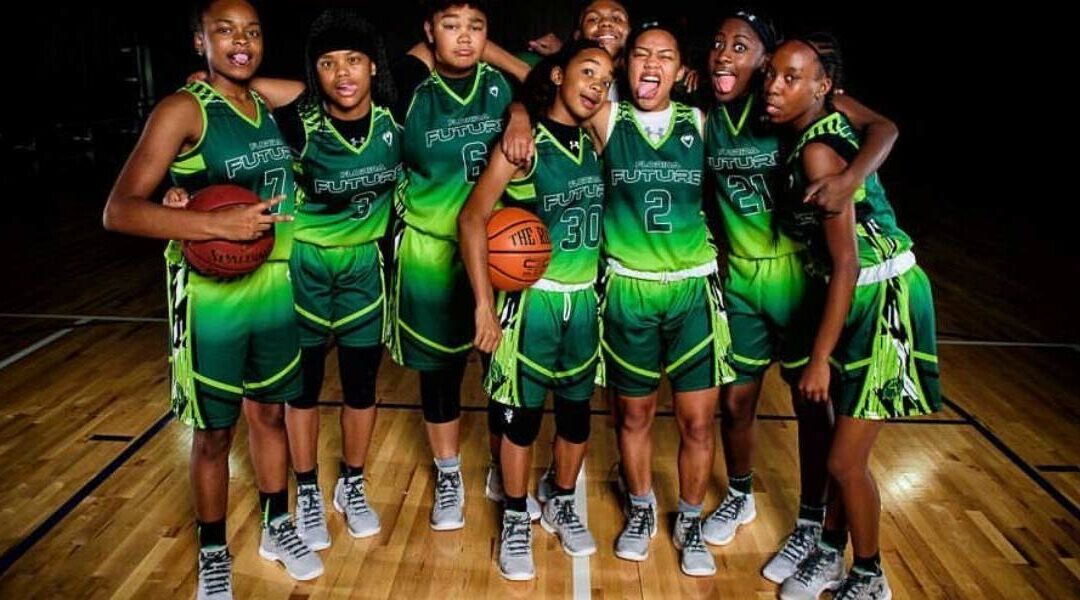
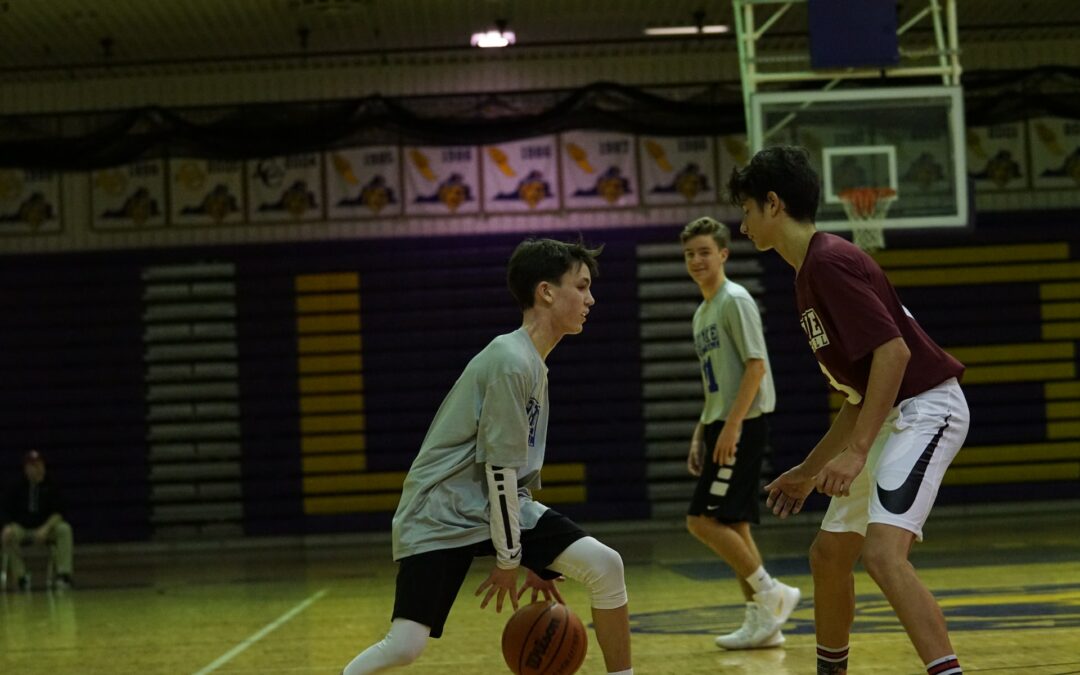



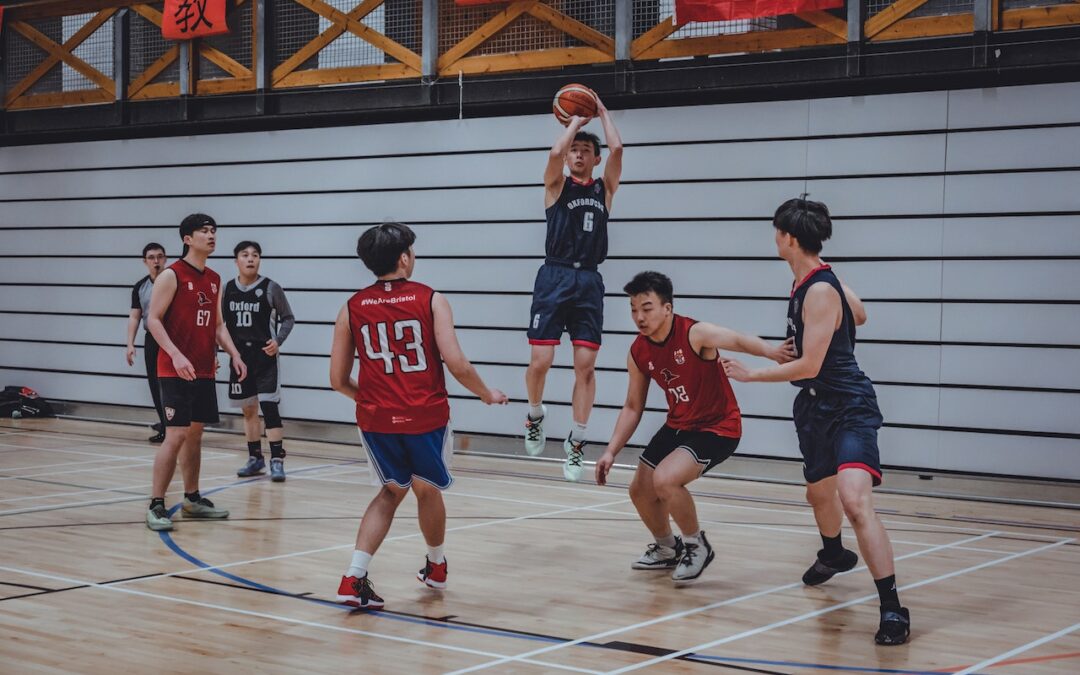
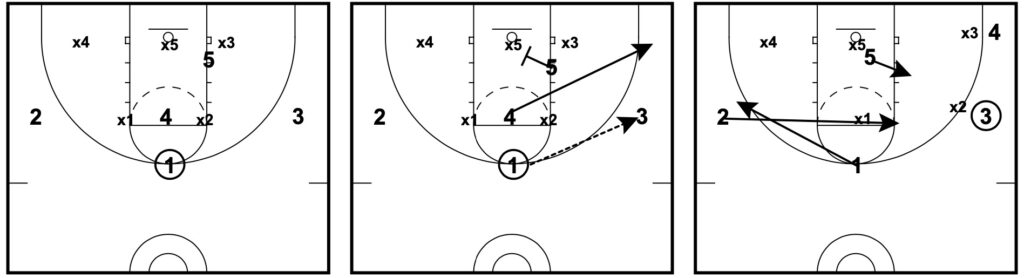
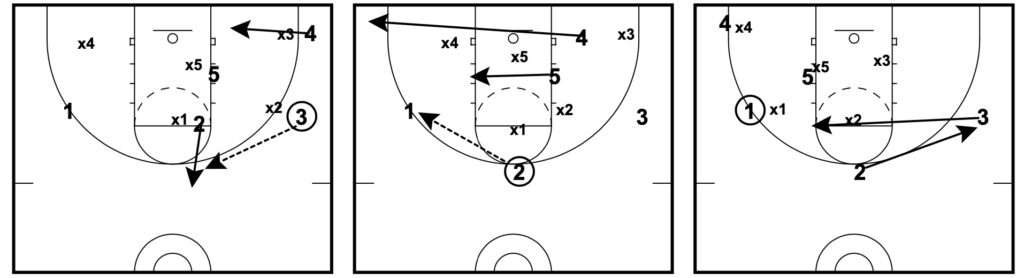
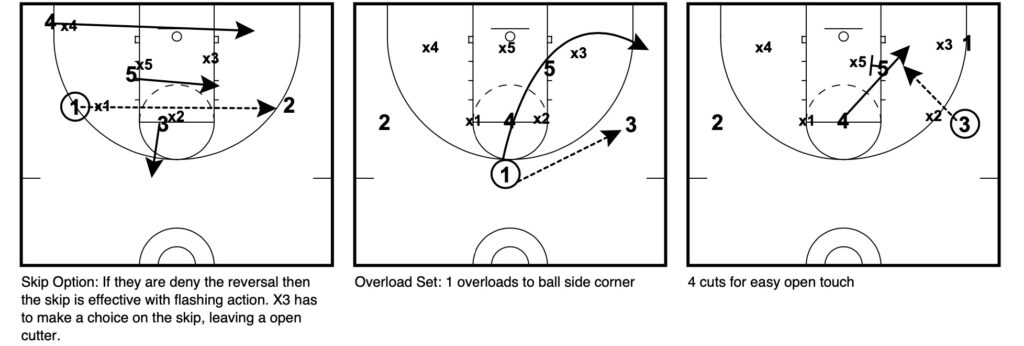
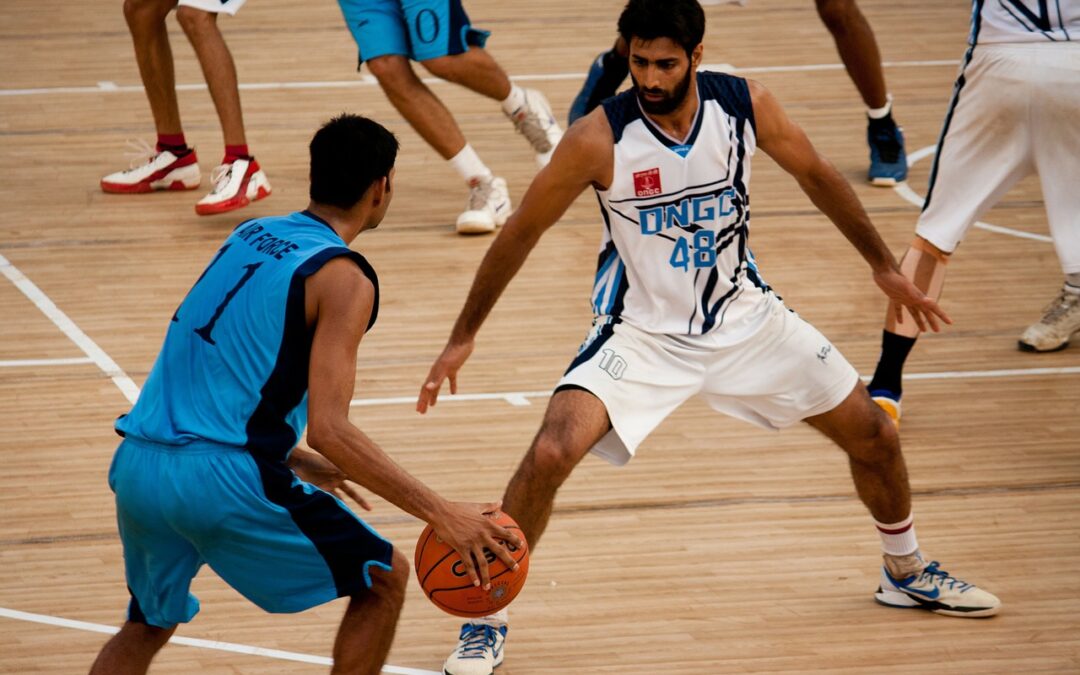
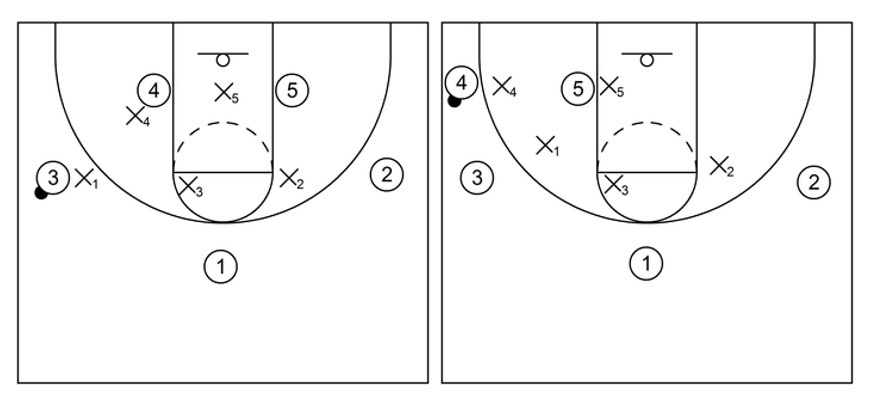
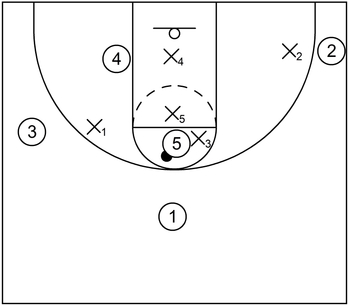 If the offense gets the ball into the high-post area, the box and 1 becomes vulnerable to breaking down. The defense needs to adjust its rotations accordingly.
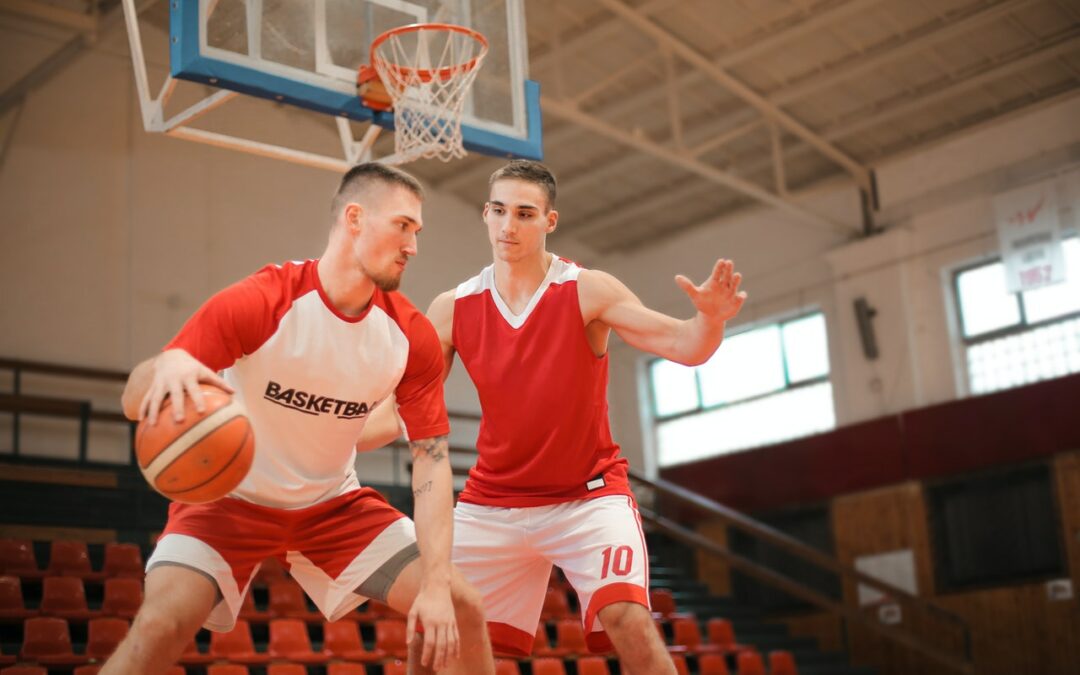
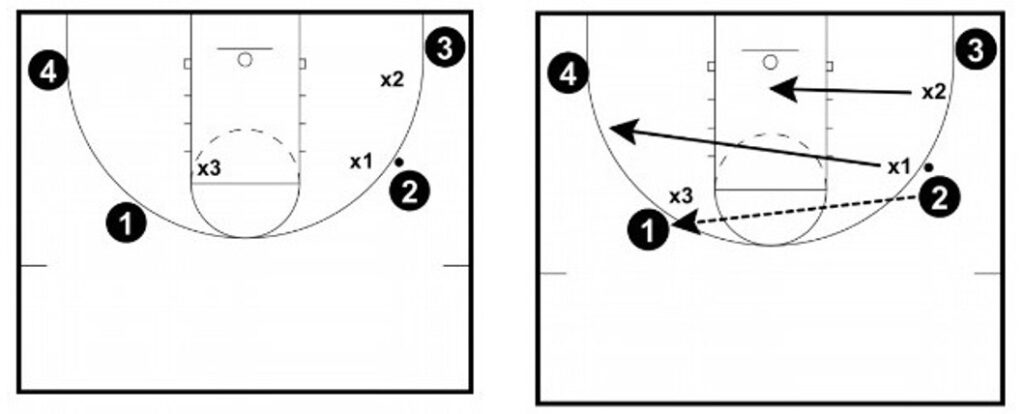
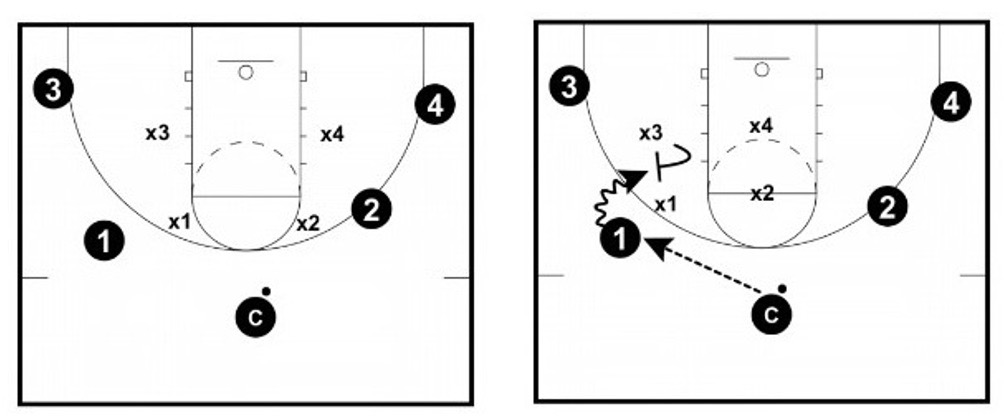
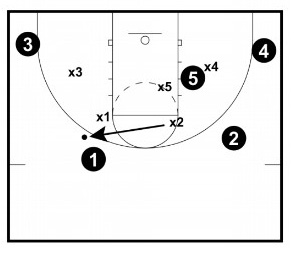 The last of these defensive drills is called the Whistle Change. This drill incorporates the scramble mentality, but emphasizes communication above all. Often, the scramble matchup happens in transition, however, here it’s done in a half-court set.
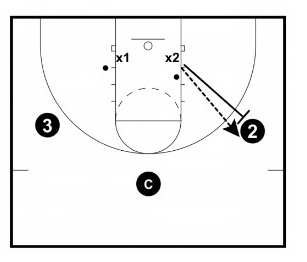
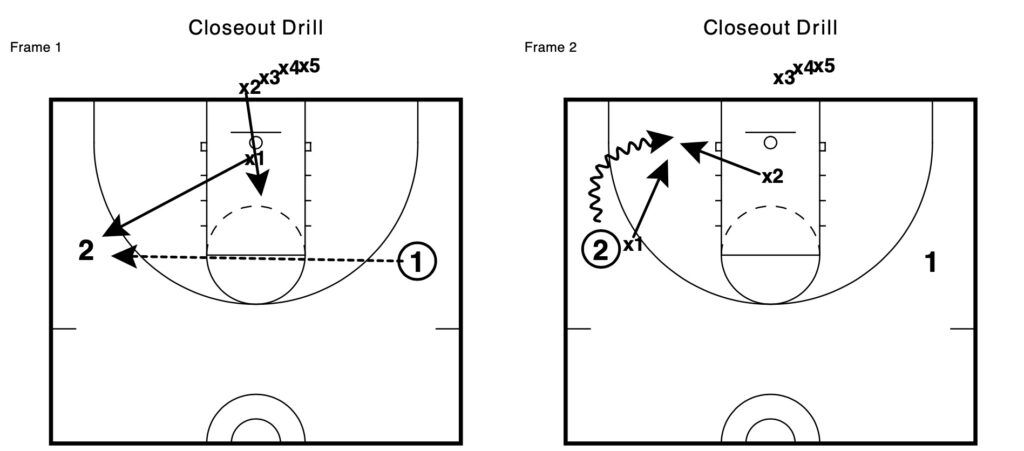
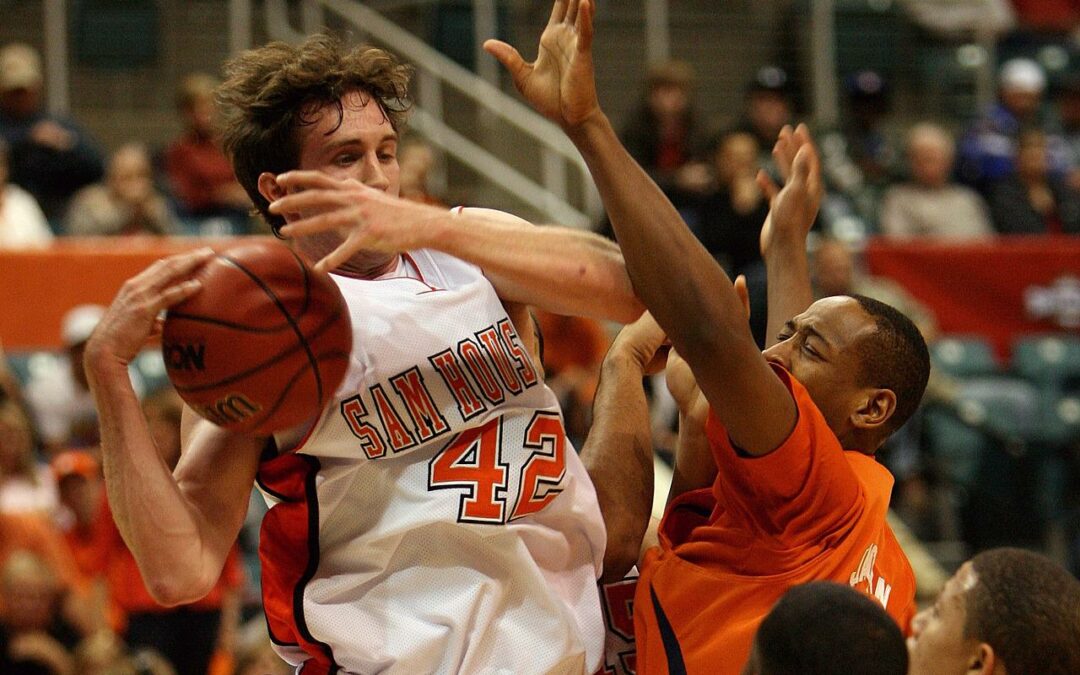
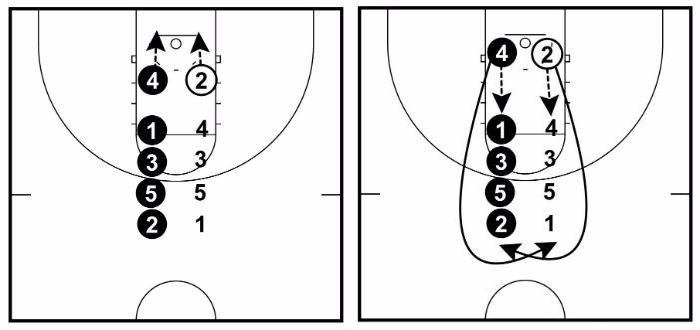
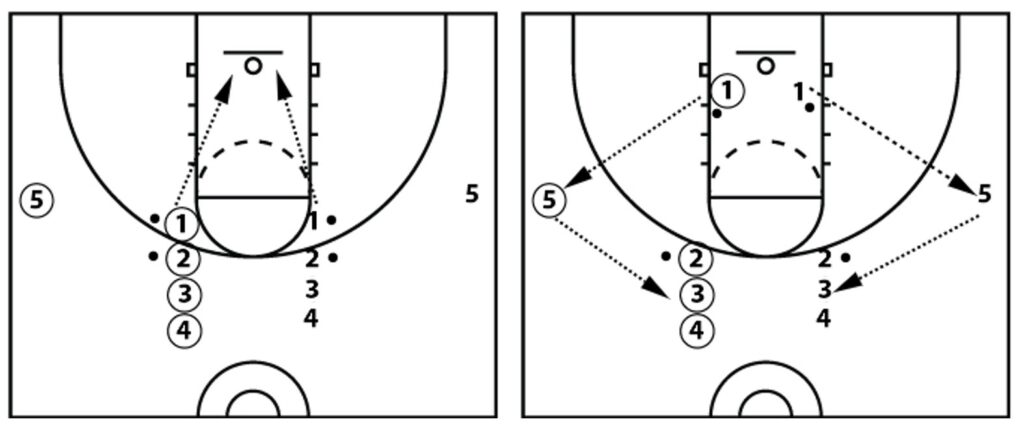
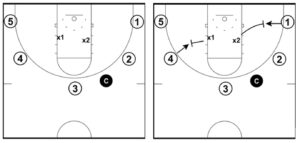
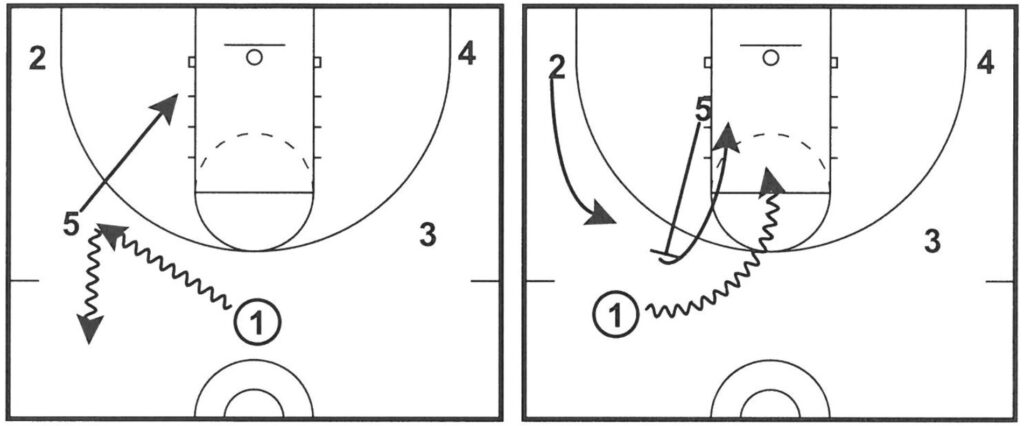
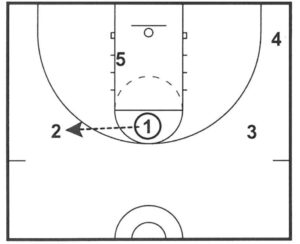
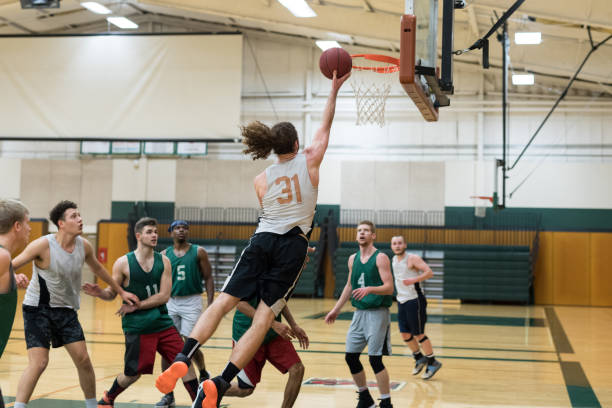
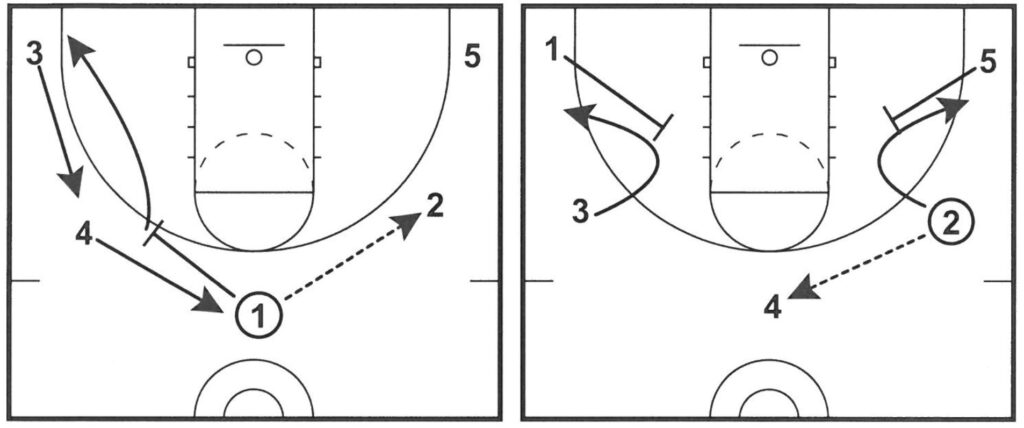
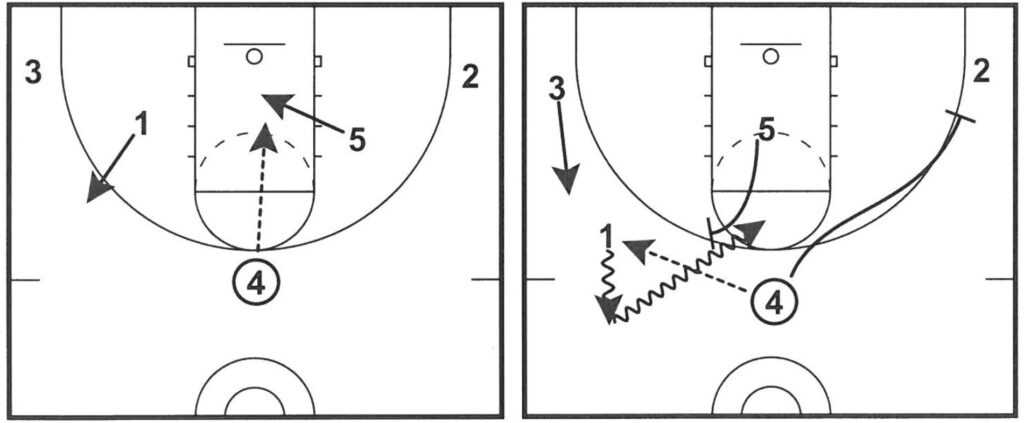
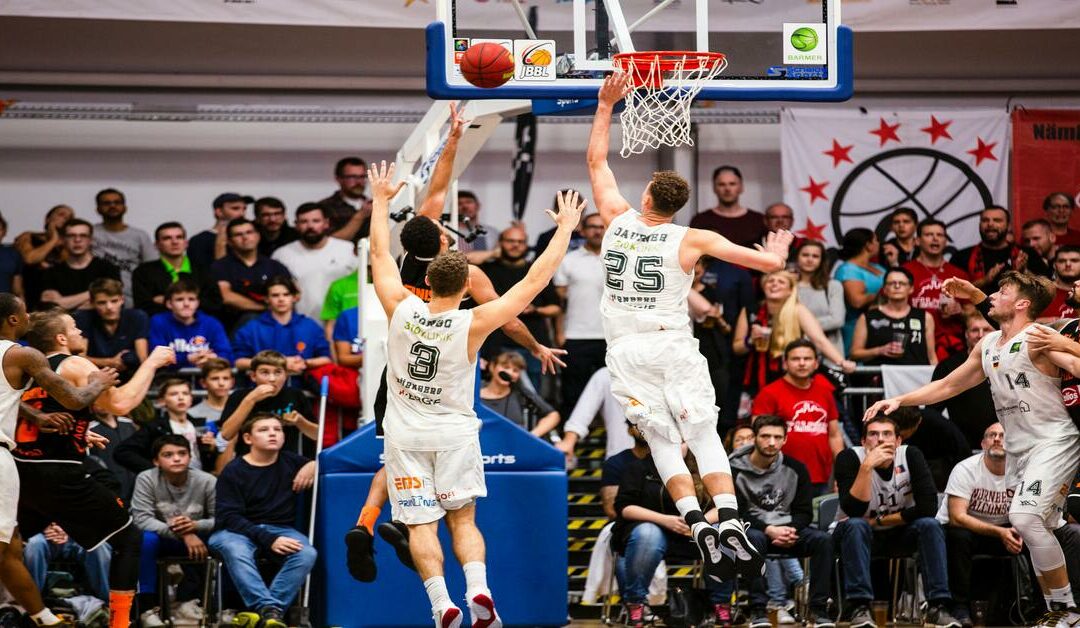
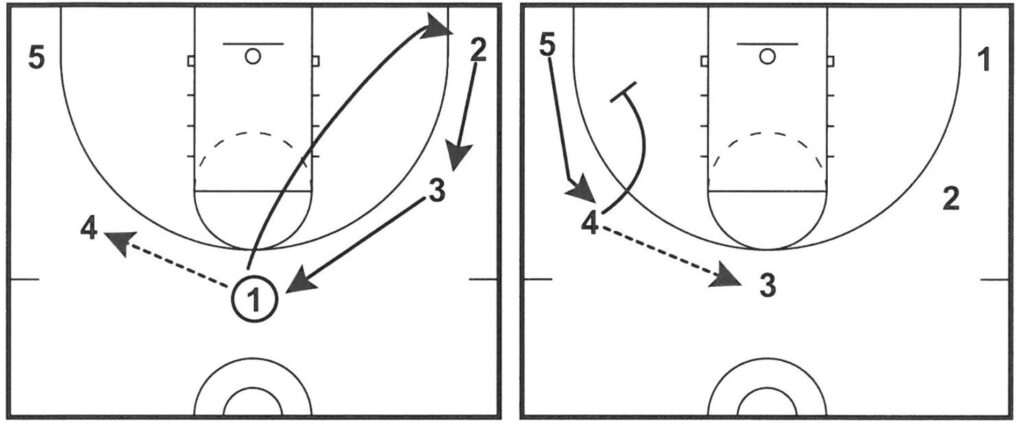
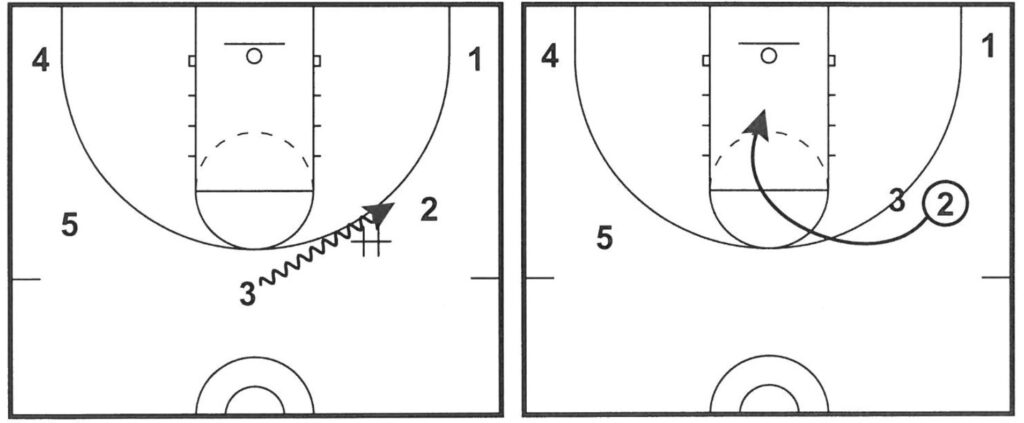
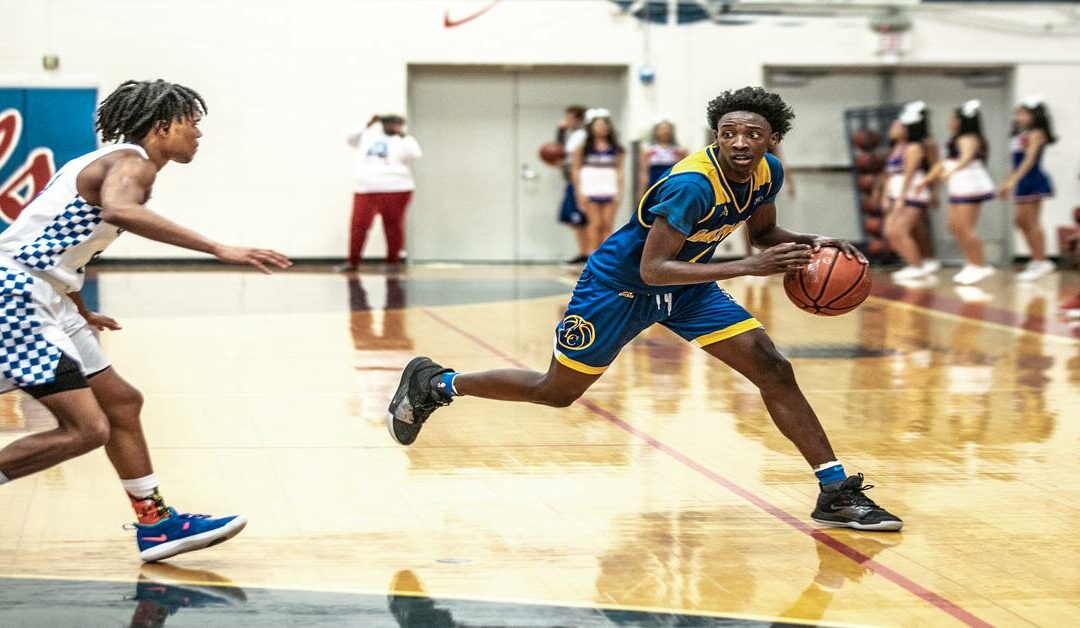
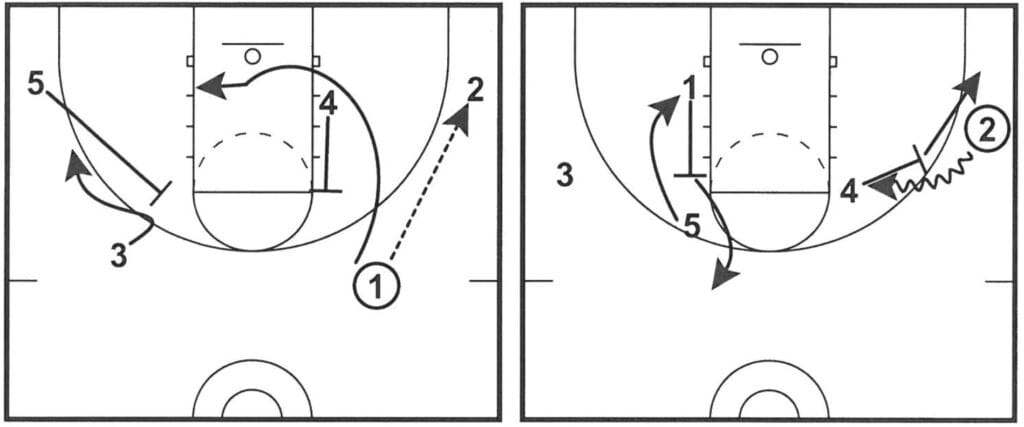
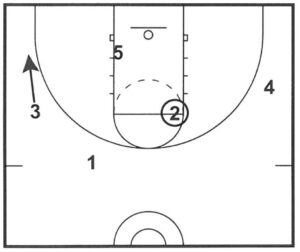 The last sequence for this set leaves the decision-making to Player 2. After using the ball screen, Player 2 can attack the rim looking for a shot. Another option is kicking back to Player 4 in the corner or short corner.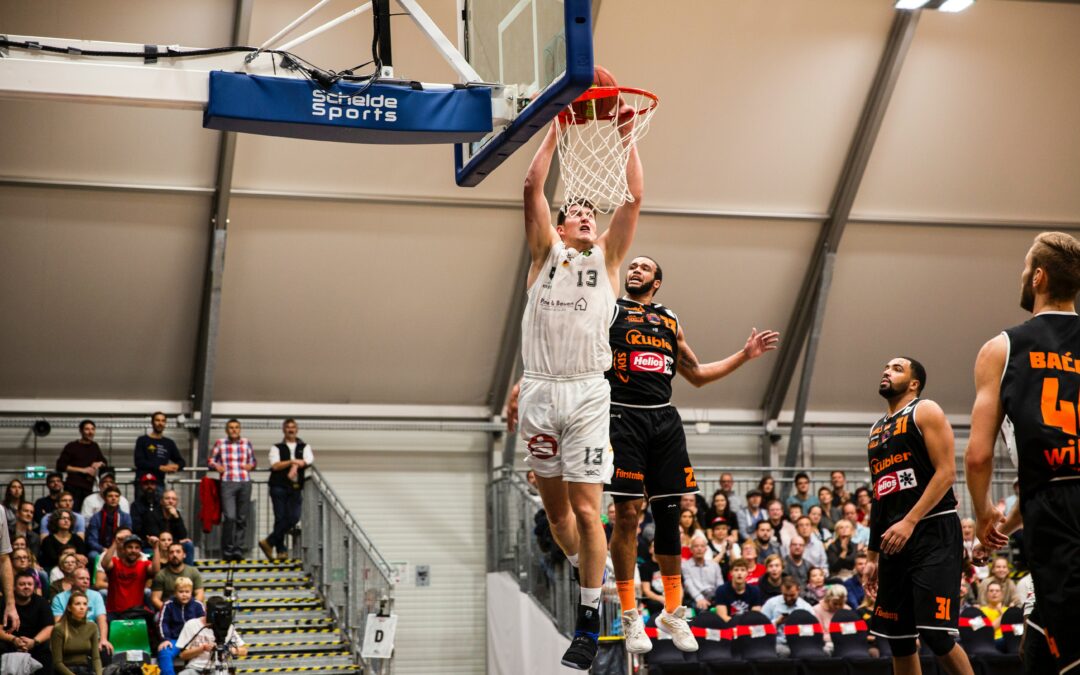
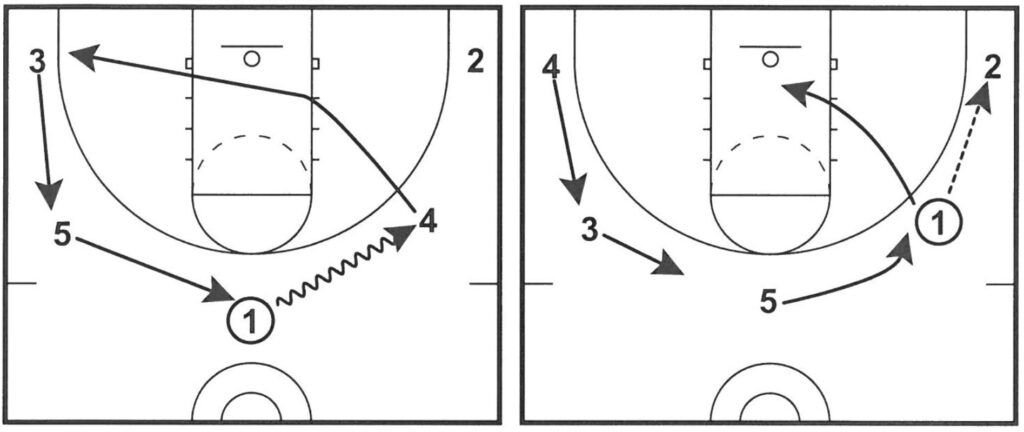
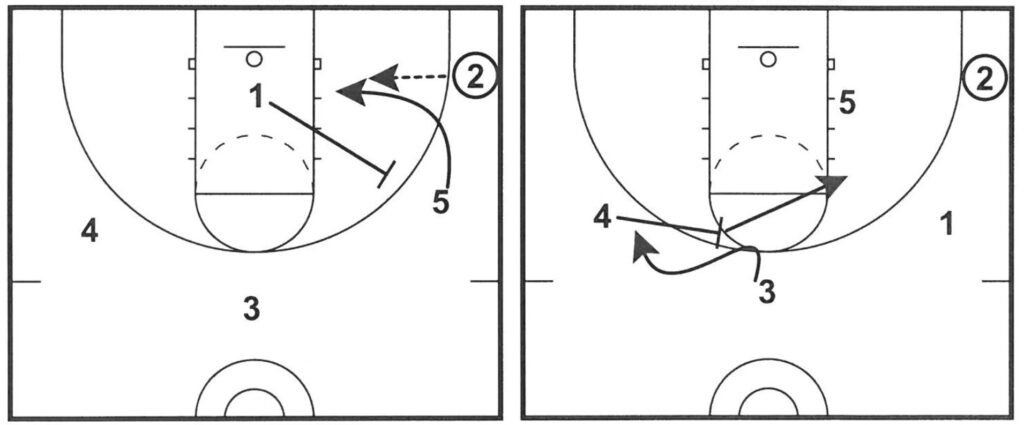
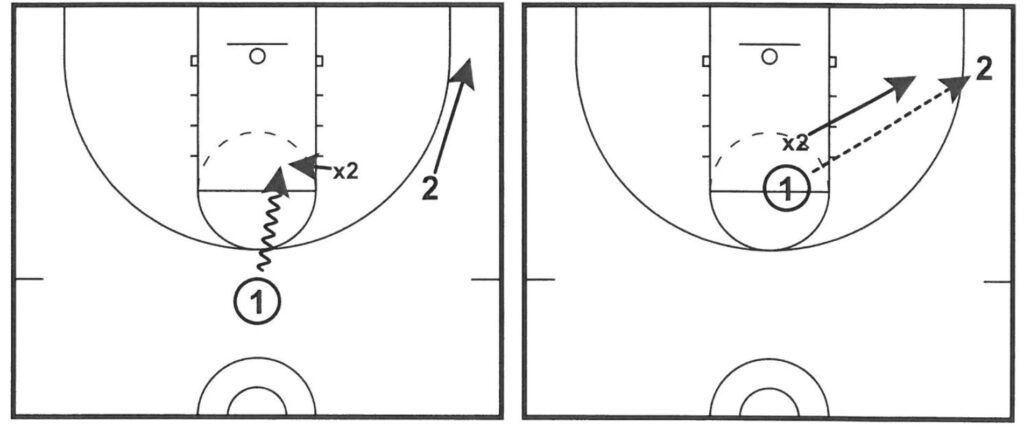
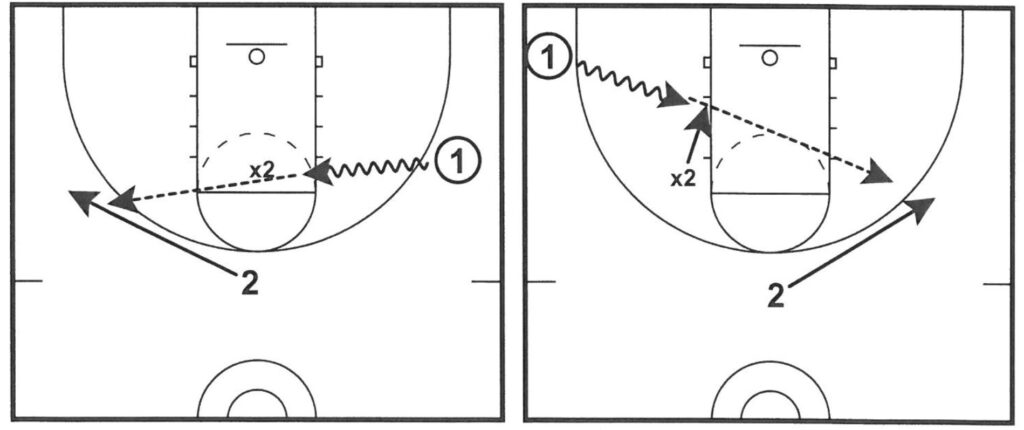
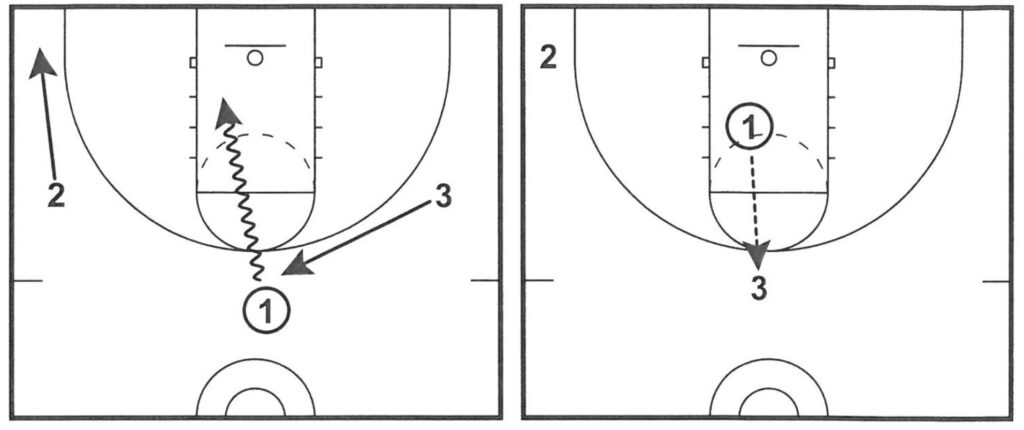
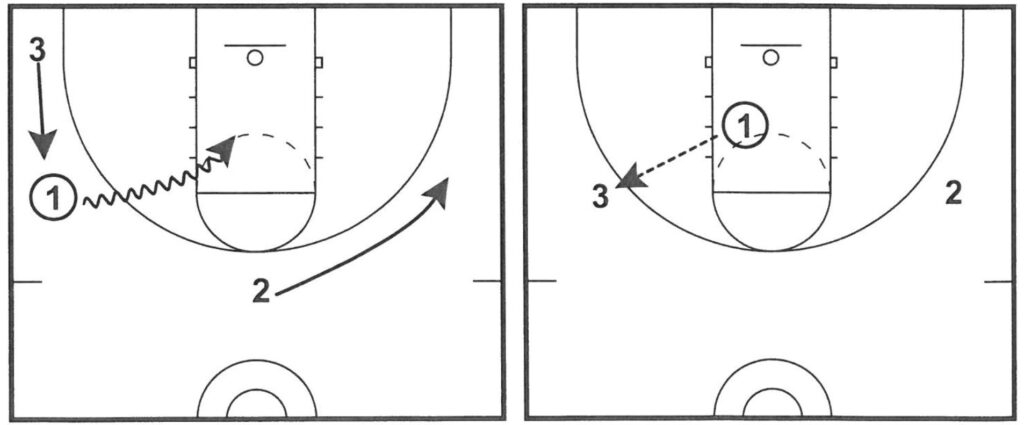
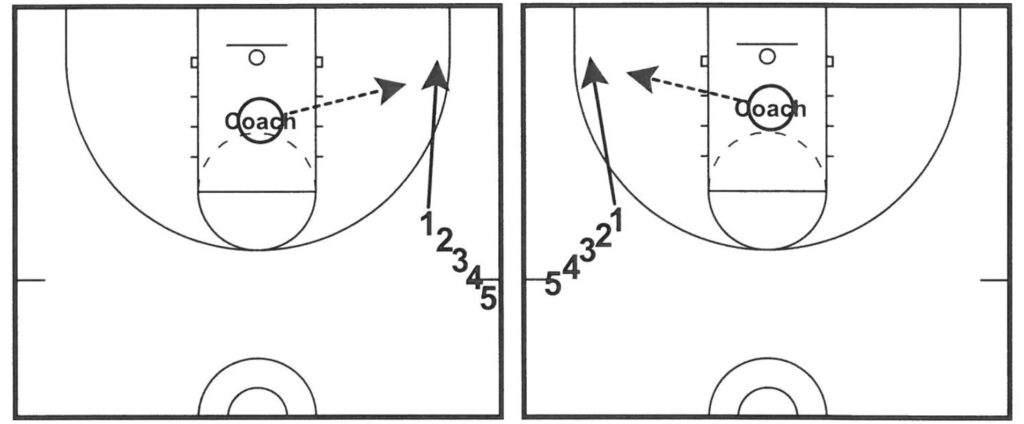
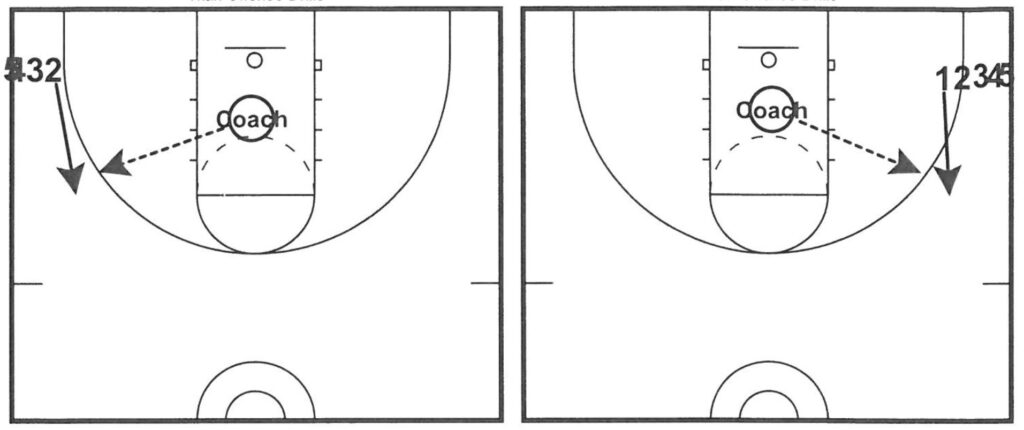
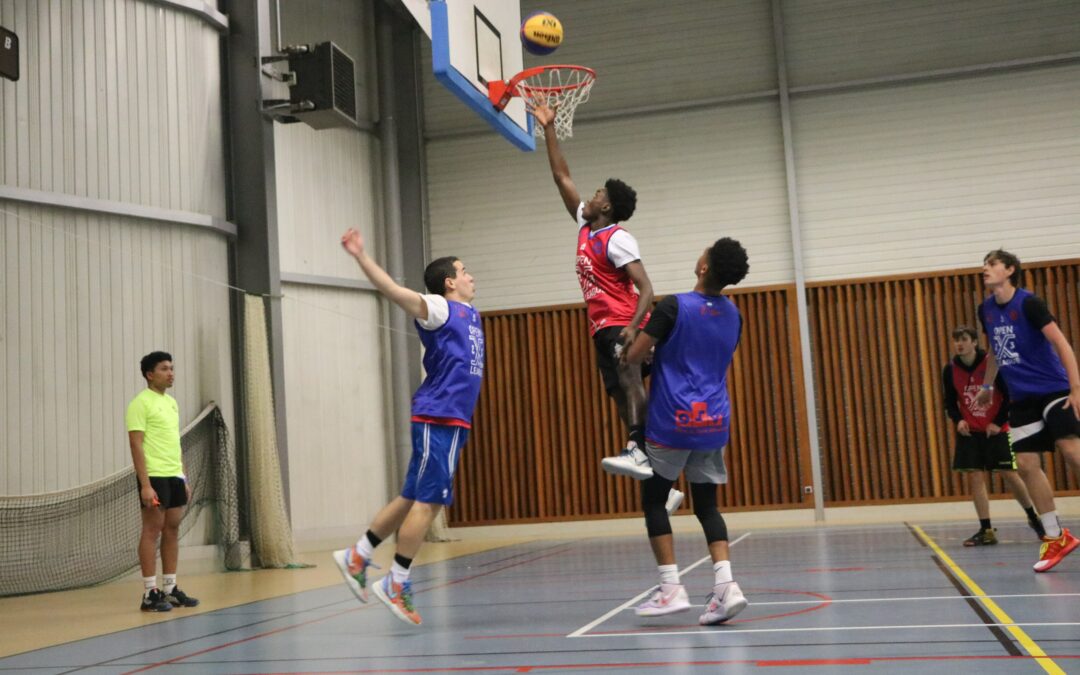
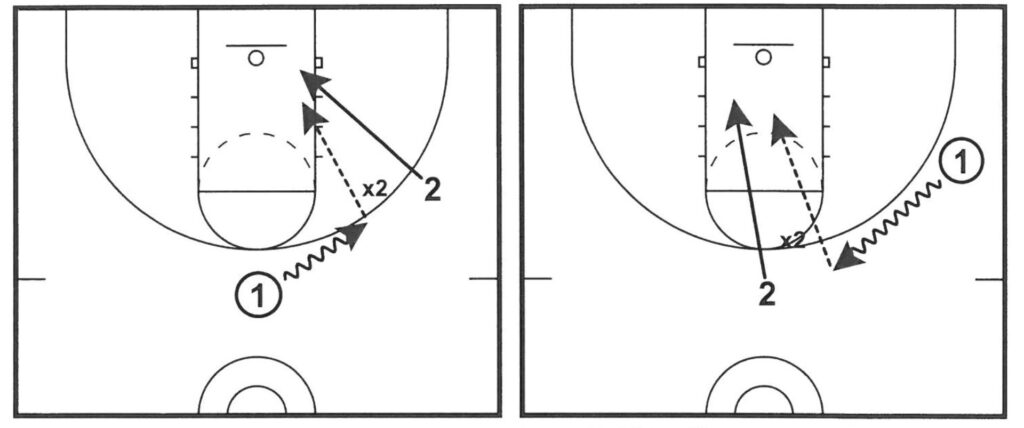
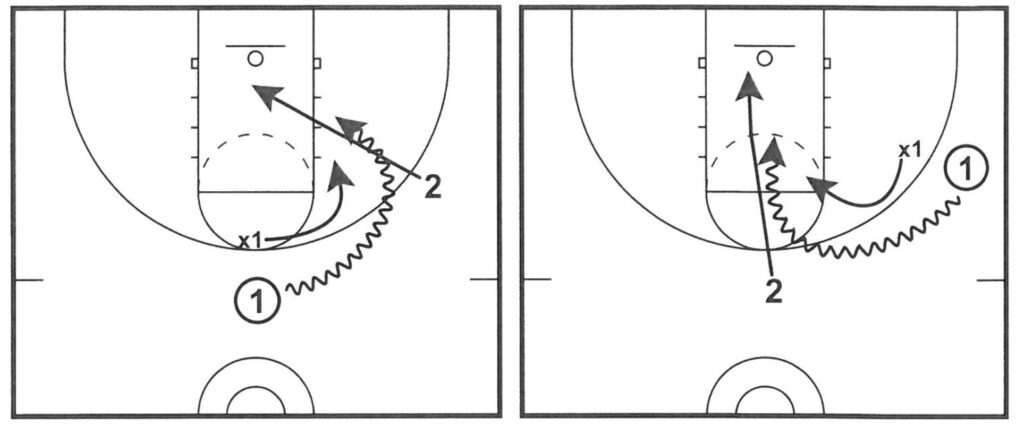
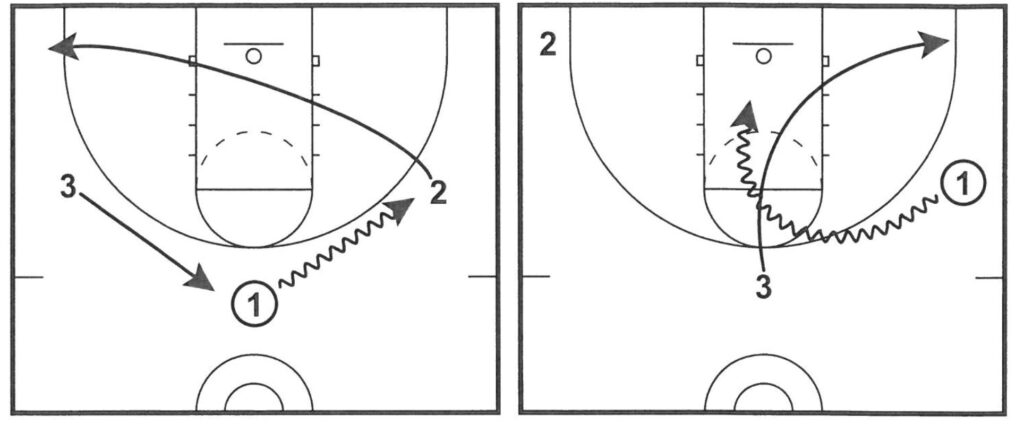
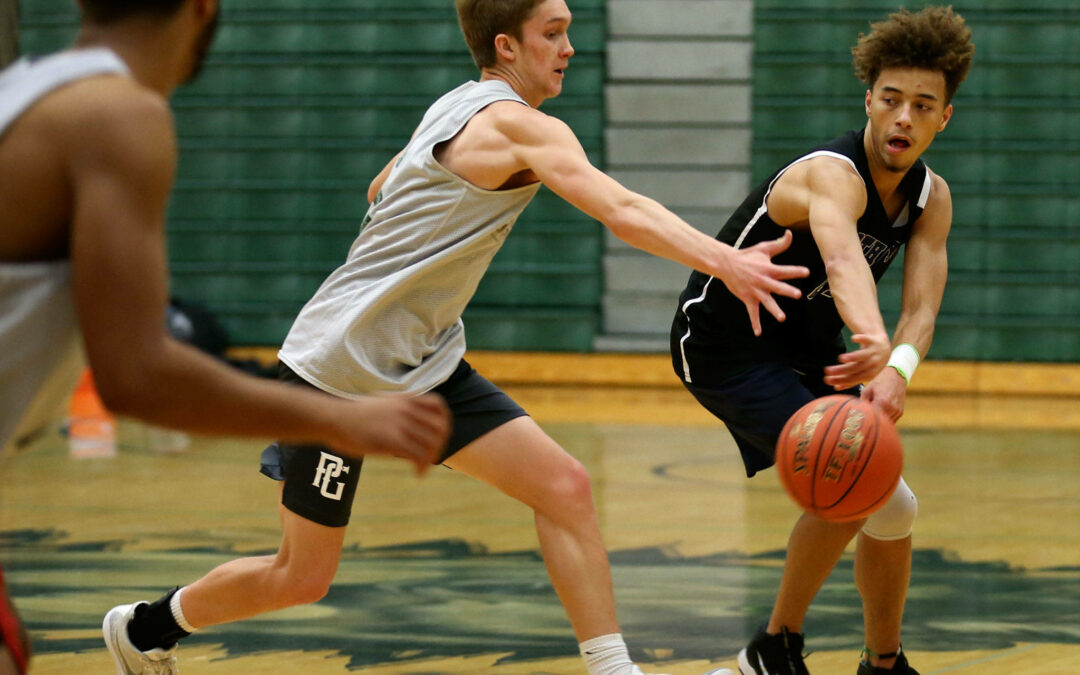
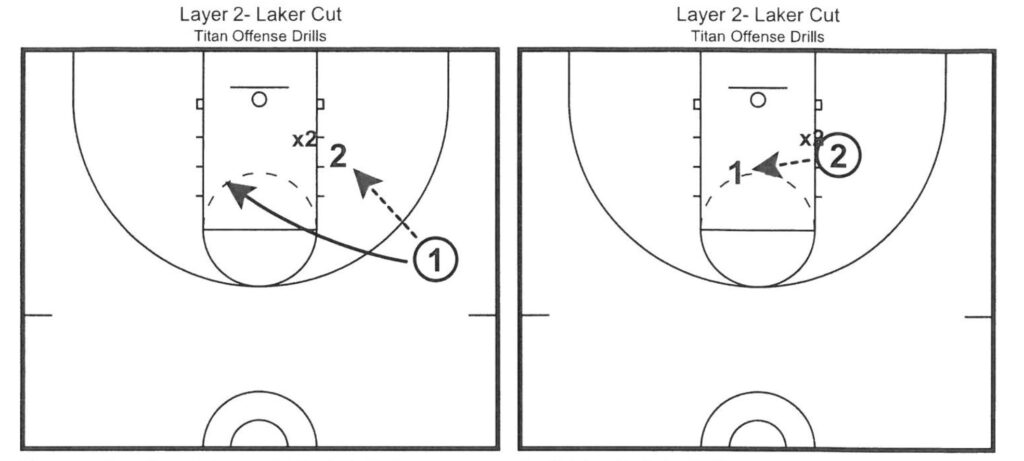
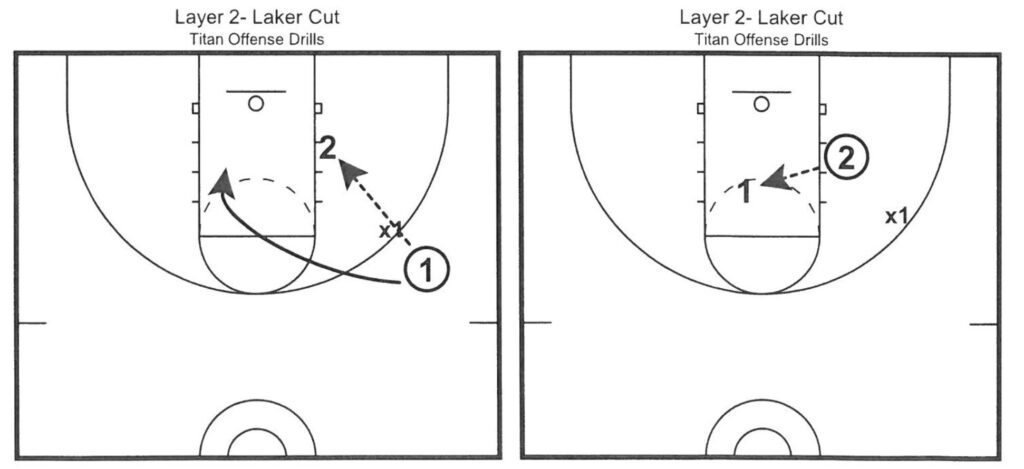
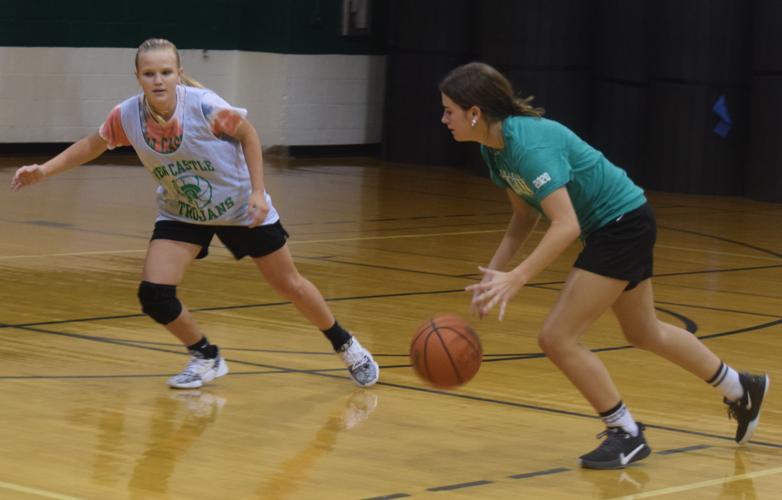
 First of the Read and React basketball drills is a basic pass and cut. This drill incorporates three players: a passer, a finisher, and a defender. The move amounts to a
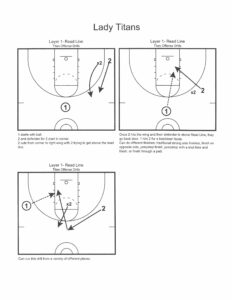 The last sequence for this first layer of Read and React basketball drills incorporates a simple
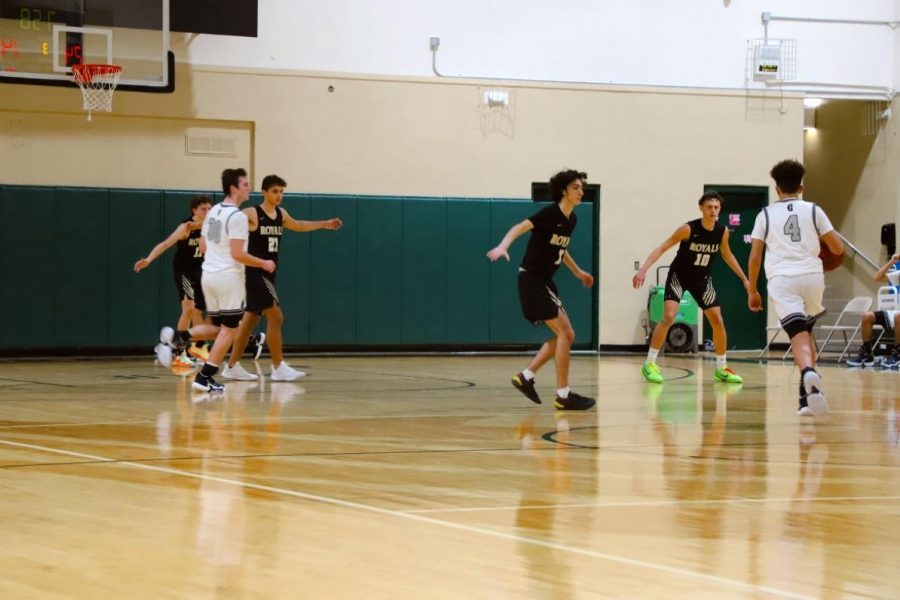
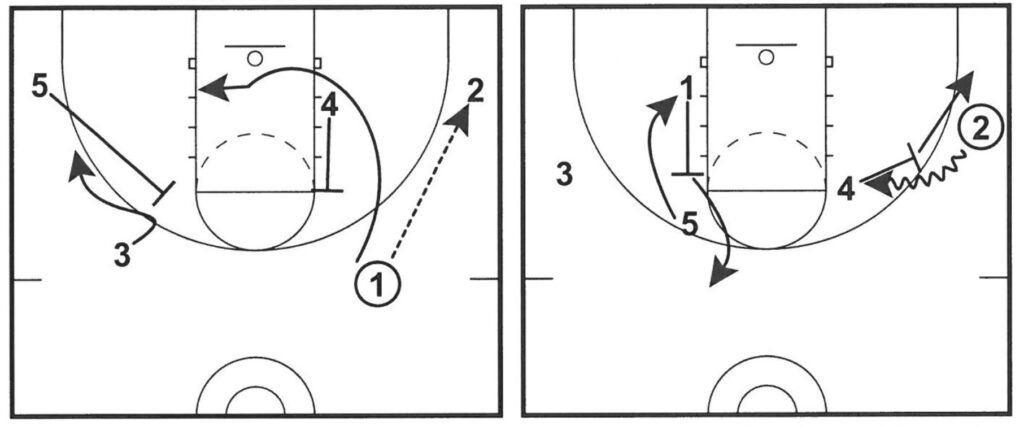
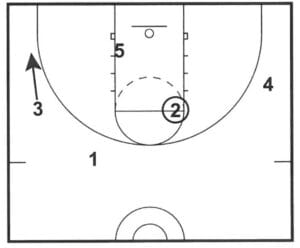 Player 2 should be a solid ball handler and decision maker, considering he’s the focal point of this set. As he attacks the lane, 2 should read the defense and react accordingly.
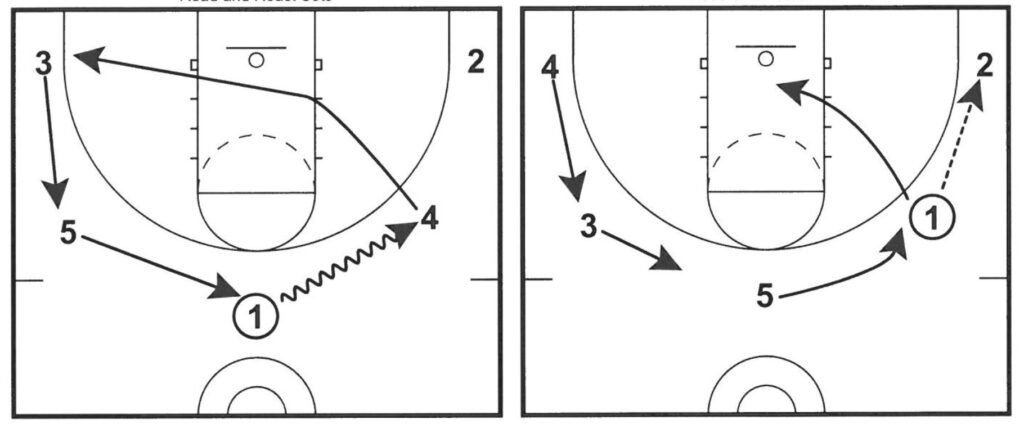
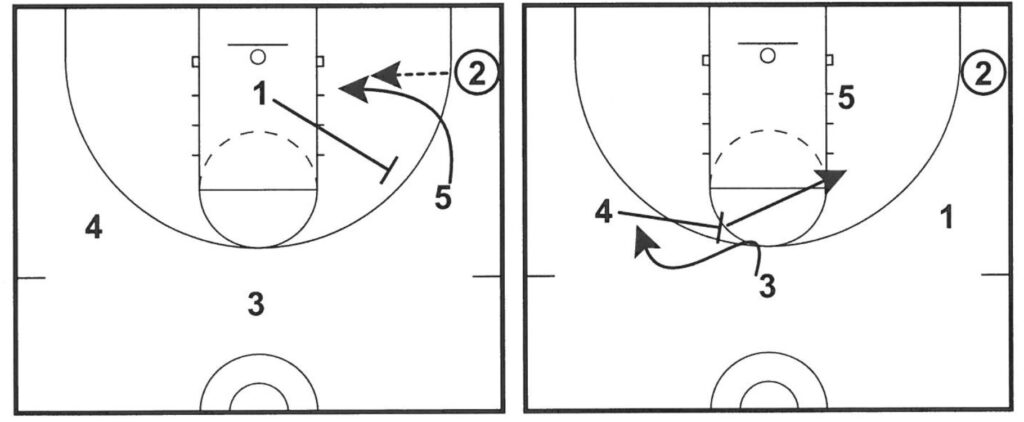
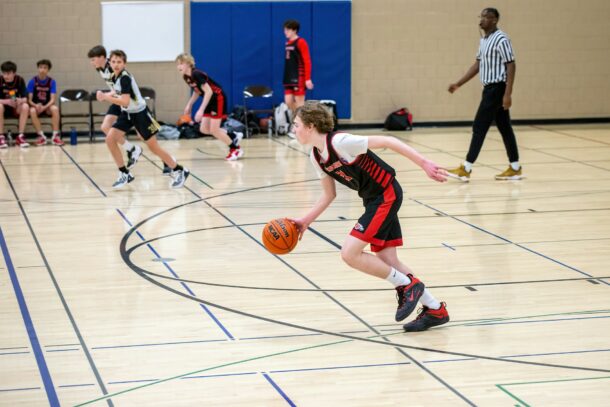
If you found this useful, don’t forget to check out additional blog posts at TeachHoops.com. Also, check out TeachHoops on Facebook, Twitter, Instagram and YouTube.
Get Notifications of New Blogs and Material
You have Successfully Subscribed!